Chunmee tea grades: what 41022, 9371 and 4011 mean for buyers
China's GB/T 14456.5-2016 standard lists seven chunmee tea grades, from 41022 down to 9366. What the codes mean, where 4011 fits and how to specify a grade.
Key facts
- China's national standard GB/T 14456.5-2016 lists seven chunmee (zhenmei) grades with export codes, in descending order of quality: 41022, 9371, 9370, 9369, 9368, 9367 and 9366.
- GB/T 14456.5-2016 caps moisture at 7.0% and dust at 1.0% for every chunmee grade and requires at least 36.0% water extract.
- The chunmee code 4011 and suffixes such as "AAA" do not appear in GB/T 14456.5-2016; they are seller labels, defined only by the seller's own sample.
- Chunmee is refined from long pan-fired green tea into curved strips, while gunpowder is refined from round pan-fired green tea into pellets and graded 3505, 9372, 9373, 9374 and 9375 under GB/T 14456.4-2016.
- In 2025 Morocco was the first destination for Chinese tea by value, with 91,393 tonnes worth US$278.1 million, up 13.4% in volume and 14.7% in value, according to China's Ministry of Commerce (MOFCOM).
Chunmee tea grades are identified by export codes. China’s national standard GB/T 14456.5-2016 lists seven chunmee grades in descending order of quality, from 41022 through 9371, 9370, 9369, 9368 and 9367 down to 9366, and caps moisture at 7.0% and dust at 1.0% for all of them. Codes such as 4011 and suffixes such as “AAA” are not in the standard, so a contract should tie the code to an approved sample.
What chunmee tea is
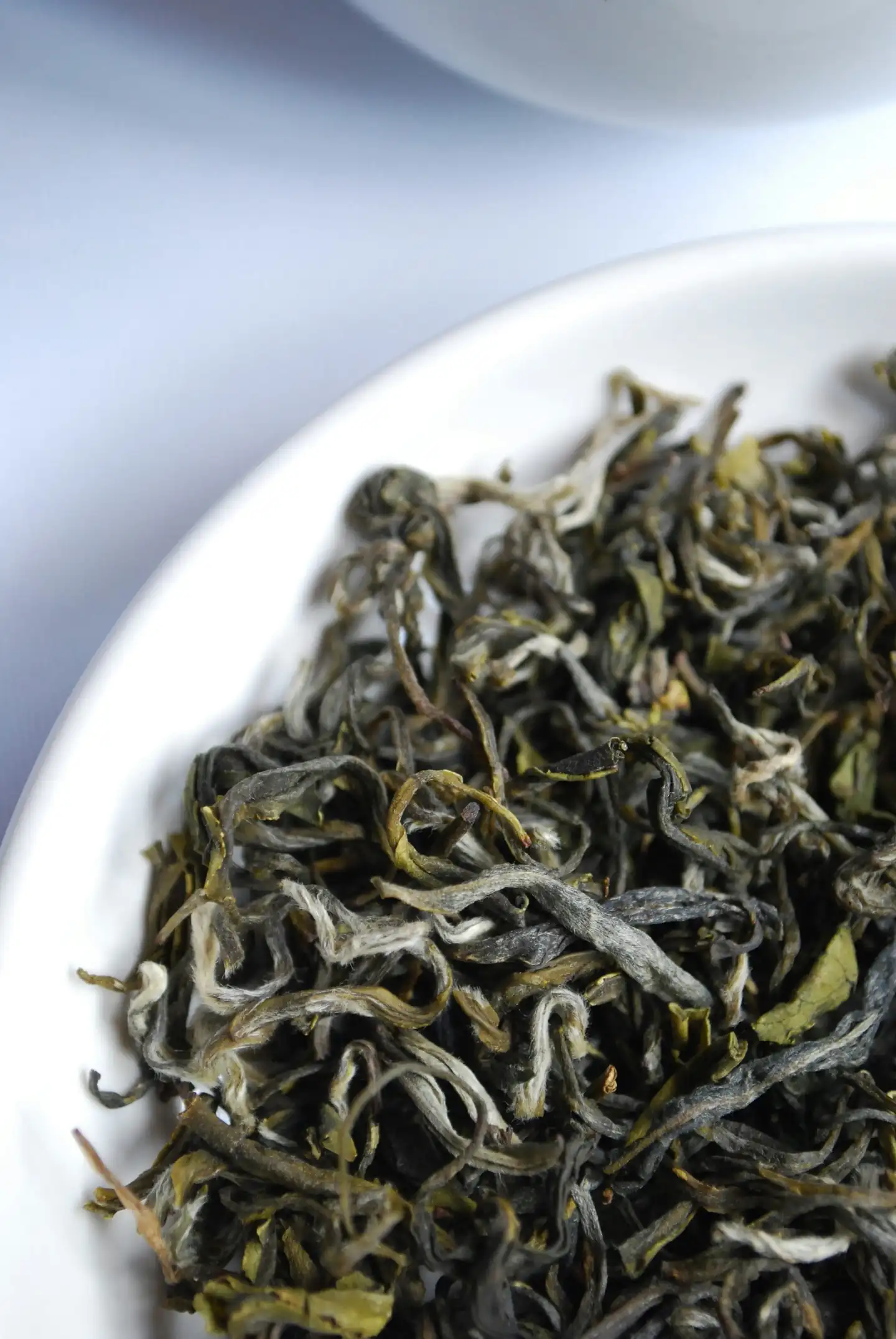
Chunmee is the trade name for zhenmei (珍眉), one of the four products of mee tea (眉茶), a green tea known for its eyebrow-like leaf; the others are yucha (雨茶), xiumei (秀眉) and gongxi (贡熙). GB/T 14456.5-2016 Green tea—Part 5: Mee tea defines mee tea as finished tea made from long pan-fired green tea (长炒青) and refined by sieving, cutting, winnowing, picking, polishing (车色) and blending.
The standard has applied since 1 January 2017 and gained an official English translation on 31 December 2021; GB/T 32742-2016 covers processing. China’s national standards platform calls mee tea a bulk green tea that is mainly exported. A review on 24 March 2021 recommended revision, but in September 2026 the 2016 edition was still listed as current.
We found no statistics that track chunmee by province. As a stand-in, we use the 2024 export figures by province from the tea branch of the China Association for the Promotion of International Agricultural Cooperation (CAPIAC); they cover all tea, almost all of it green tea, not chunmee alone. On those figures, Zhejiang accounted for US$150 million of the US$243 million of tea China exported to Morocco, while Anhui led exports to Ghana and Mauritania, ahead of Zhejiang and Jiangxi (CAPIAC, March 2025).
How chunmee export codes work
The standard calls the number attached to each grade an export commodity code. According to a Chinese agricultural reference, these tea numbers (茶号) come from trade standard samples set by the state, the physical references on which buyers and sellers priced and delivered tea, numbered to simplify trading by correspondence. The standard still keeps physical standard samples for each grade, renewed every three years. The digits are labels, not a scale. China’s black tea standard, GB/T 13738, names its grades without any code.
Mee tea products and export codes in GB/T 14456.5-2016
| Product | Grades | Export codes |
|---|---|---|
| Zhenmei (chunmee) | Tezhen super grade, tezhen grades 1 and 2, zhenmei grades 1 to 4 | 41022, 9371, 9370, 9369, 9368, 9367, 9366 |
| Yucha | Grades 1 and 2 | 8147, 8167 |
| Xiumei | Special grade, grades 1 to 3 | 8117, 9400, 9376, 9380 |
| Gongxi | Tegong grades 1 and 2, gongxi grades 1 to 3 | 9277, 9377, 9389, 9417, 9500 |
The other products look different: the standard describes yucha as short, tight leaf, with tadpole-shaped pieces in grade 1 (8147), xiumei as thin stems and flakes (9380 is flake-shaped) and gongxi as round, compact pieces.
A 2022 article in the journal China Tea Processing, written by a tea export manager, recalls that a code once meant a grade: until 1993 Morocco’s national tea and sugar office (ONTS) held the import monopoly, China licensed tea exports by quota, and China’s commodity inspection bodies checked the quality and grade of the tea before release. According to the article, Morocco opened tea imports in 1993 and China ended export quota licensing in 2006; Moroccan importers then set their own quality requirements, and the old system was no longer followed.
Codes outside the standard: 4011, “special” and “AAA”
Sellers also use labels that the standard does not contain. In the seller listings we checked, chunmee 4011 is placed above 9371 in quality and below 41022 in price. Codes also come with words such as “special”, “super” or “extra”, letter suffixes from A to AAAAA (“4011 AAA”), or the prefixes “EU” and “ORG” for versions sold as European-standard and organic. One seller calls 8147, which the standard lists as yucha grade 1, “young hyson”. None of these labels appears in GB/T 14456.5-2016 or has an official definition; each refers to the seller’s own sample.
What changes from one chunmee grade to the next
Table 1 of the standard sets the sensory requirements of each chunmee grade (our translation, shortened; the infused-leaf column is left out):
Sensory requirements of chunmee grades in GB/T 14456.5-2016
| Code | Grade | Dry leaf | Infusion |
|---|---|---|---|
| 41022 | Tezhen super grade (特珍特级) | Fine, tight, prominent tips; even; green, glossy, with bloom; very clean | High, lasting aroma; fresh, strong, full taste; green, bright liquor |
| 9371 | Tezhen grade 1 (特珍一级) | Fine, tight, with tips; even; green, glossy, with bloom; clean | High aroma; fresh, strong, mellow; green, bright |
| 9370 | Tezhen grade 2 (特珍二级) | Tight; fairly even; green, glossy; fairly clean | Relatively high; strong, full; yellowish green, bright |
| 9369 | Zhenmei grade 1 (珍眉一级) | Tight, solid; fairly even; green, fairly glossy; fairly clean | Fairly high; strong, mellow; yellowish green, fairly bright |
| 9368 | Zhenmei grade 2 (珍眉二级) | Fairly tight and solid; fairly even; yellowish green, fairly glossy; a few tender stems | Pure; mellow; yellowish green |
| 9367 | Zhenmei grade 3 (珍眉三级) | Coarse, solid; fairly even; greenish yellow; thin stalks | Plain; mild; greenish yellow |
| 9366 | Zhenmei grade 4 (珍眉四级) | Slightly coarse, loose; uneven; yellow; stalks and coarse leaf | Slightly coarse; slightly coarse, thin; yellow, slightly dull |
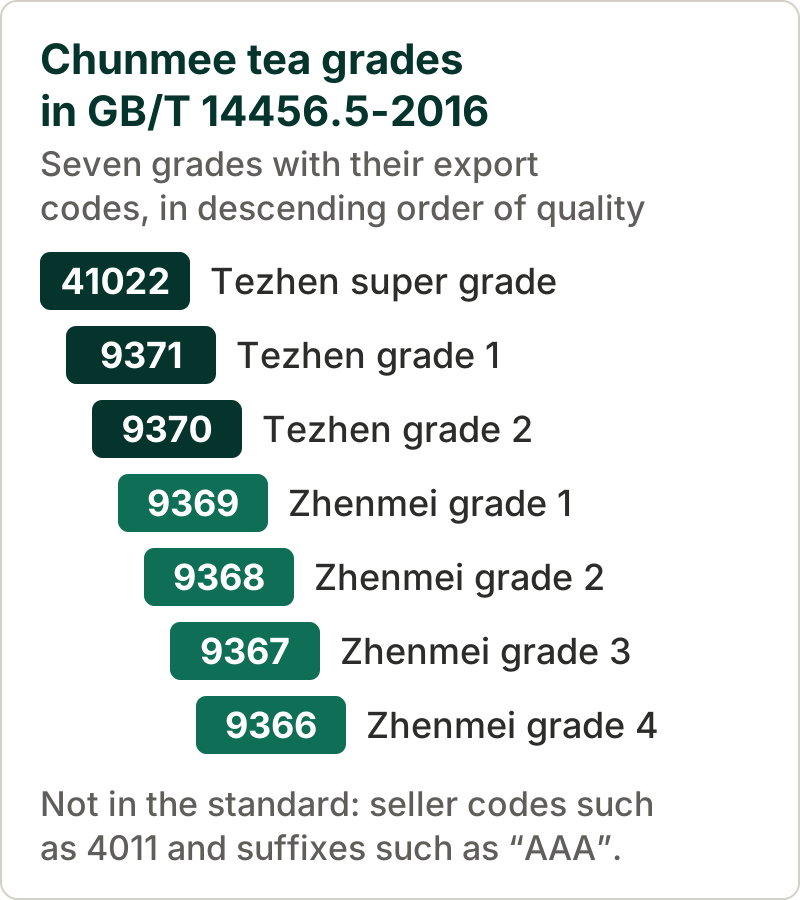 Source: China’s national standard GB/T 14456.5-2016, Table 1 (2016)
Going down the grades, the tips disappear, the leaf turns coarse and loose, stalks appear, the colour yellows and the liquor loses its brightness.
The physicochemical limits are the same for all seven grades:
Physicochemical limits for chunmee in GB/T 14456.5-2016
| Item | Limit |
|---|---|
| Moisture | 7.0% maximum |
| Total ash | 7.5% maximum |
| Dust | 1.0% maximum |
| Water extract | 36.0% minimum |
| Tea polyphenols | 14% minimum |
| Catechins | 9% minimum |
Xiumei and gongxi may contain up to 1.5% dust, with a water extract minimum of 34.0%. There is no separate limit for broken tea, and contaminants and pesticide residues must meet China’s GB 2762 and GB 2763.
Chunmee vs gunpowder
Chunmee and gunpowder compared
| Chunmee (mee tea, 眉茶) | Gunpowder (珠茶) | |
|---|---|---|
| Standard | GB/T 14456.5-2016 | GB/T 14456.4-2016 |
| Raw material | Long pan-fired green tea | Round pan-fired green tea |
| Shape | Curved strips | Rolled pellets |
| Export codes | 41022, 9371, 9370, 9369 to 9366 | 3505, 9372, 9373, 9374, 9375 |
| Key appearance factors | Tightness of the strip and tips, evenness, colour, cleanliness | Roundness, tightness and weight of the pellet, colour, evenness, cleanliness |
Sources: the two standards; gunpowder appearance factors from the 2022 article.
The 2022 article notes that gunpowder may be shaped with glutinous rice paste, a traditional practice, and warns that too much paste gives a handsome pellet but a cloudier liquor and a much thinner, astringent taste. It also reports that mee tea, the family that includes chunmee, was taking a growing share of China’s green tea exports; that high-grade mee tea was gaining favour in Morocco, the main market for high-grade gunpowder; and that in the early 2000s Mali switched mainly to mee tea within a year or two, after colour-enhancing substances added to gunpowder gave an abnormal liquor.
Which markets buy chunmee
The 2022 article lists Morocco, Uzbekistan, Ghana, Togo, Algeria, Senegal, Mauritania, Benin, Cameroon and Mali as the main markets for China’s mee tea and gunpowder. Trade statistics cover all tea, not chunmee alone: in 2025 Morocco was the first destination for Chinese tea by value, with 91,393 tonnes worth US$278.1 million, up 13.4% in volume and 14.7% in value, ahead of Senegal; Mauritania, Ghana, Côte d’Ivoire and Algeria were also in the top ten by value (MOFCOM). In 2024 China shipped 80,600 tonnes of tea to Morocco (+34.68%), 99.85% of it green tea by volume (CAPIAC).
According to the 2022 article, West African consumers judge mainly the infusion, while Moroccan buyers also want a good-looking leaf. The article adds that in Morocco tea is boiled with sugar and mint and poured repeatedly until it foams, and that drinkers like a rich, fine, lasting foam and a strong taste. We found no official source linking individual codes to countries.
What to put in a chunmee purchase specification
We suggest covering at least:
- Product and grade: “chunmee (珍眉) 9371 according to GB/T 14456.5-2016”, or the seller’s code plus the reference number of the approved sample.
- Samples: a type sample sealed by both parties, a pre-shipment sample from the lot, and retained samples; the standard settles disputes by retesting a retained sample or a double sample from the same lot.
- Crop year and season.
- Moisture and dust: at most 7.0% and 1.0%, as in the standard, tested by GB/T 8304 and GB/T 8311.
- Broken tea: a maximum share, since the standard sets none.
- Water extract: at least 36.0%.
- Cleanliness: stalk and yellow pieces no worse than the sample; no foreign matter.
- No colouring or additives: GB/T 14456.1-2017 rules out both. Morocco’s Decree No. 2-13-711 of 4 March 2015 lists among unlawful treatments the colouring of green tea, polishing with gypsum or talc, and the addition of “faux thé” (fake tea: debris, broken pieces or particles of tea or of any product that evokes its look or taste).
- Residues and contaminants: the destination’s rules as well as China’s; Morocco’s decree also requires the chemical characteristics set by order of the government authority in charge of agriculture.
- Packing and transport: closed, clean, dry containers (Moroccan decree), net weight per unit, liner and marks; the standard also requires clean, dry, odour-free transport protected from rain, damp and sun. Condensation inside shipping containers is covered in the guide to tea container capacity.
- Inspection: sampling by GB/T 8302, and the release certificate that the standard requires for every lot after checks of sensory quality, dust, moisture and net content. The export certificates issued by China Customs are covered in our guide to Chinese tea export documents.
How to compare chunmee samples
The method below is our suggestion. Steps 2, 4 and 5 adapt points from the 2022 article, which deals with gunpowder.
- Use one method for every cup: the same weight of tea, volume of boiling water and infusion time, following GB/T 23776-2018 (the method the standard names) or ISO 3103:2019. China also has an export inspection standard for gunpowder and mee tea, SN/T 4594-2016.
- Judge the dry leaf first: on a white tray, compare shape, colour, evenness and cleanliness with the approved sample, fraction by fraction (upper, middle, lower); the 2022 article describes gunpowder blenders matching each fraction to the trade sample in this way.
- Then the infusion: liquor colour, aroma, taste and infused leaf.
- Test foam for Moroccan-style tea: for each sample, pour the same volume of liquor quickly back and forth between two bowls ten times, then compare the thickness, fineness and persistence of the foam. The 2022 article describes this check for gunpowder.
- Taste it the way it will be drunk: the 2022 article notes that mint weakens or partly masks a light, fresh aroma, so a sample that shines plain may fade in mint tea.
- Measure in a laboratory: moisture and dust, before shipment and on arrival.
Finally, our advice: be wary of a leaf that looks better than its liquor. In the 2022 article, gunpowder made to look better with extra rice paste gave a cloudier liquor and a thinner taste; glossy, heavy leaf with a cloudy or off-colour infusion needs a closer look.
Questions and answers
What does 41022 mean on chunmee tea?
41022 is the export code of tezhen super grade (特珍特级), the first of the seven chunmee grades that China's national standard GB/T 14456.5-2016 lists in descending order of quality. The next grades are 9371 and 9370 (tezhen grades 1 and 2), then 9369 to 9366 (zhenmei grades 1 to 4).
Is chunmee 4011 better than 9371?
Some sellers place 4011 above 9371 in quality and below 41022 in price, but 4011 is not one of the codes in GB/T 14456.5-2016. Its quality is whatever the approved sample shows.
What moisture and dust limits apply to chunmee tea?
GB/T 14456.5-2016 allows at most 7.0% moisture and 1.0% dust for all seven chunmee grades, with at least 36.0% water extract. It sets no separate limit for broken tea, so buyers who care about broken leaf should write a figure into the contract.
What is the difference between chunmee and gunpowder tea?
Chunmee is refined from long pan-fired green tea into curved, eyebrow-shaped strips; gunpowder is refined from round pan-fired green tea into tight pellets. Each has its own Chinese standard (GB/T 14456.5-2016 and GB/T 14456.4-2016) and its own export codes.
Does a chunmee code guarantee the same quality from every seller?
No. A 2022 article in the journal China Tea Processing explains that the rule of one code for one grade broke down after Morocco opened tea imports in 1993 and China ended export quota licensing in 2006. We suggest letting the approved sample, not the code, define the quality in a contract.
How should buyers compare chunmee samples?
We suggest brewing every sample with the same weight of tea, volume of water and infusion time, then comparing dry leaf, liquor, aroma, taste and infused leaf side by side with the approved sample. Have moisture and dust checked in a laboratory with the methods named in GB/T 14456.5-2016.
Sources
- 1. SAMR national standards platform: GB/T 14456.5-2016 Green tea—Part 5: Mee tea (in Chinese) · std.samr.gov.cn
- 2. SAMR national standards platform: English version of Green tea—Part 5: Mee tea (in Chinese) · std.samr.gov.cn
- 3. SAMR national standards platform: GB/T 32742-2016 Technical specification for Mee tea producing and manufacturing (in Chinese) · std.samr.gov.cn
- 4. SAMR national standards platform: GB/T 14456.1-2017 Green tea—Part 1: Basic requirements (in Chinese) · std.samr.gov.cn
- 5. SAMR national standards full-text system: GB/T 14456.4-2016 Green tea—Part 4: Gunpowder tea (in Chinese) · openstd.samr.gov.cn
- 6. SAMR national standards full-text system: GB/T 8311-2013 Tea—Determination of dust and broken content (in Chinese) · openstd.samr.gov.cn
- 7. National Library of Standards: GB/T 23776-2018 Methodology for sensory evaluation of tea · ndls.org.cn
- 8. SAMR industry standards platform: SN/T 4594-2016 Inspection and sensory evaluation methods for export gunpowder and mee tea (in Chinese) · std.samr.gov.cn
- 9. National Tea Standardization Technical Committee (TC339): catalogue of tea standards (in Chinese) · tc339.co-tea.com
- 10. Wu X. et al. (2023), Accurate Classification of Chunmee Tea Grade Using NIR Spectroscopy and Fuzzy Maximum Uncertainty Linear Discriminant Analysis, Foods 12(3): 541 · doi.org
- 11. Wu B. et al. (2024), Near-infrared spectroscopy combined with fuzzy fast pseudoinverse linear discriminant analysis to discriminate mee tea grades, Heliyon 10(5) · doi.org
- 12. Technical key points of quality control of high-grade gunpowder tea for export, China Tea Processing 2022(4): 18–23 (in Chinese) · sciopen.com
- 13. Agricultural knowledge platform: trade standard sample teas (in Chinese) · pwsannong.com
- 14. MOFCOM and 中国食品土畜进出口商会: China export monthly statistical report, tea, December 2025 (in Chinese) · wms.mofcom.gov.cn
- 15. China Association for the Promotion of International Agricultural Cooperation, tea branch (CAPIAC): China's 2024 tea export partners (in Chinese) · capiac.org.cn
- 16. Morocco: Décret n° 2-13-711 du 4 mars 2015 relatif à la qualité et la sécurité sanitaire du thé commercialisé, Bulletin officiel n° 6348 (FAOLEX, in French) · faolex.fao.org