Gunpowder Tea Grades: 3505, 9372–9375 and What They Mean
Gunpowder tea grades come from China's GB/T 14456.4-2016: special grade 3505, then 9372 to 9375. How they differ, and why AAA and 9475 are not among them.
Key facts
- China's national standard GB/T 14456.4-2016 sorts gunpowder green tea (珠茶) into five grades, each with an export code: special grade 3505, then grades 1 to 4 as 9372, 9373, 9374 and 9375.
- Every gunpowder grade in GB/T 14456.4-2016 is limited to 7.0% moisture and 7.5% total ash, while dust is capped at 1.0% for grades 3505, 9372 and 9373 and at 1.5% for 9374 and 9375.
- Under GB/T 14456.4-2016, gunpowder 3505 must reach at least 35.0% water extract, 14% polyphenols and 9% catechins, against 33.0%, 12% and 8% for grade 9375.
- Labels such as 3505 AAA and codes such as 9475 are not defined in China's gunpowder standard, GB/T 14456.4-2016; they are used by sellers.
- Gunpowder 3505 sells mainly in Morocco, where consumers judge pellet appearance as well as the liquor and its foam, according to a 2022 article in the journal China Tea Processing.
Gunpowder tea grades are defined by China’s national standard GB/T 14456.4-2016, which sorts gunpowder green tea (珠茶, “pearl tea”) into five grades, each with an export code: special grade 3505, then grades 1 to 4 as 9372, 9373, 9374 and 9375. Down the scale, pellets get coarser, yellower and less even and the liquor flatter, but every grade must stay within 7.0% moisture and 7.5% total ash. Labels such as “3505 AAA” and codes such as 9475 are used by sellers but are not defined in the standard.
What gunpowder tea is and where it is made
GB/T 14456.4-2016 defines gunpowder as a finished tea refined from round pan-fired green tea (圆炒青) by sieving, winnowing, shaping, sorting and blending until it meets a set specification. The pellets form during pan-drying in several stages that take hours, and the standard allows glutinous rice paste to be added during shaping, in line with tradition.
Gunpowder originated around Shaoxing in Zhejiang province. It was long refined and traded in the town of Pingshui, hence the name “Pingshui gunpowder”, and is now also made in Fujian, Anhui, Jiangxi, Hubei, Guizhou, Yunnan and other provinces. Shaoxing’s rural industry plan of November 2024 presents the city as a global centre for gunpowder processing and distribution. The official record for the standard’s English version, published in December 2021, puts China’s gunpowder output at about 100,000 tonnes a year, mostly for export; the record gives no reference year for that figure.
The five gunpowder green tea grades in GB/T 14456.4
The standard was published on 14 June 2016 and took effect on 1 January 2017. It marks the codes in brackets as export product codes and calls for a physical reference sample of each grade, made to the table below and renewed every three years; sensory tests follow China’s method GB/T 23776. The official record shows a review on 24 March 2021 that concluded the standard should be revised, and it still lists the 2016 edition as in force in September 2026. China’s black tea standard, GB/T 13738, gives its grades no such codes.
Sensory requirements by grade (GB/T 14456.4-2016, Table 1)
| Grade (code) | Pellets and evenness | Colour and cleanliness | Aroma and taste | Liquor and infused leaf |
|---|---|---|---|---|
| Special (3505) | Round, tight, heavy; even | Dark green, glossy, with bloom; clean | Strong, mellow; strong, full | Bright yellow-green; tender, even, bright green |
| Grade 1 (9372) | Fairly round and tight, fairly solid; fairly even | Dark green, fairly glossy; fairly clean | Strong, pure; mellow, full | Fairly bright yellow-green; tender, fairly even, bright yellow-green |
| Grade 2 (9373) | Round; well matched | Fairly dark green and glossy; a few yellowish pellets | Pure; mellow | Fairly clear yellow-green; fairly tender and even, bright yellow-green |
| Grade 3 (9374) | Fairly round; fairly well matched | Dark green tinged with yellow; yellowish pellets, young stems | Fairly pure; fairly mellow | Yellow-green; yellow-green, fairly even |
| Grade 4 (9375) | Coarse, roundish; uneven | Yellowish dark, fairly uniform; a few flat yellow pieces, stalks | Plain; slightly coarse | Fairly clear yellow; yellow, fairly even |
Gunpowder 3505 vs 9375
The two ends of the scale differ in the cup as much as in the hand. Special grade 3505 must give a strong, full infusion from round, heavy, glossy pellets, while grade 9375 may be coarse, uneven and yellowish, with stalks and a slightly coarse taste. Chemically, 3505 needs at least 35.0% water extract, 14% polyphenols and 9% catechins, against 33.0%, 12% and 8% for 9375, and it may hold no more than 1.0% dust, against 1.5%.
The codes are labels, not measurements. The standard describes pellets in words and sets no size in millimetres, so a buyer who cares about pellet size has to write a sieve range into the contract.
3505 AAA and 9475: labels outside the standard
Letter suffixes such as A, AA or AAA and codes such as 9475 are not defined in GB/T 14456.4-2016; they are used by sellers. Tea numbers (茶号) have long been used to simplify trading by letter and telegram. In China’s system of trade standard samples, which had taken shape for the bulk export green teas, gunpowder included, by 1954 and met its first standardisation goals by 1962, gunpowder had a special grade and grades 1 to 5, each with its own number.
According to a 2022 article in the journal China Tea Processing, Morocco’s tea and sugar office (ONTS) held a monopoly on tea imports until 1993, and one code meant one grade, with quality and grade checked by China’s commodity inspection before the tea was released. The article says Morocco opened tea imports in 1993 and China ended export quota licensing for tea in 2006; since then, Moroccan private importers have set their own quality requirements, and the old standard system is no longer followed by exporters and importers. It also notes that export gunpowder is generally sold on sample, so the sample agreed in the contract is the reference for a lot.
Moisture, dust and other limits
Physical and chemical requirements (GB/T 14456.4-2016, Table 2, % by mass)
| Parameter | Grades 3505, 9372, 9373 | Grades 9374, 9375 |
|---|---|---|
| Moisture, max | 7.0% | 7.0% |
| Total ash, max | 7.5% | 7.5% |
| Dust, max | 1.0% | 1.5% |
| Water extract, min | 35.0% | 33.0% |
| Tea polyphenols, min | 14% | 12% |
| Catechins, min | 9% | 8% |
| Crude fibre, max (reference only) | 15.0% | 16.5% |
| Acid-insoluble ash, max (reference only) | 1.0% | 1.0% |
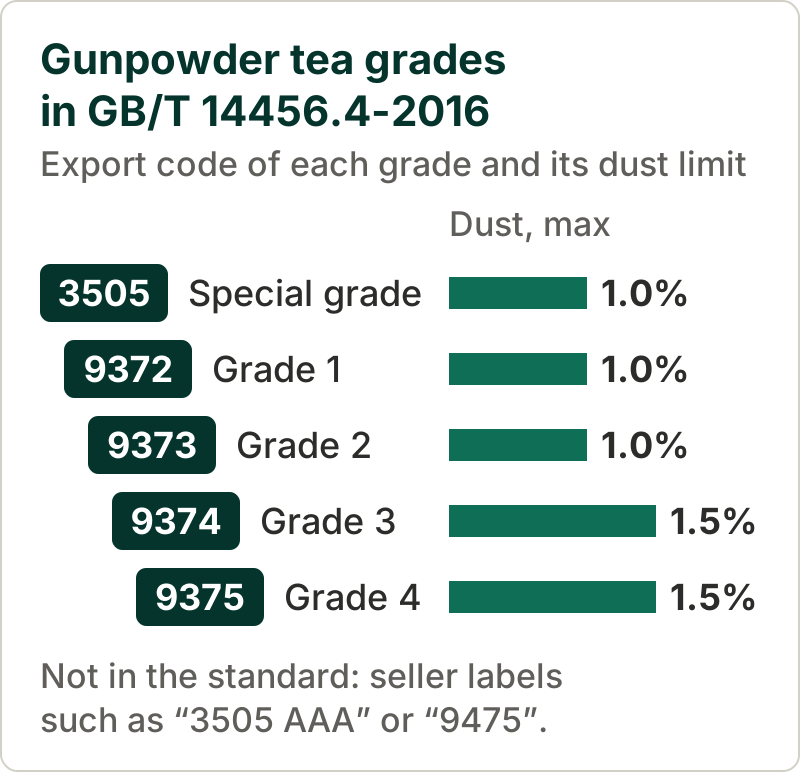 Source: China’s national standard GB/T 14456.4-2016, Tables 1 and 2 (2016)
Water-soluble ash (at least 45% of total ash) and its alkalinity (1.0% to 3.0% as KOH) are further reference values. Each batch must pass a factory release check on five items: sensory quality, moisture, dust, total ash and net content. Type inspection, twice a year, covers all the sensory, physical and chemical, contaminant, pesticide-residue and net-content requirements; the contaminant and residue limits are those of China’s GB 2762 and GB 2763.
Dust is measured with GB/T 8311-2013, which uses a 0.63 mm sieve for round and strip-shaped teas; the same method measures broken tea on a 1.25 mm sieve. Those apertures correspond to 28 and 16 meshes per inch. The gunpowder standard caps dust but sets no limit for broken tea.
Morocco, West Africa and how they buy
According to the 2022 article, grade 3505 sells mainly in Morocco, although gunpowder there is losing ground to chunmee (眉茶), China’s other bulk export green tea. The article describes Moroccan consumers as weighing appearance as much as the cup: they look for round, tight, heavy pellets with a glossy dark green colour, and no loose yellow pellets, dust, broken pieces or stalks. In its account, the tea is boiled with sugar and mint and poured back and forth until a thick foam forms, and abundant, fine and lasting foam is read as a sign of quality. The article adds that Moroccan drinkers favour a bright yellow liquor, a strong taste and the softer flavour of previous-year tea.
West African consumers, the same article says, care more about what is in the cup than about the look of the leaf. It reports that Mali drank mainly gunpowder in the 1980s and 1990s, and that in the early 2000s colouring agents that distorted the liquor colour turned Malian drinkers to chunmee within a year or two. The sources reviewed for this article do not say which gunpowder grades West African markets buy.
Packing differs too. China shipped 91,393 tonnes of tea to Morocco in 2025, worth US$278.1 million (MOFCOM), and 99.7% by weight of the green tea it declared for Morocco fell under HS 0902.20, other green tea, rather than 0902.10, green tea in immediate packings of 3 kg or less. Senegal, Mauritania and Ghana instead received 23,527, 20,117 and 17,757 tonnes of green tea under HS 0902.10, according to China’s figures in UN Comtrade.
What to put in a gunpowder purchase specification
- Grade and reference: the code (for example 3505), GB/T 14456.4-2016 and the number of the sealed contract sample.
- Limits: moisture ≤7.0% (method GB/T 8304), total ash ≤7.5%, dust ≤1.0% or 1.5% by grade (GB/T 8311) and water extract ≥35.0% or 33.0%.
- Broken tea and size: a cap on broken tea at the 1.25 mm sieve, a pellet size range in millimetres and the balance of upper, middle and lower fractions (面张, 中段, 下段).
- Additives: how much rice paste you accept, and no colouring; the 2022 article links excess paste to cloudier liquor and a thinner taste.
- Origin and season: provinces, crop season (the 2022 article finds spring tea gives tighter, heavier pellets than summer and autumn tea) and the share of previous-year tea.
- Residues: the limits of the destination country, with a test report per lot. Certificates issued in China are covered in our guide to Chinese tea export documents.
- Packing and transport: bulk or small packs (green tea in immediate packings of 3 kg or less falls under HS 0902.10, other green tea under 0902.20), net weight, liner and marks; the standard refers packaging to GH/T 1070 and requires clean, dry, odour-free transport protected from rain, damp and sun. The guide to tea container capacity shows how many cartons fit in a 20 ft or 40 ft box.
- Disputes: a retained sample; under the standard, a dispute is settled by retesting it or a double sample drawn from the same lot.
How to compare gunpowder samples
Export gunpowder is generally sold on sample, the 2022 article notes, so the shipment has to match the sample agreed in the contract. Brew the samples side by side under identical conditions. ISO 3103:2019 sets 2 g of green tea per 100 ml of boiling water and, for leafy tea, a 5-minute brew, and recommends water close to the drinking water where the tea will be consumed.
Then score the eight factors used in the Chinese standard: pellets, evenness, colour and cleanliness of the dry tea, followed by aroma, taste, liquor colour and infused leaf. Check the upper, middle and lower fractions as well: the 2022 article notes that bulk blends can drift from the hand-blended sample, with oversized pellets in the upper fraction or too large a lower fraction. For Morocco, the same article describes a foam test: pour each liquor back and forth ten times between two bowls, then compare the thickness, fineness and persistence of the foam.
China also has a sector standard for inspecting and tasting export gunpowder and chunmee, SN/T 4594-2016, in force since 1 March 2017.
Questions and answers
What does 3505 mean on gunpowder tea?
It is the export code of the special grade (特级) in China's gunpowder standard, GB/T 14456.4-2016. The four grades below it carry the codes 9372, 9373, 9374 and 9375.
What is the difference between gunpowder 3505 and 9375?
Grade 3505 must have round, tight, heavy pellets with a glossy dark green colour, a bright yellow-green liquor and a strong, full taste. Grade 9375, the fourth grade, may have coarse, uneven, yellowish pellets with stalks and a slightly coarse taste.
Is 3505 AAA an official gunpowder grade?
No. GB/T 14456.4-2016 defines only 3505, 9372, 9373, 9374 and 9375. Suffixes such as AAA and codes such as 9475 are not defined in the standard; they are used by sellers. Export gunpowder is generally sold on sample, so check any lot against the agreed sample.
Do gunpowder grade numbers indicate pellet size?
No. The standard describes pellets in words, such as round, tight, heavy or coarse, and sets no size in millimetres. If size matters, write a sieve range into the contract.
Which gunpowder grade is used for Moroccan mint tea?
Grade 3505 sells mainly in Morocco, according to a 2022 article in China Tea Processing. The same article says Moroccan drinkers look for a bright yellow liquor, a strong taste and abundant, lasting foam.
What moisture content should gunpowder tea have?
No more than 7.0% for every grade under GB/T 14456.4-2016, tested with method GB/T 8304. Total ash must not exceed 7.5%.
Sources
- 1. GB/T 14456.4-2016 Green tea, Part 4: Gunpowder tea, entry in China's official standards reading system (in Chinese) · openstd.samr.gov.cn
- 2. National public service platform for standards information: GB/T 14456.4-2016 record and 2021 review (in Chinese) · std.samr.gov.cn
- 3. National public service platform for standards information: English version of GB/T 14456.4, published 31 December 2021 (in Chinese) · std.samr.gov.cn
- 4. National public service platform for standards information: SN/T 4594-2016, inspection and evaluation of export gunpowder and chunmee (in Chinese) · std.samr.gov.cn
- 5. GB/T 23776-2018 Methodology for sensory evaluation of tea, official entry (in Chinese) · openstd.samr.gov.cn
- 6. National public service platform for standards information: GB/T 8311-2013 Tea, determination of dust and broken content (in Chinese) · std.samr.gov.cn
- 7. ISO 3103:2019 Tea, preparation of liquor for use in sensory tests, sample pages · cdn.standards.iteh.ai
- 8. Liu Xiangji, Technical key points of quality control of high-grade gunpowder tea for export, China Tea Processing, 2022, issue 4, pp. 18–23 (in Chinese) · sciopen.com
- 9. 智汇三农 agricultural knowledge platform: trade standard samples of tea (in Chinese) · pwsannong.com
- 10. 智汇三农 agricultural knowledge platform: quality standards for export tea (in Chinese) · pwsannong.com
- 11. 智汇三农 agricultural knowledge platform: continuous equipment for primary gunpowder processing (in Chinese) · pwsannong.com
- 12. Shaoxing Bureau of Agriculture and Rural Affairs and municipal rural work office: Shaoxing rural industry development plan, November 2024 (in Chinese) · zjjcmspublic.oss-cn-hangzhou-zwynet-d01-a.internet.cloud.zj.gov.cn
- 13. MOFCOM: China export monthly statistical report, tea, December 2025 (in Chinese) · wms.mofcom.gov.cn
- 14. World Customs Organization: HS Nomenclature 2022 edition, Chapter 9, coffee, tea, maté and spices · wcoomd.org
- 15. UN Comtrade via WITS: China exports of green tea, HS 0902.20, 2025 · wits.worldbank.org
- 16. UN Comtrade via WITS: China exports of green tea in immediate packings, HS 0902.10, 2025 · wits.worldbank.org