West Africa Tea Import Duties 2026: ECOWAS, Senegal, Mauritania
Green tea pays 10% customs duty under the ECOWAS common external tariff, packed or bulk. Levies, VAT, Senegal's tea tax and Mauritania's rules in 2026.
Key facts
- The ECOWAS Common External Tariff (CET) charges 10% customs duty on green tea, whether it comes in packs of 3 kg or less (HS 0902.10) or in bulk (HS 0902.20).
- In countries that belong to both WAEMU and ECOWAS, such as Senegal, tea from China also pays a 1% statistical fee, a 0.8% WAEMU solidarity levy and a 0.5% ECOWAS levy. A press report of 1 April 2025 says Mali, Burkina Faso and Niger added a 0.5% AES levy on imports from non-member countries.
- In Senegal, tea also bears a 5% tea tax and 18% VAT under the General Tax Code.
- Mauritania, which is not an ECOWAS member, says it has adopted the CET: its 2023 tariff data show 10% duty on green tea; a 1% statistical fee and 16% VAT apply, and tea is not on its excise list.
- In 2025 China exported 24,448.6 tonnes of green tea to Senegal and 20,116.7 tonnes to Mauritania, over 96% of it in packs of 3 kg or less, according to UN Comtrade.
Tea imported from China pays 10% customs duty in countries that apply the Common External Tariff (CET) of the Economic Community of West African States (ECOWAS), whether it is green tea in packs of 3 kg or less (Harmonised System code 0902.10) or in bulk (HS 0902.20). Countries that also belong to the West African Economic and Monetary Union (WAEMU, UEMOA in French), such as Senegal, add a 1% statistical fee, a 0.8% solidarity levy and a 0.5% ECOWAS levy, then VAT: 18% in Senegal, where tea also bears a 5% tea tax. Mali, Burkina Faso and Niger, which have left ECOWAS, added a 0.5% levy for their AES confederation, according to a press report of 1 April 2025. Mauritania, which is not an ECOWAS member, says it has adopted the CET: its 2023 tariff data show 10% on green tea, and its VAT rate is 16%.
ECOWAS CET: 10% on tea, packed or bulk
ECOWAS member states adopted the CET on 25 October 2013. It places every product in one of five bands: 0%, 5%, 10%, 20% or 35%. The version based on HS 2022, which rests on ECOWAS Regulation C/REG.16/12/21 of 10 December 2021, has 6,381 tariff lines; Côte d’Ivoire has applied it since 8 August 2023.
Tea sits in the 10% band, which ECOWAS describes as intermediate goods and inputs, not in the 20% band for final consumer goods. The rate does not change with the type of tea or the pack:
| HS code | Product | CET duty |
|---|---|---|
| 0902.10 | Green tea in immediate packings of 3 kg or less | 10% |
| 0902.20 | Other green tea (bulk) | 10% |
| 0902.30 | Black tea in immediate packings of 3 kg or less | 10% |
| 0902.40 | Other black tea | 10% |
Sources: Côte d’Ivoire’s customs tariff (ECOWAS CET, HS 2022 version), updated on 27 March 2026; the CET published by Togo’s revenue office (OTR) shows the same duty.
The 2023 tariff data that Burkina Faso, Côte d’Ivoire, The Gambia, Ghana, Guinea, Mali, Mauritania, Niger, Senegal and Togo reported to the United Nations Conference on Trade and Development (UNCTAD, TRAINS database) also show 10% on both green tea lines; no later year was available in September 2026. Importing in bulk to pack locally therefore brings no saving on the duty rate.
Levies added to the duty
| Levy | Rate | Where it applies |
|---|---|---|
| Statistical fee (RS) | 1% | WAEMU countries |
| WAEMU community solidarity levy (PCS) | 0.8% | WAEMU countries |
| ECOWAS community levy (PC) | 0.5% | ECOWAS members, on goods from non-member countries such as China |
| African Union levy (PUA) | 0.2% | Côte d’Ivoire |
| AES confederal levy | 0.5% (press report, 1 April 2025) | Mali, Burkina Faso, Niger, on goods from non-member countries |
| Senegalese Shippers’ Council (COSEC) levy | 0.4% | Senegal, sea imports only |
Côte d’Ivoire’s 2026 tariff shows the statistical fee, the PCS, the ECOWAS levy and the African Union levy at these rates on every tea line. WAEMU cut the PCS from 1% to 0.8% of the customs value on 1 July 2017 and, instead of lowering it to 0.5% in 2019 as first planned, kept it at 0.8%, according to Côte d’Ivoire’s customs circulars of June 2017 and October 2018. Older pages still show other figures, for example 1% in the CET posted by Togo’s revenue office and in the rate table on Senegal’s customs website. The AES levy is known only from a press report (see below). The COSEC rate appears on an undated page of Senegal’s customs website and in a tax summary reviewed in August 2026: confirm it with your broker.
In Senegal, which belongs to both WAEMU and ECOWAS, the customs duty, the statistical fee, the PCS and the ECOWAS levy are all charged on the customs (CIF) value, and together they come to 12.3% of it (10% + 1% + 0.8% + 0.5%). The COSEC levy and other national charges are added, and VAT and the tea tax are then calculated on a different base: the customs value plus the duties and taxes collected by customs.
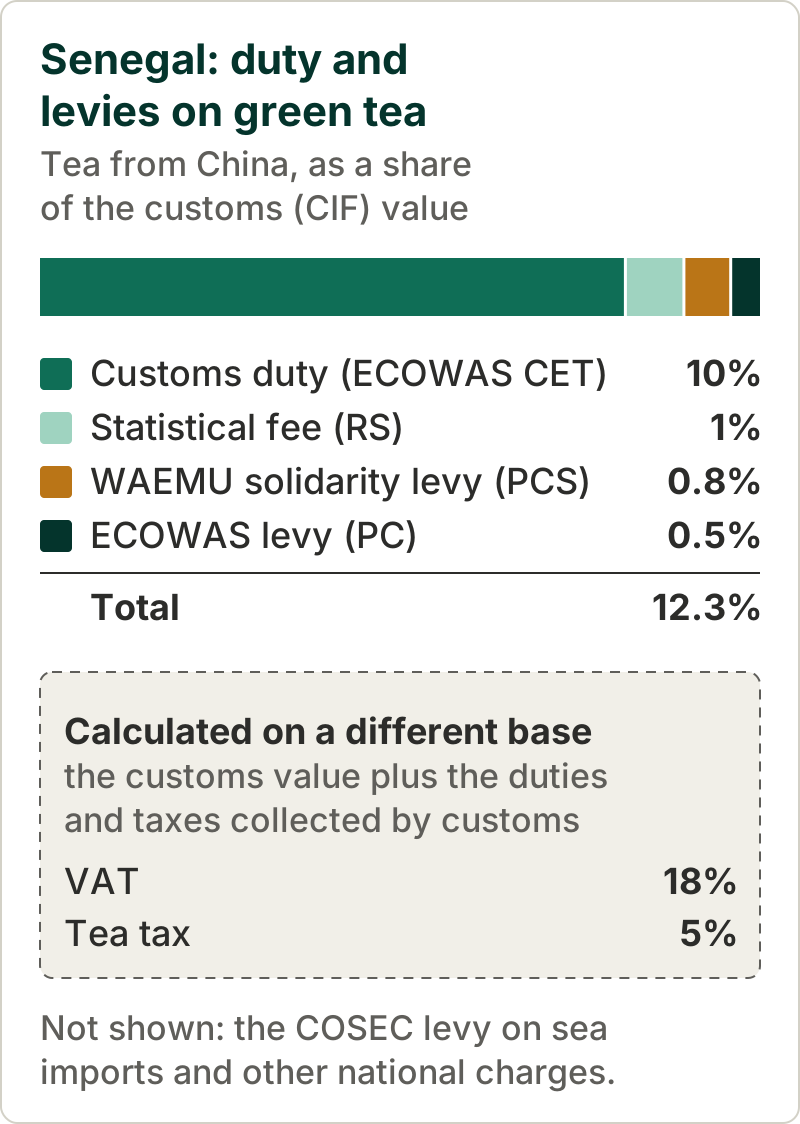 Sources: ECOWAS CET as published by Côte d’Ivoire Customs (2026); Senegal’s General Tax Code (2025)
Importing tea into Senegal: duties and taxes
Senegal’s General Tax Code (Code général des impôts, CGI) levies a “tax on tea” of 5% on black and green tea, tea extracts and essences, and preparations based on those extracts or essences (articles 427 and 428 of the edition published by the tax administration, DGID, updated to January 2025). On imports, its base is the customs value plus all duties and taxes collected by customs, excluding VAT and the tea tax itself (article 408).
VAT is 18% (article 369). On imports it is charged on the customs value plus the duties and taxes that customs collect for the State budget (article 368). Tea is not on the list of VAT-exempt unprocessed basic foods, which covers cereals (except luxury rice), vegetables, groundnuts and pulses, meat, eggs, unprocessed fish and unprocessed milk.
Three more charges can apply, depending on the goods and the importer:
- customs modernisation levy (PROMAD): Senegal’s customs administration says a 2021 decree set it at 3% on goods cleared under the ordinary regime, with most mass-consumption and “sensitive” goods excluded, as well as goods originating in WAEMU and ECOWAS countries; a tax summary reviewed in August 2026 gives 1.5% of the customs value under the 2022 Finance Act. Ask your broker whether it applies to tea, and at what rate;
- advance payment on imports: 3% of the customs value plus entry duties, on a list of consumer goods that includes tea; it is credited against tax due, and companies attached to the Large Taxpayers’ Centre are exempt (article 220);
- tax compliance levy: 12% of the customs value plus entry duties, not creditable, for importers who do not regularly file and pay their taxes (article 220 bis).
On paperwork, the French customs factsheet on Senegal (January 2020) notes that above CFA 200,000 of customs value the declaration goes through a licensed customs broker unless you hold an authorisation to declare. The documents it lists include the commercial invoice, the transport document (bill of lading), the certificate of origin, the insurance certificate and a phytosanitary certificate for plant products. Food imports need a food import declaration (DIPA) filed with the domestic trade directorate, sea shipments need the electronic cargo tracking note (BSC) issued by COSEC, and imports from outside the franc zone, such as China, need an import certificate and a foreign-exchange undertaking. Clearance is largely paperless, through the GAINDE platform and its ORBUS module. These requirements date from 2020: check them with your broker.
Mauritania tea imports: duty, VAT and procedure
Mauritania is not an ECOWAS member, but it signed an association agreement with ECOWAS in Nouakchott on 5 May 2017, whose ratification was authorised by Law 2018.045 of 28 December 2018. According to its Ministry of Economy and Finance, Mauritania adopted the CET on that basis, first in its HS 2017 version, then in its HS 2022 version in 2024. Its 2023 tariff data show 10% on green tea, in packs of 3 kg or less and in bulk.
| Item | Mauritania |
|---|---|
| Customs duty, green tea (HS 0902.10 and 0902.20), 2023 data | 10% |
| Statistical fee | 1% of the customs value |
| VAT | 16% |
| Advance on profit tax, collected by customs | 2% |
| Excise duty | tea not on the list (August 2025) |
The finance ministry’s 2024 tax expenditure report gives 1% of the customs value as the normal rate of the statistical fee. Sixteen per cent is the standard VAT rate in Mauritania’s General Tax Code (official 2023 edition), and tea is not on its exemption list. Under articles 56 and 92 of the same code, companies and other businesses liable to profit tax pay customs an advance of 2% of the customs value plus import duties and taxes (excluding VAT) on the goods they import; it is credited against their profit tax. The World Trade Organization (WTO) reported a 20% consumption tax on tea in its 2018 review; the 2023 tax code no longer lists tea, and neither does the excise list rewritten by the August 2025 supplementary finance law. The customs assessment notice also lists a community levy (PC) and a sports and culture levy (PSC). The 2026 Finance Law shows them at 0.5% and 1% on phones, but no text found says whether they apply to tea: ask Mauritanian customs.
The 2026 clearance guide of the Directorate General of Customs sets out the procedure: detailed declaration (DED) in SYDONIA World, a green, yellow, blue or red control channel, an assessment notice, payment to the Treasury, then a release order (BAE). Goods not removed within four months of entry in the warehouse register are sold at public auction. A new Customs Code was enacted by Law 2026.015 of 24 May 2026. Mauritania’s own import statistics, its tariff history and the port of Nouakchott are covered in our guide to Mauritania’s green tea trade.
Mali, Burkina Faso and Niger: the AES levy
Mali, Burkina Faso and Niger, grouped in the AES confederation, left ECOWAS on 29 January 2025, according to an ECOWAS statement, and remain WAEMU members, according to a press report of 1 April 2025. The same report says that on 28 March 2025 the AES College of Heads of State adopted a 0.5% levy on goods imported from non-member countries, goods from WAEMU countries excluded, and that, according to Mali’s foreign ministry, the customs administrations of the three countries collect it. Mali’s Council of Ministers of 16 April 2025 mentioned the setting up of this “confederal levy” without giving its rate, and no official text stating the rate was found. Their 2023 tariff data show 10% on green tea. Before shipping, ask your broker or the national customs whether the levy applies as reported, whether the tariff has changed since 2023 and whether the ECOWAS levy is still collected.
In Mali, VAT applies at a standard 18% to most goods, imports included, while unprocessed basic foodstuffs are exempt, according to the WTO’s 2017 review. How tea is treated could not be confirmed: check with Malian customs.
Ghana, Guinea and The Gambia: CET plus national charges
Ghana, Guinea and The Gambia belong to ECOWAS but not to WAEMU. Their 2023 tariff data also show 10% on green tea, and their other import charges differ from country to country. In August 2025 the US International Trade Administration listed some fifteen duties and charges that Ghana collects on imports in addition to the tariff and VAT, including an ECOWAS levy, an African Union levy, the National Health Insurance Levy and a processing fee. Ask the Ghana Revenue Authority, Guinean or Gambian customs, or a customs broker for the current list and rates.
China’s 2025 green tea exports to West Africa
China exported about 419,000 tonnes of tea in 2025 (+11.9% by volume), including 368,986 tonnes of green tea, according to the December 2025 report of China’s Ministry of Commerce (MOFCOM), which covers the full year. By value, Senegal ranked second among China’s tea markets, behind Morocco, with 24,449 tonnes of tea of all kinds (+61.4% by volume). For all tea, not only green tea, MOFCOM also recorded higher volumes to Mauritania (+26.8%) and Côte d’Ivoire (+300.4%) and lower volumes to Ghana (−53.2%).
China’s export declarations, as reported to the United Nations’ UN Comtrade database, split green tea by pack size:
| Country | Packs of 3 kg or less (t) | Other green tea (t) | Total (t) | Share in packs of 3 kg or less |
|---|---|---|---|---|
| Senegal | 23,526.7 | 921.9 | 24,448.6 | 96% |
| Mauritania | 20,116.7 | – | 20,116.7 | 100% |
| Ghana | 17,757.2 | 317.5 | 18,074.7 | 98% |
| Côte d’Ivoire | 16,511.2 | 150.0 | 16,661.2 | 99% |
| Niger | 7,156.7 | 3,925.1 | 11,081.8 | 65% |
| Mali | 10,303.1 | 22.7 | 10,325.8 | 99.8% |
| The Gambia | 8,571.2 | 67.1 | 8,638.3 | 99% |
| Guinea | 5,179.2 | – | 5,179.2 | 100% |
| Togo | 2,457.2 | 124.5 | 2,581.7 | 95% |
| Burkina Faso | 768.6 | – | 768.6 | 100% |
Data: UN Comtrade via WITS, exports reported by China, HS 0902.10 and 0902.20, 2025; “–” means no line was reported.
In total, West Africa, Mauritania included, received about 117,100 tonnes of Chinese green tea in packs of 3 kg or less in 2025, around 80% of the 145,506 tonnes China exported under that code (The Tea Trade’s calculation). Among the ten countries in the table, Niger is the exception: more than a third of the green tea China shipped there was in packs over 3 kg. HS 0902.10 covers every pack up to 3 kg, so the data do not separate small boxes from 1–3 kg packs.
Separate guides explain chunmee grades and gunpowder grades.
Before you ship
Use the right HS code even though the rate is the same: 0902.10 for immediate packings of 3 kg or less, 0902.20 above that. This is general information, not legal or tax advice: have a customs broker confirm the classification, rates and documents before each shipment. The verified gross mass (VGM) each container needs before loading is explained in the guide to tea container capacity.
Questions and answers
What is the import duty on tea in West Africa?
Countries that apply the ECOWAS Common External Tariff charge 10% customs duty on green and black tea, whatever the pack size. Countries in both WAEMU and ECOWAS, such as Senegal, add a 1% statistical fee, a 0.8% WAEMU solidarity levy and a 0.5% ECOWAS levy, before VAT and national taxes. A press report of 1 April 2025 says Mali, Burkina Faso and Niger added a 0.5% AES levy: confirm their current charges with their customs.
How much duty and tax do I pay to import tea into Senegal?
Green tea pays 10% customs duty, a 1% statistical fee, a 0.8% WAEMU levy and a 0.5% ECOWAS levy, all on the customs value. Senegal's 5% tea tax and 18% VAT are then calculated on the customs value plus duties. Sea shipments also pay a 0.4% Shippers' Council levy, and a customs modernisation levy (PROMAD) may apply, but sources disagree on its rate and scope: have a customs broker confirm both.
What taxes apply to tea imports into Mauritania?
According to its Ministry of Economy and Finance, Mauritania has adopted the ECOWAS CET, and its 2023 tariff data show 10% customs duty on green tea. A 1% statistical fee on the customs value and 16% VAT are added, and importers liable to profit tax pay customs a 2% advance that is credited against that tax. Tea is not on the excise list rewritten in August 2025. Ask Mauritanian customs whether the community levy (PC) and the sports and culture levy (PSC) apply to tea.
Does bulk tea pay less duty than packed tea in West Africa?
No. The ECOWAS CET charges 10% on green tea in packs of 3 kg or less (HS 0902.10) and on other green tea (HS 0902.20), so packing locally brings no saving on the duty rate.
What is the AES levy?
According to a press report of 1 April 2025, it is a 0.5% levy on goods imported into Mali, Burkina Faso and Niger from non-member countries, China included, decided by the AES College of Heads of State on 28 March 2025 and collected by the three countries' customs. No official text giving its rate was found: confirm it with their customs or a customs broker.
How much green tea does China export to West Africa?
In 2025 China exported 24,448.6 tonnes of green tea to Senegal, 20,116.7 tonnes to Mauritania, 18,074.7 tonnes to Ghana and 16,661.2 tonnes to Côte d'Ivoire, according to UN Comtrade. West Africa, Mauritania included, took about 80% of China's green tea exports in packs of 3 kg or less.
Sources
- 1. ECOWAS, ECOTIS: Common External Tariff (CET), five-band structure · ecotis.ecowas.int
- 2. Côte d'Ivoire Customs: circular 2258 on the ECOWAS CET based on the 2022 Harmonised System (31 July 2023, in French) · douanes.ci
- 3. Côte d'Ivoire Customs: ECOWAS CET (HS 2022) with the main national duties and taxes, updated 27 March 2026 (in French) · douanes.ci
- 4. Côte d'Ivoire Customs: circular 1861 on the reduction of the PCS rate (29 June 2017, in French) · douanes.ci
- 5. Côte d'Ivoire Customs: circular 1960 on the PCS rate (2 October 2018, in French) · douanes.ci
- 6. Togolese Revenue Office (OTR): ECOWAS CET, part 1, chapter 9 coffee, tea, maté and spices (undated, in French) · otr.tg
- 7. Senegal Customs: table of import duties and taxes (undated, in French) · douanes.sn
- 8. ECOWAS: Protocol A/P1/7/96 on the conditions governing the application of the community levy (27 July 1996) · ecowas.int
- 9. UNCTAD TRAINS via WITS: applied MFN duty reported for 2023 on HS 090210 and 090220 by Senegal, Mali, Ghana, Niger, Mauritania, Guinea, The Gambia, Burkina Faso, Togo and Côte d'Ivoire · wits.worldbank.org
- 10. Senegal, Directorate General of Taxes and Estates (DGID): General Tax Code, annotated edition updated to January 2025 (in French) · dgid.sn
- 11. French Customs: 10 questions to ask before exporting to Senegal (January 2020, in French) · douane.gouv.fr
- 12. Senegal Customs: the PROMAD levy (19 November 2024, in French) · douanes.sn
- 13. Senegal Customs: 'Mission fiscale', summary of the foreign trade tax system (undated, in French) · douanes.sn
- 14. Senegal, corporate other taxes: worldwide tax summary (last reviewed 7 August 2026) · taxsummaries.pwc.com
- 15. Mali: the AES introduces a 0.5% customs levy on non-member countries (press report, 1 April 2025, in French) · koaci.com
- 16. ECOWAS: press statement on the withdrawal of Burkina Faso, Mali and Niger (29 January 2025) · ecowas.int
- 17. Mali, Presidency: communiqué of the Council of Ministers of 16 April 2025 (in French) · koulouba.ml
- 18. WTO: Trade Policy Review of the WAEMU countries, annex 5, Mali (WT/TPR/S/362, 2017, in French) · wto.org
- 19. WTO: Trade Policy Review, Mauritania (WT/TPR/S/371, 24 April 2018, French version) · wto.org
- 20. Mauritania, Ministry of Finance: 2024 tax expenditure report (published December 2025, in French) · finances.gov.mr
- 21. Mauritania, Ministry of Economy and Finance: draft 2025 Finance Law, explanatory memorandum on the customs tariff (October 2024, in French) · finances.gov.mr
- 22. Mauritania, Directorate General of Taxes: General Tax Code, official 2023 edition (in French) · finances.gov.mr
- 23. Mauritania: 2025 supplementary finance law, Law 2025-040 of 21 August 2025 (in French) · finances.gov.mr
- 24. Mauritania: 2026 Finance Law, Law 2026-001 of 12 January 2026 (in French) · finances.gov.mr
- 25. Mauritania: 2026 supplementary finance law, Law 2026-035 of 10 August 2026 (in French) · finances.gov.mr
- 26. Mauritania, Directorate General of Customs: import and export clearance procedures guide (2026, in French) · douanes.mr
- 27. US International Trade Administration: Ghana, Import Tariffs (6 August 2025) · trade.gov
- 28. China's Ministry of Commerce (MOFCOM) and foodstuffs chamber of commerce: monthly tea export report, December 2025 (in Chinese) · wms.mofcom.gov.cn
- 29. UN Comtrade via WITS: China's exports of green tea in packs of 3 kg or less (HS 0902.10) by partner, 2025 · wits.worldbank.org
- 30. UN Comtrade via WITS: China's exports of other green tea (HS 0902.20) by partner, 2025 · wits.worldbank.org