Chinese tea types: the six families, HS codes and 2025 exports
The six Chinese tea types and jasmine tea for importers: processing, provinces, HS 0902 codes, storage. Green tea was 88% of China's 2025 export volume.
Key facts
- Chinese tea is classified into six types by processing: green, white, yellow, oolong, black (hongcha, 'red tea' in Chinese) and dark (heicha, including ripe pu-erh); jasmine tea is a reprocessed, scented tea.
- In the Harmonized System, green tea falls under subheadings 0902.10 and 0902.20, and black and partly fermented tea under 0902.30 and 0902.40, split at immediate packings of 3 kg.
- China's customs tariff has had its own lines for white tea and jasmine tea since 1 January 2023; its 2021 tariff already had separate lines for oolong, ripe pu-erh and other dark tea.
- China exported 418,800 tonnes of tea in 2025; green tea made up 88.11% of the volume and 80.4% of the value.
- Shenzhen's local standard DB4403/T 88-2020 recommends storing green tea at no more than 10 °C and 50% relative humidity, and dark and compressed teas at no more than 25 °C and 70%.
Chinese tea is classified into six types: green, white, yellow, oolong, black (called hongcha, “red tea”, in China) and dark (heicha, which includes ripe pu-erh). They differ in how the leaf is processed, above all in how far it is oxidised; jasmine and other scented teas are reprocessed teas, not a seventh type. In 2025 green tea made up 88.1% of the 418,800 tonnes of tea China exported, but 80.4% of the export value.
The six types of Chinese tea at a glance
The international standard ISO 20715:2023 classifies tea into six types according to the processing steps that control oxidation. In China, the national standard GB/T 30766-2014, in force since 27 October 2014, sets the terms and categories used in production and trade.
| Type | Key processing steps | Provinces (examples) | Common forms and examples |
|---|---|---|---|
| Green (绿茶) | fixing by heat, rolling or shaping, drying | Zhejiang, Jiangsu, Anhui | chunmee (眉茶), gunpowder (珠茶) |
| White (白茶) | a single withering and drying stage | Fujian | loose leaf, compressed white tea |
| Yellow (黄茶) | fixing, rolling, “yellowing” under cover, drying | Hunan | small volumes (0.70% of output) |
| Oolong (乌龙茶) | withering, tumbling, partial oxidation, fixing, rolling, drying | Fujian (Wuyi Mountains, Anxi) | e.g. Tieguanyin, Da Hong Pao |
| Black (红茶, hongcha) | withering, rolling or maceration, oxidation, drying | Anhui (Qimen) | congou, broken, souchong |
| Dark (黑茶, heicha) | fixing, rolling, pile fermentation, drying | Hunan, Hubei, Sichuan, Guangxi, Yunnan, Shaanxi | bricks and cakes |
| Scented (花茶), e.g. jasmine | a base tea, usually green, layered with fresh flowers | Fujian, Guangxi | as the base tea |
The steps follow ISO 20715. The provinces are examples taken from well-known teas of each type, not a ranking of production. Several of these forms have their own Chinese national standards: GB/T 14456 for chunmee and gunpowder, GB/T 30357 for oolongs such as Tieguanyin, GB/T 13738 for black teas, GB/T 31751 for compressed white tea and GB/T 9833 for compressed teas.
Black, red or dark? Fermentation and the naming trap
In tea, “fermentation” usually has nothing to do with microbes. ISO 20715 treats aeration, oxidation and fermentation as synonyms: polyphenols in the broken leaf react with oxygen in the air. In ISO terms, then, the “black tea (fermented)” of the Harmonized System (HS) is an oxidised tea.
Fixing uses heat, from steam or a hot pan, to inactivate the enzymes behind oxidation. Green, yellow and dark teas are fixed early in processing; oolong only after partial oxidation; black and white teas are not fixed at all.
Dark tea is the only type with a microbial stage, pile fermentation (post-fermentation), in which fixed leaves are heaped and dampened. ISO 20715 lists ripe (shou) pu-erh under dark tea.
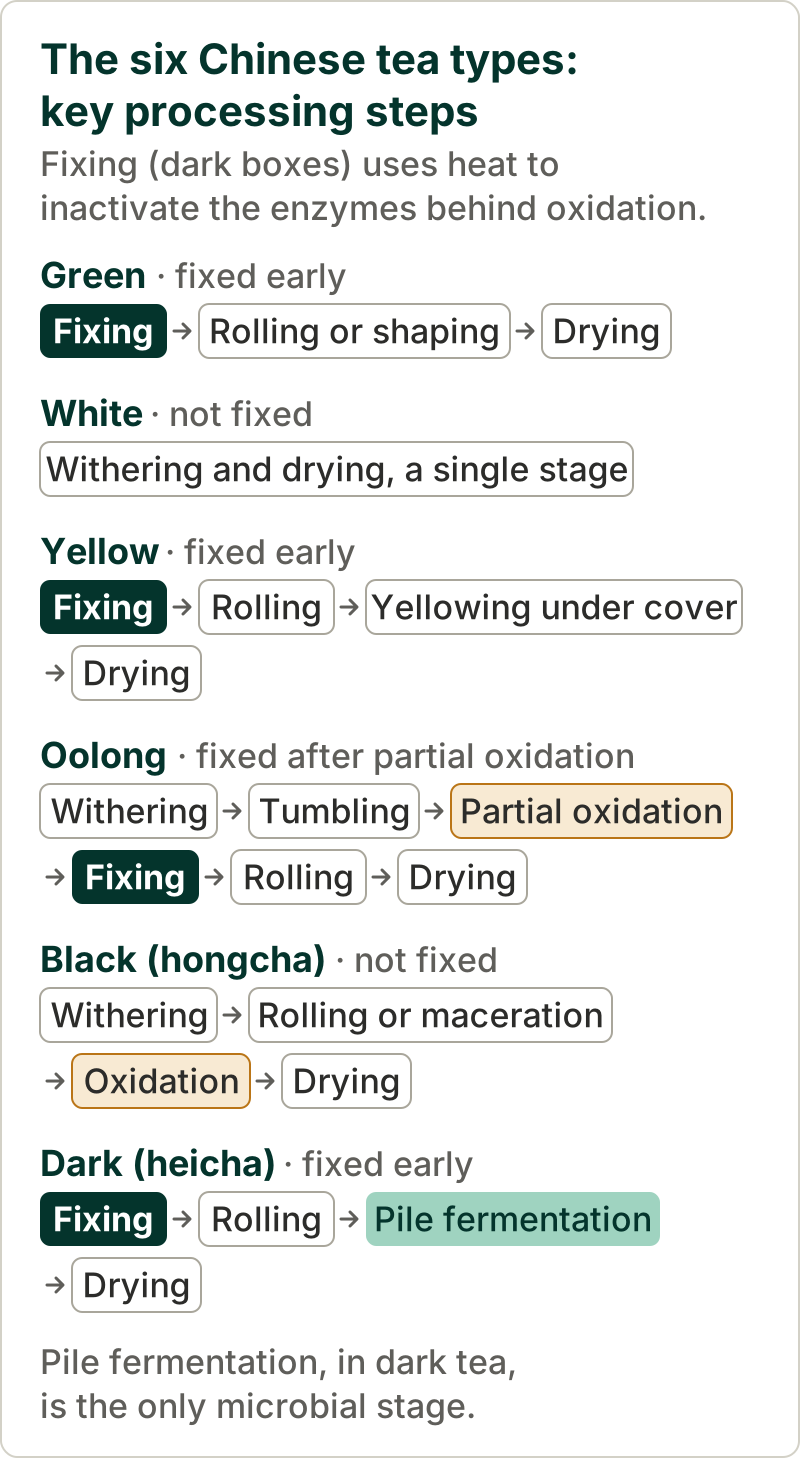 Source: ISO 20715, Tea — Classification of tea types (2023)
The names cause mistakes. The tea sold as “black” in English and in the HS is hongcha (红茶), literally “red tea”; heicha (黑茶), literally “black tea”, is dark tea. We recommend writing the Chinese name on contracts and specifications.
Chinese tea categories for importers: the HS code map
The World Customs Organization’s HS nomenclature (2022 edition) puts all tea under heading 09.02, “Tea, whether or not flavoured”. Its four subheadings combine two tests: green tea, or black and partly fermented tea; and immediate packings of up to 3 kg, or larger. Our guide to HS codes for tea explains the 3 kg test, the EU and US lines and the 2028 changes.
| Subheading | HS 2022 wording | Chinese types under it in China’s tariff |
|---|---|---|
| 0902.10 | Green tea (not fermented) in immediate packings of a content not exceeding 3 kg | green, white, jasmine and other scented teas |
| 0902.20 | Other green tea (not fermented) | the same, in larger packings |
| 0902.30 | Black tea (fermented) and partly fermented tea, in immediate packings of a content not exceeding 3 kg | black, oolong, ripe pu-erh and other dark teas |
| 0902.40 | Other black tea (fermented) and other partly fermented tea | the same, in larger packings |
China’s tariff splits these subheadings into 8-digit national lines:
- under 0902.10 and 0902.20, since 1 January 2023: jasmine tea (0902.1011 and 0902.2011), other scented tea (0902.1019 and 0902.2019), white tea (0902.1020 and 0902.2020) and other green tea (0902.1090 and 0902.2090). That year the jasmine and other scented tea lines replaced a single scented tea line, and white tea was split off from other green tea;
- under 0902.30 and 0902.40, already in the 2021 tariff: oolong (0902.3010 and 0902.4010), ripe pu-erh (0902.3031 and 0902.4031), other dark tea (0902.3039 and 0902.4039) and other black and partly fermented tea (0902.3090 and 0902.4090).
Yellow tea and raw (sheng) pu-erh have no line of their own. The 2025 figures fit this split: green, white and scented teas add up to about 377,100 tonnes, the volume exported under 0902.10 and 0902.20, while black tea, oolong and dark teas come to about 41,600 tonnes, the volume under 0902.30 and 0902.40.
Chinese tea exports by type in 2025
China exported 418,800 tonnes of tea in 2025 (+11.93%), worth US$1.55 billion, according to the China Tea Marketing Association (CTMA), which draws on customs statistics.
| Customs category | Volume 2025 | Share of volume | Year on year |
|---|---|---|---|
| Green tea | 369,000 t | 88.11% | +13.93% |
| Black tea | 25,900 t | 6.18% | +4.48% |
| Oolong | 13,900 t | 3.32% | −10.14% |
| Jasmine tea | 7,510 t | 1.79% | +0.31% |
| Ripe pu-erh | 1,401 t | 0.33% | −3.02% |
| White tea | 477 t | 0.11% | +4.63% |
| Other dark tea | 472 t | 0.11% | −7.88% |
| Other scented tea | 147 t | 0.04% | +6.78% |
For value, the monthly report of China’s Ministry of Commerce (MOFCOM) uses three groups. From its figures, green tea made up 80.4% of export value, at an average of US$3,368 a tonne; black tea 8.8%, at US$5,258 a tonne; and “speciality teas” 10.8%, at US$6,982 a tonne. The speciality group’s volume (23,904 t) corresponds to the combined volume of oolong, ripe pu-erh, white tea, other dark tea and scented teas in the CTMA table.
Exports are far greener than production. Of the 3.64 million tonnes of crude tea (maocha) China produced in 2025, green tea was 59.03%, black 15.65%, dark 12.26%, oolong 9.61%, white 2.75% and yellow 0.70% (CTMA). Exports equalled roughly 11.5% of that output.
Where each type of Chinese tea is shipped
UN Comtrade data for 2025, as reported by China (via WITS), show the main buyers:
- green tea in packings of 3 kg or less (0902.10), by volume: Senegal (23,527 t), Mauritania (20,117 t), Ghana (17,757 t), Côte d’Ivoire (16,511 t) and Mali (10,303 t);
- green tea in larger packings (0902.20), by volume: Morocco (91,128 t), Uzbekistan (28,840 t), Chad (12,484 t) and Algeria (11,622 t);
- black and partly fermented tea (0902.30 and 0902.40 combined), by value: Malaysia (US$65.4m), Japan (US$29.2m), Hong Kong (US$21.7m), Russia (US$21.6m) and the United States (US$17.1m).
Green tea in packings above 3 kg made up 99.7% of the volume of China’s 2025 tea exports to Morocco, while Senegal, Mauritania and Ghana mainly bought packs of 3 kg or less.
By province, Zhejiang shipped 185,297 tonnes in 2025, 44% of the total, ahead of Anhui (73,491 t), Hunan (55,668 t), Hubei (30,809 t) and Fujian (20,847 t) (MOFCOM).
From January to August 2026, export volume fell 6.10% to 252,500 tonnes, while value rose 1.43% to US$991 million (CTMA, 20 September 2026).
Storage, packaging and labelling by type
Storage. Shenzhen’s local standard DB4403/T 88-2020 on tea packaging, storage and transport, which lists the national standard GB/T 30375-2013 among its references, recommends:
| Type | Temperature | Relative humidity |
|---|---|---|
| Green, yellow, oolong dried over a low fire | 10 °C or below | 50% or below |
| Black, other oolong, white, scented | 25 °C or below | 50% or below |
| Dark and compressed teas | 25 °C or below | 70% or below |
Packaging. The same standard suggests laminates based on aluminium foil or metallised film as a moisture barrier, calls for airtight bags and vacuum packing against oxidation (it also recommends nitrogen flushing), and recommends light-proof packaging. For dark and compressed teas, it advises more breathable materials instead. Moisture in transit, including container sweat, is covered in the guide to tea container capacity.
Labelling. We recommend using the same type name on the label, the invoice and the customs entry. In Morocco, Decree No. 2-13-711 of 4 March 2015 defines green tea and black tea but no other tea type, such as oolong or white tea; its other definitions cover tea flower, decaffeinated, soluble and flavoured tea, and imitation tea (“faux thé”). It requires closed, clean and dry containers, the nature of any added flavouring in a flavoured tea’s sales name, and the country of origin where it differs from the place of provenance. It also lists among unlawful practices the sale of unpackaged tea in bulk (en vrac), the colouring of green tea, and glazing with gypsum or talc.
Documents and shelf life. We recommend checking, for each type, the Chinese tariff line declared at export and the stated shelf life against your invoice, label and storage conditions.
Questions and answers
What are the six types of Chinese tea?
Green, white, yellow, oolong, black (hongcha) and dark (heicha). Jasmine and other scented teas are reprocessed teas, usually made on a green tea base.
Is Chinese red tea the same as black tea?
Yes. Hongcha (红茶), 'red tea' in Chinese, is what the English-speaking trade and the HS call black tea (0902.30 and 0902.40). Heicha (黑茶), literally 'black tea', is a different type: dark tea, which includes ripe pu-erh.
What HS code applies to oolong, pu-erh and white tea?
In China's tariff, oolong and ripe pu-erh fall under 0902.30 or 0902.40, depending on whether the immediate packing holds 3 kg or less; raw pu-erh has no line of its own. White tea falls under the green tea subheadings, with its own lines 0902.1020 and 0902.2020 since 2023.
How much of China's tea exports is green tea?
In 2025 green tea was 88.11% of export volume, or 369,000 of 418,800 tonnes, according to the China Tea Marketing Association. By value it was 80.4%, based on figures from China's Ministry of Commerce.
Should pu-erh be stored like green tea?
Not according to Shenzhen's local standard DB4403/T 88-2020. It recommends no more than 10 °C and 50% relative humidity for green tea, but no more than 25 °C and 70% for dark and compressed teas, a group that includes pu-erh, in more breathable packaging.
Which countries buy Chinese green tea in small packs?
In 2025 the main buyers of Chinese green tea in packings of 3 kg or less were Senegal, Mauritania, Ghana, Côte d'Ivoire and Mali, according to UN Comtrade data. Morocco is different: 99.7% of the volume of China's tea exports to Morocco was green tea in packings above 3 kg.
Sources
- 1. WCO, HS Nomenclature 2022 edition: Chapter 9 (heading 09.02) · wcoomd.org
- 2. ISO 20715:2023, Tea — Classification of tea types (preview pages) · cdn.standards.iteh.ai
- 3. National Library of Standards of China: GB/T 30766-2014, Classification of tea (status and scope) · ndls.org.cn
- 4. National Tea Standardization Technical Committee (TC339): list of national tea standards · tc339.co-tea.com
- 5. State Council Tariff Commission: 2021 agreement tariff rate table (annex 7, with the 8-digit lines of heading 0902) · gss.mof.gov.cn
- 6. State Council Tariff Commission: 2023 tariff line adjustment table (annex 7) · gss.mof.gov.cn
- 7. Office of the State Council Tariff Commission: tariff changes from 1 January 2023 (new white tea line) · gss.mof.gov.cn
- 8. MOFCOM and CFNA: monthly tea export report, December 2025 · wms.mofcom.gov.cn
- 9. China Tea Marketing Association: China's tea imports and exports in 2025 (20 January 2026) · ctma.com.cn
- 10. China Tea Marketing Association: China's tea imports and exports, August 2026 (20 September 2026) · ctma.com.cn
- 11. China Tea Marketing Association: 2025 tea production and sales analysis, part 1 (association's news-portal account, 9 April 2026) · sohu.com
- 12. UN Comtrade via WITS: China's exports under 0902.10 in 2025 · wits.worldbank.org
- 13. UN Comtrade via WITS: China's exports under 0902.20 in 2025 · wits.worldbank.org
- 14. UN Comtrade via WITS: China's exports under 0902.30 in 2025 · wits.worldbank.org
- 15. UN Comtrade via WITS: China's exports under 0902.40 in 2025 · wits.worldbank.org
- 16. Shenzhen local standard DB4403/T 88-2020: tea packaging, storage and transport · amr.sz.gov.cn
- 17. Morocco, Decree No. 2-13-711 of 4 March 2015 on the quality and safety of tea (FAOLEX) · faolex.fao.org
- 18. Wikipedia: Chinese tea · en.wikipedia.org
- 19. Wikipedia: Fermented tea · en.wikipedia.org
- 20. Wikipedia: Jasmine tea · en.wikipedia.org