Import green tea into Morocco: 2026 duty, rules and data
Morocco charges 2.5% duty on green tea in packings of 20 kg or more and 30% below. Tariff codes, VAT, ONSSA rules, payment terms and 2025 import data.
Key facts
- Since 1 January 2024, Morocco has charged 2.5% import duty on green tea only when it arrives in packings with a content of 20 kg or more; packings over 3 kg and under 20 kg, and packings of 3 kg or less, pay 30%.
- In 2026 the Moroccan tariff lines for ordinary green tea are 0902.10.00.90 (3 kg or less, 30%), 0902.20.90.10 (over 3 kg and under 20 kg, 30%) and 0902.20.90.90 (20 kg or more, 2.5%), plus a 0.25% parafiscal import tax and 20% import VAT.
- According to China's Ministry of Commerce (MOFCOM), China exported 91,393 tonnes of tea to Morocco in 2025, 13.4% more than in 2024, worth US$278 million; Morocco ranked first among its tea markets by value.
- In Morocco, establishments that pack, store, transport or distribute tea need a sanitary authorisation, issued by ONSSA except for retail and catering, and tea sold in the country must meet Decree 2-13-711 of 4 March 2015 on definitions, quality and labelling.
- As a general rule, Morocco's 2026 foreign-exchange instruction (IGOC) caps advance payments to a foreign supplier at 30% of the import value and allows 100% prepayment up to the equivalent of MAD 200,000.
To import green tea into Morocco in 2026, budget for 2.5% import duty if the tea arrives in packings with a content of at least 20 kg and 30% if the packings are smaller, plus a 0.25% parafiscal import tax and 20% import VAT. The tea must be packed, stored and distributed by establishments with a sanitary authorisation (from ONSSA, the national food-safety office, except for retail and catering) and must meet Decree 2-13-711 on tea quality. According to MOFCOM, China shipped 91,393 tonnes of tea to Morocco in 2025, and Morocco ranked first among its tea markets by value.
How much green tea Morocco buys from China
Almost all of Morocco’s tea comes from China, and almost all of it is green. In Morocco’s own declarations to the UN Comtrade database, the country imported 93,540 tonnes of tea in 2025, of which 92,550 tonnes came from China (98.9%). Of those 92,550 tonnes, 92,511 were green tea.
| Year | Tea exported by China to Morocco (MOFCOM) | Tea imported by Morocco, all origins (Office des Changes) |
|---|---|---|
| 2022 | 75,440 t | 82,000 t |
| 2023 | 59,832 t | 62,000 t |
| 2024 | 80,584 t | 78,000 t |
| 2025 | 91,393 t | – |
The two series differ – one is reported by China, the other covers every origin and is rounded to the thousand tonnes – but both show a dip in 2023 and a rebound in 2024, and MOFCOM’s figures show further growth in 2025. Morocco’s foreign-exchange office, the Office des Changes, put the value of 2024 tea imports at MAD 2,433 million, 28.1% more than in 2023.
In 2025 Chinese shipments to Morocco rose 13.4% in volume to a value of US$278 million, an average of US$3,043 per tonne. Morocco ranked first among destinations for Chinese tea by value in both 2024 and 2025. At 30 September 2026, MOFCOM’s monthly reports ran only to April 2026. For January to April 2026 they show 29,512 tonnes, 0.7% less than a year earlier, worth US$92.9 million (+3.6%).
Morocco tea import duty: 2.5% or 30%
Morocco’s tariff splits green tea by the content of each packing. The lines below are those set by the 2025 finance law, as reproduced in customs circular 6619/210 (descriptions translated from French); the 2026 finance law did not change them.
| Tariff line | Green tea (not fermented) | Import duty |
|---|---|---|
| 0902.10.00.90 | in immediate packings with a content not exceeding 3 kg | 30% |
| 0902.20.90.10 | in packings with a content over 3 kg and under 20 kg | 30% |
| 0902.20.90.90 | in packings with a content of 20 kg or more | 2.5% |
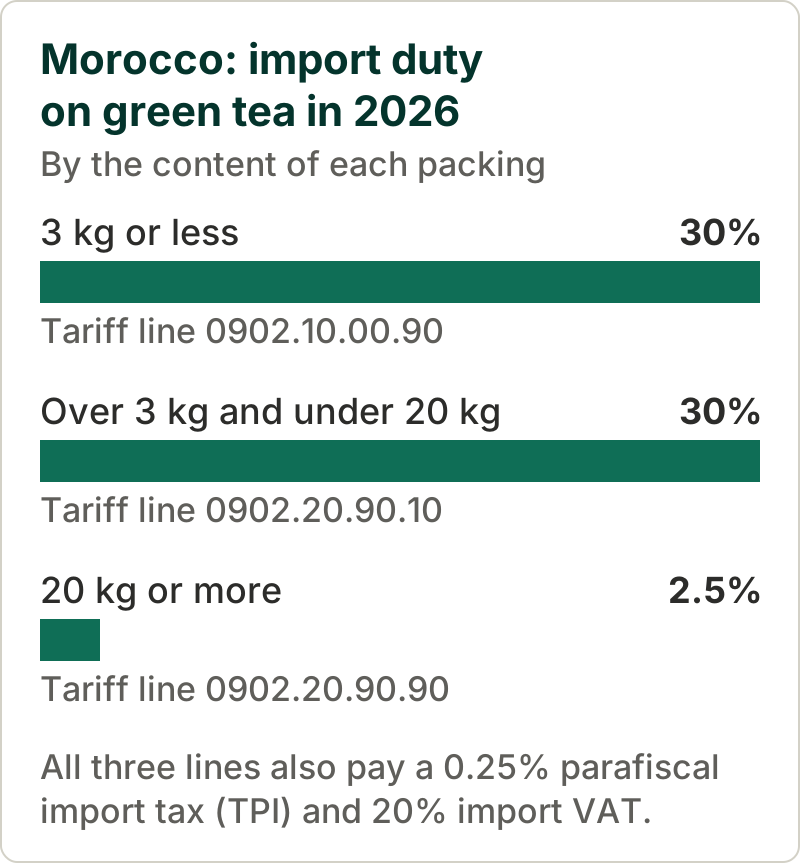 Sources: Moroccan Customs, circular 6619/210 (2024) and ADIL tariff database (September 2026)
This structure dates from the 2024 finance law, in force since 1 January 2024 (customs circular 6522/210). From 2015, green tea had paid 32.5% in packings of up to 3 kg and 2.5% in anything larger (customs circular 5480/210). The 2024 law cut the small-packing rate to 30% and raised the rate for packings over 3 kg and under 20 kg from 2.5% to 30%, so the 2.5% rate now starts at 20 kg.
The 2025 finance law then created separate lines at 200% for tea containing cannabis components (THC or CBD). Ordinary green tea moved to the “other” sub-lines shown above at unchanged rates – which is why the 10-digit codes differ from those used in 2024. For black tea the threshold is still 3 kg: 32.5% up to 3 kg, 2.5% above.
The tariff refers to the “content” of the packing. We advise asking your customs broker how customs assess that weight before you fix the packing size. How other tariffs read the 3 kg line of the Harmonized System is explained in our guide to HS codes for tea.
VAT and other import taxes
In ADIL, the customs tariff database (checked in September 2026), the three green tea lines carry two charges in addition to the import duty:
- the parafiscal import tax (TPI) of 0.25%;
- import VAT of 20%. The 2015 finance law moved tea, loose or packed, from the reduced 14% import VAT rate to 20%.
How tea imports are taxed in West Africa is explained in our guide to West African import duties. For Côte d’Ivoire, see Côte d’Ivoire’s tea imports from China and its import rules. For Algeria, where the latest tariff data (UNCTAD, 2023) show 30% on green tea whatever the packing, see importing green tea into Algeria.
ONSSA: authorisation and import checks
Food safety for tea falls under ONSSA (Office national de sécurité sanitaire des produits alimentaires). Under Decree 2-10-473, the implementing decree of Food Safety Law 28-07, ONSSA issues the sanitary authorisations for tea businesses, except retail outlets and catering, which municipal hygiene services authorise. For an importer this means three things.
A sanitary authorisation. Any establishment that produces, packs, stores, transports or distributes tea must be authorised (Decree 2-13-711, Article 7). Tea is not on the list of activities that require an “agrément” (approval), so the permit it needs is an authorisation. The file goes to the local ONSSA office and has an administrative part (company statutes, commercial register certificate, building permit for the premises) and a technical part (plans, a technical sheet listing packaging materials, a procedures manual based on good hygiene practice guides). Once the application and file are found compliant, ONSSA inspects the site within 45 days. The authorisation number must then appear on the company’s documents and packaging.
Checks before import. Before importing, the importer must make sure the tea comes from an establishment running a HACCP or equivalent self-monitoring system and travels with the certificates required, issued by the competent authority of the exporting country. It must also have a product recall plan (Decree 2-10-473, Article 48).
Import control. ONSSA checks the documents, carries out identity and physical checks on the goods and may take samples for laboratory analysis.
What Decree 2-13-711 requires
Decree 2-13-711 of 4 March 2015 (Official Bulletin No. 6348 of 2 April 2015) sets the quality and safety conditions for tea marketed in Morocco.
- Definitions. Green tea is made exclusively from the tender leaves, tips of young stems, buds or shoots of Camellia sinensis, suitably prepared and dried without losing their useful components. “Fake tea” means an assembly of debris, broken pieces or particles of tea or of any other product evoking the look or taste of tea.
- Quality. Tea must be clean, free of foreign matter, have the appearance, colour and taste of tea, and must not be exhausted; contaminants and pesticide residues must comply with the regulations in force.
- Packing and labelling. Tea must be packed in closed, clean and dry containers and labelled under Decree 2-12-389: information must be in Arabic (other languages may be added), and the mandatory mentions on prepacked tea include the name and address of the operator and, for imported products, of the importer, the country of origin, the lot and the sanitary authorisation number. If the country of origin differs from the place of provenance, the label must say so; a blend that names one origin must name the others with their proportions.
- Prohibited practices. Article 9 treats as unlawful the sale of bulk tea, tablets made from tea screening residues, adding fake tea, and colouring green tea or polishing it with gypsum or talc.
Order 3231-15 of 2 October 2015 sets the chemical characteristics green tea must meet:
| Parameter | Requirement |
|---|---|
| Aqueous extract | at least 32% |
| Total ash | 4% to 8% |
| Water-soluble ash | at least 45% of total ash |
| Alkalinity of water-soluble ash (as KOH) | 1.0% to 3.0% |
| Acid-insoluble ash | at most 1.0% |
| Crude fibre | at most 16.5% |
| Total catechins | at least 7% |
| Total polyphenols | at least 11% |
| Ratio of catechins to polyphenols | at least 0.5 |
For pesticides, maximum residue limits have applied to imported tea since 1 October 2019, according to the WTO’s 2024 Trade Policy Review of Morocco. In its 2019 notification to the WTO, Morocco stated that a limit of 0.01 mg/kg, or the limit of quantification, applies to active substances not authorised for use on tea plants. The EU applies the same 0.01 mg/kg default to pesticides that have no specific limit for tea, as our guide to EU pesticide limits for tea explains.
Our guides to chunmee grades and gunpowder grades explain how each grade is defined.
Paying a Chinese supplier: Office des Changes rules
A commercial import needs an import title (titre d’importation) registered on the PortNet system and lodged with a bank, which checks that it matches the contract and that the payment terms comply with exchange-control rules. The 2026 General Instruction on Foreign Exchange Operations (IGOC) then sets these general rules:
- as a rule, the bank pays the supplier after customs have recorded the goods against the import title;
- payment can be made earlier through a documentary credit (letter of credit) or a documentary collection against the original bill of lading or another transport document;
- an advance provided for in the contract may be paid, up to 30% of the total import value, but not if the contract also requires the balance to be paid before the goods arrive, unless that balance goes through a documentary credit or collection;
- 100% prepayment of the invoice is allowed up to the foreign-currency equivalent of MAD 200,000.
Articles 52 to 54 of the IGOC cover these payments made before customs record the goods. Other limits apply to some operators, such as exporters paying from their foreign-currency accounts, operators categorised by the Office des Changes and aerospace companies. A “30% with the order, balance by documentary collection” structure fits the general rules.
Documents to prepare
For the sanitary check at import, ONSSA asks for:
- a copy of the single goods declaration (DUM) or of the DO;
- copies of the commercial invoice, packing list and transport document (bill of lading, air waybill, CMR);
- health certificates or equivalent documents issued by the competent authority of the exporting country;
- documents identifying the authorised premises where the tea will be stored;
- any other document the regulations require for the product.
Bulk or packed: what the duty gap means for buyers
The gap between 2.5% and 30% is 27.5 percentage points. On a customs value of MAD 100,000, duty is MAD 2,500 in packings of 20 kg or more but MAD 30,000 in 10 kg cartons or retail boxes, before TPI and VAT. How that customs value is built from an FOB or CIF price is worked through in our guide to tea Incoterms and landed cost.
Almost all imports already arrive in packings over 3 kg. In 2025, packings of 3 kg or less accounted for 403 tonnes, under 0.5% of the 92,765 tonnes of green tea imported (UN Comtrade); the international data do not separate 3–20 kg packings from those of 20 kg or more.
For buyers, we suggest:
- order in packings of at least 20 kg and state it in the contract, invoice and packing list;
- pack in an ONSSA-authorised establishment, your own or a contract packer’s – the decree bans the sale of bulk tea and requires closed containers;
- design the Moroccan label (Arabic text, operator and importer, origin, lot, authorisation number) together with the pouches and boxes, and list the packaging materials in the sanitary authorisation file.
This article is general information, current at 30 September 2026, and not legal advice: check each point with your customs broker (transitaire) before shipping.
Questions and answers
What is the import duty on green tea in Morocco?
In 2026, green tea in packings with a content of 20 kg or more (tariff line 0902.20.90.90) pays 2.5% import duty. Packings over 3 kg and under 20 kg (0902.20.90.10) and packings of 3 kg or less (0902.10.00.90) pay 30%, and all three also pay a 0.25% parafiscal import tax and 20% import VAT.
Does a 25 kg carton of green tea qualify for the 2.5% rate?
Only if the carton's content is 20 kg or more: the 2.5% line (0902.20.90.90) covers packings with a content of 20 kg or more, while packings over 3 kg and under 20 kg pay 30%. Confirm with your customs broker how customs assess the content before fixing the packing size.
Do I need ONSSA approval to import tea into Morocco?
Establishments that pack, store, transport or distribute tea must hold a sanitary authorisation (Decree 2-13-711, Article 7), which ONSSA issues except for retail and catering; tea is not among the activities that require an agrément (approval). At import, ONSSA checks the documents and the goods and may take samples for laboratory analysis.
How much green tea does Morocco import from China?
Morocco reported 92,511 tonnes of green tea imported from China in 2025, out of 92,765 tonnes of green tea in total (UN Comtrade). China's Ministry of Commerce recorded 91,393 tonnes of tea shipped to Morocco in the same year.
Can a Moroccan importer pay a Chinese supplier in advance?
Within limits set by the Office des Changes for 2026. As a general rule, the bank may pay an advance of up to 30% of the import value, or 100% of the invoice up to the equivalent of MAD 200,000. Otherwise it pays once customs have recorded the goods, or earlier through a documentary credit or documentary collection.
Sources
- 1. Moroccan Customs – Circular 5480/210 of 30 December 2014 on the 2015 finance law (in French) · douane.gov.ma
- 2. Moroccan Customs – Circular 6522/210 of 29 December 2023 on the 2024 finance law (in French) · douane.gov.ma
- 3. Moroccan Customs – Circular 6619/210 of 26 December 2024 on the 2025 finance law (in French) · douane.gov.ma
- 4. Moroccan Customs – Circular 6702/210 of 26 December 2025 on the 2026 finance law (in French) · douane.gov.ma
- 5. Moroccan Customs – ADIL tariff database (checked September 2026) · douane.gov.ma
- 6. WTO – Trade Policy Review of Morocco, Secretariat report WT/TPR/S/453 (March 2024) · wto.org
- 7. WTO – SPS notification G/SPS/N/MAR/62/Add.1 of 2 July 2019 on pesticide MRLs for tea imported into Morocco · docs.wto.org
- 8. ONSSA – Decree 2-13-711 of 4 March 2015 on the quality and safety of marketed tea (English translation) · onssa.gov.ma
- 9. ONSSA – Order 3231-15 of 2 October 2015 fixing the chemical characteristics of tea (English translation) · onssa.gov.ma
- 10. ONSSA – regulations for products of plant origin: coffee, tea and chicory · onssa.gov.ma
- 11. ONSSA – Decree 2-10-473 of 6 September 2011 implementing Law 28-07 on food safety (in French) · onssa.gov.ma
- 12. ONSSA – Decree 2-12-389 of 22 April 2013 on the labelling of food products (in French) · onssa.gov.ma
- 13. ONSSA – sanitary authorisation file for plant products (in French) · onssa.gov.ma
- 14. ONSSA – import control procedure for plant products and products of plant origin · onssa.gov.ma
- 15. Office des Changes – General Instruction on Foreign Exchange Operations 2026 (IGOC, in French) · oc.gov.ma
- 16. Office des Changes – Morocco's foreign trade in 2024, annual report (in French) · oc.gov.ma
- 17. MOFCOM – China tea export monthly report, December 2022 (in Chinese) · wms.mofcom.gov.cn
- 18. MOFCOM – China tea export monthly report, December 2023 (in Chinese) · wms.mofcom.gov.cn
- 19. MOFCOM – China tea export monthly report, December 2024 (in Chinese) · wms.mofcom.gov.cn
- 20. MOFCOM – China tea export monthly report, December 2025 (in Chinese) · wms.mofcom.gov.cn
- 21. MOFCOM – China tea export monthly report, April 2026 (in Chinese) · wms.mofcom.gov.cn
- 22. MOFCOM – index of monthly tea export reports (in Chinese) · wms.mofcom.gov.cn
- 23. UN Comtrade via WITS – Morocco tea imports (HS 0902) by origin, 2025 · wits.worldbank.org
- 24. UN Comtrade via WITS – Morocco imports of other green tea (HS 0902.20), 2025 · wits.worldbank.org
- 25. UN Comtrade via WITS – Morocco imports of green tea in immediate packings of 3 kg or less (HS 0902.10), 2025 · wits.worldbank.org