Tunisia tea imports: the OCT monopoly, VAT and volumes
Tunisia tea imports run through a state monopoly, the OCT: VAT suspended since 2024 and 9,220 t shipped by China, India and Sri Lanka in 2025.
Key facts
- The WTO's 2025 review of Tunisia's trade policies lists the Office du Commerce de la Tunisie (OCT), a state body created by Decree-Law 62-6 of 3 April 1962, as the state trading enterprise for imports of coffee, tea and sugar, and says these enterprises keep their import monopolies.
- Tunisia's 2025 finance law (Law 2024-48 of 9 December 2024, Article 35) suspends VAT on the import and sale of tea imported by the OCT and by persons authorised by the trade ministry; before the 2024 finance law, the OCT's tea paid VAT at 19%, according to the finance ministry.
- China, India and Sri Lanka declared 9,220 tonnes of tea exports to Tunisia in 2025, 39.3% more than in 2024, and China's 4,028 tonnes, 43.7% of the total, were mostly green tea in packings over 3 kg (The Tea Trade's calculation from UN Comtrade).
- Tunisia's own figures in UN Comtrade show 6,378 tonnes of tea imports in 2022, 57.9% of it black tea from India and Sri Lanka and 42.1% green tea, nearly all of it from China, but only 673 tonnes in 2023, a year for which its three suppliers declared 6,090 tonnes.
- The Office du Commerce de la Tunisie reports importing 2,976 tonnes of green tea from China and 2,603 tonnes of black tea from India and Sri Lanka in 2024, 5,579 tonnes in all, after 5,572 tonnes in 2023 (The Tea Trade's calculation from the OCT's website, checked October 2026).
Tunisia’s tea imports are a state monopoly held by the Office du Commerce de la Tunisie (OCT), according to the office itself and the WTO’s 2025 review of Tunisia’s trade policies; the finance ministry describes the OCT as the body in charge of importing the country’s sugar, rice, green coffee and tea. China, India and Sri Lanka declared 9,220 tonnes of tea exports to Tunisia in 2025, 43.7% of it from China, mostly green tea in packings over 3 kg (The Tea Trade’s calculation from UN Comtrade). Tunisia suspended VAT on tea imported by the OCT in its 2024 finance law and extended the suspension in 2025 to importers authorised by the trade ministry; before that, the OCT’s tea paid VAT at 19%, according to the finance ministry.
Who imports tea into Tunisia: the Office du Commerce de la Tunisie
The OCT (الديوان التونسي للتجارة in Arabic) was created by Decree-Law 62-6 of 3 April 1962, ratified by Law 62-14 of 24 May 1962, as the preamble of a 1994 decree on import and export controls recalls. It is one of the public enterprises supervised by the Ministry of Commerce and Export Development, according to the finance ministry’s report on public enterprises.
Its role in tea is spelt out in the finance ministry’s explanatory memorandum to the draft 2024 finance law: the OCT supplies the market with consumer goods whose prices fluctuate, such as sugar, rice, green coffee and tea, as the body in charge of importing them. The office describes itself as the sole operator for tea, a monopoly that it says lets the State regulate prices. The WTO’s 2025 review lists it among the state trading enterprises Tunisia has notified, for imports of coffee, tea and sugar, and says these enterprises keep their import monopolies. The 2025 finance law, however, names “persons authorised by the ministry in charge of trade” alongside the OCT (see the VAT section below). No list of authorised tea importers was found (checked October 2026).
Tunisia has kept a state importer for tea where Morocco has not: Morocco’s tea and sugar office (ONTS) held the import monopoly until 1993, according to a 2022 article in the journal China Tea Processing, as our guide to chunmee grades recalls.
Tunisia tea imports: volumes and origins
In 2022, the last year in which Tunisia’s own figures in UN Comtrade agree with its suppliers’ declarations, the country recorded 6,378 tonnes of tea imports worth US$13.0 million. Black tea made up 57.9% of the volume, from India (3,278 t) and Sri Lanka (415 t), and green tea 42.1%, nearly all of it from China. China also supplied all the green tea in bulk in 2020 and 89.4% of it in 2021, the rest coming almost entirely from India. All but 2.2 tonnes of the 2022 imports came in packings over 3 kg, under HS 0902.20 for green tea and 0902.40 for black tea; the codes are explained in our guide to tea HS codes.
Tunisia’s tea imports by origin, 2019–2022 (HS 0902; source: UN Comtrade, figures reported by Tunisia)
| Year | All origins (t) | India (t) | China (t) | Sri Lanka (t) | China’s share of volume | Value, all origins (US$ million, CIF) |
|---|---|---|---|---|---|---|
| 2019 | 8,074.5 | 4,647.8 | 2,718.7 | 601.8 | 33.7% | 12.77 |
| 2020 | 7,446.0 | 3,566.6 | 3,162.8 | 712.8 | 42.5% | 13.08 |
| 2021 | 7,726.8 | 4,914.2 | 2,355.0 | 455.3 | 30.5% | 13.79 |
| 2022 | 6,377.9 | 3,278.5 | 2,682.4 | 414.8 | 42.1% | 12.98 |
All origins include small amounts from other countries. China’s shares are The Tea Trade’s calculation. India and Sri Lanka supplied most of the volume in each of the four years.
Chinese tea is the low-value part of the mix. China declared its 2025 tea for Tunisia at an average of US$1.32 per kg, and its green tea in packings over 3 kg, 94.8% of the volume (99.4% in 2024), at US$1.30 per kg, against US$3.69 per kg for all its tea exports (The Tea Trade’s calculation from UN Comtrade). These unit values are customs values divided by weight, not prices: they mix grades. For China, Tunisia (突尼斯 in Chinese sources) is a small market: its 4,028 tonnes in 2025 were 0.96% of China’s tea export volume, against 15,298 tonnes for Algeria and 9,862 tonnes for Libya, as shown in our guide to China’s 2025 tea exports.
The OCT reports selling 2,809 t of green tea and 4,324 t of black tea in 2022, and 2,457 t and 3,306 t in 2024: 7,133 and 5,763 tonnes in all (The Tea Trade’s calculation from the OCT’s website, checked October 2026).
What Tunisia’s suppliers declared, 2022–2025
Tunisia’s own figures in UN Comtrade stop telling the whole story after 2022, so the export declarations of its three suppliers, and the OCT’s own import figures, are the better guide to recent years.
Tea for Tunisia: Tunisia’s records and its suppliers’ declarations, 2022–2025 (HS 0902, tonnes; source: UN Comtrade)
| Year | Recorded by Tunisia, all origins | Declared by China | Declared by India | Declared by Sri Lanka | Three suppliers’ total |
|---|---|---|---|---|---|
| 2022 | 6,377.9 | 2,944.6 | 2,609.1 | 706.3 | 6,260.1 |
| 2023 | 673.2 | 2,304.1 | 3,073.0 | 712.8 | 6,089.9 |
| 2024 | values only | 3,263.4 | 2,920.0 | 433.9 | 6,617.3 |
| 2025 | not yet reported | 4,028.1 | 2,741.0 | 2,450.9 | 9,219.9 |
Totals are The Tea Trade’s calculation. For 2024, the weights UN Comtrade shows for Tunisia are flagged as its own estimates, and Tunisia gave none for its green tea from China, so they are not used here.
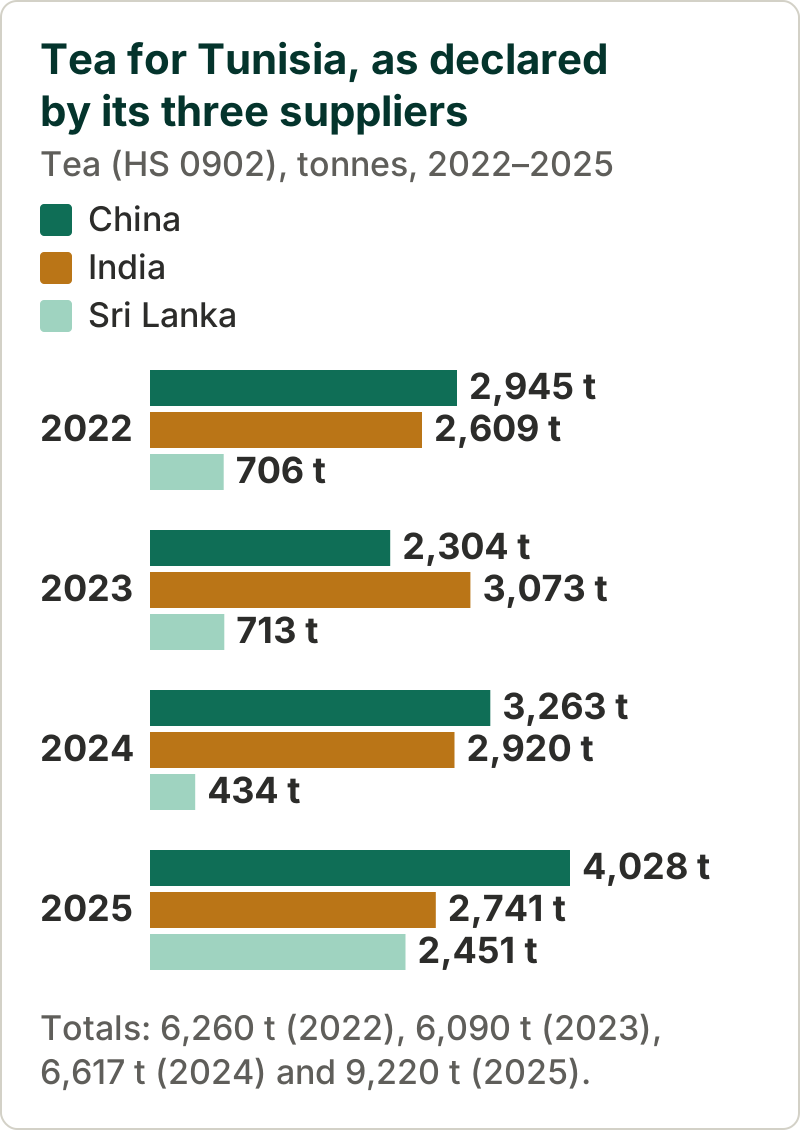 Source: UN Comtrade, exports reported by China, India and Sri Lanka (2022–2025)
The two series agree for 2022, when Tunisia recorded 1.9% more tea than its three suppliers declared. In 2023 they part company: Tunisia recorded 673 tonnes, 99.3% of it green tea from China and almost no black tea (2.6 tonnes, in small packs), while China, India and Sri Lanka declared 6,090 tonnes for Tunisia. For 2024, Tunisia reported values but no weights of its own: US$21.4 million of tea imports, including US$14.7 million of black tea from India and Sri Lanka and US$6.68 million of green tea from China. That is more than twice the US$10.1 million its three suppliers declared, whereas in 2022 its figure was 11.9% above theirs (The Tea Trade’s calculation). Tunisia had reported no figures for 2025 when this guide was checked (October 2026).
The OCT’s own figures fill part of the gap. It reports importing 1,925 tonnes of green tea from China and 3,647 tonnes of black tea from India and Sri Lanka in 2023, and 2,976 and 2,603 tonnes in 2024: 8.5% and 15.7% less than its three suppliers declared for those years (The Tea Trade’s calculation). Its figure for black tea in 2022, 3,693 tonnes, matches the one Tunisia reported to UN Comtrade.
In 2025 the three suppliers’ declarations rose 39.3%, to 9,220 tonnes: China’s by 23.4% and Sri Lanka’s more than fivefold, from 434 to 2,451 tonnes. The statistics do not show whether the OCT or authorised importers bought the extra tea.
Why the two sets of figures differ
The United Nations recommendations for trade statistics (IMTS 2010) explain the usual gaps. Exporters value goods free on board (FOB) and importers at cost, insurance and freight (CIF), and importers record the country of origin while exporters record the last known destination: Ceylon tea bought through a third country, for instance, would count as Sri Lankan in Tunisia’s figures but not in Sri Lanka’s. None of this explains a year in which almost no black tea was recorded: the OCT reports importing 3,647 tonnes of it in 2023.
One fact may be relevant. The 2026 finance law (Article 41) authorises the finance minister to waive the customs duties, other taxes, late-payment interest and fines owed by the OCT because simplified customs declarations lodged for its imports before 1 January 2025 were never regularised. Whether goods cleared that way are missing from the trade statistics is not stated: this is a possibility, not a measured fact.
How the OCT buys and distributes tea
The OCT imports tea in bulk and has it packed in Tunisia: it reports packing 7,249 tonnes of tea in 2022, and several of its tender notices for 2025 and 2026 seek contractors to pack tea and suppliers of bagging materials (checked October 2026).
No source found says how the OCT chooses its tea suppliers. Its website says that its tenders are open only to suppliers approved in advance by its internal procurement control committee who have accepted and signed the specifications for the purchase. The tea tenders it publishes concern packing, not purchase: no notice for buying tea was found (checked October 2026).
The office’s finances matter to its suppliers. In its memorandum to the draft 2024 finance law, the finance ministry wrote that higher world prices for tea and coffee had hurt the OCT’s finances, leaving it struggling to meet its financial commitments to foreign and local suppliers. Its report on public enterprises adds that these difficulties hampered the opening of letters of credit and brought late penalties for ships kept waiting. Our guide to tea export payment terms compares the options.
Tea prices in Tunisia: regulated, but not subsidised
Tea is on the list of products whose prices the State regulates at every stage, from production to distribution (Decree 91-1996, as amended), according to the WTO’s 2025 review. The finance ministry presented the VAT relief on tea and coffee as a way of controlling prices and preserving purchasing power.
Tea is not, however, among the basic products the State budget subsidises. The 2024 budget report sets that subsidy at 3,591 million dinars for 2024, against an updated 3,805 million in 2023, shared among cereals, vegetable oil, milk, pasta and couscous, sugar and school paper; tea is not on the list. The gap between what the OCT pays abroad and what it may charge at home therefore falls on the office. The finance ministry’s report on public enterprises lists among the causes of its difficulties the large gap between the purchase price of imported goods and their selling price on the domestic market, the dinar’s swings against the dollar and the euro, and unstable world prices for sugar, coffee, tea and rice since early 2020. The OCT’s net result went from a profit of 8.4 million dinars in 2020 to losses of 120.2 million dinars in 2021 and 413.3 million dinars in 2022 (provisional).
VAT and customs duty on tea in Tunisia
Tax rules on tea imported into Tunisia, 2023–2026 (sources: finance laws and finance ministry; checked October 2026)
| Period | Rule | Legal text |
|---|---|---|
| Until 2023 | VAT at 19% on tea and coffee imported by the OCT, while its sugar and rice already had VAT suspended | Tax law then in force, as described by the finance ministry (draft 2024 finance law) |
| 2024 | VAT suspended on the import of coffee (09.01) and tea (09.02) by the OCT, by adding them to Annex 4 of the 2016 finance law | 2024 finance law (Law 2023-13 of 11 December 2023), Article 21 |
| From 2025 | Article 21 repealed; VAT suspended on the import and sale of coffee and tea imported by the OCT and by persons authorised by the trade ministry | 2025 finance law (Law 2024-48 of 9 December 2024), Article 35 |
| 2026 | The finance minister may waive the duties, other taxes, interest and fines the OCT owes on simplified customs declarations for imports before 1 January 2025 | 2026 finance law (Law 2025-17 of 12 December 2025), Article 41 |
In the tariff data Tunisia reported to UNCTAD’s TRAINS database, which stop at 2016, customs duty depended on the packing: tea in immediate packings of 3 kg or less paid 36% from 2009 to 2016, while the rate on tea in larger packings varied before falling to 7% in 2015 and 0% in 2016.
Applied duty on tea in Tunisia, by year of tariff data, 2009–2016 (source: UNCTAD TRAINS via WITS)
| Years with data | Green tea, packs of 3 kg or less (0902.10) | Other green tea (0902.20) | Black tea, packs of 3 kg or less (0902.30) | Other black tea (0902.40) |
|---|---|---|---|---|
| 2009, 2011, 2012, 2014 | 36% | 36% | 36% | 36% |
| 2010, 2013 | 36% | 15% | 36% | 15% |
| 2015 | 36% | 7% | 36% | 7% |
| 2016 | 36% | 0% | 36% | 0% |
The tariff has been reworked since. The WTO’s 2025 review counts 11 duty rates in 2025, from 0% to 50%, against six in 2016, and gives the 33 tariff lines for coffee, tea and mate an average of 27.1%, with rates from 0% to 50% and 18.2% of the lines duty-free; it does not give the rate for each tea line, and TRAINS has no year after 2016 (checked October 2026). Confirm the current rate with a Tunisian customs broker. Chinese goods pay Tunisia’s ordinary rates, while free trade partners such as Morocco, Egypt, Turkey and Libya get preferential rates, according to MOFCOM’s 2025 country guide.
What this means for tea exporters
- The buyer. Expect to sell to the OCT, whose tenders are open only to suppliers it has approved in advance. Since 2025 the finance law also names importers authorised by the trade ministry, so ask a private buyer for its authorisation before shipping.
- The product. Chinese tea for Tunisia is mostly green tea in packings over 3 kg, at low unit values (US$1.30 per kg in 2025); black tea comes mainly from India and Sri Lanka.
- The data. For 2023 and 2024, use the OCT’s import figures and the suppliers’ declarations: Tunisia’s own figures in UN Comtrade are incomplete, and none had been reported for 2025 in October 2026.
- Taxes. VAT is suspended on tea imported by the OCT and by authorised importers. The duty rates reported for 2016 (0% on tea in bulk, 36% in small packs) predate a tariff overhaul, so confirm the current rate.
- Payment and documents. The finance ministry’s draft 2024 finance law reported that the OCT struggled to pay its suppliers, so agree secure terms; the documents for a shipment are listed in our guide to Chinese tea export documents.
This is general information, not legal or tax advice: have a customs broker in Tunisia confirm the procedure, documents and rates before each shipment.
Questions and answers
Who imports tea into Tunisia?
A state body, the Office du Commerce de la Tunisie (OCT), which holds the import monopoly for tea according to its own website and the WTO's 2025 review of Tunisia's trade policies. The 2025 finance law also names persons authorised by the trade ministry alongside it for the VAT suspension on tea.
Is there VAT on tea in Tunisia?
Not on tea imported by the OCT or by importers the trade ministry authorises: the 2025 finance law (Article 35) suspends VAT on its import and sale. The finance ministry says the OCT's tea paid VAT at 19% before the 2024 finance law.
What is the import duty on tea in Tunisia?
Tunisia's last tariff data in UNCTAD's TRAINS database, for 2016, put tea in packings over 3 kg at 0% and tea in packs of 3 kg or less at 36%. The tariff has been reworked since: the WTO's 2025 review gives the coffee, tea and mate lines rates from 0% to 50% without listing each tea line, so check the current rate with a Tunisian customs broker.
How much tea does Tunisia import?
China, India and Sri Lanka declared 9,220 tonnes of tea exports to Tunisia in 2025 (UN Comtrade). The OCT, the state importer, reports importing 2,976 tonnes of green tea and 2,603 tonnes of black tea in 2024, 5,579 tonnes in all (The Tea Trade's calculation).
Where does Tunisia's tea come from?
Black tea comes mainly from India and Sri Lanka, green tea mainly from China. In 2022 Tunisia recorded 3,693 tonnes of black tea in bulk from India and Sri Lanka and 2,682 tonnes of green tea in bulk, all of it from China (UN Comtrade).
Is tea subsidised in Tunisia?
No. Tea is not among the basic products subsidised in the 2024 State budget or by the General Compensation Fund, but its price is regulated at every stage, from production to distribution, according to the WTO's 2025 review. The finance ministry counts the gap between import costs and domestic selling prices among the causes of the OCT's losses.
Sources
- 1. Tunisia, Ministry of Finance: Finance Law for 2025, Law 2024-48 of 9 December 2024, Article 35 (Official Gazette No. 149, 10 December 2024, in Arabic) · finances.gov.tn
- 2. Tunisia, Ministry of Finance: Finance Law for 2024, Law 2023-13 of 11 December 2023, Article 21 (Official Gazette No. 144, 12 December 2023, in Arabic) · finances.gov.tn
- 3. Tunisia, Ministry of Finance: draft Finance Law for 2024 and explanatory memorandum (2023, in Arabic) · finances.gov.tn
- 4. Tunisia, Ministry of Finance: Finance Law for 2026, Law 2025-17 of 12 December 2025, Article 41 (Official Gazette No. 148, 12 December 2025, in Arabic) · finances.gov.tn
- 5. Tunisia, Ministry of Finance: report on the draft State budget for 2024 (October 2023, in Arabic) · finances.gov.tn
- 6. Tunisia, Ministry of Finance: report on public enterprises, annexed to the draft Finance Law for 2024 (in Arabic) · finances.gov.tn
- 7. Tunisia: Decree 94-1744 of 29 August 1994 on technical controls at import and export (Official Gazette, via FAOLEX, in French) · faolex.fao.org
- 8. Office du Commerce de la Tunisie: tea page, with import and sales tables for 2020–2024 (checked October 2026, in French) · oct.gov.tn
- 9. Office du Commerce de la Tunisie: tender notices (checked October 2026, in French) · oct.gov.tn
- 10. Office du Commerce de la Tunisie: becoming a supplier (in French) · oct.gov.tn
- 11. Office du Commerce de la Tunisie: packing activity, 2021–2022 (in French) · oct.gov.tn
- 12. WTO Secretariat: Trade Policy Review, Tunisia, report WT/TPR/S/479, 30 September 2025 · wto.org
- 13. MOFCOM, Chinese Academy of International Trade and Economic Cooperation and Chinese Embassy in Tunisia: country guide for outbound investment and cooperation, Tunisia, 2025 edition (in Chinese) · mofcom.gov.cn
- 14. UN Comtrade: tea exports (HS 0902) to Tunisia declared by China, India and Sri Lanka, 2022 · comtradeapi.un.org
- 15. UN Comtrade: tea exports (HS 0902) to Tunisia declared by China, India and Sri Lanka, 2023 · comtradeapi.un.org
- 16. UN Comtrade: tea exports (HS 0902) to Tunisia declared by China, India and Sri Lanka, 2024 · comtradeapi.un.org
- 17. UN Comtrade: tea exports (HS 0902) to Tunisia declared by China, India and Sri Lanka, 2025 · comtradeapi.un.org
- 18. UN Comtrade: China's tea exports to Tunisia by HS subheading (0902.10 to 0902.40), 2025 · comtradeapi.un.org
- 19. UN Comtrade via WITS: China's tea exports (HS 0902) by partner, 2025 · wits.worldbank.org
- 20. UN Comtrade via WITS: China's exports of other green tea (HS 0902.20) by partner, 2024 · wits.worldbank.org
- 21. UN Comtrade: Tunisia's tea imports by HS subheading, world and main partners, 2019 · comtradeapi.un.org
- 22. UN Comtrade: Tunisia's tea imports by HS subheading, world and main partners, 2020 · comtradeapi.un.org
- 23. UN Comtrade: Tunisia's tea imports by HS subheading, world and main partners, 2021 · comtradeapi.un.org
- 24. UN Comtrade: Tunisia's tea imports by HS subheading, world and main partners, 2022 · comtradeapi.un.org
- 25. UN Comtrade: Tunisia's tea imports by HS subheading, world and main partners, 2023 · comtradeapi.un.org
- 26. UN Comtrade: Tunisia's tea imports by HS subheading, world and main partners, 2024, with estimate flags · comtradeapi.un.org
- 27. UNCTAD TRAINS via WITS: applied MFN duty reported by Tunisia on green tea in packs of 3 kg or less (HS 0902.10), all years · wits.worldbank.org
- 28. UNCTAD TRAINS via WITS: applied MFN duty reported by Tunisia on other green tea (HS 0902.20), all years · wits.worldbank.org
- 29. UNCTAD TRAINS via WITS: applied MFN duty reported by Tunisia on black tea in packs of 3 kg or less (HS 0902.30), all years · wits.worldbank.org
- 30. UNCTAD TRAINS via WITS: applied MFN duty reported by Tunisia on other black tea (HS 0902.40), all years · wits.worldbank.org
- 31. United Nations Statistics Division: International Merchandise Trade Statistics, Concepts and Definitions 2010 (2011) · unstats.un.org
- 32. Liu Xiangji, Technical key points of quality control of high-grade gunpowder tea for export, China Tea Processing, 2022, issue 4, pp. 18–23 (in Chinese) · sciopen.com