Chinese tea export documents: origin, phyto, health
Chinese tea export documents: invoice, packing list, bill of lading, export declaration, certificate of origin and, if required, a phytosanitary certificate.

Key facts
- Under the State Council reform plan approved by China's National People's Congress on 17 March 2018, the entry-exit inspection and quarantine duties of the former AQSIQ moved to the General Administration of Customs (GACC, 海关总署), which now inspects export tea and issues its certificates.
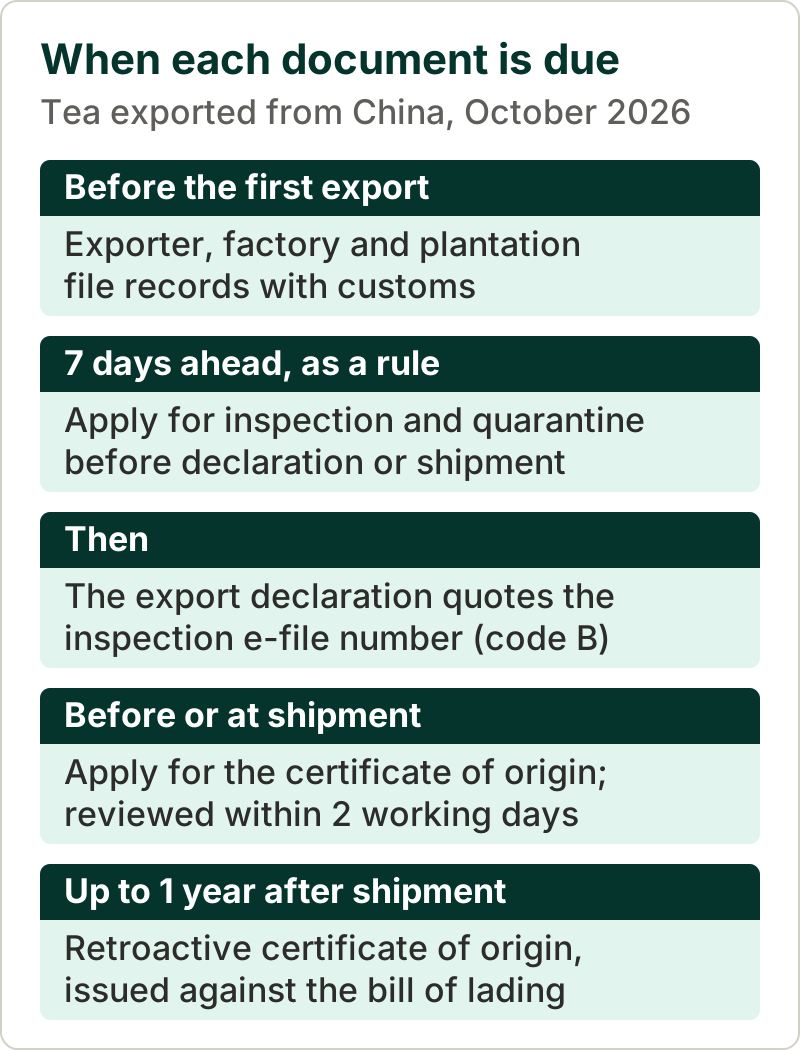
- Under GACC Announcement 2025 No. 138, in force since 7 July 2025, exporters apply for export inspection and quarantine at the customs office of the place of production or consolidation, as a general rule 7 days before declaration or shipment.
- Under GACC Order No. 270, in force since 1 September 2024, China's customs and the China Council for the Promotion of International Trade (CCPIT) issue certificates of origin, applied for before or at shipment or retroactively up to 1 year after it.
- Morocco, the first market for Chinese tea by value in 2025 according to MOFCOM, has no free trade agreement with China: none of the signed agreements on MOFCOM's list, checked in October 2026, covers it, so a certificate of origin for tea shipped there is non-preferential.
- Plantations that grow tea for export must be record-filed with China's customs: tea has been on the catalogue of export food raw materials under filing since AQSIQ Announcement 2012 No. 149 of 8 October 2012, and GACC Order No. 249 keeps the duty.
The export documents for a shipment of Chinese tea are usually a sales contract, a commercial invoice, a packing list, a bill of lading, the export declaration and a certificate of origin from customs or the China Council for the Promotion of International Trade (CCPIT). When the importing country requires it, customs also inspect the tea and issue a phytosanitary or health certificate. Those certificates have come from the General Administration of Customs (GACC, 海关总署) since 2018, when the State Council reform plan approved on 17 March gave it the entry-exit inspection and quarantine duties of the former AQSIQ. Morocco, the first market for Chinese tea by value in 2025 (MOFCOM), has no free trade agreement with China, so a certificate of origin for tea shipped there is non-preferential.
AQSIQ is gone: GACC has issued tea export certificates since 2018
On 17 March 2018 the first session of the 13th National People’s Congress approved the State Council’s institutional reform plan. It moved the entry-exit inspection and quarantine duties and staff of the General Administration of Quality Supervision, Inspection and Quarantine (AQSIQ, 国家质量监督检验检疫总局) to GACC and did not retain AQSIQ, whose other duties went to the new State Administration for Market Regulation. GACC’s mandate of 10 September 2018 includes animal and plant quarantine, statutory inspection, export food work under international agreements and certificates of origin.
Traders felt the change within weeks:
- 20 April 2018: a company record-filed with customs obtained its customs declaration and inspection declaration rights together, and so did a registered customs broker (GACC Announcement 2018 No. 28).
- 1 June 2018: the clearance forms (通关单) of the old inspection bureaux were abolished. An export subject to statutory inspection and quarantine is now declared with the electronic file number (电子底账数据号) from the inspection receipt, under code “B” (GACC Announcement 2018 No. 50).
A guide that still sends you to AQSIQ or to a “CIQ” bureau describes the system before 2018. Today the inspection, the certificates and the declaration all go through customs offices (海关).
Tea export documents: the checklist
Documents a tea shipment from China usually needs (Chinese laws and GACC rules, CCPIT, IPPC; checked October 2026)
| Document | Issued by | When it is required | Notes |
|---|---|---|---|
| Sales contract (贸易合同) | Seller and buyer | Every shipment | Filed with the inspection application; its quarantine terms are one basis of the export check |
| Commercial invoice (发票) | Seller | Every shipment | Filed with the inspection application; Morocco’s food safety office (ONSSA) asks for a copy at import |
| Packing list (装箱单) | Seller | Every shipment | ONSSA also asks for a copy |
| Bill of lading (提单) or sea waybill | Carrier or its agent | Every sea shipment | In Morocco, payment by documentary credit or collection before customs record the goods is made against the original bill of lading |
| Export declaration (报关单) | Exporter or customs broker | Every shipment | 13-digit code; inspection e-file number under code B where inspection applies |
| Certificate of origin, non-preferential (非优惠原产地证书) | Customs or CCPIT | When the buyer, its bank or the importing country asks | Apply before or at shipment; no fee at customs |
| Certificate of origin, preferential | Customs or CCPIT | Only where a trade agreement or preference scheme cuts the importing country’s duty | No Chinese agreement covers Morocco or West Africa |
| Phytosanitary certificate (植物检疫证书) | Customs | When the importing country requires one | Issued after export quarantine |
| Health certificate (卫生证书) or inspection certificate (检验证书) | Customs | When the importing country or the contract requires one | Can follow the importing country’s requirements, with GACC’s consent |
| Insurance certificate | Insurer | When the seller insures the cargo | Among the documents French customs listed for Senegal in January 2020 |
| Importing-country documents | Bodies in the importing country | Depends on the destination | Senegal, for example: cargo tracking note (BSC), as listed in January 2020 |
The official documents rest on the commercial ones: customs want the contract and the invoice with the inspection application (GACC Announcement 2025 No. 138), and the contract’s quarantine terms are one basis of the export check (Implementing Regulations of the Animal and Plant Quarantine Law, Articles 31 and 34). Keep names, weights, marks and lot numbers identical on every document.
The export declaration (报关单) is lodged by the exporter or by a customs broker. It uses a 13-digit code, the 10-digit HS code plus a 3-digit inspection (CIQ) code, and the declaration elements for tea include the product name, the processing (unfermented, semi-fermented or fermented), the net weight of each inner pack and the brand, Yixing Customs explained in 2023. Our guide to tea HS codes covers classification, and the guide to Incoterms and landed cost explains who books freight and insurance.
 Sources: GACC Orders No. 249 (2021), No. 253 and No. 270 (2024), GACC Announcements 2018 No. 50 and 2025 No. 138
Certificate of origin for Chinese tea: non-preferential or FTA
China’s Regulations on the Origin of Import and Export Goods (2004, revised in 2019) let an exporter apply to customs or to the CCPIT (中国国际贸易促进委员会) and its local branches for a certificate of origin. GACC Order No. 270, in force since 1 September 2024, governs three kinds: non-preferential certificates, for most-favoured-nation treatment and other non-preferential measures; certificates under the Generalised System of Preferences (GSP); and regional preferential certificates, which claim the tariff cuts of a free trade agreement or preferential arrangement.
- When: apply before or at shipment. A certificate can be issued retroactively up to 1 year after shipment, with the bill of lading or other transport documents, and is then marked as such; returned goods and goods whose origin cannot be checked get none.
- How fast: the issuing body reviews an application within 2 working days. Customs charge no fee.
- Who: since 1 November 2023, exporters no longer record-file with customs before their first certificate (GACC Announcement 2023 No. 136).
A preferential certificate pays off only where an agreement or preference scheme cuts the importing country’s duty on your tariff line. In October 2026, MOFCOM’s China FTA Network counted 24 signed free trade agreements with 31 countries and regions, among them the Regional Comprehensive Economic Partnership (RCEP), the China–ASEAN free trade area and agreements with Pakistan, Georgia, Mauritius, Cambodia, Korea and Australia. RCEP first took effect on 1 January 2022, for China, Japan, Australia, New Zealand and six ASEAN members (CCPIT). Each agreement’s own rules on certificates prevail over Order No. 270. Of the 15 largest buyers of Chinese tea by volume in 2025, only Japan has an agreement with China, through RCEP: check Japan’s schedule for your tea line before paying for the certificate.
Morocco has no free trade agreement with China. None of the signed agreements on MOFCOM’s list covers it, and the free trade partners Morocco named to the WTO in 2024, from the European Union and the United States to the Agadir Agreement countries and the United Arab Emirates, do not include China. Chinese green tea therefore pays Morocco’s ordinary duty, 2.5% or 30% depending on the packing, as our Morocco import guide explains. China’s zero tariffs for 53 African countries, in force since 1 May 2026, apply to goods entering China, not to tea leaving it.
Phytosanitary certificate for tea (植物检疫证书)
Whether you need one is the importing country’s decision. Under the International Plant Protection Convention’s standard ISPM 32, commodities processed to the point where they can no longer be infested with quarantine pests should not require phytosanitary certification, and importing countries assign the category. Some list a certificate for plant products: Senegal’s import documents included a sanitary or phytosanitary certificate, depending on the goods’ animal or plant origin, according to a French customs factsheet of January 2020, and Morocco’s ONSSA asks for health certificates or equivalent documents issued by the competent authority of the exporting country.
How China issues it. The exporter applies to customs before the goods leave (Law on Entry and Exit Animal and Plant Quarantine, Article 20). Under GACC Announcement 2025 No. 138, in force since 7 July 2025, the application goes to the customs office of the place of production or consolidation, as a general rule 7 days before declaration or shipment, with the contract, the invoice and the producer’s own inspection certificate or test report. Plant products are inspected in the warehouse or yard and must be complete, intact, neatly stacked and clearly marked. The check applies the importing country’s and China’s quarantine rules, any bilateral quarantine agreement and the contract’s quarantine terms (Implementing Regulations, Articles 33 and 34); goods that pass are released on the certificate (Law, Article 21).
A new application is needed if the destination changes to one with different requirements, if the goods are repacked or consolidated, or if the inspection’s validity period runs out (Law, Article 22; Announcement 2025 No. 138).
ePhyto. The IPPC defines an ePhyto as “the electronic equivalent of a phytosanitary certificate in XML format”. Whether China and a given importing country exchange them could not be confirmed for this guide (checked October 2026): ask the buyer whether its authority accepts one or wants the paper original.
Health and inspection certificates for tea
Tea is food, so GACC Order No. 249 on import and export food safety, in force since 1 January 2022, applies. Export food must meet the importing country’s standards or the contract; where neither sets a requirement and no treaty does, it must meet China’s national food safety standards (Article 38). Customs check it through record-filing, document checks, on-site inspection and supervisory sampling, among other measures (Article 39).
Tea that passes receives a certificate and may be exported (Article 51). Depending on the destination’s requirements and the product, customs issue a phytosanitary certificate, a health certificate (卫生证书), an inspection certificate (检验证书) or another format, which GACC can agree to change when an importing country changes the form or content it wants. Tea that fails may be exported only if a technical treatment brings it into compliance.
Pre-shipment inspection in importing countries
Some importing countries add checks of their own. As described by French customs in January 2020, Senegal’s import verification programme (PVI) required a prior import declaration (DPI) for goods worth 1 million CFA francs FOB or more, and an inspection in the country of origin or shipment, confirmed by a verification certificate (AV), from 3 million CFA francs FOB; for sea freight, the same factsheet listed the electronic cargo tracking note (BSC) issued by the Senegalese Shippers’ Council. These 2020 rules could not be confirmed as current on an official Senegalese page (checked October 2026), so confirm them with the importer’s broker; our guide to West African tea import duties covers the charges. No programme could be confirmed for other markets, so ask each buyer.
China-side requirements for tea exporters, factories and plantations
Before the first shipment, up to three record-filings may be needed:
- Exporter. The exporter files with customs as a consignor or consignee (进出口货物收发货人备案), under Article 11 of the Customs Law and GACC Order No. 253. Customs take 3 working days, charge nothing, and the filing does not expire.
- Factory. An export food production enterprise (出口食品生产企业) files with the customs office of its domicile (Food Safety Law, Article 99; Order No. 249, Article 42). It needs a food safety and hygiene control system based on hazard analysis and preventive controls, including a food defence plan. Customs promise a decision within 3 working days and charge no fee, and filings have had no expiry date since December 2019. Order No. 249 repealed the former AQSIQ rules on these filings, Order No. 192 of 2017.
- Plantation. Tea has been on the catalogue of export food raw materials whose plantations must be record-filed since AQSIQ Announcement 2012 No. 149 of 8 October 2012; GACC’s online service guide still lists it, and Order No. 249 requires plantations to file with their local customs office (Article 40). Tea producers, plantations, farmers’ cooperatives and industry associations can apply. The land must be legally used, fairly contiguous, buffered and free of nearby pollution, with soil and irrigation water meeting national standards and sound management of quality and farm inputs, Yixing Customs explained in 2023. GACC publishes the list of filed plantations.
Is export tea inspected? Order No. 249 provides that export food is inspected and quarantined according to law by the customs office of the place of production, or at another place GACC designates (Article 48). The producer or exporter applies for pre-declaration supervision (出口申报前监管) to the customs office of the place of production or consolidation, which carries out on-site inspection and supervisory sampling of export food subject to inspection and quarantine (Article 49). The process has changed several times: the e-file number and code B replaced the clearance forms on 1 June 2018, Order No. 249 replaced the AQSIQ export food rules on 1 January 2022, and Announcement 2025 No. 138 has set where and when to apply since 7 July 2025. Whether each 10-digit tea line carries a statutory inspection (法定检验) code in the 2026 tariff could not be confirmed on an official GACC page (checked October 2026): ask your customs broker for your line’s current supervision conditions.
No export licence. Tea is not among the 43 goods in China’s 2026 export licence catalogue (MOFCOM and GACC Announcement 2025 No. 89, in force since 1 January 2026).
What to ask for in the contract
Put the document requirements in the contract, so that nothing is settled at the port:
- The list: each document, its issuer, the originals and copies, and when drafts and originals must reach you.
- Certificate of origin: non-preferential, or the preferential certificate of a named agreement if one cuts your duty; consignee and description identical to the invoice.
- Phytosanitary or health certificate: which one, any wording your authority requires, and a final destination fixed before inspection, since a change can mean a new inspection.
- Consistency: the same product name, tariff code, net and gross weights, marks and lot numbers on the invoice, packing list, bill of lading and certificates. The carton marks required by GACC Order No. 249 are listed in the guide to tea export packaging formats.
- Test reports: a laboratory report per lot against the destination’s pesticide limits, besides the producer’s inspection certificate or test report that customs require. For the EU, these limits are set out in our guide to EU pesticide limits for tea.
- Transport and insurance: an original bill of lading if you pay by documentary credit or collection, or a sea waybill if agreed, and an insurance certificate when the seller insures the goods. In Algeria, the importer’s bank pays only once it holds the final invoices and the shipping or customs documents (Algeria’s import and payment rules).
- Importing-country papers: permits, cargo tracking notes or verification certificates that your country requires, and who obtains and pays for them.
- Costs and delays: who pays for certificates and inspections, and who bears the cost of a late or wrong document.
This guide is general information, checked on 2 October 2026, and not legal advice: confirm each requirement with your customs broker and the importing authority before shipping.
Questions and answers
What documents do I need to export tea from China?
Usually a sales contract, a commercial invoice, a packing list, a bill of lading or sea waybill, the export declaration filed with China Customs and a certificate of origin. When the importing country requires it, customs also issue a phytosanitary or health certificate after inspecting the tea.
Who issues a certificate of origin for Chinese tea?
China's customs, or the China Council for the Promotion of International Trade (CCPIT) and its local branches, under GACC Order No. 270 of 2024. Apply before or at shipment; a certificate can also be issued retroactively up to 1 year after shipment, against the bill of lading.
Does tea need a phytosanitary certificate?
Only if the importing country requires one. The IPPC standard ISPM 32 says goods processed so that they can no longer carry quarantine pests should not need one, but each importing country decides. Senegal's import documents, as listed by French customs in January 2020, included one for plant products.
Is there a free trade agreement between China and Morocco?
No. None of the signed agreements on MOFCOM's list of China's free trade agreements covers Morocco (checked October 2026), and the free trade partners Morocco listed in its 2024 policy statement to the WTO do not include China. Chinese tea pays Morocco's ordinary duty, and any certificate of origin for it is non-preferential.
Does AQSIQ still issue certificates for Chinese tea?
No. The 2018 State Council reform plan did not retain AQSIQ and moved its entry-exit inspection and quarantine duties and staff to the General Administration of Customs (GACC). Customs offices now inspect export tea and issue its phytosanitary and health certificates.
How early should I apply for export inspection of tea in China?
As a general rule 7 days before the export declaration or shipment, at the customs office of the place of production or consolidation, under GACC Announcement 2025 No. 138, in force since 7 July 2025. Goods whose inspection takes longer need more time.
Sources
- 1. State Council: Institutional reform plan of the State Council, 17 March 2018 (in Chinese) · gov.cn
- 2. National People's Congress: Decision approving the State Council institutional reform plan, 17 March 2018 (in Chinese) · gov.cn
- 3. Gov.cn: Provisions on the functions, internal structure and staffing of GACC, 10 September 2018 (in Chinese) · gov.cn
- 4. GACC: Announcement 2018 No. 28 on merging customs and inspection declaration qualifications, 16 April 2018 (in Chinese) · beijing.gov.cn
- 5. GACC: Announcement 2018 No. 50 abolishing the entry and exit goods clearance forms, 29 May 2018 (in Chinese) · gov.cn
- 6. GACC: Order No. 249, Administrative Measures on Import and Export Food Safety, 2021 (in Chinese) · gov.cn
- 7. Food Safety Law of the People's Republic of China, as amended on 12 September 2025 (in Chinese) · policy.mofcom.gov.cn
- 8. AQSIQ: Announcement 2012 No. 149, catalogue of export food raw materials under record-filing, 8 October 2012 (in Chinese) · tid.gov.hk
- 9. GACC service guide: record-filing of export food raw material plantations (in Chinese) · online.customs.gov.cn
- 10. GACC service guide: record-filing of export food production enterprises (in Chinese) · online.customs.gov.cn
- 11. GACC service guide: record-filing of consignors and consignees (in Chinese) · online.customs.gov.cn
- 12. People's Daily Overseas Edition: What to watch when exporting tea, a customs Q&A, 29 April 2023 (in Chinese) · paper.people.com.cn
- 13. State Council: Regulations on the Origin of Import and Export Goods, 2019 revision (in Chinese) · gov.cn
- 14. GACC: Order No. 270 on issuing certificates of origin for export goods, 30 July 2024 (in Chinese) · policy.mofcom.gov.cn
- 15. GACC service guide: issuance of certificates of origin (in Chinese) · online.customs.gov.cn
- 16. GACC: Announcement 2023 No. 136 abolishing record-filing for certificate-of-origin applicants, 9 October 2023 (in Chinese) · gov.cn
- 17. MOFCOM: China FTA Network, list of agreements (checked October 2026, in Chinese) · fta.mofcom.gov.cn
- 18. CCPIT: Notice on issuing RCEP and back-to-back certificates of origin, 20 December 2021 (in Chinese) · ccpit.org
- 19. WTO: Trade Policy Review of Morocco, report by Morocco, WT/TPR/G/453, 18 March 2024 · wto.org
- 20. MOFCOM: Zero-tariff treatment for 53 African countries takes effect, 28 April 2026 (in Chinese) · mofcom.gov.cn
- 21. Law on Entry and Exit Animal and Plant Quarantine, 1991, amended 2009 (in Chinese) · sww.sh.gov.cn
- 22. State Council: Implementing Regulations of the Law on Entry and Exit Animal and Plant Quarantine, Decree No. 206, 1996 (in Chinese; text of the GACC website, reproduced by Japan's Forestry Agency) · rinya.maff.go.jp
- 23. GACC: Announcement 2025 No. 138 on pre-declaration inspection and quarantine applications for exports, 26 June 2025 (in Chinese) · hunan.gov.cn
- 24. GACC service guide: inspection and quarantine of animals, plants and their products (in Chinese) · online.customs.gov.cn
- 25. IPPC: ISPM 32, Categorization of commodities according to their pest risk · assets.ippc.int
- 26. IPPC: ePhyto, electronic phytosanitary certificates · ippc.int
- 27. French Customs: 10 questions to ask before exporting to Senegal, January 2020 (in French) · douane.gouv.fr
- 28. ONSSA: import control procedure for plant products · onssa.gov.ma
- 29. Office des Changes: General Instruction on Foreign Exchange Operations 2026 (in French) · oc.gov.ma
- 30. MOFCOM and GACC: Announcement 2025 No. 89, 2026 export licence catalogue, 30 December 2025 (in Chinese) · mofcom.gov.cn
- 31. MOFCOM: China export monthly statistical report, tea, December 2025 (in Chinese) · wms.mofcom.gov.cn
- 32. UN Comtrade via WITS: China tea exports (HS 0902) by partner, 2025 · wits.worldbank.org