Côte d'Ivoire tea imports from China: 2025 data and rules
Côte d'Ivoire tea imports from China: 16,701 t declared by China in 2025 (+300.4%), 1,318 t recorded by Côte d'Ivoire. Transit, VAT and VoC rules.
Key facts
- China exported 16,701 tonnes of tea worth US$71.1 million to Côte d'Ivoire in 2025, up 300.4% in volume and 310.9% in value on 2024, according to China's Ministry of Commerce (MOFCOM).
- Côte d'Ivoire rose from 47th destination for Chinese tea by volume in 2023 to 22nd in 2024 and sixth in 2025, according to The Tea Trade's ranking of UN Comtrade data.
- Côte d'Ivoire's own import statistics recorded only 1,318 tonnes of tea from China in 2025, and 3,941 tonnes from all origins, according to the figures Côte d'Ivoire reported to UN Comtrade.
- Transit traffic through the port of Abidjan to Mali rose 83.1% to 1,528,915 tonnes in 2025, and transit to Burkina Faso rose 15% to 2,366,685 tonnes, according to the Port Autonome d'Abidjan.
- Since 1 July 2026, tea shipped to Côte d'Ivoire needs a certificate of conformity issued before shipment under the VoC programme, according to notice n° 249/MCIA/DGCE of Côte d'Ivoire's Ministry of Commerce; the ministry's 2019 procedure guide applies the check above 1 million CFA francs FOB.
China’s tea exports to Côte d’Ivoire rose from 729 tonnes in 2023 and 4,171 tonnes in 2024 to 16,701 tonnes worth US$71.1 million in 2025, up 300.4% in volume and 310.9% in value, according to China’s Ministry of Commerce (MOFCOM) and UN Comtrade; that made Côte d’Ivoire the sixth destination for Chinese tea. Côte d’Ivoire’s own import statistics, however, recorded only 1,318 tonnes of tea from China in 2025, and 3,941 tonnes from all origins. In the same year, transit cargo through the port of Abidjan to Mali rose 83.1%; together with the import figures, this suggests that most of the tea crosses Côte d’Ivoire rather than stays there (an interpretation, explained below). Since 1 July 2026, tea shipped to the country also needs a certificate of conformity issued before shipment.
China’s tea exports to Côte d’Ivoire, 2023–2025
China’s export statistics, where the country appears as 科特迪瓦, show how fast Côte d’Ivoire climbed. In 2023 it was the 47th destination for Chinese tea by volume; in 2025 it came sixth by volume and by value, behind Morocco, Uzbekistan, Senegal, Mauritania and Ghana by volume. The ranks below are The Tea Trade’s calculation from UN Comtrade, which lists 128 to 136 destinations a year; China’s tea export markets are compared in a separate guide.
China’s tea exports to Côte d’Ivoire, 2023–2025 (HS 0902, all tea; source: UN Comtrade via WITS, MOFCOM for 2025)
| Year | Volume (t) | Volume change | Value (US$ million) | Unit value (US$/kg) | Rank by volume | Rank by value |
|---|---|---|---|---|---|---|
| 2023 | 729.4 | – | 2.61 | 3.58 | 47th | 48th |
| 2024 | 4,170.9 | +471.8% | 17.31 | 4.15 | 22nd | 21st |
| 2025 | 16,701.2 | +300.4% | 71.12 | 4.26 | 6th | 6th |
Changes, unit values (value ÷ volume) and ranks are The Tea Trade’s calculation. MOFCOM’s December 2025 report gives the same 2025 volume and value, with +300.4% by volume and +310.9% by value.
Over two years the volume grew about 23-fold (16,701.2 ÷ 729.4 = 22.9), and Côte d’Ivoire’s share of China’s 2025 tea exports reached 4.0%, against 0.2% in 2023. Almost all of it was green tea in packs of 3 kg or less.
The jump came mostly in the second half of 2025. Côte d’Ivoire was not among the ten markets MOFCOM details for January to June 2025, so it took less than the tenth, Russia, at US$23.7 million; at least two-thirds of its US$71.1 million for the year was therefore shipped from July to December (The Tea Trade’s calculation). June 2025 alone brought 1,102 tonnes, up 1,490% on June 2024, and December 1,704 tonnes (+310.2%). The pace held into 2026: from January to April, China shipped 6,483 tonnes to Côte d’Ivoire (+88.4%), worth US$29.7 million (+113.2%), which made it China’s third tea market by value after Morocco and Mauritania. No later MOFCOM report could be opened in early October 2026.
What Côte d’Ivoire’s import statistics show
Côte d’Ivoire’s own figures, which it reports to UN Comtrade in kilograms, tell a different story. They show 1,472 tonnes of tea imported from China in 2023, 1,015 tonnes in 2024 and 1,318 tonnes in 2025, while tea imports from all origins stayed between 3,754 and 3,941 tonnes a year.
Tea from China: China’s exports and Côte d’Ivoire’s imports compared (tonnes, HS 0902; source: UN Comtrade via WITS)
| Year | China’s exports to Côte d’Ivoire | Côte d’Ivoire’s imports from China | Côte d’Ivoire’s imports, all origins |
|---|---|---|---|
| 2023 | 729.4 | 1,471.6 | 3,867.1 |
| 2024 | 4,170.9 | 1,015.2 | 3,753.9 |
| 2025 | 16,701.2 | 1,317.8 | 3,941.5 |
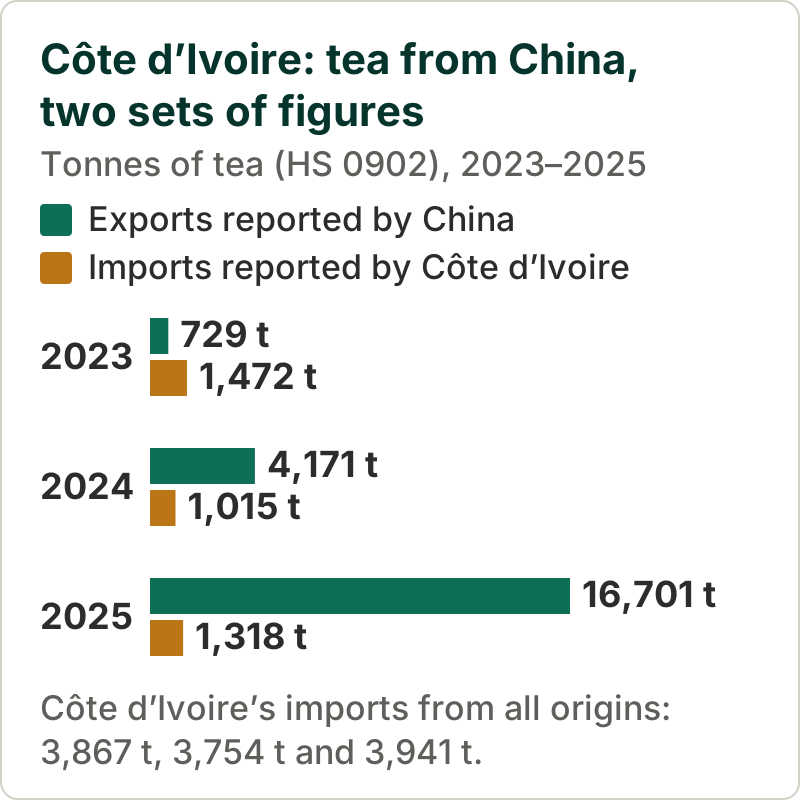 Source: UN Comtrade via WITS, figures reported by China and by Côte d’Ivoire (2023–2025)
In 2025 China declared 12.7 times as much tea for Côte d’Ivoire as Côte d’Ivoire recorded from China, a gap of 15,383 tonnes (The Tea Trade’s calculation). Even if every kilogram of tea Côte d’Ivoire imported that year had been Chinese, it would equal less than a quarter (23.6%) of what China declared.
Values differ as well. Côte d’Ivoire’s statistics give green tea from China in packs of 3 kg or less a unit value of US$0.63 per kg in 2025 (US$621,133 for 992,666 kg), while China’s export declarations for the same product and destination average US$4.26 per kg. Import values include freight and insurance, so they should be higher than export values, not lower; the statistics do not explain the gap.
What the Ivorian figures do show is the tea that stays in the country. In 2025 its recorded imports were 2,303 tonnes of green tea, 55% of it from China, and 1,638 tonnes of black tea. By value, black tea in packs of 3 kg or less from Kenya came first, with US$7.9 million of the US$13.7 million total. The sources reviewed for this guide include no official estimate of household tea consumption in Côte d’Ivoire.
Why the two sets of figures differ
The United Nations recommendations for trade statistics (IMTS 2010) cover the usual causes of such mirror gaps:
- Valuation: exports are valued FOB, at the exporting country’s border; imports CIF, including freight and insurance. Our guide to tea Incoterms and landed cost explains both terms.
- Timing: tea shipped in December is counted by China in one year and by the importer in the next; China shipped 1,704 tonnes to Côte d’Ivoire in December 2025.
- Partner country: importers record the country of origin, exporters the country of last known destination, which may be the country of the port rather than the final market.
- Transit: goods simply carried through a country to a known third country are excluded from its imports, whatever customs procedure they travel under.
- Re-exports: goods sold on after entering a country, outside a transit procedure, and shipped out unchanged count as imports, then re-exports. Côte d’Ivoire recorded 790 tonnes of tea exports in 2024 (614 to Mali) and 290 tonnes in 2025 (206 to Mali).
Valuation and timing cannot account for more than 15,000 tonnes, and recorded re-exports are small. The likely explanation, an interpretation rather than a measured fact, is that most of the tea China declares for Côte d’Ivoire is landed at Abidjan and moves on in transit, so it never enters Ivorian import statistics.
Transit through Abidjan to Mali and Burkina Faso
The Port Autonome d’Abidjan publishes its transit traffic by destination country, and in 2025 it rose by more than a third.
Transit traffic through the port of Abidjan, 2024–2025 (tonnes, final net figures; source: Port Autonome d’Abidjan)
| Destination | 2024 | 2025 | Change |
|---|---|---|---|
| Burkina Faso | 2,058,803 | 2,366,685 | +15% |
| Mali | 835,216 | 1,528,915 | +83.1% |
| All transit | 2,919,355 | 3,938,708 | +34.9% |
Transit made up 8.39% of the port’s 46,935,601 tonnes of traffic in 2025, according to the port, and Burkina Faso and Mali took 98.9% of it (The Tea Trade’s calculation). The port’s figures do not split transit by product, so they cover all cargo, not tea. Two other sets of figures point the same way:
- Burkina Faso recorded 4,174 tonnes of tea imports from China in 2023 and 3,954 tonnes in 2024, while China declared only 1,119 and 707 tonnes for it. The 2024 gap of 3,247 tonnes is far larger than timing can explain, so most of that tea was presumably declared by China for another country (The Tea Trade’s calculation).
- Ghana recorded only 142 tonnes of tea from China in 2024, when China declared 38,622 tonnes for it. China’s exports declared for Ghana then fell to 18,075 tonnes in 2025.
Interpretation: the rise in tea declared for Côte d’Ivoire in 2025 (+12,530 tonnes) came in the same year as the fall in tea declared for Ghana (−20,548 tonnes), the 83.1% jump in Abidjan’s transit to Mali and a 56.3% rise in China’s tea exports declared for Mali. These figures are consistent with part of the Sahel’s tea switching to Abidjan, but no source reviewed for this guide measures tea transit by route.
Côte d’Ivoire’s Customs Code of 2022 suspends duties and taxes on goods in customs transit (article 214), against guarantees whose amount the director general of customs sets (article 194). The World Trade Organization’s 2017 Trade Policy Review described the road transit regime as it then stood: Côte d’Ivoire applied the T1 procedure of the TRIE inter-state road transit convention, said it levied no tax on international transit and required a specially approved declarant. Two guarantees were lodged: 0.50% of the CIF value through the Chamber of Commerce, and one covering the suspended duties, returned once the goods had left the country.
Importing tea into Côte d’Ivoire: FDI, GUCE and BSC
Tea cleared for consumption in Côte d’Ivoire goes through the foreign trade single window (guichet unique du commerce extérieur, GUCE), according to the ministry’s 2019 VoC procedure guide. Each step below gives its source and date:
- Import declaration form (FDI). According to the WTO’s 2017 Trade Policy Review, the fiche de déclaration à l’importation, electronic and free of charge since 2015, merged the customs’ advance import declaration with the trade ministry’s import information form. It lets the bank domicile the payment before the goods arrive, and it is needed to lodge the detailed customs declaration. A new FDI is required if the supplier changes or if the quantity or value changes by more than 10%. The 2019 VoC procedure guide also lists a copy of the FDI among the documents for the certificate of conformity (see below).
- Cargo tracking note (BSC). The bordereau de suivi des cargaisons, managed by the Office Ivoirien des Chargeurs (OIC) since 2006, is compulsory for imports through Ivorian seaports, according to the WTO’s 2017 Trade Policy Review. The OIC’s undated import tariff sheet, online in October 2026, charges €18 per container of 20 feet or less and €36 per larger container.
- Customs broker. Under the Customs Code of 2022 (articles 142 to 144), the person entitled to dispose of the goods may lodge its own customs declaration if it gives the same financial guarantees as a licensed customs broker (commissionnaire en douane agréé), under conditions set by the director general of customs; only a licensed broker may declare on someone else’s behalf. The WTO’s 2017 Trade Policy Review had found that self-declaration was not permitted, so ask a broker how the rule applies today.
On the Chinese side, the exporter supplies the export documents that the broker and the bank will ask for.
Conformity checks for tea since 1 July 2026 (VoC)
Côte d’Ivoire’s conformity verification programme (programme de vérification de la conformité, VoC) checks imported goods against standards before shipment. From 1 July 2026 (date of the bill of lading), the checks are compulsory for all products in the families covered by Decree 2016-1152 of 28 December 2016, which made certain standards mandatory, as amended by Decree 2020-389 of 15 April 2020, according to the Ministry of Commerce’s notice n° 249/MCIA/DGCE of 1 July 2026. The ministry’s list of products joining the programme that day includes all four tea lines, green and black, in packs of 3 kg or less and larger (HS 0902.10 to 0902.40), under food products. The notice also cites Decree 2025-418 of 18 June 2025, which approved the concession agreements for the service; the earlier agreements had been approved by Decree 2017-567 of 6 September 2017.
The ministry’s procedure guide (version 1.2, written for the programme’s relaunch in 2019) sets out how the checks work:
- they apply when the FOB value of the products covered in a shipment exceeds 1 million CFA francs;
- the exporter applies to one of four inspection companies mandated by the State, which may inspect the goods and have samples tested in an accredited laboratory;
- the inspection company has five working days from a complete file to issue the certificate of conformity (CoC) or refuse it;
- the CoC is valid for three months, is sent into the GUCE and must be presented to customs before the goods can enter Ivorian customs territory;
- fees are paid by the exporter: in the 2019 guide, 0.45% of the declared FOB value (minimum 197,000 and maximum 2,684,000 CFA francs) for occasional suppliers, 0.40% for registered products and 0.30% for licensed products. That scale predates the concession agreements approved by Decree 2025-418, so check the current one with the inspection company.
The guide applies the programme to goods intended for import into Côte d’Ivoire and does not mention transit. Ask the inspection company or the ministry whether tea crossing the country to Mali or Burkina Faso needs a CoC.
VAT and taxes on tea in Côte d’Ivoire
Tea pays the ECOWAS common external tariff of 10% and the community levies set out in the West Africa tea import duties guide. On top, Côte d’Ivoire’s customs tariff updated on 27 March 2026 shows VAT at 18% on all four tea lines, green and black, whatever the pack size. The tariff has 24 columns of duties and taxes; on tea, only six carry a rate, and we found no excise or other tea-specific tax in it (checked October 2026).
Tea gets neither the reduced VAT rate of 9% reported in the WTO’s 2017 Trade Policy Review nor the exemption some unprocessed products enjoy: in the same tariff, whole pepper, vanilla and cinnamon show 0% VAT, and 18% once ground.
Labelling and standards: CODINORM and the Ministry of Commerce
According to the WTO’s 2017 Trade Policy Review, Côte d’Ivoire Normalisation (CODINORM), an association set up in 1992 by the private sector with State representatives and supervised by the Ivorian standards committee (CIN), certifies products to Ivorian standards (normes ivoiriennes, NI), represents the country in regional and international standards bodies and is its WTO enquiry point on technical barriers to trade; standards are voluntary unless a decree makes them mandatory after approval by the CIN. Under the 2019 VoC guide, a certificate of conformity spares the importer the fee for CODINORM’s market-entry and advertising certificate, but the importer must still apply for it.
According to the WTO’s 2017 Trade Policy Review, food labelling falls under Decree 92-487 of 26 August 1992, enforced by the Ministry of Commerce’s directorate of metrology, quality control and fraud prevention, and the label must give the sales name, the list of ingredients, the net quantity, the durability date with any special storage conditions, the name and address of the manufacturer, packer or seller, the place of origin or provenance, and instructions for use where they are needed.
What this means for tea exporters and importers
- Reading the data. China’s figures for Côte d’Ivoire probably include tea bound for the Sahel; Ivorian figures, 3,754 to 3,941 tonnes a year in 2023–2025, show what stays.
- Before loading. Since 1 July 2026, obtain the CoC before the tea is loaded, agree who pays the inspection fee, and have the FDI and BSC ready.
- Transit. Tea crossing to Mali or Burkina Faso travels in customs transit, with its duties suspended against a guarantee; the destination country’s duties and rules then apply.
This is general information, not legal or tax advice: have a customs broker in Abidjan confirm the procedure, documents and rates before each shipment.
Questions and answers
How much tea does Côte d'Ivoire import from China?
China declared 16,701 tonnes of tea worth US$71.1 million for Côte d'Ivoire in 2025, up 300.4% in volume (MOFCOM). Côte d'Ivoire's own import statistics, however, recorded 1,318 tonnes of tea from China that year and 3,941 tonnes from all origins (UN Comtrade).
Why did China's tea exports to Côte d'Ivoire jump in 2025?
The customs data do not say. Côte d'Ivoire's own import figures stayed flat, while transit through Abidjan to Mali rose 83.1% and China's tea exports declared for Ghana halved. That points to tea crossing Côte d'Ivoire to the Sahel, but it is an interpretation, not a measured fact.
Do I need a certificate of conformity to export tea to Côte d'Ivoire?
Yes, since 1 July 2026 (date of the bill of lading): tea is on the Ministry of Commerce's list of products joining the VoC programme on that date. Under the ministry's procedure guide (2019), when the products covered in a shipment exceed 1 million CFA francs FOB, a certificate of conformity from a State-mandated inspection company must be presented to customs.
What is the VAT on tea in Côte d'Ivoire?
18%, on green and black tea alike, according to the customs tariff updated on 27 March 2026. We found no excise or other tea-specific tax in that tariff (checked October 2026); the 10% ECOWAS customs duty and the community levies come on top.
What is the FDI for imports into Côte d'Ivoire?
According to the WTO's 2017 Trade Policy Review, the fiche de déclaration à l'importation is an electronic import declaration form, free of charge since 2015. It lets the bank domicile the payment before the goods arrive and is needed to lodge the detailed customs declaration; a new one is required if the supplier changes or the quantity or value changes by more than 10%.
Does tea for Mali and Burkina Faso pass through Abidjan?
The port of Abidjan handled 1,528,915 tonnes of transit cargo for Mali and 2,366,685 tonnes for Burkina Faso in 2025, all goods combined. Its published figures do not split transit by product, but trade data suggest that much of the tea China declares for Côte d'Ivoire moves on in transit.
Sources
- 1. Côte d'Ivoire, Ministry of Commerce, Industry and Crafts: notice to importers n° 249/MCIA/DGCE on the conformity verification programme (VoC), 1 July 2026 (in French) · commerce.gouv.ci
- 2. Côte d'Ivoire, Ministry of Commerce: remaining products of Decree 2016-1152 subject to the VoC programme from 1 July 2026 (in French) · commerce.gouv.ci
- 3. Côte d'Ivoire, Ministry of Commerce: procedure guide for verifying the conformity of imported goods with standards, version 1.2 (in French) · commerce.gouv.ci
- 4. Côte d'Ivoire Customs: ECOWAS CET (HS 2022) with the main national duties and taxes, updated 27 March 2026 (in French) · douanes.ci
- 5. Côte d'Ivoire: Law 2022-975 on the Customs Code, Official Journal special issue of 21 July 2023 (in French) · douanes.ci
- 6. Port Autonome d'Abidjan: global and transit traffic 2024–2025, final results in net tonnes (in French) · portabidjan.ci
- 7. Office Ivoirien des Chargeurs (OIC): tariffs of the import cargo tracking note (BSC), undated (in French) · oic.ci
- 8. MOFCOM and 中国食品土畜进出口商会: China export monthly statistical report, tea, December 2025 (in Chinese) · wms.mofcom.gov.cn
- 9. MOFCOM and 中国食品土畜进出口商会: China export monthly statistical report, tea, June 2025 (in Chinese) · wms.mofcom.gov.cn
- 10. MOFCOM and 中国食品土畜进出口商会: China export monthly statistical report, tea, April 2026 (in Chinese) · wms.mofcom.gov.cn
- 11. UN Comtrade via WITS: China's tea exports (HS 0902) by partner, 2025 · wits.worldbank.org
- 12. UN Comtrade via WITS: China's tea exports (HS 0902) by partner, 2024 · wits.worldbank.org
- 13. UN Comtrade via WITS: China's tea exports (HS 0902) by partner, 2023 · wits.worldbank.org
- 14. UN Comtrade via WITS: China's exports of green tea in packs of 3 kg or less (HS 0902.10) by partner, 2025 · wits.worldbank.org
- 15. UN Comtrade via WITS: Côte d'Ivoire's tea imports (HS 0902) by partner, 2025 · wits.worldbank.org
- 16. UN Comtrade via WITS: Côte d'Ivoire's tea imports (HS 0902) by partner, 2024 · wits.worldbank.org
- 17. UN Comtrade via WITS: Côte d'Ivoire's tea imports (HS 0902) by partner, 2023 · wits.worldbank.org
- 18. UN Comtrade: Côte d'Ivoire's tea imports by HS subheading (0902.10 to 0902.40), 2025 · comtradeapi.un.org
- 19. UN Comtrade via WITS: Côte d'Ivoire's tea exports (HS 0902) by partner, 2025 · wits.worldbank.org
- 20. UN Comtrade via WITS: Côte d'Ivoire's tea exports (HS 0902) by partner, 2024 · wits.worldbank.org
- 21. UN Comtrade via WITS: Burkina Faso's tea imports (HS 0902) by partner, 2024 · wits.worldbank.org
- 22. UN Comtrade via WITS: Burkina Faso's tea imports (HS 0902) by partner, 2023 · wits.worldbank.org
- 23. UN Comtrade via WITS: Ghana's tea imports (HS 0902) by partner, 2024 · wits.worldbank.org
- 24. United Nations Statistics Division: International Merchandise Trade Statistics, Concepts and Definitions 2010 (2011) · unstats.un.org
- 25. WTO: Trade Policy Review of the WAEMU countries, annex 3, Côte d'Ivoire (WT/TPR/S/362, 14 September 2017, in French) · wto.org