How much tea fits in a 20ft or 40ft container?
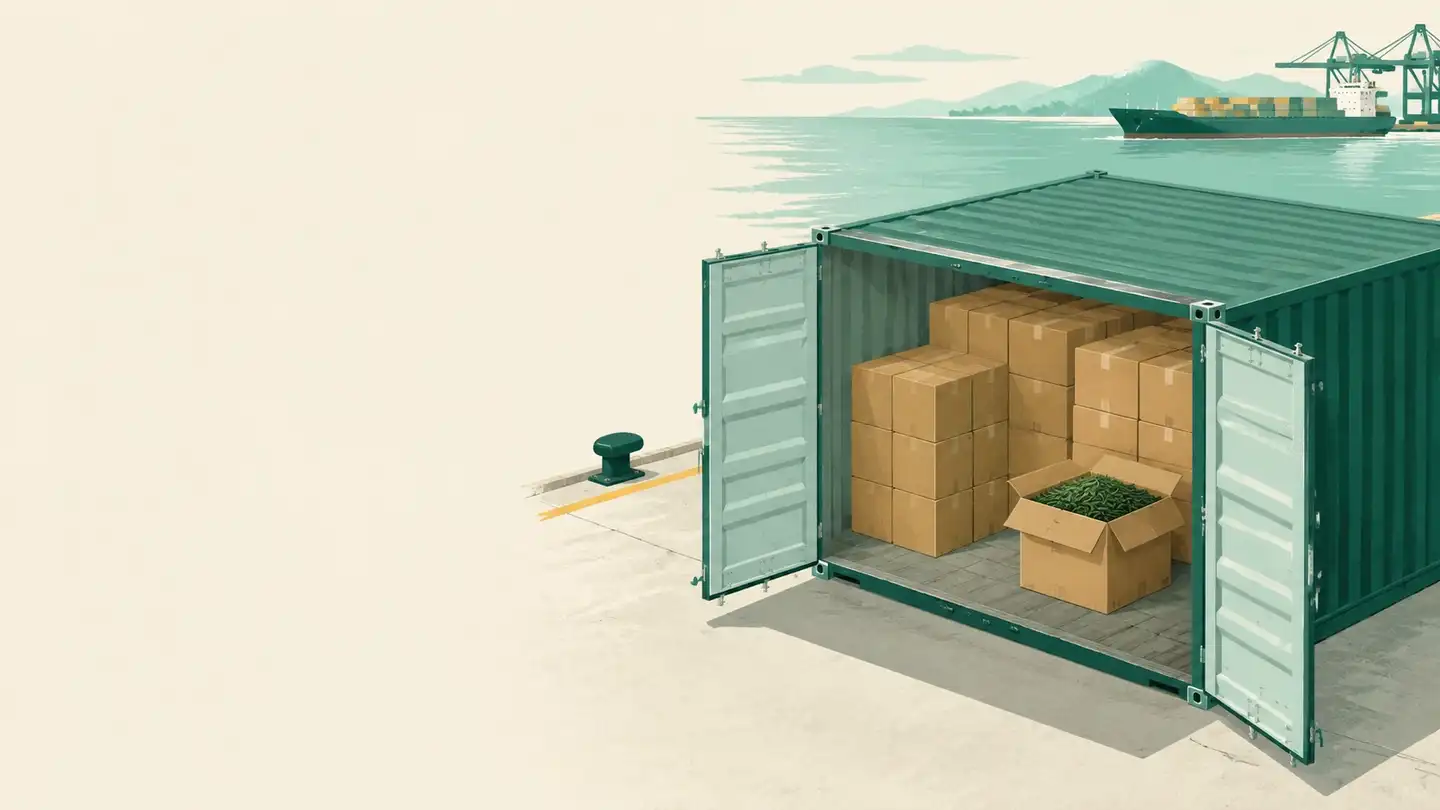
Tea container capacity, worked example: about 5.9–7.9 t of leaf tea in a 20ft box, 12.5–16.7 t in a 40ft and 15.7–20.9 t in a high cube. Space runs out first.
Key facts
- Since its 2022 amendment, ISO 668 rates 20 ft and 40 ft series 1 freight containers at a maximum gross mass of 36,000 kg, against 30,480 kg in the 2020 edition; the limit that applies to a given box is the one on its CSC safety approval plate.
- ISO 668:2020 and ISO 1496-1:2013 require a 20 ft container to measure at least 5,867 × 2,330 × 2,350 mm inside and a 40 ft high cube at least 11,998 × 2,330 × 2,655 mm, with door openings at least 2,286 mm wide.
- Under SOLAS regulation VI/2, in force since 1 July 2016, a packed container may not be loaded on a ship without its verified gross mass (VGM), which the shipper must declare and which includes pallets, dunnage and the container's tare (IMO, MSC.1/Circ.1475).
- In this guide's worked example on ISO minimum interiors, 600 × 500 × 400 mm cartons of leaf tea at an assumed 0.30–0.40 kg per litre hold about 5.9–7.9 tonnes in a 20 ft container, 12.5–16.7 tonnes in a 40 ft and 15.7–20.9 tonnes in a 40 ft high cube, each box filling up before its weight limit.
- A 1971 study in Japan's Tea Research Journal measured Japanese sencha from the market at 0.3–0.4 g/ml in compact filling; it is the only green-tea bulk density found, so this guide borrows it as an assumption, not as a measured value for gunpowder or chunmee.
Tea container capacity depends on the tea and its cartons as much as on the box. In a worked example built on the minimum interior sizes in ISO 668 and ISO 1496-1, 600 × 500 × 400 mm cartons of leaf green tea at an assumed 0.30–0.40 kg per litre, a range measured for Japanese sencha in 1971, give about 5.9–7.9 tonnes in a 20 ft container, 12.5–16.7 tonnes in a 40 ft and 15.7–20.9 tonnes in a 40 ft high cube, while each box could carry roughly 27 to 34 tonnes of cargo. With these cartons space runs out first: weight can bind first only above about 0.5 kg per litre, and only in a 40 ft box. No published bulk density was found for gunpowder or chunmee.
20ft and 40ft container dimensions and weight limits
ISO 668 sets the outside sizes of series 1 containers and, with ISO 1496-1, the standard for general-purpose boxes, their minimum inside dimensions and door openings. Boxes must be as large inside as possible, so a given box may measure slightly more. In shipping and customs data they carry ISO 6346 size-type codes such as 22G1 (20 ft), 42G1 (40 ft) and 45G1 (40 ft high cube): the first character gives the length, the second the height and width, and G1 a general-purpose box (US Customs code list, July 2024).
ISO minimums and average tares for general-purpose containers (ISO 668:2020 and its 2022 amendment, ISO 1496-1:2013; tares: Eurostat, July 2026)
| 20 ft (1CC) | 40 ft (1AA) | 40 ft high cube (1AAA) | |
|---|---|---|---|
| Outside length × width × height | 6,058 × 2,438 × 2,591 mm | 12,192 × 2,438 × 2,591 mm | 12,192 × 2,438 × 2,896 mm |
| Minimum inside length × width × height | 5,867 × 2,330 × 2,350 mm | 11,998 × 2,330 × 2,350 mm | 11,998 × 2,330 × 2,655 mm |
| Inside volume at these minimums (calculated) | 32.1 m³ | 65.7 m³ | 74.2 m³ |
| Minimum door opening, width × height | 2,286 × 2,261 mm | 2,286 × 2,261 mm | 2,286 × 2,566 mm |
| ISO rating (maximum gross mass) | 36,000 kg | 36,000 kg | 36,000 kg |
| Average tare in EU statistics | 2,300 kg | 3,700 kg | 3,700 kg (no separate figure) |
| Payload at a 30,480 or 36,000 kg rating (calculated) | 28,180–33,700 kg | 26,780–32,300 kg | 26,780–32,300 kg |
The minimum inside height is the outside height minus 241 mm. Ratings have changed: ISO 668:2020 rated both sizes at 30,480 kg, allowing up to 36,000 kg for boxes tested and marked to it, before its 2022 amendment made 36,000 kg the rating; the 1995 edition rated 20 ft boxes at 52,900 lb, about 24,000 kg, according to a 2018 US Department of Energy standard. Read the plate, not the table.
Tare, payload and the CSC plate
Every container in international sea transport carries a safety approval plate under the International Convention for Safe Containers (CSC), usually on the left-hand door. The maximum gross mass on that plate should never be exceeded, says the CTU Code, the packing code of the IMO, the ILO and UNECE. The tare is painted on the doors; if the rating painted there differs from the plate, the plate prevails. The Code puts the cargo a box can take at its rating minus its tare, any attached equipment and the securing and bracing material.
Tares vary from box to box, so Eurostat’s maritime statistics manual (July 2026) uses averages of 2.3 tonnes for a 20 ft and 3.7 tonnes for a 40 ft box only when the real figure is missing. The payloads above use those averages; replace them with your box’s figures.
Bulk density: why the tea decides
Whether a box fills up or weighs out depends on how many kilograms of tea fit in a litre once packed: its bulk density. The only green-tea measurements found come from a 1971 study in Japan’s Tea Research Journal, which measured Japanese sencha (煎茶) bought on the market at 0.3–0.4 g/ml, the same as kg per litre, in compact filling and 10 to 20% less in loose filling. Top-grade samples packed at 0.367–0.395 g/ml and low-grade ones at 0.287–0.315 g/ml, so grade alone shifted density by about a quarter (calculated). Sencha is a Japanese green tea, not a Chinese export grade, so this guide uses its range only as an assumption.
Other published figures are of the same order: FAO’s food density database lists black tea leaves at 0.48 g/ml, and the cargo handbook of the German Insurance Association (GDV) gives tea in plywood chests or paper bags a stowage factor of 2.60–3.07 m³ per tonne, or 0.33–0.38 tonnes per m³ (calculated).
No published bulk density was found for gunpowder (珠茶) or chunmee (眉茶), which a 2022 article in the journal China Tea Processing calls China’s two bulk export green teas. China’s standards describe the pellets of the top gunpowder grade, 3505, as round, tight and heavy, and the strips of the top chunmee grade, 41022, as fine and tight. To find your own figure, fill a jug of known volume with the tea, level it and weigh it: kilograms divided by litres is the bulk density, and knocking the jug on a board about 50 times, until the level stops falling, gives the compact value used below (the 1971 study’s method).
Worked example: cartons in a 20ft, 40ft and 40ft high cube
Assumptions (replace them with your own figures):
- Carton: 600 × 500 × 400 mm, taken here as the outside size, or 0.12 m³. A Chinese agricultural reference lists 400 × 400 × 600 mm and 400 × 500 × 600 mm as the case sizes generally used by the main tea-exporting countries, such as India, Sri Lanka, Kenya and Indonesia, known as international standard cases (国际标准箱); it does not say that Chinese green-tea exporters use them.
- Tea space (this guide’s own assumption, no source): 110 litres per carton; walls, liner and headspace take the rest.
- Packaging (this guide’s own assumption, no source): 1.5 kg of carton and liner per carton.
- Leaf tea (assumption borrowed from another tea): 0.30–0.40 kg/L, the compact range measured for Japanese sencha in the 1971 study, not a measured value for gunpowder or chunmee, so 33–44 kg net per carton.
- Box: ISO minimum interior, floor-loaded, no pallets, Eurostat average tare, rating 30,480 or 36,000 kg.
Step 1, cartons by volume. Divide each inside dimension by a carton dimension, round down and multiply. The orientation that gives the most cartons in all three boxes puts the 600 mm side along the box, the 400 mm side across and the 500 mm side upright:
- 20 ft: 5,867 ÷ 600 → 9; 2,330 ÷ 400 → 5; 2,350 ÷ 500 → 4; 9 × 5 × 4 = 180 cartons.
- 40 ft: 11,998 ÷ 600 → 19, so 19 × 5 × 4 = 380 cartons.
- 40 ft high cube: 2,655 ÷ 500 → 5, so 19 × 5 × 5 = 475 cartons.
The stacks, 2.0 m and 2.5 m high, clear the 2,261 mm and 2,566 mm door openings. The cartons fill 67%, 69% and 77% of the inside volume (calculated); turning the last row, at the doors, adds 12, 15 and 20 cartons.
Step 2, weight check. Cargo weight is cartons × (net weight + packaging). At 34.5–45.5 kg a carton, the loads weigh 6.2–8.2 tonnes in a 20 ft box, 13.1–17.3 tonnes in a 40 ft and 16.4–21.6 tonnes in a high cube, against payloads of 28.2–33.7 and 26.8–32.3 tonnes.
Step 3, binding limit. Space runs out in all three boxes. Weight would bind first only if a carton weighed more than the payload divided by the number of cartons: in a high cube rated 30,480 kg, 26,780 ÷ 475 = 56.4 kg, or 54.9 kg of tea, which is 0.50 kg/L over 110 litres. These thresholds hold for this carton layout only, which leaves 23–33% of the box empty: if packed tea filled a box completely, weight would bind first above about 0.36–0.44 kg/L in a high cube, 0.41–0.49 kg/L in a 40 ft box and 0.88–1.05 kg/L in a 20 ft box (payload ÷ inside volume, packaging ignored; calculated).
Worked example results, 600 × 500 × 400 mm cartons, floor-loaded (calculated from ISO 668, ISO 1496-1, Eurostat 2026 and the assumptions above)
| Box | Cartons by volume | Leaf tea at 0.30–0.40 kg/L | Cargo with cartons | Payload | Limit reached first | Weight binds first only above |
|---|---|---|---|---|---|---|
| 20 ft | 180 | 5.9–7.9 t | 6.2–8.2 t | 28.2–33.7 t | Volume | 1.41–1.69 kg/L (out of reach) |
| 40 ft | 380 | 12.5–16.7 t | 13.1–17.3 t | 26.8–32.3 t | Volume | 0.63–0.76 kg/L (69.0–83.5 kg net per carton) |
| 40 ft high cube | 475 | 15.7–20.9 t | 16.4–21.6 t | 26.8–32.3 t | Volume | 0.50–0.60 kg/L (54.9–66.5 kg net per carton) |
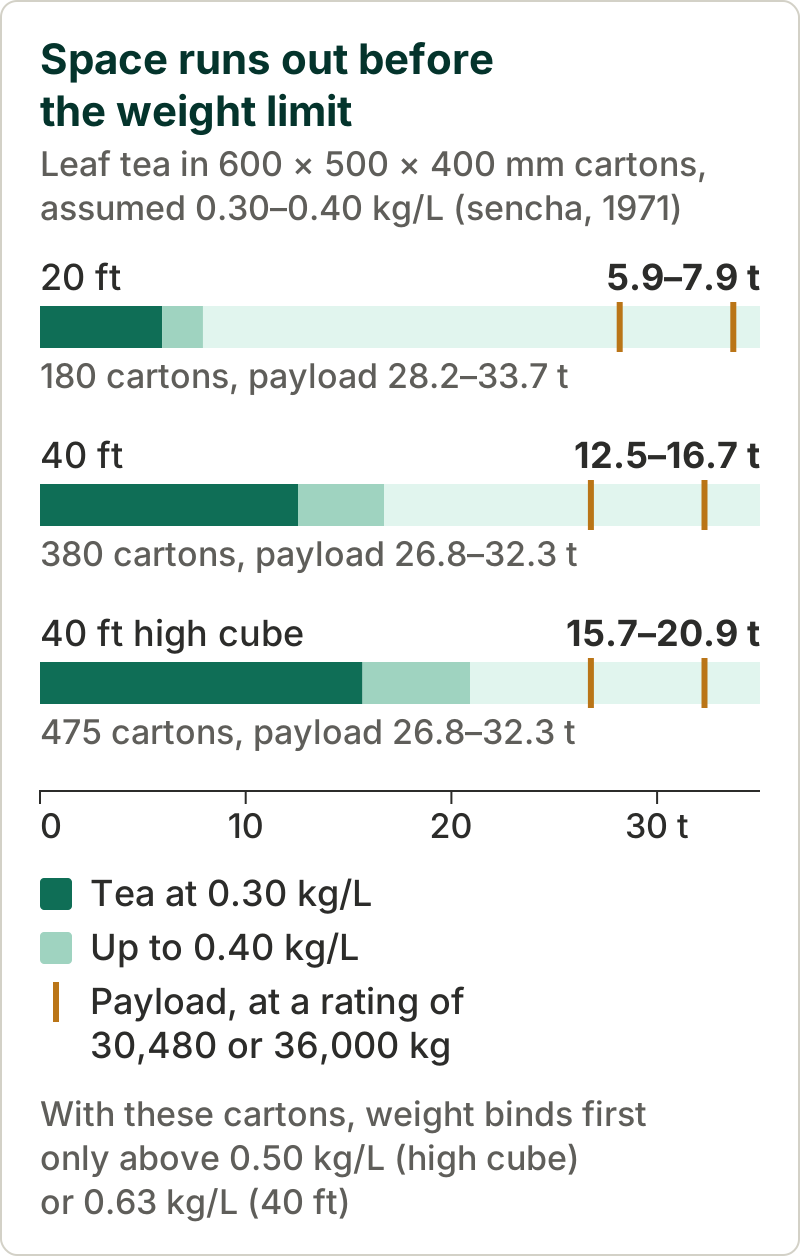 Sources: ISO 668:2020 and Amd 1:2022, ISO 1496-1:2013, Eurostat (July 2026); density assumed from Fukatsu and Hara (1971); calculation in this guide
To redo the arithmetic with your own cartons:
- Measure a carton’s outside dimensions and weigh a full one.
- Divide the box’s inside dimensions by the carton’s in each of the six orientations, round down, multiply, and keep the largest count.
- Compare that count × gross weight with the payload: the CSC-plate rating minus the tare and any pallets or dunnage.
- Multiply the smaller of the carton count and payload ÷ gross weight by the net weight per carton.
Gunpowder vs chunmee: which limit binds first
For leaf tea within 0.30–0.40 kg/L, the sencha range assumed here for leaf tea such as chunmee, volume is the limit in every box of the example: a high cube rated 30,480 kg still has 5.2–10.4 tonnes of payload unused (calculated).
Gunpowder may differ. Each extra 0.1 kg/L puts about 2.0 tonnes more tea in a 20 ft box, 4.2 tonnes in a 40 ft and 5.2 tonnes in a high cube (calculated), until the payload stops it: above 0.50 kg/L in a high cube rated 30,480 kg and 0.60 kg/L in one rated 36,000 kg, and above 0.63 and 0.76 kg/L in a 40 ft box. With these cartons no leaf tea reaches a 20 ft box’s payload, which would take 1.41 kg/L. If your gunpowder weighs more than about half a kilogram per litre, or your cartons fill the box better than these, plan a high cube by weight, at most its payload of 26.8–32.3 tonnes of tea and cartons, rather than by carton count.
VGM and road weight limits
At sea, SOLAS regulation VI/2, as amended by IMO resolution MSC.380(94), has applied since 1 July 2016. The shipper, the party named as such on the bill of lading or who concluded the contract of carriage, must declare the packed container’s verified gross mass (VGM): its tare plus all cargo, pallets, dunnage and packing and securing material. It comes from weighing the packed box (Method 1) or weighing every package and adding the tare (Method 2, using a method certified as decided by the competent authority of the country where the box was packed and sealed). Sealed packages with their exact mass marked need not be weighed again.
The VGM goes in a shipping document signed by a person the shipper authorises; an electronic signature or the name in capitals will do (MSC.1/Circ.1475). A box without a VGM is not loaded until one is obtained, and if the port terminal weighs the box, its figure prevails. SOLAS regulation VI/5 forbids packing a container beyond the maximum gross mass on its CSC plate.
On the road, the truck counts too. China’s GB 1589-2016 (汽车、挂车及汽车列车外廓尺寸、轴荷及质量限值) caps a six-axle combination at 49,000 kg in total and a five-axle one at 43,000 kg. Its successor, GB 1589-2026, applies to newly type-approved vehicles from 1 July 2027 and to types already approved from 1 January 2028, and SAMR’s announcement of 31 August 2026 lists no change to these totals among its main changes. The CTU Code adds that height or mass limits along the route also apply: check the destination’s too.
Pallets or floor-loading
The worked example assumes floor-loading, with cartons stacked straight on the container floor. Pallets speed up handling but take floor space and height, so fewer cartons fit, and their weight counts in the VGM and against the payload.
Solid-wood pallets, crates and dunnage fall under ISPM 15, the standard of the International Plant Protection Convention (IPPC): the wood must be treated, for example heated to 56 °C for 30 continuous minutes throughout, and marked with the standard’s dedicated symbol and codes for the country, the producer or treatment provider and the treatment. Packaging made wholly of processed wood, such as plywood, particle board or oriented strand board, is exempt. The CTU Code asks for ISPM 15 compliance when a box goes to a country with wood quarantine rules, and says wet timber, pallets or packaging should not be used.
Container rain and moisture
China’s standards cap moisture at 7.0% for every gunpowder and chunmee grade (see the guides to gunpowder grades and chunmee grades) and require clean, dry, odour-free transport protected from rain, damp and sun. China’s standards for jasmine tea and white tea allow up to 8.5% moisture. Inside a closed box, says the CTU Code, humidity settles at a level set by the moisture in the cargo, packaging and dunnage, and no mould grows below 75% relative humidity. Even dry pallets and dunnage hold 12–15% moisture, enough to set it at 60–75%. On top of a ship’s deck stow, temperatures can swing by more than 25 °C a day; as the roof cools in the late afternoon, the air under it reaches its dew point and drops fall onto the cargo: container sweat, or container rain.
The Code’s remedies for hygroscopic cargo: pack it “container-dry”, since desiccants fail with cargo that is not dry enough and their absorption capacity must be calculated, and cover sensitive cargo with a fleece. Polythene sheeting stops drips but may promote mildew in a damp box, and cardboard loses up to 75% of its strength as humidity rises from 40% to 95%, so stacked cartons can collapse unless wet-strength board is used.
The GDV handbook adds that tea is extremely sensitive to odours, that containers with a damp, contaminated or smelling floor should be rejected, and that tea in containers must be stowed below deck, safe from rain, seawater and heating by day and cooling at night, and away from sources of heat. The 2022 China Tea Processing article recalls that, early in the trade, months at sea with heat and damp oxidised the tea and darkened its liquor, a colour Moroccan drinkers came to expect.
Before you book a container
- Fix the carton first. The example’s carton fills only 67–77% of the box, while the GDV handbook notes that cartons can be sized to fill a container almost completely (tea export packaging formats); a fuller box also reaches its weight limit at a lower tea density. For Morocco, keep each packing at 20 kg or more, the threshold for the 2.5% duty (importing green tea into Morocco).
- Get the box’s own figures. Read the rating and tare on the CSC plate and the doors before planning a dense load.
- Agree who books and declares. Who books the container and pays the freight follows from the Incoterm (tea Incoterms and landed cost); the VGM is due from the shipper.
Standards and rules in this guide were checked in October 2026.
Questions and answers
How many tons of tea fit in a 20ft container?
In a worked example on the ISO minimum interior, 180 cartons of 600 × 500 × 400 mm hold about 5.9–7.9 tonnes of leaf green tea at an assumed 0.30–0.40 kg per litre, a range measured for Japanese sencha. The box fills up long before its payload of about 28–34 tonnes, so the answer depends on the tea's density and the carton size.
How much tea fits in a 40ft container?
About 12.5–16.7 tonnes of leaf tea in a 40 ft box (380 cartons) and 15.7–20.9 tonnes in a 40 ft high cube (475 cartons), in the same worked example. With these cartons, a tea packing above about 0.50 kg per litre can reach a high cube's payload before it fills; cartons that fill the box better lower that threshold.
Does gunpowder tea weigh out a container before chunmee does?
No published bulk density was found for gunpowder or chunmee, so weigh a litre of your own lot. With this guide's example cartons, weight binds first only above about 0.50 kg per litre in a 40 ft high cube or 0.63 kg per litre in a 40 ft box, while a 20 ft box would need 1.41 kg per litre, out of reach for leaf tea.
What is the maximum gross weight of a 20ft or 40ft container?
ISO 668 has rated both at 36,000 kg since its 2022 amendment, against 30,480 kg in the 2020 edition. The limit that binds is the maximum gross mass on the box's CSC safety approval plate; the payload is that figure minus the tare painted on the doors.
What is the VGM and who declares it?
The verified gross mass is the mass of the packed container, tare included, required by SOLAS regulation VI/2 since 1 July 2016. The shipper obtains it by weighing the packed box or by weighing all contents, pallets and dunnage and adding the tare, and a person it authorises signs the declaration.
Do wooden pallets for tea need ISPM 15 treatment?
Yes, for countries that apply ISPM 15: solid-wood pallets, crates and dunnage must be treated, for example heated to 56 °C for 30 minutes throughout, and marked. Packaging made wholly of processed wood, such as plywood or oriented strand board, is exempt.
Sources
- 1. ISO 668:2020 Series 1 freight containers, classification, dimensions and ratings, sample pages with Tables 2 and 3 · cdn.standards.iteh.ai
- 2. ISO 668:2020/Amd 1:2022, amended Table 2 of ratings, sample pages · cdn.standards.iteh.ai
- 3. ISO 1496-1:2013 Series 1 freight containers, general cargo containers, sample pages · cdn.standards.iteh.ai
- 4. IMO: Verification of the gross mass of a packed container (SOLAS regulation VI/2) · imo.org
- 5. IMO: MSC.1/Circ.1475, Guidelines regarding the verified gross mass of a container carrying cargo, 9 June 2014 · wwwcdn.imo.org
- 6. IMO, ILO and UNECE: Code of Practice for Packing of Cargo Transport Units (CTU Code), 2014 edition · ilo.org
- 7. IPPC: ISPM 15, Regulation of wood packaging material in international trade, 2018 version (published July 2021) · ippc.int
- 8. SAMR national standards full-text system: GB 1589-2016 Limits of dimensions, axle load and masses for motor vehicles, trailers and combination vehicles (in Chinese) · openstd.samr.gov.cn
- 9. SAMR: mandatory national standard GB 1589-2026 published, 31 August 2026 (in Chinese) · samr.gov.cn
- 10. Eurostat: Reference Manual on Maritime Transport Statistics, version 4.7, July 2026 · ec.europa.eu
- 11. US Customs and Border Protection: Customs Automated Manifest Interface Requirements, Appendix M, container and equipment type codes, July 2024 · cbp.gov
- 12. US Department of Energy, Hanford Site: freight container lifting standard, DOE/RL-92-36 Attachment 2, June 2018 · hanford.gov
- 13. GB/T 14456.4-2016 Green tea, Part 4: Gunpowder tea, official record (in Chinese) · openstd.samr.gov.cn
- 14. SAMR national standards platform: GB/T 14456.5-2016 Green tea, Part 5: Mee tea (in Chinese) · std.samr.gov.cn
- 15. Moroccan Customs: Circular 6619/210 of 26 December 2024 on the 2025 finance law (in French) · douane.gov.ma
- 16. Fukatsu S. and Hara T. (1971), Examination of bulk density measurement of refined green tea, Tea Research Journal (Chagyo Kenkyu Hokoku) 34: 37–40 (in Japanese, English summary) · doi.org
- 17. FAO/INFOODS Density Database, version 2.0 (2012) · fao.org
- 18. German Insurance Association (GDV), Transport Information Service: Tea · tis-gdv.de
- 19. China Agriculture Press, 智汇三农 knowledge platform: tea packaging inspection (in Chinese) · pwsannong.com
- 20. Liu Xiangji, Technical key points of quality control of high-grade gunpowder tea for export, China Tea Processing, 2022, issue 4, pp. 18–23 (in Chinese) · sciopen.com