Chinese black tea grades: Keemun, Dianhong and Lapsang
Chinese black tea grades follow GB/T 13738: congou from special grade to grade 6, Lapsang souchong to grade 3, with no export codes. Keemun and Dianhong too.
Key facts
- China's black tea standard, GB/T 13738, has three parts: broken black tea (GB/T 13738.1-2017), congou (GB/T 13738.2-2017) and souchong (GB/T 13738.3-2012), all listed as in force on China's national standards platform in October 2026.
- Under GB/T 13738.2-2017, congou black tea has seven grades, special grade (特级) and grades 1 to 6, for both large-leaf and medium and small-leaf tea, with moisture capped at 7.0%, total ash at 6.5% and dust at 1.0% to 1.5%.
- GB/T 13738.3-2012 splits souchong into Zhengshan xiaozhong (正山小种), from Tongmu village and the Wuyishan nature reserve, in four grades, and smoked xiaozhong (烟小种), from outside the reserve, in five grades.
- Anhui's standard DB34/T 1086—2026, in force since 3 July 2026, defines four Keemun types, congou, Xiangluo, Maofeng and Jinzhen, with eight grades for Keemun congou and three for each of the others.
- China exported 25,868 tonnes of black tea worth US$136.0 million in 2025, 6.2% of its tea export volume, at an average US$5.26 per kg, according to MOFCOM.
Chinese black tea grades are set by GB/T 13738, a national standard in three parts: broken black tea (2017), congou (2017) and souchong (2012). Congou is graded from special grade (特级) down to grade 6, and Zhengshan xiaozhong, the Lapsang souchong of Wuyishan, from special grade to grade 3; every grade is capped at 7.0% moisture, and none carries an export code. Keemun (祁门红茶) follows its own Anhui standard, revised in 2026, while Lapsang souchong is protected as a geographical indication in China and the EU.
China’s black tea standard, GB/T 13738
Black tea is hongcha (红茶, “red tea”) in Chinese, one of the six Chinese tea types. Its national standard, GB/T 13738 (红茶), has one part per style. Each part was reviewed on 24 March 2021 with the conclusion that it should be revised, but China’s national standards platform still listed all three editions as in force in October 2026.
GB/T 13738, black tea: the three parts (official records, checked October 2026)
| Part | Style | Edition in force | In force since | Products | Grades or sizes |
|---|---|---|---|---|---|
| 1 | Broken black tea (红碎茶) | GB/T 13738.1-2017 | 1 May 2018 | Large-leaf; medium and small-leaf | Broken nos. 1 to 5, fannings, dust (large-leaf); nos. 1 to 3, fannings, dust (smaller leaf) |
| 2 | Congou, or gongfu (工夫红茶) | GB/T 13738.2-2017 | 1 May 2018 | Large-leaf; medium and small-leaf | Special grade (特级), grades 1 to 6 |
| 3 | Souchong (小种红茶) | GB/T 13738.3-2012 | 1 July 2013 | Zhengshan xiaozhong (正山小种); smoked xiaozhong (烟小种) | Special grade to grade 3; special grade to grade 4 |
The 2017 editions of Parts 1 and 2 replaced those of 2008. Part 1 is a modified adoption of ISO 3720:2011, Black tea — Definition and basic requirements, and Part 2 draws on it. In Parts 2 and 3, each grade has a physical reference sample, renewed every three years. No part attaches an export code to a grade, unlike China’s standards for gunpowder and chunmee green tea.
Congou tea grades in GB/T 13738.2-2017
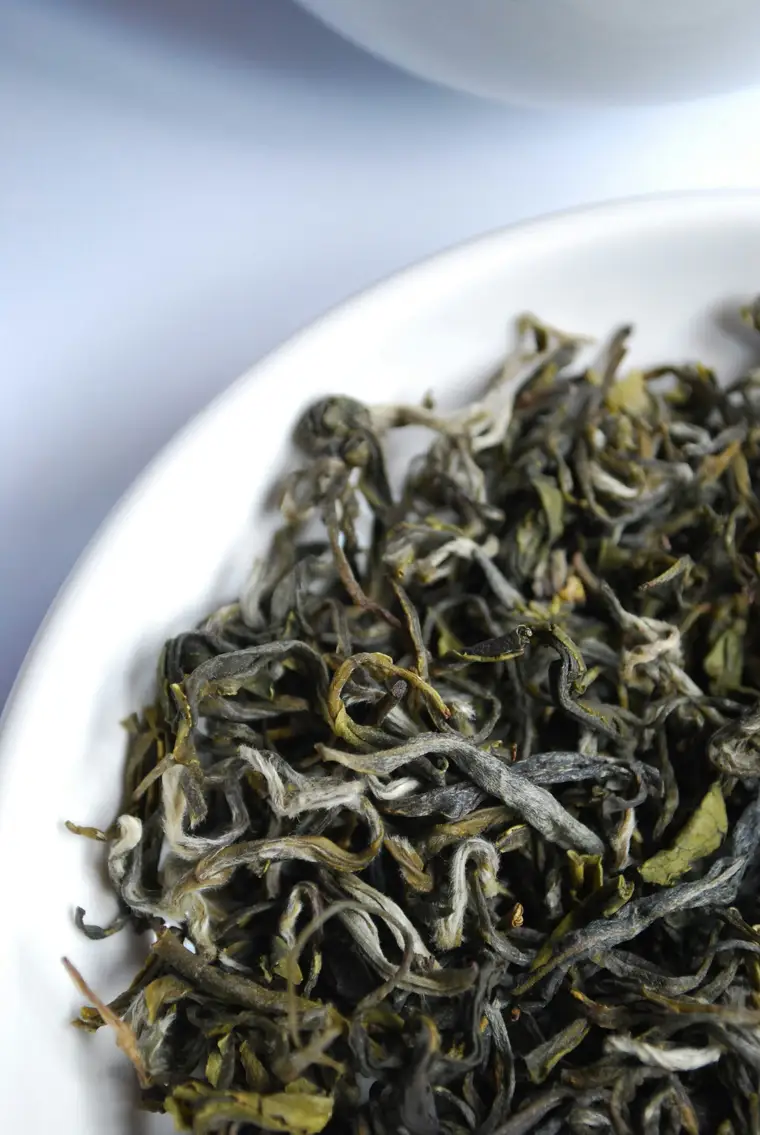
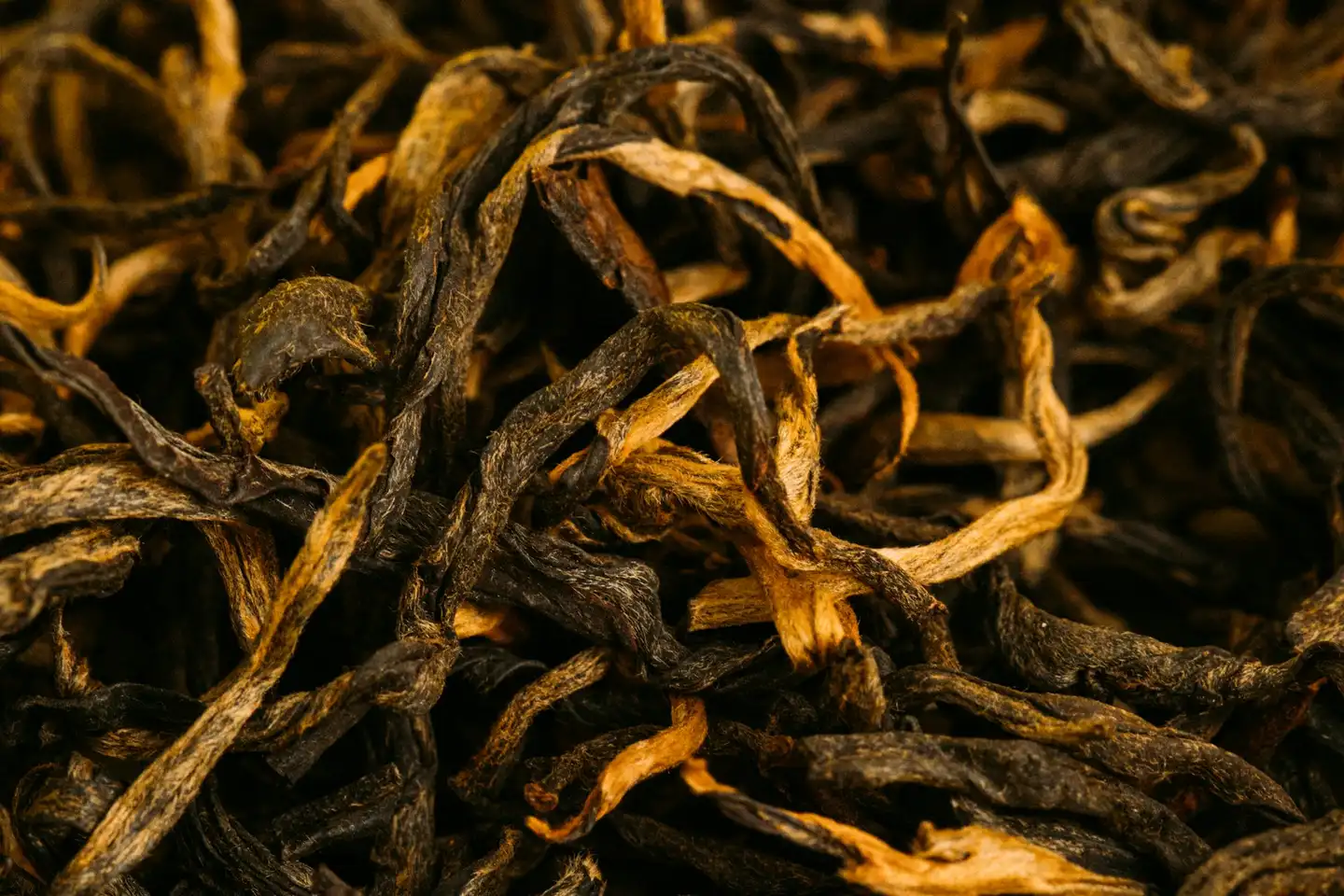
Congou (工夫红茶, gongfu hongcha) is whole-leaf black tea made by withering, rolling, fermentation, drying and refining. The standard divides it by tea variety into large-leaf congou (大叶种工夫红茶) and medium and small-leaf congou (中小叶种工夫红茶), and grades each in seven steps: special grade (特级), then grades 1 to 6 (一级 to 六级). Down the scale, the leaf gets looser and stalkier, the tips disappear, the liquor dulls and the taste coarsens.
Sensory requirements, large-leaf congou (GB/T 13738.2-2017, Table 1)
| Grade | Dry leaf | Aroma and taste | Liquor |
|---|---|---|---|
| Special (特级) | Plump, tight, many tips; glossy, golden tips showing | Rich, sweet; fresh, strong, full | Vivid red |
| Grade 1 (一级) | Plump, tight, with tips; many golden tips | Sweet, strong; fresh, mellow, quite strong | Fairly vivid red |
| Grade 2 (二级) | Plump, firm; some golden tips; a few tender stems | Strong; mellow, strong | Bright red |
| Grade 3 (三级) | Firm; a few tips; fibrous stalks | Pure, fairly strong; mellow | Quite bright red |
| Grade 4 (四级) | Fairly firm; stalks and coarse leaf | Pure; fairly strong | Red, fairly bright |
| Grade 5 (五级) | Slightly loose; many stalks and coarse leaf | Fairly pure; slightly astringent | Red, not bright |
| Grade 6 (六级) | Coarse, loose; many stalks and flakes | Slightly coarse and astringent | Slightly dark red |
Medium and small-leaf congou runs the same seven steps, from fine, tight, glossy black leaf with many tips and a fresh, sweet aroma to fairly coarse, loose leaf with a coarse, thin taste.
Physical and chemical requirements, congou (GB/T 13738.2-2017, Table 3, % by mass)
| Parameter | Special grade, grade 1 | Grades 2 and 3 | Grades 4 to 6 |
|---|---|---|---|
| Moisture, max | 7.0% | 7.0% | 7.0% |
| Total ash, max | 6.5% | 6.5% | 6.5% |
| Dust, max | 1.0% | 1.2% | 1.5% |
| Water extract, min, large-leaf | 36% | 34% | 32% |
| Water extract, min, medium and small-leaf | 32% | 30% | 28% |
Tea polyphenols (at least 9.0% for large-leaf, 7.0% for medium and small-leaf congou), crude fibre (at most 16.5%), acid-insoluble ash and water-soluble ash (at least 45% of total ash) are reference values only. Every batch needs a factory release check on sensory quality, moisture, dust and net content. China’s jasmine tea standard, GB/T 22292-2017, sets the same four checks.
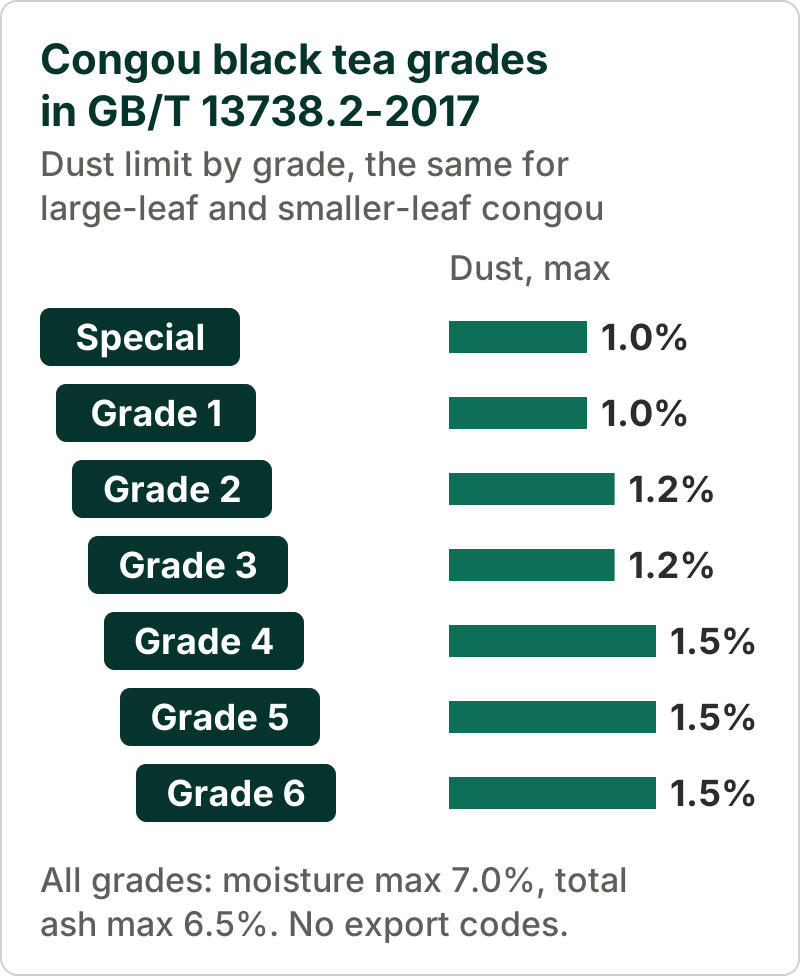 Source: China’s national standard GB/T 13738.2-2017, Tables 1 and 3 (2017)
Broken black tea: sizes, not grades
Broken black tea (红碎茶) is withered, rolled and cut (揉切), fermented and dried. GB/T 13738.1-2017 also splits it into large-leaf and medium and small-leaf tea, but sorts it by size (规格) rather than grade: broken nos. 1 to 5 (碎茶1号 to 5号), fannings (片茶) and dust (末茶) for large-leaf tea; broken nos. 1 to 3, fannings and dust for medium and small-leaf tea. China’s older trade standard samples used the abbreviations OP (leaf), FBOP and BOP (broken), BOPF and F (fannings) and D (dust); the national standard does not.
Physical and chemical requirements, broken black tea (GB/T 13738.1-2017, Table 3, % by mass)
| Parameter | Large-leaf | Medium and small-leaf |
|---|---|---|
| Moisture, max | 7.0% | 7.0% |
| Total ash | 4.0% to 8.0% | 4.0% to 8.0% |
| Dust, max | 2.0% | 2.0% |
| Water extract, min | 34% | 32% |
| Tea polyphenols, min (reference only) | 9.0% | 9.0% |
These figures match ISO 3720:2011 (at least 32% water extract, 4% to 8% total ash, at least 9% total polyphenols), except for the 34% water extract of large-leaf tea. The ISO text sets no moisture or dust limit; China added both.
Souchong grades: Zhengshan xiaozhong (Lapsang) and smoked xiaozhong
Souchong (小种红茶) is black tea withered and dried over pinewood smoke (熏松烟), in the words of the scope of GB/T 13738.3-2012. The standard splits it by origin and process into two products:
- Zhengshan xiaozhong (正山小种), from leaf grown in Tongmu village (桐木村), Xingcun town, Wuyishan city, and within the Wuyishan nature reserve, made by the local traditional method, with an aroma of dried longan and pine smoke. Four grades: special grade and grades 1 to 3.
- Smoked xiaozhong (烟小种), from leaf grown outside the nature reserve, made like congou and smoked over pinewood at the end. Five grades: special grade and grades 1 to 4.
Physical and chemical requirements, souchong (GB/T 13738.3-2012, Table 3, % by mass)
| Parameter | Special grade, grade 1 | Grades 2 to 4 |
|---|---|---|
| Moisture, max | 7.0% | 7.0% |
| Total ash, max | 7.0% | 7.0% |
| Dust, max | 1.0% | 1.2% |
| Water extract, min, Zhengshan xiaozhong | 34% | 32% |
| Water extract, min, smoked xiaozhong | 32% | 30% |
Special-grade Zhengshan xiaozhong must have a sturdy, tight, glossy black leaf, a clear dried-longan or pine-smoke aroma, a mellow, full taste with a “high-mountain” character (高山韵) and an orange-red liquor. Smoked xiaozhong is judged mainly on its pine-smoke aroma, from “strong and lasting” (special grade) to “light, with a coarse green note” (grade 4). Additives are banned.
Zhengshan xiaozhong is also a protected name: registered in China as a certification mark (证明商标), No. 7430842, on 14 January 2010, and one of the 100 Chinese names protected in the EU since the EU–China agreement on geographical indications took effect on 1 March 2021, with “Lapsang Souchong” as its translation. A footnote to its entry in the agreement (Annex III, No. 23) set a five-year transition from the agreement’s entry into force: tea placed on the EU market before 3 June 2017 could keep the name “Lapsang Souchong”, provided it did not mislead consumers and its real origin was clearly shown. Counted from 1 March 2021, that transition ended in March 2026 (our calculation). The definitions do not match: GB/T 13738.3 limits Zhengshan xiaozhong to Tongmu village and the nature reserve, while the specification filed for the EU listing covers towns, streets and farms across Wuyishan city, smoked and unsmoked tea alike.
Keemun grades: four types in Anhui’s standard
Keemun has no national standard of its own. Its reference is Anhui’s provincial standard DB34/T 1086—2026, Quality requirements for product of geographical indication — Keemun black tea, in force since 3 July 2026, which replaced the 2009 edition. It reserves the name for tea grown in listed townships of Qimen and Yi counties (Huangshan city) and of Shitai, Guichi and Dongzhi (Chizhou city), from the local Qimen cultivar or varieties bred from it, with a “Qimen aroma” (祁门香) that it likens to flowers, fruit and honey.
Keemun types and grades (DB34/T 1086—2026)
| Type | Shape | Grades | Water extract, min |
|---|---|---|---|
| Keemun congou (祁门工夫红茶) | Strips | 礼茶, 特茗, special grade, grades 1 to 5 | 34% to grade 1, then 32%, 30% (grades 3, 4) and 28% |
| Keemun Xiangluo (祁红香螺) | Curled | Special grade, grades 1 and 2 | 34% |
| Keemun Maofeng (祁红毛峰) | Curved | Special grade, grades 1 and 2 | 34% |
| Keemun Jinzhen (祁红金针) | Tight, straight | Special grade, grades 1 and 2 | 34% |
Every type is capped at 7.0% moisture, 6.5% total ash and 1.0% dust, except congou grade 5 (1.5% dust). Crude fibre (at most 13.0%) and water-soluble ash (at least 50% of total ash) are full limits here, stricter than the national congou standard’s reference values. The 2026 edition added the Jinzhen type and, above the other congou grades, 礼茶, literally “gift tea”. Its production area follows a 2022 provincial approval to apply for a geographical-indication certification mark; whether a mark was registered could not be confirmed on an official register. A sector standard, GH/T 1178-2019, also covers Keemun congou.
Dianhong grades: Yunnan’s rules
Dianhong (滇红) is the collective name for Yunnan black tea, covering traditional congou, broken tea and newer congou styles, with its home in Fengqing county, Lincang; traditional Dianhong congou is made from Yunnan large-leaf tea (Camellia sinensis var. assamica), according to a 2023 paper in the journal Science and Technology of Food Industry. In GB/T 13738 terms, that puts it among the large-leaf grades.
We found no national or Yunnan provincial standard that carries the name Dianhong on China’s national standards information platform (searched October 2026). Yunnan’s processing code DB53/T 1351-2025, in force since 8 April 2025, covers all congou made in the province without naming Dianhong; its grades apply to fresh leaf, from 100% single buds (special grade) to one bud with three or four leaves (grade 4). A group standard of the China Tea Science Society, T/CTSS 38-2021, Dianhong congou black tea, covers strip-shaped black tea made in Yunnan. Yunnan’s agriculture department lists Fengqing Dianhong (凤庆滇红) among the province’s registered geographical-indication trademarks (2021).
Chinese black teas in the EU–China GI agreement
Chinese black teas in the EU–China agreement on geographical indications
| Name in the agreement | Chinese | List |
|---|---|---|
| Lapsang Souchong (Zhengshan xiaozhong) | 正山小种 | Annex III (first list) |
| Tanyang Gongfu Black Tea | 坦洋工夫 | Annex III |
| Yingde Black Tea | 英德红茶 | Annex III |
| Yidu Black Tea | 宜都宜红茶 | Annex III |
| Wuzhishan Black Tea | 五指山红茶 | Annex V (second list) |
| Songxi Black Tea | 松溪红茶 | Annex V |
The Annex III names have been protected in the EU since 1 March 2021; work on the second list was still in progress in December 2025, according to China’s intellectual property office (CNIPA). Keemun and Dianhong appear in neither list of the agreement as signed. Among white teas, Fuding Bai Cha is on the first list and Zhenghe Bai Cha on the second; see our guide to white tea grades.
Grade names on export documents
GB/T 13738 names grades in words, with no codes: a lot is, for example, 大叶种工夫红茶 特级 (large-leaf congou, special grade), or 碎茶2号 (broken no. 2) for broken tea. Numbers belonged to China’s older trade standard samples: according to a Chinese agricultural reference, each place-name congou was graded by number, Keemun’s grades 3, 4 and 5 being 80304, 80403 and 80504, and “China congou” was a blend of place-name congous graded in four steps under three regional sets of standards.
Some names that sound like trade labels are now official: “Keemun Maofeng” is a type in DB34/T 1086—2026 with three grades of its own, not a grade of Keemun congou. Others, such as Hao Ya (毫芽), do not appear in that standard, which therefore gives them no definition. A contract should tie any such label to a sealed sample.
Black tea in China’s exports
China exported 25,868 tonnes of black tea in 2025, worth US$136.0 million, according to MOFCOM: 6.2% of its tea export volume, at an average of US$5.26 per kg. Volume rose 4.5% on 2024, but value fell 20.9% as the average price dropped 24.3% (see China’s tea exports in 2025). Exports are a small outlet: China produced about 570,000 tonnes of black crude tea in 2025 (our calculation: 15.65% of 3.64 million tonnes, CTMA) and imported 49,100 tonnes of black tea, nearly twice what it exported (CTMA).
In MOFCOM’s code list, black tea means two Chinese customs lines: 0902.3090, under HS subheading 0902.30 (immediate packings of 3 kg or less), and 0902.4090, under 0902.40 (larger packings); our guide to tea HS codes explains the structure. MOFCOM does not publish the split between them, and the six-digit figures China reports to UN Comtrade also include oolong, ripe pu-erh and other dark tea: in 2025, 7,142 tonnes (US$67.7 million) left under 0902.30 and 34,496 tonnes (US$171.6 million) under 0902.40, Malaysia being the first buyer by value under both. In 2025, Japan was the only one of China’s 20 largest tea markets by volume where black and partly fermented tea outweighed green tea (see our guide to Chinese tea export markets).
What to put in a black tea purchase specification
- Standard and product: the part of GB/T 13738 (or DB34/T 1086 for Keemun) and its year, the product and the grade in Chinese and English, for example 特级, special grade.
- Reference sample: the number of the sealed contract sample.
- Limits: moisture ≤7.0% (method GB/T 8304), dust and water extract for the grade (GB/T 8311, GB/T 8305), total ash.
- Origin: for Keemun, Dianhong or Zhengshan xiaozhong, the production area and, for souchong, smoked or unsmoked.
- Residues: the limits of the destination country, with a test report per lot. For the EU, see our guide to EU pesticide limits for tea.
- Packing and HS code: 0902.30 for immediate packings of 3 kg or less, 0902.40 above; net weight and liner.
- Disputes: a retained sample; GB/T 13738 settles disputes by retesting it or a double sample from the same lot.
Questions and answers
What are the grades of Chinese black tea?
China's standard GB/T 13738 grades congou black tea from special grade (特级) through grades 1 to 6, Zhengshan xiaozhong from special grade to grade 3 and smoked xiaozhong to grade 4. Broken black tea is sorted by size instead: broken nos. 1 to 5 (or 1 to 3), fannings and dust.
Do Chinese black tea grades have export codes like gunpowder 3505?
No. The three parts of GB/T 13738 name grades only in words, such as 特级 (special grade) and 一级 (grade 1), unlike China's gunpowder and chunmee standards. Write the standard, product and grade on the contract and tie them to a sealed sample.
Is Lapsang souchong the same as Zhengshan xiaozhong?
Lapsang Souchong is the translation given for Zhengshan xiaozhong (正山小种) in the EU–China agreement on geographical indications, which has protected the name in the EU since 1 March 2021. China's standard GB/T 13738.3-2012 calls tea made like congou and smoked over pine outside the Wuyishan nature reserve smoked xiaozhong (烟小种) instead.
Is Keemun Mao Feng an official grade?
Keemun Maofeng (祁红毛峰) is one of the four Keemun types in Anhui's standard DB34/T 1086—2026, with its own special grade and grades 1 and 2; it is not a grade of Keemun congou. Hao Ya (毫芽) does not appear in that standard.
Is Keemun a protected geographical indication in the EU?
Not under the EU–China agreement on geographical indications: Keemun (祁门红茶) is on neither list of Chinese names in the agreement as signed in 2020, unlike Lapsang souchong, Tanyang Gongfu, Yingde and Yidu black teas. Anhui's 2026 standard defines its production area.
What moisture content should Chinese black tea have?
No more than 7.0% in all three parts of GB/T 13738 and in Anhui's Keemun standard. The international standard ISO 3720:2011 sets no moisture limit for black tea as received.
Sources
- 1. GB/T 13738.1-2017 Black tea, Part 1: Broken black tea, entry in China's official standards reading system (in Chinese) · openstd.samr.gov.cn
- 2. National public service platform for standards information: GB/T 13738.1-2017 record and 2021 review (in Chinese) · std.samr.gov.cn
- 3. GB/T 13738.2-2017 Black tea, Part 2: Congou black tea, official entry (in Chinese) · openstd.samr.gov.cn
- 4. National public service platform for standards information: GB/T 13738.2-2017 record and 2021 review (in Chinese) · std.samr.gov.cn
- 5. GB/T 13738.3-2012 Black tea, Part 3: Souchong black tea, official entry (in Chinese) · openstd.samr.gov.cn
- 6. National public service platform for standards information: GB/T 13738.3-2012 record and 2021 review (in Chinese) · std.samr.gov.cn
- 7. Anhui Administration for Market Regulation: DB34/T 1086—2026 Quality requirements for product of geographical indication, Keemun black tea, record in the local standards filing system (in Chinese) · dbba.sacinfo.org.cn
- 8. Anhui Administration for Market Regulation: DB34/T 1086—2026, official full text, 2026 (in Chinese) · dbba.sacinfo.org.cn
- 9. National public service platform for standards information: GH/T 1178-2019 Keemun congou black tea, record (in Chinese) · std.samr.gov.cn
- 10. Yunnan Administration for Market Regulation: DB53/T 1351-2025 Technical code of practice for processing congou black tea, record in the local standards filing system (in Chinese) · dbba.sacinfo.org.cn
- 11. National Library of Standards of China: T/CTSS 38-2021 Dianhong congou black tea, group standard record (in Chinese) · ndls.org.cn
- 12. Yunnan Department of Agriculture and Rural Affairs: reply to proposal No. 0069 listing Yunnan's tea geographical indications, April 2021 (in Chinese) · nync.yn.gov.cn
- 13. Xu Yawen et al., Quality analysis of traditional and wild Yunnan congou black tea, Science and Technology of Food Industry, 2023, 44(6), pp. 335–344 (in Chinese) · spgykj.com
- 14. Council of the European Union: Agreement between the EU and the Government of the People's Republic of China on cooperation on, and protection of, geographical indications, document 8361/20, July 2020 · data.consilium.europa.eu
- 15. EU Delegation to China: EU-China agreement protecting geographical indications enters into force, 1 March 2021 · eeas.europa.eu
- 16. European Commission GI register (eAmbrosia): technical specification of the geographical indication Zhengshan Xiao Zhong (Lapsang Souchong) · ec.europa.eu
- 17. China National Intellectual Property Administration: EU–China GI cooperation, December 2025 (in Chinese) · cnipa.gov.cn
- 18. ISO 3720:2011 Black tea, definition and basic requirements, sample pages · cdn.standards.iteh.ai
- 19. MOFCOM: China export monthly statistical report, tea, December 2025 (in Chinese) · wms.mofcom.gov.cn
- 20. MOFCOM: China export monthly statistical report, tea, December 2024, with the HS codes of each tea group (in Chinese) · wms.mofcom.gov.cn
- 21. China Tea Marketing Association: China's tea imports and exports in 2025, 20 January 2026 (in Chinese) · ctma.com.cn
- 22. China Tea Marketing Association: 2025 tea production and sales analysis, part 1 (association's news-portal account, 9 April 2026, in Chinese) · sohu.com
- 23. UN Comtrade via WITS: China exports of black and partly fermented tea in immediate packings of 3 kg or less, HS 0902.30, 2025 · wits.worldbank.org
- 24. UN Comtrade via WITS: China exports of other black and partly fermented tea, HS 0902.40, 2025 · wits.worldbank.org
- 25. World Customs Organization: HS Nomenclature 2022 edition, Chapter 9, coffee, tea, maté and spices · wcoomd.org
- 26. State Council Tariff Commission: 2021 agreement tariff rate table (annex 7, with the 8-digit lines of heading 0902, in Chinese) · gss.mof.gov.cn
- 27. 智汇三农 agricultural knowledge platform: trade standard samples of tea (in Chinese) · pwsannong.com