HS codes for tea: 0902 green, black and the 3 kg rule
HS codes for tea: green tea is 0902.10 in immediate packings of up to 3 kg, else 0902.20; black tea and oolong 0902.30 or 0902.40. China, EU and US lines.
Key facts
- In the World Customs Organization's HS 2022 nomenclature, tea is heading 09.02, split into green tea in immediate packings of 3 kg or less (0902.10), other green tea (0902.20), black and partly fermented tea in immediate packings of 3 kg or less (0902.30) and other black and partly fermented tea (0902.40).
- According to the WCO's HS Explanatory Notes, oolong and tea flavoured with jasmine flowers or essential oils belong in heading 09.02, while maté goes to heading 09.03 and herbal infusions to headings such as 08.13, 09.09, 12.11 or 21.06.
- The HS 2028 edition, in force from 1 January 2028, keeps tea codes 0902.10 to 0902.40 and the 3 kg split but names white and yellow tea as partly fermented tea under 0902.30 and 0902.40, whereas China's 2026 tariff lists white tea under the green tea subheadings.
- Of the 418,758 tonnes of tea China exported in 2025, 55.3% was declared as other green tea (HS 0902.20), 34.7% as green tea in immediate packings of 3 kg or less (0902.10) and 9.9% as black and partly fermented tea, according to China's figures in UN Comtrade.
- In 2026 the EU charges a 3.2% customs duty on green tea in immediate packings of 3 kg or less (CN code 0902 10 00) and no duty on the other three tea codes, according to the EU's Common Customs Tariff as applied in Northern Ireland (UK Trade Tariff, October 2026).
The HS code for tea is heading 09.02 of the Harmonized System, and the six-digit subheading turns on two questions: is the tea green, or black or partly fermented like oolong, and does each immediate packing hold 3 kg or less? Green tea is 0902.10 in packings of up to 3 kg and 0902.20 otherwise; black and partly fermented tea is 0902.30 or 0902.40 (World Customs Organization, HS 2022). In 2025, 55.3% of China’s tea exports by volume left under 0902.20 and 34.7% under 0902.10, according to China’s declarations to UN Comtrade.
HS code for tea: the four subheadings of heading 09.02
The heading reads “Tea, whether or not flavoured”, so flavouring alone does not take tea out of 09.02; the notes to Chapter 21 confirm it by excluding flavoured tea from that chapter. Each subheading then combines a type test with a packing test.
Heading 09.02 in HS 2022 (wording: World Customs Organization; examples: The Tea Trade)
| Subheading | HS 2022 wording | Typical products |
|---|---|---|
| 0902.10 | Green tea (not fermented) in immediate packings of a content not exceeding 3 kg | green tea bags; retail boxes and tins; 1 kg bags of gunpowder or chunmee; small packs of jasmine tea |
| 0902.20 | Other green tea (not fermented) | gunpowder and chunmee in cartons lined with a single bag of more than 3 kg; jasmine tea in bulk |
| 0902.30 | Black tea (fermented) and partly fermented tea, in immediate packings of a content not exceeding 3 kg | black tea bags and retail packs; oolong in retail packs; ripe pu-erh and other dark tea in packings of up to 3 kg (China’s tariff) |
| 0902.40 | Other black tea (fermented) and other partly fermented tea | black tea, oolong and dark tea in packings of more than 3 kg |
“Fermented” is the HS word for what tea makers call oxidation, as our guide to the six types of Chinese tea explains. In the HS Explanatory Notes, green tea is fresh leaf that is heated, rolled and dried, while black tea is rolled and fermented before it is fired or dried.
What “immediate packings” and “not exceeding 3 kg” mean
The legal notes to Chapter 9 do not define an immediate packing. National wording points to the packing that holds the tea itself: China’s tariff asks whether the inner packing (内包装) holds a net weight of no more than 3 kg per piece, and Japan’s tariff speaks of direct packaging (直接包装) with a net weight of 3 kg or less. In practice:
- Weigh the tea, not the parcel. The test is the net weight in each packing, and “not exceeding 3 kg” includes 3 kg. In a 2025 ruling, US Customs and Border Protection (CBP) classified loose black tea in five-pound (2.27 kg) metallised film bags under 0902.30.
- Under China’s wording, count the inner packings, not the shipping carton. A carton of forty 250 g boxes holds forty inner packings of 250 g; a 25 kg carton lined with one bag of loose tea holds a single inner packing of 25 kg.
- Do not assume every customs service reads it that way. In 2012 CBP classified green and white tea “in small foil pouches, packed in bulk cartons” of up to 50 pounds under 0902.20, but the same pouches packed in retail tins or paper boxes of a pound or less under 0902.10. Only the outer packing differed, and the ruling gives no reasoning.
State the net weight of each inner packing on the invoice, packing list and carton marks, with the rest of your export documents, and ask the importing country’s customs or a broker before you ship a new packing format. Common formats, from lined bulk cartons to retail tins and tea bags, are described in the guide to tea export packaging formats.
Oolong, white tea, jasmine and compressed tea
The WCO’s Explanatory Notes, which guide the interpretation of the HS, settle most borderline teas. CBP rulings quote them in English, and Japan Customs publishes a Japanese version.
- Oolong. “This heading also includes partly fermented tea (e.g., Oolong tea)”, so oolong goes to 0902.30 or 0902.40. China gives it its own lines, 0902.3010 and 0902.4010. China’s grades for Tieguanyin, Wuyi rock tea and other oolongs are explained in our guide to oolong tea grades.
- Jasmine and other flavoured tea. Tea flavoured during processing, or with essential oils such as lemon or bergamot oil, artificial flavourings or “parts of various other aromatic plants or fruits (such as jasmine flowers, dried orange peel or cloves)”, stays in 09.02. Jasmine tea on a green tea base therefore stays green: China has had separate jasmine lines, 0902.1011 and 0902.2011, since 2023.
- Blends. These are judged one by one. In 2016 CBP moved a green tea with 30% lemon peel, 16% lemongrass and 1% jasmine flowers, and a green tea blended with spearmint, from 2101.20 to 0902.10 as flavoured green tea. The same year it kept a decaffeinated black tea blended with rooibos and spices in 2101.20, as a preparation with a basis of tea: rooibos, it said, is a herbal “tea”, not a flavouring.
- White tea. The 2022 HS text does not name it. China lists white tea under the green tea subheadings, with its own lines 0902.1020 and 0902.2020 since 2023, and a 2012 CBP ruling also classified white tea with green tea. The HS 2028 text names it as partly fermented tea (see below). China’s grades for white tea are explained in our guide to white tea grades.
- Dark tea and pu-erh. China lists ripe pu-erh (0902.3031 and 0902.4031) and other dark tea (0902.3039 and 0902.4039) under the black tea subheadings. Yellow tea and raw (sheng) pu-erh have no line of their own.
- Compressed and decaffeinated tea. In Japan Customs’ version of the Notes, the heading includes tea flowers, buds, waste and powdered tea formed into balls or tablets, and tea compressed into various shapes and sizes. Decaffeinated tea also stays in 09.02, while caffeine itself goes to heading 29.39.
What falls outside heading 09.02
Tea-like products classified elsewhere (HS 2022, HS Explanatory Notes, CBP rulings)
| Product | Heading | Basis |
|---|---|---|
| Maté | 09.03 | HS 2022 |
| Herbal infusions not made from the tea plant, such as rooibos, chamomile or mint on its own | for example 08.13, 09.09, 12.11 or 21.06 | Explanatory Notes; rooibos in 1211.90 (CBP, 2021) |
| Ginseng “tea” (ginseng extract with lactose or glucose) | 21.06 | Explanatory Notes |
| Tea extracts, essences and concentrates, including instant tea | 2101.20 | HS 2022; instant green tea powder (CBP, 1999) |
| Preparations with a basis of tea or of tea extracts | 2101.20 | HS 2022 |
| Ready-to-drink tea | 22.02, as 2202.10 or 2202.99 | sweetened fruit tea from China (CBP, 2022); canned milk tea (CBP, 2024) |
| From 2028: dietary supplements in capsules or tablets | 21.07 | HS 2028 |
China’s tariff adds a national note: its line 1211.9039 can cover single-species herbal “teas” such as mint tea and rooibos (2024 tariff line adjustment table).
Does HS 2028 change the HS codes for tea?
The numbers stay; the wording changes. The 2028 edition of the HS, accepted after a recommendation of the WCO Council of 26 June 2025, enters into force on 1 January 2028 with 299 sets of amendments. Its new text for the tea subheadings reads:
- 0902.10: “Non-fermented tea (green tea) in immediate packings of a content not exceeding 3 kg”
- 0902.20: “Other non-fermented tea (green tea)”
- 0902.30: “Fermented tea (black tea, dark tea) and partly fermented tea (white tea, yellow tea, oolong tea), in immediate packings of a content not exceeding 3 kg”
- 0902.40: “Other fermented tea (black tea, dark tea) and partly fermented tea (white tea, yellow tea, oolong tea)”
The 3 kg split is unchanged, and dark tea, already under China’s black tea subheadings, is named as fermented tea. White and yellow tea, however, are named as partly fermented, under 0902.30 and 0902.40, whereas China’s tariff and the 2012 CBP ruling put white tea with green tea. The WCO’s correlation tables between the two editions (July 2026 corrigendum) list no transfer of goods within heading 09.02. They only flag that the new heading 21.07 for dietary supplements may take in some products now under 09.02, one of 48 headings they list for that possible transfer. The new Chapter 21 notes limit “measured doses” to capsules, pills, tablets, ampoules and cachets, and leave plants intended to be infused out of the retail supplement preparations, so the change concerns supplements in such doses, not leaf tea or tea bags.
China publishes each year’s tariff at the end of the year before: the 2026 edition was announced on 31 December 2025. White tea exporters should check China’s 2028 lines, and their buyers’ tariffs, when they appear (checked October 2026).
National tariff lines: China, the EU and the US
Countries add their own digits to the six HS digits. The lines below are those in force in October 2026.
China: eight categories on each side of 3 kg
China’s 2026 tariff (State Council Tariff Commission announcement 2025 No. 12, in force since 1 January 2026) has 16 eight-digit lines for tea, and none has changed since 2023. The China Tea Marketing Association (CTMA) reports export volumes, based on customs statistics, for eight categories whose names match these lines. CTMA gives no codes, so the pairing in the table below is our inference.
China’s tea tariff lines and 2025 export volumes (lines: State Council Tariff Commission; volumes: CTMA; pairing: our inference)
| Tariff line | 3 kg or less | Over 3 kg | CTMA category | CTMA exports, 2025 |
|---|---|---|---|---|
| Jasmine tea (茉莉花茶) | 0902.1011 | 0902.2011 | 茉莉花茶 | 7,510 t |
| Other scented tea (其他花茶) | 0902.1019 | 0902.2019 | 其他花茶 | 147 t |
| White tea (白茶) | 0902.1020 | 0902.2020 | 白茶 | 477 t |
| Other green tea (其他绿茶) | 0902.1090 | 0902.2090 | 绿茶 | 369,000 t |
| Oolong (乌龙茶) | 0902.3010 | 0902.4010 | 乌龙茶 | 13,900 t |
| Ripe pu-erh (普洱茶(熟茶)) | 0902.3031 | 0902.4031 | 普洱熟茶 | 1,401 t |
| Other dark tea (其他黑茶) | 0902.3039 | 0902.4039 | 黑茶 | 472 t |
| Other black and partly fermented tea (其他发酵、部分发酵红茶) | 0902.3090 | 0902.4090 | 红茶 | 25,900 t |
The totals support the pairing. The code list printed in the December 2024 monthly tea report of China’s Ministry of Commerce (MOFCOM) counts only 0902.1090 and 0902.2090 as green tea, and MOFCOM’s green tea total for 2025 was 368,985.5 t; adding CTMA’s jasmine, white and other scented tea gives 377,119.5 t, against 377,120 t exported under 0902.10 and 0902.20 (our calculation from UN Comtrade). MOFCOM puts every line except the “other” green and black lines into speciality tea (特种茶), and its code list still carries four codes that are not in the current tariff, such as 0902.1010, the single scented tea line split in 2023.
On an export declaration, China uses a ten-digit commodity number: the first eight digits are the tariff and statistics code, and digits 9 and 10 are supervision codes (GACC announcement 2019 No. 18).
European Union: four CN codes
The EU’s Combined Nomenclature for 2026 (Commission Implementing Regulation (EU) 2025/1926) does not subdivide the tea subheadings: its codes are 0902 10 00, 0902 20 00, 0902 30 00 and 0902 40 00, worded as in the HS, and TARIC import codes add two zeros. The third-country duty is 3.2% on 0902 10 00 and free on the other three, according to the UK Trade Tariff’s Northern Ireland service, which shows the EU tariff measures that apply there (checked October 2026). Tea from China under all four codes also faces increased border checks for pesticide residues, as our guide to EU pesticide limits for tea explains.
United States: flavoured green tea pays duty
US tariff lines for tea (Harmonized Tariff Schedule of the United States, Revision 20, 2026)
| HTS line | Description | General rate |
|---|---|---|
| 0902.10.10 | Green tea, immediate packings of 3 kg or less: flavored | 6.4% |
| 0902.10.90 | Green tea, immediate packings of 3 kg or less: other | Free |
| 0902.20.10 | Other green tea: flavored | 6.4% |
| 0902.20.90 | Other green tea: other | Free |
| 0902.30.00 | Black and partly fermented tea, immediate packings of 3 kg or less | Free |
| 0902.40.00 | Other black and partly fermented tea | Free |
Statistical suffixes separate certified organic tea in most lines, and tea in tea bags under 0902.30.00. The US also has its own packing rule: under Additional U.S. Note 4 to Chapter 9, the immediate and intermediate containers of tea in packages of less than 2.3 kg net are dutiable as if imported empty, except for goods from 11 listed partners, a list that does not include China. Nor is the general rate the whole bill: a 2025 CBP ruling on black tea of Chinese and Sri Lankan origin listed additional duties under Chapter 99 of the HTS, so check the current measures before you quote a landed cost.
Morocco and West Africa
Morocco and the ECOWAS countries add national digits too. Morocco splits green tea in packings over 3 kg into packings under 20 kg and packings of 20 kg or more, which sets its duty (see Morocco’s import duty on green tea). The lines and charges of ECOWAS countries are in our guide to West African tea import duties.
Why the 3 kg line matters: duties and statistics
Does the 3 kg line change the import duty? (general or MFN rates; EU tariff 2026 via the UK Trade Tariff for Northern Ireland, WTO, UNCTAD TRAINS, US HTS 2026)
| Market | 3 kg or less | Over 3 kg |
|---|---|---|
| European Union (2026) | green 3.2%; black and partly fermented free | free |
| Morocco | green 30%; black 32.5% | green 30% under 20 kg, 2.5% at 20 kg or more; black 2.5% |
| ECOWAS common external tariff | 10% | 10% |
| United States (2026) | flavoured green 6.4%; other tea free | as for 3 kg or less |
Morocco’s green tea rates follow its 2024 finance law, as recorded by the WTO, and were unchanged in 2026; its black tea rates, and the ECOWAS rate as applied by Senegal, Côte d’Ivoire and Ghana, are those reported to UNCTAD for 2023. The 3 kg line therefore moves the duty on green tea in the EU and on black tea in Morocco, where green tea has turned on a 20 kg line since 2024, and not at all in ECOWAS countries or the United States. Algeria’s latest tariff data (UNCTAD, 2023) make no difference either, with 30% on green tea in both subheadings (Algeria’s duties on imported tea).
It also decides how statistics see the trade. China’s declarations to UN Comtrade split its 2025 exports as follows.
China’s tea exports by HS subheading, 2025 (UN Comtrade via WITS; shares and unit values: our calculation)
| Subheading | Tonnes | Share of volume | US$ per kg |
|---|---|---|---|
| 0902.10 | 145,506 | 34.7% | 4.27 |
| 0902.20 | 231,614 | 55.3% | 2.96 |
| 0902.30 | 7,142 | 1.7% | 9.48 |
| 0902.40 | 34,496 | 8.2% | 4.97 |
| Total | 418,758 | 100% | 3.69 |
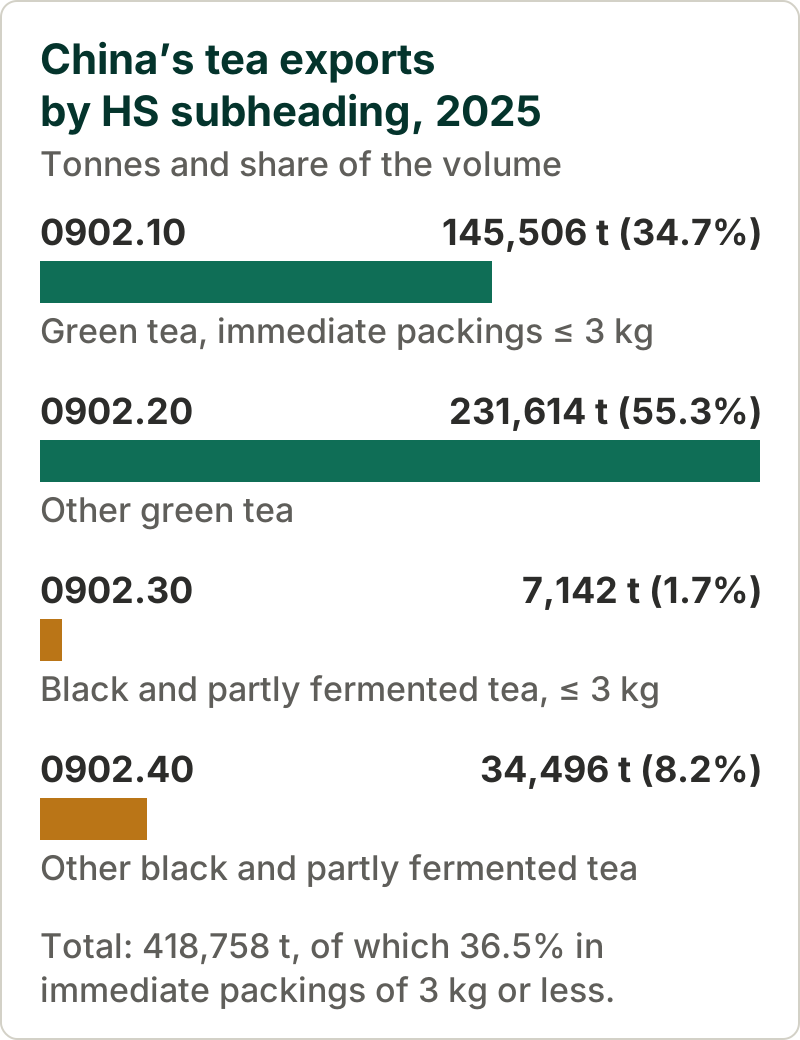 Source: UN Comtrade via WITS, exports reported by China (2025)
Senegal, Mauritania, Ghana, Côte d’Ivoire and Mali were the five main buyers of green tea in packings of 3 kg or less by volume, while Morocco alone took 39.3% of the green tea in larger packings. Unit values are customs values divided by weight: they mix grades and include the packing, so they are not prices. Country detail is in our guide to China’s 2025 tea exports. How China’s 20 largest tea markets have changed since 2015 is shown in our guide to Chinese tea export markets.
Before you declare: a checklist
- Type: green, or black and partly fermented; from 2028, check where white tea goes.
- Packing: the net weight of tea in each inner packing, not the weight of the carton.
- National code: China’s eight-digit line at export, the buyer’s national code at import.
- Blends: ask for a ruling when herbs or fruit make up a large share of the blend.
- Consistency: the same description and code on the contract, invoice, packing list and label.
Questions and answers
What is the HS code for green tea?
0902.10 when the tea is in immediate packings holding 3 kg or less, such as tea bags, retail boxes or 1 kg bags, and 0902.20 for other green tea, such as gunpowder or chunmee in 25 kg cartons lined with a single bag. National tariffs add their own digits to these six. Customs services can differ on small packs shipped in bulk cartons: a 2012 US ruling put small pouches packed in bulk cartons under 0902.20.
What is the difference between HS 090210 and 090220?
Only the packing. Both cover green (not fermented) tea: 0902.10 applies when each immediate packing holds 3 kg or less, and 0902.20 to all other green tea. China's tariff words the test as a net weight of no more than 3 kg per inner packing.
What is the HS code for black tea?
0902.30 for black tea in immediate packings of 3 kg or less and 0902.40 for other black tea. The same two subheadings cover partly fermented tea such as oolong.
What HS code applies to oolong, jasmine and white tea?
Oolong is partly fermented tea, so 0902.30 or 0902.40. Jasmine tea made on green tea stays in 0902.10 or 0902.20, with its own Chinese lines 0902.1011 and 0902.2011. China and a 2012 US ruling put white tea with green tea, but from 1 January 2028 the HS 2028 text names it under 0902.30 and 0902.40.
Are herbal tea, instant tea and iced tea classified under 0902?
No. Herbal infusions not made from the tea plant go to headings such as 08.13, 09.09, 12.11 or 21.06; tea extracts and instant tea go to 2101.20; and ready-to-drink tea beverages go to heading 22.02.
Does HS 2028 change the HS codes for tea?
The four codes and the 3 kg split stay. From 1 January 2028 the wording reads 'non-fermented tea (green tea)' and 'fermented tea (black tea, dark tea) and partly fermented tea (white tea, yellow tea, oolong tea)', which places white tea under 0902.30 and 0902.40. The WCO's correlation tables, however, record no transfer of goods within heading 09.02.
Sources
- 1. World Customs Organization: HS Nomenclature 2022 edition, Chapter 9, coffee, tea, maté and spices · wcoomd.org
- 2. World Customs Organization: HS Nomenclature 2022 edition, Chapter 21, miscellaneous edible preparations · wcoomd.org
- 3. World Customs Organization: HS Nomenclature 2022 edition, Chapter 22, beverages, spirits and vinegar · wcoomd.org
- 4. World Customs Organization: amendments to the HS Nomenclature accepted pursuant to the Council Recommendation of 26 June 2025, in force 1 January 2028 (document NG0304Ba) · wcoomd.org
- 5. World Customs Organization: HS 2028 amendments effective from 1 January 2028 · wcoomd.org
- 6. World Customs Organization: Table I correlating the HS 2028 version to the HS 2022 version, including the corrigendum of July 2026 · wcoomd.org
- 7. Japan Customs: Explanatory Notes to the Customs Tariff, Chapter 9, based on the WCO's HS Explanatory Notes (in Japanese) · customs.go.jp
- 8. State Council Tariff Commission: announcement 2025 No. 12 on the 2026 Customs Tariff of the People's Republic of China, 31 December 2025 (in Chinese) · gss.mof.gov.cn
- 9. State Council Tariff Commission: 2023 tariff line adjustment table, annex 7, with the jasmine and white tea lines (in Chinese) · gss.mof.gov.cn
- 10. State Council Tariff Commission: 2021 agreement tariff rate table, annex 7, with the eight-digit lines of heading 0902 (in Chinese) · gss.mof.gov.cn
- 11. State Council Tariff Commission: 2024 tariff line adjustment table, annex 5, note 2 on herbal teas under line 1211.9039 (in Chinese) · gss.mof.gov.cn
- 12. General Administration of Customs (GACC): announcement 2019 No. 18 on the rules for completing import and export declarations (in Chinese) · gov.cn
- 13. MOFCOM and 中国食品土畜进出口商会: China export monthly statistical report, tea, December 2024, with the list of customs codes used (in Chinese) · wms.mofcom.gov.cn
- 14. MOFCOM and 中国食品土畜进出口商会: China export monthly statistical report, tea, December 2025 (in Chinese) · wms.mofcom.gov.cn
- 15. EUR-Lex: Commission Implementing Regulation (EU) 2025/1926 of 22 September 2025 amending Annex I to Council Regulation (EEC) No 2658/87 (Combined Nomenclature for 2026) · eur-lex.europa.eu
- 16. UK Trade Tariff (UK government): Northern Ireland tariff for commodity 0902 10 00 00, which shows the EU third-country duties that apply in Northern Ireland, checked October 2026 · trade-tariff.service.gov.uk
- 17. US International Trade Commission: Harmonized Tariff Schedule of the United States, Revision 20 (2026), Chapter 9 · hts.usitc.gov
- 18. US Customs and Border Protection: ruling H236614 on oolong tea fermented with ginseng, 5 August 2013 · rulings.cbp.gov
- 19. US Customs and Border Protection: ruling H320527 on rooibos tea, 12 November 2021 · rulings.cbp.gov
- 20. US Customs and Border Protection: ruling N203765 on green, white, oolong and black tea from China, 7 March 2012 · rulings.cbp.gov
- 21. US Customs and Border Protection: ruling H260569 on flavoured green tea blends, 5 October 2016 · rulings.cbp.gov
- 22. US Customs and Border Protection: ruling H275766 on a decaffeinated chai tea, 9 June 2016 · rulings.cbp.gov
- 23. US Customs and Border Protection: ruling E87596 on instant tea, 13 October 1999 · rulings.cbp.gov
- 24. US Customs and Border Protection: ruling N324304 on a ready-to-drink fruit tea from China, 3 March 2022 · rulings.cbp.gov
- 25. US Customs and Border Protection: ruling N342508 on a ready-to-drink milk tea, 4 October 2024 · rulings.cbp.gov
- 26. US Customs and Border Protection: ruling N354721 on the classification and origin of black tea, 29 October 2025 · rulings.cbp.gov
- 27. WTO: Trade Policy Review of Morocco, Secretariat report WT/TPR/S/453, 18 March 2024 · wto.org
- 28. UNCTAD TRAINS via WITS: applied MFN duties reported for 2023 on HS 0902 by Morocco, Senegal, Côte d'Ivoire, Ghana and the EU · wits.worldbank.org
- 29. China Tea Marketing Association (CTMA): brief on China's tea imports and exports in 2025, 20 January 2026 (in Chinese) · ctma.com.cn
- 30. UN Comtrade via WITS: China's exports of green tea in immediate packings of 3 kg or less (HS 0902.10), 2025 · wits.worldbank.org
- 31. UN Comtrade via WITS: China's exports of other green tea (HS 0902.20), 2025 · wits.worldbank.org
- 32. UN Comtrade via WITS: China's exports of black and partly fermented tea in immediate packings of 3 kg or less (HS 0902.30), 2025 · wits.worldbank.org
- 33. UN Comtrade via WITS: China's exports of other black and partly fermented tea (HS 0902.40), 2025 · wits.worldbank.org