Russia's tea imports from China: duties, rules and data
Russia's tea imports from China: 16,038 t in 2025 (US$48.6m), China's 7th market. EAEU duty 0% on bulk tea, 12–12.5% on small packs; labels, GOST.

Key facts
- China declared 16,038 tonnes of tea worth US$48.6 million for Russia in 2025, 4.5% less than in 2024, which made Russia the seventh destination for Chinese tea by volume, according to UN Comtrade data reported by China.
- Under the Eurasian Economic Union's Common Customs Tariff, checked in October 2026, green and black tea in packings over 3 kg pays no import duty, while packs of 3 kg or less pay 12% (green) or 12.5% (black) of the customs value, with minimums of €0.24 to €0.50 per kg.
- Since the results for January–February 2022, official foreign trade statistics of individual Eurasian Economic Union member states have been classified as restricted, according to the Eurasian Economic Commission, and Russia has reported no trade data to UN Comtrade for any year after 2021.
- In 2021, the last year Russia reported, China supplied 11.1% of Russia's 154,982 tonnes of tea imports but 83.1% of its green tea, while black and partly fermented tea made up 90.7% of the total (The Tea Trade's calculation from UN Comtrade).
- Russia's standards for black and green tea, GOST 32573-2013 and GOST 32574-2013, in force since 1 July 2015 according to Rosstandart, cap moisture at 10.0% and require at least 32.0% and 33.0% of water-soluble extract respectively, according to their texts.
China declared 16,038 tonnes of tea worth US$48.6 million for Russia in 2025, 4.5% less than in 2024, which made Russia the seventh destination for Chinese tea by volume, according to UN Comtrade; among the 38 countries that had declared 2025 tea exports to Russia by October 2026, an incomplete set (Viet Nam, fifth in 2021, has no data after 2023), China came fourth, after India, Sri Lanka and Kenya. Most of it is green tea in packings over 3 kg, which pays no duty under the Eurasian Economic Union’s (EAEU) Common Customs Tariff, while packs of 3 kg or less pay 12% or 12.5% with a minimum per kilogram (checked October 2026). Russia’s own figures stop in 2021: since the January–February 2022 results, the Eurasian Economic Commission (EEC) has classified the trade statistics of individual member states as restricted, so exporters’ declarations are the only recent series.
China’s tea exports to Russia, 2015–2025
Russia, listed as 俄罗斯联邦 in the tables of China’s Ministry of Commerce (MOFCOM), took between 12,771 and 19,718 tonnes of Chinese tea a year from 2015 to 2025, leaving aside 2016, for which UN Comtrade holds only an estimated quantity. The volume rose 25.6% over the decade, or 2.3% a year, slightly less than China’s tea exports as a whole (+28.9%; see our guide to Chinese tea export markets). The path was uneven: a peak of 19,718 tonnes in 2022, a 25.1% fall in 2023, then a 13.7% rebound in 2024, when Russia was China’s fourth tea market by volume. Value rose every year from 2020 to 2024, to US$58.7 million, before falling 17.3% in 2025.
China’s tea exports to Russia, 2015–2025 (HS 0902; source: UN Comtrade, figures reported by China)
| Year | Volume (t) | Volume change | Value (US$ million) | Unit value (US$/kg) | Black and partly fermented, share of volume |
|---|---|---|---|---|---|
| 2015 | 12,770.7 | – | 37.20 | 2.91 | 17.7% |
| 2016 | not reported | – | 41.18 | – | – |
| 2017 | 14,748.0 | – | 38.83 | 2.63 | 20.3% |
| 2018 | 14,938.5 | +1.3% | 41.15 | 2.75 | 25.1% |
| 2019 | 13,931.9 | −6.7% | 44.59 | 3.20 | 28.5% |
| 2020 | 14,812.1 | +6.3% | 38.73 | 2.61 | 28.9% |
| 2021 | 18,163.8 | +22.6% | 51.63 | 2.84 | 31.1% |
| 2022 | 19,717.6 | +8.6% | 51.73 | 2.62 | 31.5% |
| 2023 | 14,759.3 | −25.1% | 54.20 | 3.67 | 35.7% |
| 2024 | 16,787.6 | +13.7% | 58.72 | 3.50 | 29.6% |
| 2025 | 16,038.3 | −4.5% | 48.56 | 3.03 | 27.5% |
Changes, unit values (value ÷ volume) and shares are The Tea Trade’s calculation. For 2016, UN Comtrade carries only an estimated quantity (flagged as such), so it is left out. Black and partly fermented tea is HS 0902.30 plus 0902.40.
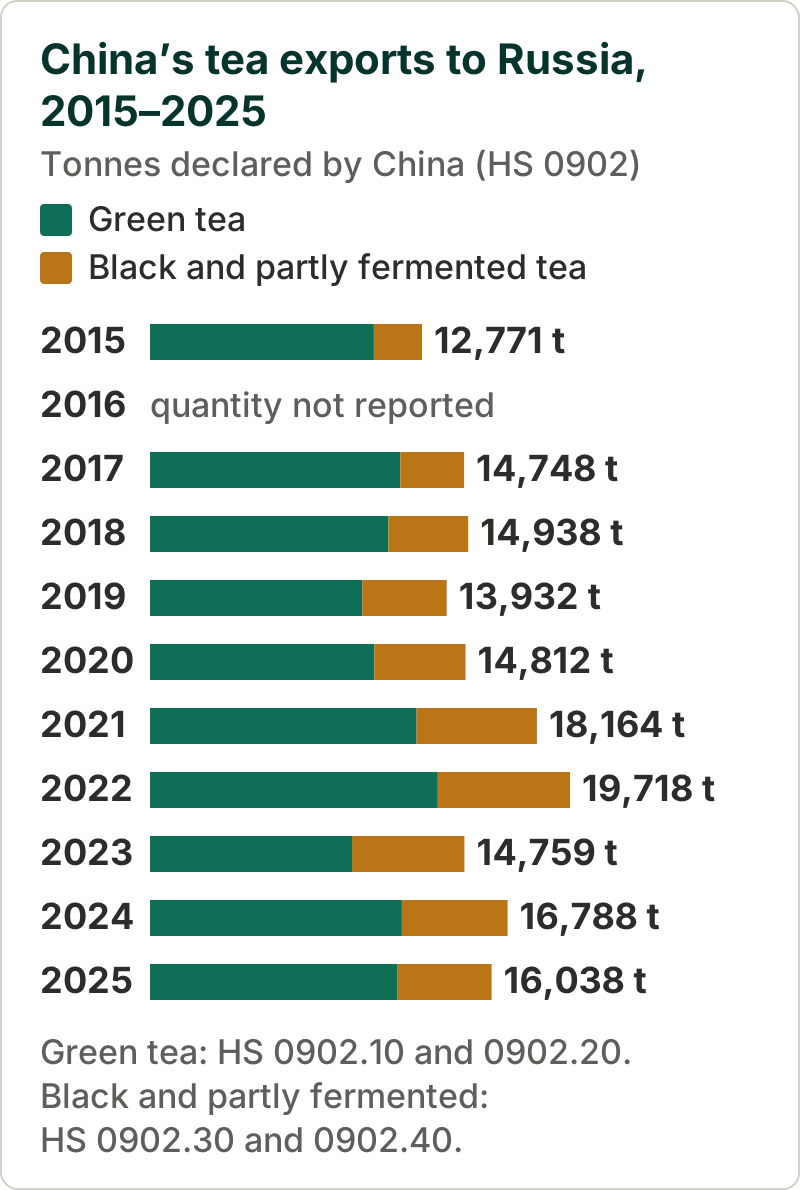 Source: UN Comtrade, exports reported by China (2015–2025)
MOFCOM’s monthly tea reports give a cross-check. The December 2024 report puts Russia seventh by value for the year, with 16,784.3 tonnes (+13.7%) worth US$58.7 million (+8.3%); in 2025 Russia fell to 11th by value (UN Comtrade) and out of MOFCOM’s top-ten table. MOFCOM also reports a Eurasian Economic Union group (欧亚经济联盟): 20,878.9 tonnes in 2024 and 20,551.2 tonnes in 2025, so Russia took about four-fifths of China’s tea for the union (80.4% in 2024, The Tea Trade’s calculation from MOFCOM). From January to April 2026 the group received 5,931.3 tonnes, 14.4% less than a year earlier; Russia is not shown separately for that period, and no later report could be opened in October 2026.
What Russia buys from China: bulk green tea and black tea
Almost all of it travels in bulk. In 2025, 71.2% of the volume China declared for Russia was green tea in packings over 3 kg (HS 0902.20) and 26.0% black or partly fermented tea in packings over 3 kg (0902.40). Packs of 3 kg or less, under 0902.10 and 0902.30, made up 2.8%, and they are the only lines that pay duty in Russia (see the tariff below). Our guide to tea HS codes explains the four subheadings.
China’s tea exports to Russia by HS subheading, 2025 (source: UN Comtrade, figures reported by China)
| Subheading | Volume (t) | Share of volume | Value (US$ million) | Unit value (US$/kg) |
|---|---|---|---|---|
| 0902.10, green tea, packs of 3 kg or less | 217.1 | 1.4% | 1.66 | 7.64 |
| 0902.20, other green tea | 11,412.7 | 71.2% | 25.30 | 2.22 |
| 0902.30, black and partly fermented, packs of 3 kg or less | 232.9 | 1.5% | 2.29 | 9.84 |
| 0902.40, other black and partly fermented | 4,175.6 | 26.0% | 19.32 | 4.63 |
| Total | 16,038.3 | 100% | 48.56 | 3.03 |
Shares and unit values are The Tea Trade’s calculation; unit values are customs values divided by weight, not prices.
The black-tea share has risen since 2015: 17.7% of the volume then, 35.7% at its 2023 peak and 27.5% in 2025. In 2025 Russia was the third buyer by value of China’s 0902.40 exports, after Malaysia and Japan, with US$19.3 million. China’s 0902.40 lines cover oolong, ripe pu-erh and other dark tea as well as black tea, so these figures are not black tea alone; China’s own black tea standards are set out in our guide to Chinese black tea grades.
Russia’s own tea import statistics stop in 2021
Russia’s own detailed figures stop in 2021. Since the results for January–February 2022, official statistics on the foreign and mutual trade of individual EAEU member states have been classified as information of restricted distribution, and figures for the union as a whole are not published, according to the EEC. In UN Comtrade, Russia’s latest report covers 2021: a check on 13 October 2026 found no Russian records for 2022, 2023, 2024 or 2025. Mirror data, the exports that other countries declare for Russia, are the only recent series.
Russia’s 2021 figures describe a black tea market. Black and partly fermented tea made up 90.7% of its 154,982 tonnes of tea imports. China was the fourth supplier, with 17,222 tonnes (11.1%), but it supplied 83.1% of Russia’s green tea and 3.7% of its black and partly fermented tea (The Tea Trade’s calculation from UN Comtrade). For the same year, Russia recorded 942 tonnes (5.2%) less tea from China than the 18,164 tonnes China declared for Russia, and a value of US$48.6 million including insurance and freight (CIF), against China’s free-on-board (FOB) US$51.6 million.
Russia’s main tea suppliers: Russia’s 2021 records and the exporters’ 2025 declarations, which are incomplete (HS 0902; source: UN Comtrade)
| Supplier | 2021, recorded by Russia (t) | Share | 2025, declared by the exporter (t) | Share of declared total |
|---|---|---|---|---|
| India | 35,550 | 22.9% | 31,807 | 31.6% |
| Kenya | 32,508 | 21.0% | 21,372 | 21.3% |
| Sri Lanka | 29,773 | 19.2% | 21,594 | 21.5% |
| China | 17,222 | 11.1% | 16,038 | 16.0% |
| Viet Nam | 12,453 | 8.0% | no record | – |
| Indonesia | 7,431 | 4.8% | 3,086 | 3.1% |
| United Arab Emirates | 5,050 | 3.3% | no record | – |
| Argentina | 3,702 | 2.4% | no record | – |
| Kazakhstan | 3,248 | 2.1% | 3,320 | 3.3% |
| Total (2025: 38 reporting countries only) | 154,982 | 100% | 100,515 | 100% |
The 2025 column is incomplete. It sums the declarations of the 38 countries that had reported tea exports to Russia for 2025 by 13 October 2026; “no record” means UN Comtrade held no such declaration from that country. Viet Nam, the United Arab Emirates and Argentina, 13.7% of Russia’s tea in 2021, are among those missing, and Viet Nam has no tea export data at all after 2023. The 2025 total is therefore not Russia’s import total, and the 2025 shares are shares of what was declared. Under the United Nations recommendations for trade statistics, importers record the country of origin and exporters the country of last known destination, so the two columns are not on the same basis. Shares are The Tea Trade’s calculation.
By value the order changes. In 2025 Sri Lanka declared US$117.9 million of tea for Russia, India US$68.4 million, China US$48.6 million and Kenya US$43.2 million, so among the countries that reported, China ranked third by value and fourth by volume, as it did in 2024 (UN Comtrade).
EAEU import duty on tea: the Common Customs Tariff
Russia does not set its own tea duty. It applies the Common Customs Tariff (CCT) of the EAEU, whose members are Armenia, Belarus, Kazakhstan, Kyrgyzstan and Russia, in the version approved by EEC Council Decision No. 80 of 14 September 2021. The tariff splits each small-pack subheading into tea “in single-use packaging” (в одноразовой упаковке), a term the tariff file does not define, and other tea.
EAEU import duty on tea, heading 09.02 (source: EEC, Common Customs Tariff, group 09; checked October 2026)
| CCT line | Description | Import duty |
|---|---|---|
| 0902 10 000 1 | Green tea in packs of 3 kg or less, in single-use packaging | 12%, but not less than €0.34 per kg |
| 0902 10 000 9 | Green tea in packs of 3 kg or less, other | 12%, but not less than €0.24 per kg |
| 0902 20 000 0 | Other green tea | 0% |
| 0902 30 000 1 | Black and partly fermented tea in packs of 3 kg or less, in single-use packaging | 12.5%, but not less than €0.50 per kg |
| 0902 30 000 9 | Black and partly fermented tea in packs of 3 kg or less, other | 12.5%, but not less than €0.25 per kg |
| 0902 40 000 0 | Other black and partly fermented tea | 0% |
The percentage applies to the customs value. The euro minimum takes over when that value is below €2.00 per kg for the two “other” small-pack lines, €2.83 per kg for green tea in single-use packaging and €4.00 per kg for black tea in single-use packaging (The Tea Trade’s calculation: minimum ÷ rate). A note to the tariff set all four small-pack lines at 0% from 28 March to 30 September 2022 inclusive.
Chinese tea pays these rates in full. The EEC Council’s Decision No. 17 of 5 March 2021, in force since 12 October 2021, removed 75 developing countries from the list of users of the union’s tariff preferences (EEC), China among them, according to the EEC’s trade policy director; the later changes to the list, in 2025 and 2026, concerned other countries. None of China’s signed free trade agreements covers Russia either, so a certificate of origin for tea shipped there is non-preferential; our guide to Chinese tea export documents explains the two kinds.
EAEU food safety and labelling rules: TR CU 021/2011 and 022/2011
Two EAEU technical regulations govern tea on the Russian market. Both have been amended since 2011, most recently with effect from 10 November 2024, and the points below are as amended (checked October 2026). The food safety regulation TR CU 021/2011, adopted by Customs Union Commission Decision No. 880 of 9 December 2011 and in force since 1 July 2013, requires a declaration of conformity (декларация о соответствии) for food placed on the market, except unprocessed food of animal origin, specialised food and vinegar. The applicant must be a company or individual entrepreneur registered in a member state: the manufacturer, a seller, or a party acting for the foreign manufacturer under a contract with it. A Chinese exporter therefore needs a registered importer or representative to make the declaration. The regulation sets out three declaration schemes, one of them (2д) for a single batch tested in a laboratory of the applicant’s choice; the declaration is registered, and the product then carries the union’s single mark of circulation.
Maximum levels of toxic elements for tea (TR CU 021/2011, Annex 3, mg/kg)
| Element | Maximum level | Products in the same row |
|---|---|---|
| Lead | 10.0 | Tea (black, green, pressed) |
| Arsenic | 1.0 | Tea, coffee, fruit concentrates with sugar |
| Cadmium | 1.0 | Tea |
| Mercury | 0.1 | Tea |
The labelling regulation TR CU 022/2011 (Decision No. 881 of 9 December 2011, in force since 1 July 2013) lists 11 items for packaged food: name, composition, quantity, date of manufacture, shelf life, storage conditions, the name and location of the manufacturer (and of the importer where required), recommendations or restrictions for use, nutrition value, information on components obtained from genetically modified organisms, and the single mark of circulation. The label must be in Russian, and also in a member state’s own language where its law requires it. For food from outside the union, the importer’s name and location must appear, and the manufacturer’s name and location may be written in Latin letters and Arabic numerals, or in the official language of the manufacturer’s country, if the country is named in Russian (wording in force since 28 April 2019). The nutrition value may be omitted for tea, and the composition for a single-ingredient product whose name identifies it. Transport packaging needs a shorter list that includes a batch number, but tea shipped unpacked in transport packaging for later packing must carry the full consumer list.
Russian standards for black and green tea: GOST 32573 and 32574
Russia’s standards for black and green tea are interstate standards (GOST), adopted on 3 December 2013 by the Interstate Council for Standardization, Metrology and Certification and in force as national standards in Russia since 1 July 2015: GOST 32573-2013 for black tea and GOST 32574-2013 for green tea. They replaced GOST 1937-90 and GOST 1938-90 for black tea and GOST 1939-90 and GOST 3716-90 for green tea, and Rosstandart lists one published correction to the first and two to the second (Rosstandart records, checked October 2026). Both are on the list of standards whose voluntary application ensures compliance with TR CU 021/2011, approved by EEC Board Decision No. 236 of 24 December 2019, where Rosstandart showed them in force in October 2026, together with GOST 32593-2013 on tea terms and definitions and GOST 33481-2015 for partly fermented tea. Voluntary means that the regulation, not the standard, is binding; a contract can still name the standard.
Physical and chemical requirements in GOST 32573-2013 and GOST 32574-2013 (% by mass; source: Table 2 of each standard’s text)
| Indicator | Black tea, GOST 32573 | Green tea, GOST 32574 |
|---|---|---|
| Water-soluble extractive substances, min | 32.0 | 33.0 |
| Moisture, max | 10.0 | 10.0 |
| Total ash | 4.0 to 8.0 | 4.0 to 8.0 |
| Water-soluble ash, share of total ash, min | 45.0 | 40.0 |
| Crude fibre, max | 19.0 | 24.0 |
According to their texts, neither standard defines grades. Both sort tea by processing and appearance into leaf, granulated and pressed (brick) tea, and leaf tea by size into large (size 1), medium (sizes 2 to 6) and small (sizes 7 to 15), the sizes being those of each adopting country’s own documents. The extract, ash and fibre limits do not apply to pressed tea, and moisture, ash and fibre are checked only when the quality is disputed. The product name must include “черный чай” or “чай черный” (black tea), or “зеленый чай” or “чай зеленый” (green tea).
Paying for tea from China: dated facts
The Bank of Russia publishes the currencies in which foreign trade contracts are settled. In 2021, 58.2% of Russia’s payments to China for imported goods and services were made in US dollars, 10.6% in euros, 27.1% in other currencies and 4.1% in roubles. For later years, the bank publishes the split by region and by group of currencies. For imports from Asia, the rouble’s share of payments rose from 19.7% in 2021 to 49.5% in 2025 and that of other currencies from 11.6% to 42.0%, while the currencies of the states and territories on the list approved by Russian Government Order No. 430-r of 5 March 2022 fell from 68.6% to 8.5%. The figures cover all goods and services, not tea alone. Payment terms themselves are covered in our guide to tea export payment terms.
What this means for tea exporters and importers
- Market size. China’s declarations put Russia at 13,932 to 19,718 tonnes of Chinese tea a year in 2017–2025. Russia’s own figures stop in 2021, so compare exporters’ declarations with exporters’ declarations.
- Packing and duty. Packings over 3 kg (HS 0902.20 and 0902.40) carry no CCT duty; packs of 3 kg or less pay 12% or 12.5% with a euro minimum, and Chinese tea gets no tariff preference (checked October 2026).
- Before loading. Check that an importer or representative registered in an EAEU member state will register the declaration of conformity under TR CU 021/2011, and that the Russian label, with the importer’s name and location, follows TR CU 022/2011.
- Specification. If the contract names GOST 32573-2013 or GOST 32574-2013, test the lot against them: 10.0% moisture at most, and at least 32.0% or 33.0% water-soluble extract.
- Payment. Agree the currency and the bank route in the contract before shipment.
This is general information, not legal or tax advice: have a customs broker in Russia confirm the tariff line, the documents and the rates before each shipment.
Questions and answers
How much tea does Russia import from China?
China declared 16,038 tonnes worth US$48.6 million for Russia in 2025, and 16,788 tonnes in 2024, when Russia was its fourth tea market by volume (UN Comtrade). Over 2015–2025 the peak was 19,718 tonnes, in 2022; 27.5% of the 2025 volume was black or partly fermented tea (The Tea Trade's calculation).
What is the import duty on tea in Russia?
Russia applies the Eurasian Economic Union's Common Customs Tariff: 0% on green and black tea in packings over 3 kg, and 12% on green tea or 12.5% on black tea in packs of 3 kg or less, with a minimum of €0.24 to €0.50 per kg (checked October 2026). Since 12 October 2021, China has not been on the union's list of developing countries eligible for tariff preferences.
Does tea need a declaration of conformity in Russia?
Yes. The EAEU food safety regulation TR CU 021/2011 requires a declaration of conformity for food placed on the market, lodged by a company or entrepreneur registered in a member state, such as the importer. Its limits for tea include 10.0 mg/kg of lead and 1.0 mg/kg of cadmium.
What must a tea label show in Russia?
TR CU 022/2011 lists 11 items for the Russian-language label of packaged food, among them the name, composition, quantity, production date, shelf life, storage conditions, the manufacturer's name and location and the single mark of circulation. Food from outside the union must also name the importer; for tea the nutrition value may be omitted, and so may the composition of a single-ingredient tea whose name identifies it.
Why are there no recent Russian tea import statistics?
Since the January–February 2022 results, official trade statistics of individual EAEU member states have been classified as restricted, according to the Eurasian Economic Commission, and Russia's last report to UN Comtrade covers 2021. Exporters' declarations, such as China's, are the only recent series.
Which countries supply Russia's tea?
Among the countries that had declared 2025 tea exports to Russia in UN Comtrade by October 2026, India, Sri Lanka, Kenya and China led by volume, in that order; China was fourth with 16,038 tonnes and third by value. These declarations are incomplete: Viet Nam, fifth in 2021, has no data after 2023. In Russia's own 2021 figures the order was India, Kenya, Sri Lanka and China.
Sources
- 1. Eurasian Economic Commission: Common Customs Tariff of the EAEU, group 09, coffee, tea, maté and spices, file of 25 April 2022, the current file in October 2026 (in Russian) · eec.eaeunion.org
- 2. EEC Council: Decision No. 17 of 5 March 2021 amending the lists of developing and least developed countries using the EAEU tariff preferences, in force 12 October 2021 (in Russian) · docs.eaeunion.org
- 3. Eurasian Economic Commission: interview with the Director of the Trade Policy Department on cutting trade preferences for third countries, 15 March 2021 (in Russian) · eec.eaeunion.org
- 4. Customs Union Commission: technical regulation TR CU 021/2011, On food safety, Decision No. 880 of 9 December 2011, text published by the EEC (2011 text, amended 2019–2024; in Russian) · eec.eaeunion.org
- 5. Customs Union Commission: technical regulation TR CU 022/2011, Food products in terms of their labelling, Decision No. 881 of 9 December 2011, text published by the EEC (2011 text, amended 2017–2024; in Russian) · eec.eaeunion.org
- 6. Rosstandart: list of standards whose voluntary application ensures compliance with TR CU 021/2011, approved by EEC Board Decision No. 236 of 24 December 2019 (in Russian) · protect.gost.ru
- 7. Eurasian Economic Commission: statistics of foreign and mutual trade, note on data since January–February 2022 (in Russian) · eec.eaeunion.org
- 8. Bank of Russia: external sector statistics, currency structure of settlements under foreign trade contracts, 2013–2021 and 2019–2025 (xlsx, in Russian) · cbr.ru
- 9. MOFCOM and 中国食品土畜进出口商会: China export monthly statistical report, tea, December 2024 (in Chinese) · wms.mofcom.gov.cn
- 10. UN Comtrade: China's tea exports to Russia by HS subheading, 2025 (the same query by year gives 2015–2024) · comtradeapi.un.org
- 11. UN Comtrade: Russia's tea imports (HS 0902) by partner, 2021 · comtradeapi.un.org
- 12. UN Comtrade: tea exports (HS 0902) to Russia declared by every reporting country, 2025 · comtradeapi.un.org