Tea export payment terms: T/T, D/P, D/A and L/C
Tea export payment terms: how T/T deposits, D/P and D/A collections (URC 522) and letters of credit (UCP 600) work, and China's SAFE rules on receipts.

Key facts
- Under the International Chamber of Commerce's UCP 600 rules (2007 revision), a letter of credit is irrevocable even if it does not say so, and each bank has at most five banking days after presentation to decide whether the documents comply.
- Under the International Chamber of Commerce's Uniform Rules for Collections (URC 522, 1995 revision), banks release the shipping documents against payment (D/P) or against acceptance of a bill of exchange (D/A), and only against payment when the collection instruction does not say which.
- Under the rules of China's State Administration of Foreign Exchange (SAFE), as in force in 2026, a Chinese exporter must report within 30 days any advance received more than 30 days before export and any payment due more than 90 days after it.
- The yuan settled 27.2% of China's cross-border trade in goods in 2024, or 12.4 trillion yuan, and 28.1% in the first half of 2025, according to the People's Bank of China's RMB Internationalization Report 2025.
- Since 1 August 2025, Instruction 02/07/2025/RFE of the Central Bank of West African States (BCEAO) has required importers in the West African Economic and Monetary Union (WAEMU) to domicile any import worth more than 20 million CFA francs with an authorised intermediary such as a bank, and has limited advance payments on those imports to 50% of the value of the goods.
Tea export payment terms set when, and against what, a buyer pays a Chinese exporter: by bank transfer (telegraphic transfer, T/T), which can be split into a deposit and a balance; by documentary collection, in which banks release the shipping documents against payment (D/P) or against acceptance of a bill of exchange (D/A) under the International Chamber of Commerce’s URC 522 rules; or by letter of credit, the buyer’s bank’s undertaking to pay against complying documents under the ICC’s UCP 600. Only the letter of credit adds a bank’s promise: in a collection, banks neither verify the documents nor guarantee payment, the US International Trade Administration (ITA) notes. In China, the exporter must as a rule collect the payment itself and report advances and long payment terms to the State Administration of Foreign Exchange (SAFE, 国家外汇管理局), and the yuan settled 27.2% of China’s cross-border trade in goods in 2024, according to the People’s Bank of China (PBOC; rules checked October 2026).
Tea export payment terms compared
Each method sets when your money leaves and what you hold when it does; a contract can combine them, such as a deposit by transfer and the balance by collection.
Payment methods compared, from the buyer’s side (sources: ICC UCP 600 and URC 522; US International Trade Administration; SAFE; checked October 2026)
| Method | Buyer pays | What the banks do | Buyer’s main risk | Documents it turns on | Rules |
|---|---|---|---|---|---|
| T/T before shipment (deposit or prepayment) | Before shipment | Move the money, check no document | Tea late, short or not as agreed | Contract, pro forma invoice | Contract; SAFE report if received more than 30 days before export |
| T/T after shipment, open account | On the agreed date after shipment | Move the money | Little: the seller carries the credit risk | Invoice, agreed shipping documents | Contract; SAFE report if due more than 90 days after export |
| Documents against payment (D/P) | When the bank presents the documents, before clearance | Release the documents against payment; no guarantee | Paying before the tea is cleared and checked | Sight bill if any, invoice, packing list, original bill of lading, certificates | URC 522 |
| Documents against acceptance (D/A) | At maturity of the accepted bill | Release the documents against acceptance | Little: the seller gives credit | Bill payable later, same commercial documents | URC 522; SAFE limits beyond 90 days |
| Letter of credit (L/C) | On a complying presentation, at sight or later | Issuing bank must honour; documents examined within 5 banking days | Complying documents for tea that does not comply; fees | As the credit lists: invoice, on-board bill of lading, insurance under CIF or CIP, certificates | UCP 600, ISBP 821 |
Telegraphic transfer: deposit and balance
A telegraphic transfer is a plain bank transfer, filed under remittance (汇款) on the registration form of China’s foreign-exchange regulator, beside letter of credit (信用证) and collection (托收). The ITA calls a wire transfer the most secure and preferred cash-in-advance option for exporters, and payment in advance, of all or a significant part of the price before shipment, the least attractive option for the buyer.
No bank looks at a document in a transfer, so the contract does all the work: a deposit with the order, then a balance due before shipment, against copies of the documents, against the originals or on a date after arrival. Each later step moves risk to the seller, who carries the credit risk on open account (ITA). Morocco, Algeria and the countries of the West African Economic and Monetary Union (WAEMU) cap the deposit, as shown below, and a Chinese exporter that receives an advance more than 30 days before export must report it to SAFE within 30 days (SAFE Current Account Foreign Exchange Business Guide, 2020 edition, Article 20).
D/P and D/A: documentary collection under URC 522
In a documentary collection (托收), the seller’s bank sends the shipping documents, with or without a bill of exchange, to a bank in your country, which releases them on the seller’s instructions. The ICC’s Uniform Rules for Collections, URC 522 (1995 revision), apply when the collection instruction says so (Article 4). They distinguish financial documents, such as bills of exchange, from commercial documents, such as invoices and transport documents (Article 2).
- D/P, documents against payment: the bank releases the documents only against payment.
- D/A, documents against acceptance: you receive them by accepting a bill of exchange payable at a future date, and pay at maturity.
If an instruction with such a bill does not say which applies, the documents are released only against payment (Article 7).
The banks’ role is narrow: they need not handle a collection (Article 1), check only that the documents appear to be as listed in the instruction (Article 12) and take no responsibility for their form, accuracy or genuineness (Article 13). The ITA adds that collections, with no verification of the documents and no guarantee of payment, are generally less expensive than letters of credit, and recommends them only for established relationships in stable markets.
For you, D/P means paying before you can clear the tea, since the importer needs the documents to clear the goods (ITA); D/A makes the seller your lender. If you neither pay nor accept, the presenting bank must advise the seller’s bank without delay, and the documents may be returned if no instructions arrive within 60 days (Article 26); the seller must then find another buyer, ship the tea back or abandon it (ITA). In principle, exporters in SAFE’s B and C classes may not sign export contracts with payment terms of more than 90 days, D/A included.
Letters of credit: UCP 600 and ISBP 821
A letter of credit (信用证) is the issuing bank’s undertaking to honour a presentation of documents that complies with the credit (UCP 600, Article 2). UCP 600, the sixth revision of rules first issued in 1933, has applied since July 2007 to credits whose text says they are subject to it, and binds all parties unless the credit modifies or excludes it (Article 1).
- Irrevocable: a credit is irrevocable even if it does not say so (Article 3).
- Separate from the sale: the credit is a transaction separate from the sales contract (Article 4).
- Documents, not tea: banks deal with documents, not with goods (Article 5).
- Confirmation: a confirming bank adds its own undertaking to the issuing bank’s (Article 2).
The UCP 600 clock
A credit must state an expiry date for presentation (Article 6). A presentation that includes an original transport document must be made no later than 21 calendar days after shipment, and before expiry (Article 14(c)), unless the credit sets other terms (Article 1). Each bank then has at most five banking days after presentation to decide whether the documents comply (Article 14(b)). If they comply, the issuing bank must honour (Article 7); if not, a bank that refuses sends a single notice by the close of the fifth banking day, and the issuing bank may ask you whether you waive the discrepancies (Article 16).
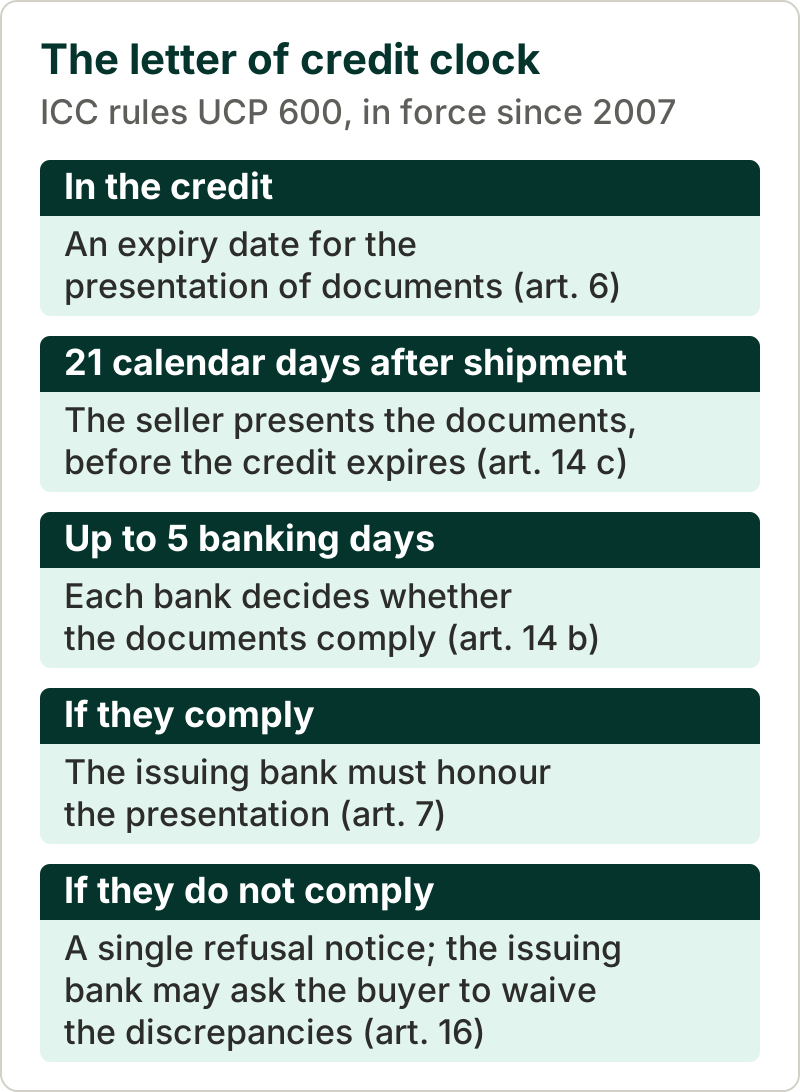 Source: ICC, UCP 600 (2007 revision), articles 6, 7, 14 and 16
Documents to specify for tea
Since banks check documents, not tea, your protection lies in what the credit asks for:
- Invoice: issued by the seller, in your name and in the credit’s currency, describing the goods as the credit does (Article 18); other documents may use general terms, and no data may conflict between documents or with the credit (Article 14).
- Bill of lading: it must show the tea shipped on board a named vessel at the port of loading stated in the credit (Article 20).
- Insurance: if the credit is silent, cover of at least 110% of the CIF or CIP value (Article 28); who insures under each rule is explained in our guide to Incoterms and landed cost for tea.
- Quantity: “about” allows 10% either way (Article 30(a)); otherwise a 5% quantity tolerance applies only if the credit does not count packing units, such as cartons, and the drawings stay within its amount (Article 30(b)).
- Partial shipments: allowed unless the credit says otherwise (Article 31).
- Quality: to have it checked before payment, require an inspection certificate or a test report; the certificates China’s customs issue are covered in our guide to Chinese tea export documents.
Banks examine documents by the ICC’s International Standard Banking Practice (ISBP 821, revised in 2023), which explains how UCP 600 is applied without amending it (ICC Academy, 2024). Letters of credit are relatively expensive because of bank fees (ITA).
China’s foreign-exchange rules on export receipts
A Chinese exporter is paid under the Foreign Exchange Administration Regulations (外汇管理条例, State Council Decree No. 532 of 5 August 2008) and SAFE’s Current Account Foreign Exchange Business Guide (2020 edition), as amended in 2023 and 2024, both on SAFE’s list of rules in force at 30 June 2026:
- Real trade, checked by banks: receipts must rest on a real and lawful transaction, and banks check the documents against the payment (Regulations, Article 12), confirming the nature of incoming funds with the exporter when they cannot tell (Guide, Article 11). The exporter declares the contract, invoice and bill of lading numbers (Article 19).
- The list: in principle, banks handle foreign exchange for goods only for companies on SAFE’s list of trade foreign-exchange enterprises (贸易外汇收支企业名录) (Article 1); since 1 June 2024, banks have registered companies on it directly (Notice Huifa [2024] No. 11).
- The exporter collects: the rule is “whoever exports collects” (谁出口谁收汇, Article 9). In an agency export the agent normally collects, and export receipts may be kept abroad only as the rules allow (Article 8).
- Reports: within 30 days, the exporter reports advances received more than 30 days before export and payments due more than 90 days after it (Article 20).
- Classes: SAFE grades companies A, B or C (Article 27). In principle, exporters in classes B and C may not sign contracts with payment terms of more than 90 days (Articles 34 and 35); after six months in the class, once the problem that put them there is corrected, they may register such business with SAFE (Article 34 for class B; 2024 notice, Article 4, for class C since June 2024).
The export-receipt verification form (出口收汇核销单) was abolished on 1 August 2012 (Announcement 2012 No. 1 of SAFE, GACC and the State Taxation Administration), so a guide that still asks for one is out of date.
For you: pay from your own company to the exporter named in the contract, quote the contract and invoice numbers, and if the seller asks you to pay another company or an account abroad, ask which exception to “whoever exports collects” applies.
Paying in US dollars or yuan
You can pay a Chinese exporter in yuan (renminbi, 人民币) or in a foreign currency: yuan settlement of cross-border trade began as a pilot in five cities in July 2009 and was opened to the whole country in July 2011 (PBOC).
In 2024, the yuan settled 12.4 trillion yuan of China’s cross-border trade in goods, 27.2% of the total, against 24.8% in 2023, and 28.1% in the first half of 2025, according to the PBOC’s RMB Internationalization Report 2025. Foreign currencies, not broken down in the report, settled the other 72.8% in 2024 (the 2023 share and the 72.8% are The Tea Trade’s calculation). In China’s trade with Africa, yuan settlement of trade in goods reached 56.37 billion yuan in 2024, up 35.9%; the PBOC has authorised yuan clearing banks in South Africa, Zambia and Mauritius, and 63 banking institutions from African countries were in China’s Cross-border Interbank Payment System (CIPS) at the end of 2024. In China’s goods trade with Kazakhstan, Kyrgyzstan and Tajikistan, the yuan’s share was about 25% in 2024 and 30% in the first half of 2025.
The contract currency decides who carries the exchange risk until payment: the buyer who pays in dollars or yuan while selling in dirhams or CFA francs, or the seller paid in dollars, who may keep the foreign currency or sell it to a bank (Regulations, Article 13). Under a letter of credit, the invoice is in the credit’s currency (UCP 600, Article 18).
Your country’s rules: domiciliation and advance limits
Several importing countries tie payment to a bank file and cap advances:
- Morocco: as a general rule, the bank pays after customs have recorded the goods, or earlier by documentary credit or collection against the original transport document. An advance is capped at 30% of the import value, and full prepayment at the equivalent of MAD 200,000 (Office des Changes, IGOC 2026, Articles 50 and 52 to 54); our guide to importing green tea into Morocco gives the details.
- Algeria: the contract must be domiciled with a bank before any payment, the bank pays against the final invoices and the shipping or customs documents, and advances are capped at 15% of the contract value, against a refund guarantee from a first-class bank, unless the Banque d’Algérie authorises more (Regulation 07-01, Articles 29, 44 and 50). See Algeria’s import and payment rules.
- WAEMU countries, such as Senegal and Côte d’Ivoire: since 1 August 2025, any import worth more than 20 million CFA francs must be domiciled with an authorised intermediary such as a bank (Instruction 02/07/2025/RFE of the Central Bank of West African States, BCEAO, Article 3, under the union’s Regulation 06/2024 of 20 December 2024), and an advance may not exceed 50% of the value of the goods. Without a letter of credit, the bank can release the currency against the on-board bill of lading if payment falls due against it, or against the customs import certificate once the goods are in; below the threshold, a final invoice is enough (Article 6). Duties in these countries are covered in our guide to West African tea import duties.
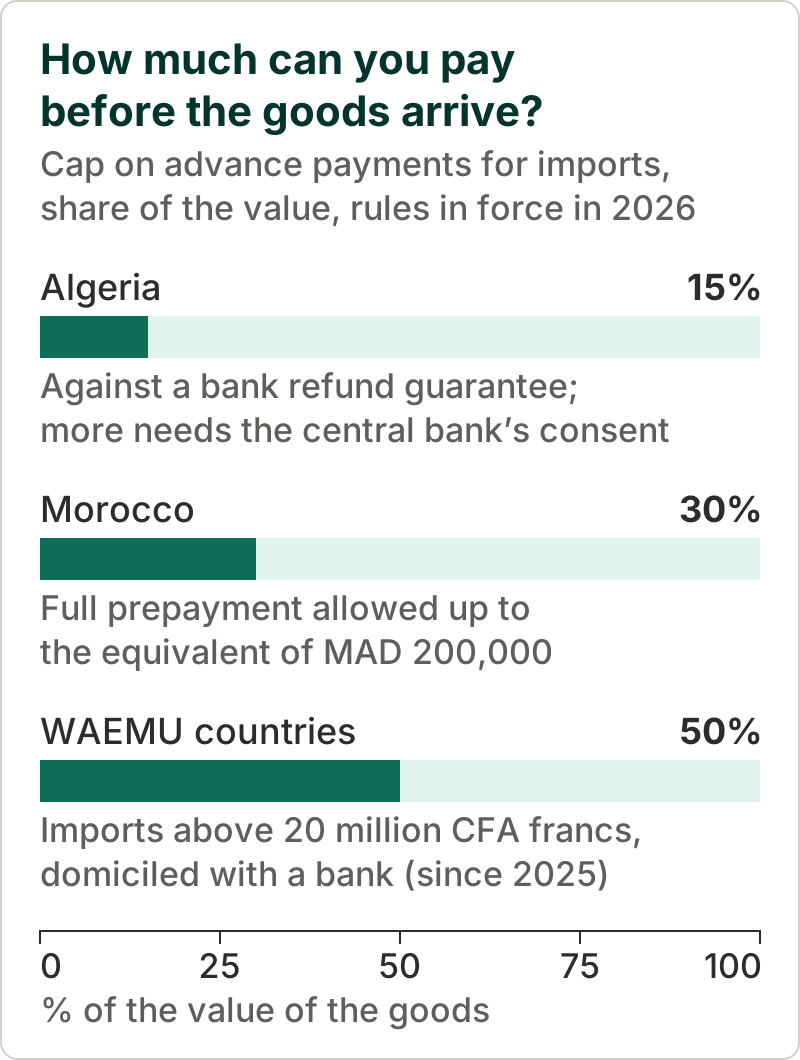 Sources: Banque d’Algérie Regulation 07-01 (2007), article 50; Office des Changes, IGOC 2026, articles 53 and 54; BCEAO Instruction 02/07/2025/RFE (2025), articles 3 and 6
What to put in the payment clause
- Method and steps: the deposit, its percentage and due date, and what triggers the balance.
- Currency and charges: the currency of the price and of payment, and who pays each bank’s charges.
- Parties: your company as payer, the exporter named in the contract as payee with its account in China, and the contract and invoice numbers in every transfer.
- Documents: originals and copies of the invoice, packing list, on-board bill of lading, certificate of origin, phytosanitary or health certificate and insurance certificate.
- Letter of credit: latest shipment date, presentation period, expiry date and place, quantity in kilograms or in cartons, partial shipments, confirmation and any inspection certificate.
- D/A or deferred payment: a due date within 90 days of export, or the seller’s confirmation that SAFE’s rules allow it a longer term.
- Your own rules: your country’s domiciliation threshold and advance cap.
This is general information, checked in October 2026, and not legal or financial advice: confirm the terms with your bank before you sign.
Questions and answers
What are the payment terms for buying tea from China?
A buyer pays by bank transfer (T/T), which can be split into a deposit and a balance, by documentary collection, documents against payment (D/P) or against acceptance (D/A) under the ICC's URC 522, or by letter of credit under UCP 600. The terms are negotiated, within the exchange rules of China and of the buyer's country.
What is the difference between D/P and D/A?
Under documents against payment (D/P), the bank hands the shipping documents to the buyer only against payment. Under documents against acceptance (D/A), it hands them over when the buyer accepts a bill of exchange payable at a later date. If the collection instruction does not say which, URC 522 has the documents released only against payment.
Is a letter of credit safer than a bank transfer for the buyer?
It ties payment to documents: the issuing bank must honour a presentation that complies with the credit (UCP 600, Article 7). But banks deal with documents, not goods (Article 5), so the credit protects the buyer only as far as the documents it requires, such as an on-board bill of lading or an inspection certificate.
How long does the seller have to present documents under a letter of credit?
Under UCP 600, a presentation that includes an original transport document must be made no later than 21 calendar days after shipment, and before the credit expires, unless the credit says otherwise. Each bank then has at most five banking days to decide whether the documents comply.
Can I pay a Chinese tea exporter in yuan?
Yes. Cross-border trade settlement in yuan has been open throughout China since July 2011, and the yuan settled 27.2% of China's cross-border trade in goods in 2024 and 28.1% in the first half of 2025, according to the People's Bank of China. Your own country's exchange rules decide how you buy the currency.
How much deposit can I pay a Chinese supplier before shipment?
That depends on your country's exchange rules. As a general rule Morocco caps advances at 30% of the import value (full prepayment is allowed up to the equivalent of MAD 200,000), Algeria at 15% against a bank refund guarantee, and the West African Economic and Monetary Union (WAEMU) at 50% for imports above 20 million CFA francs (rules checked October 2026).
Sources
- 1. ICC: Uniform Customs and Practice for Documentary Credits, UCP 600 (2007 revision), text in the ICC Digital Library · library.iccwbo.org
- 2. ICC: UCP 600 foreword, ICC Digital Library · library.iccwbo.org
- 3. ICC: Banking Commission approves UCP 600, 25 October 2006 · library.iccwbo.org
- 4. ICC: Uniform Rules for Collections, URC 522 (1995 revision), text in the ICC Digital Library · library.iccwbo.org
- 5. ICC Academy: ISBP for practitioners, applying ICC's banking standards, 24 July 2024 · academy.iccwbo.org
- 6. State Council of China: Foreign Exchange Administration Regulations, Decree No. 532, 5 August 2008 (in Chinese) · gov.cn
- 7. SAFE: Notice issuing the Current Account Foreign Exchange Business Guide (2020 edition), Huifa [2020] No. 14, with its amendments (in Chinese) · safe.gov.cn
- 8. SAFE: Current Account Foreign Exchange Business Guide (2020 edition), full text (in Chinese) · safe.gov.cn
- 9. SAFE: Notice on further optimising trade foreign exchange business, Huifa [2024] No. 11, 3 April 2024 (in Chinese) · gov.cn
- 10. SAFE, GACC and State Taxation Administration: Announcement 2012 No. 1 on reforming the foreign exchange administration of trade in goods, 29 June 2012, since repealed (in Chinese) · safe.gov.cn
- 11. SAFE: List of the main foreign exchange regulations in force at 30 June 2026 (in Chinese) · safe.gov.cn
- 12. SAFE Zhejiang branch: Administrative licensing guide, current account, September 2026 (in Chinese) · safe.gov.cn
- 13. People's Bank of China: RMB Internationalization Report 2025 (in Chinese and English) · nanjing.pbc.gov.cn
- 14. BCEAO: Instruction No. 02/07/2025/RFE on the domiciliation and settlement of imports of goods and services, 7 July 2025 (in French) · bceao.int
- 15. Office des Changes: General Instruction on Foreign Exchange Operations 2026 (IGOC, in French) · oc.gov.ma
- 16. Office des Changes: Imports of goods, articles 46 to 68 of the general instruction (in French) · oc.gov.ma
- 17. Algeria, Journal officiel No. 31 of 13 May 2007: Banque d'Algérie Regulation 07-01 of 3 February 2007 (in French) · joradp.dz
- 18. US International Trade Administration: Methods of payment · trade.gov
- 19. US International Trade Administration: Cash-in-advance · trade.gov
- 20. US International Trade Administration: Documentary collections · trade.gov
- 21. US International Trade Administration: Letters of credit · trade.gov