China–Africa tea shipping times, port by port
China–Africa tea shipping times: 22–28 days' sailing from Shanghai to Casablanca via Suez, 24–31 to Tema round the Cape (calculated), plus hubs and port waits.
Key facts
- On the sea distances of the US National Geospatial-Intelligence Agency's Pub. 151, Shanghai is 9,351 nautical miles from Casablanca through the Suez Canal, about 21.6 to 27.8 days' sailing at an assumed steady 18 to 14 knots (The Tea Trade's calculation).
- Round the Cape of Good Hope, Pub. 151's distances put Cotonou 10,346 nautical miles from Shanghai, Tema 10,405 and Abidjan 10,498, about 24 to 31 days' sailing at an assumed 18 to 14 knots; for these Gulf of Guinea ports the Cape is the shorter route (The Tea Trade's calculation).
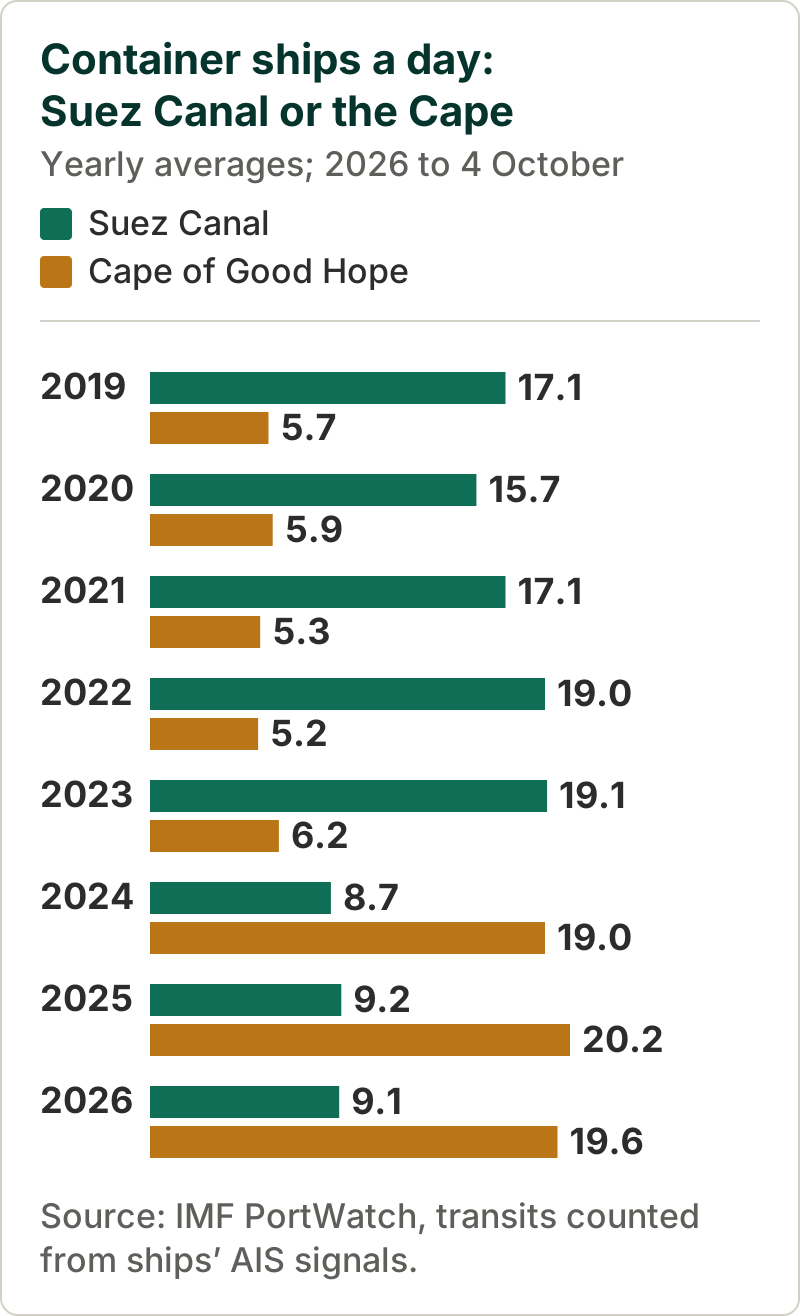
- IMF PortWatch data show an average of 9.1 container ships a day through the Suez Canal from 1 January to 4 October 2026, against 19.1 in 2023, and 19.6 a day round the Cape of Good Hope, against 6.2 (The Tea Trade's calculation).
- The Tanger Med Port Authority's 2025 connections booklet lists seven weekly services from Shanghai to Tanger Med taking 29 to 58 days, and onward services from Tanger Med reaching Dakar in 4 to 11 days, Tema in 10 to 12 and Cotonou in 15 to 16.
- In the World Bank's Container Port Performance Index for 2025, published in June 2026, Tanger Med ranked 6th of 400 container ports and Dakar 144th, while Nouakchott, Cotonou, Lomé, Casablanca, Tema, Algiers and Abidjan ranked between 304th and 381st.
Sea freight from China to North and West Africa takes about three to four and a half weeks of sailing on the shortest route. On the distances of the US National Geospatial-Intelligence Agency (NGA), a ship at an assumed steady 18 to 14 knots needs 21.6 to 27.8 days from Shanghai to Casablanca through the Suez Canal, and 23.9 to 31.2 days to Cotonou, Lomé, Tema or Abidjan round the Cape of Good Hope (The Tea Trade’s calculation). Since the Red Sea diversions began in December 2023, the canal has carried less than a fifth of its 2023 container tonnage in 2024 and 2025, and 43% of its 2023 monthly average in September 2026 (IMF PortWatch; The Tea Trade’s calculation), and at those speeds going round the Cape adds about 8 to 14 days at sea for North African ports. Real services take longer still, with port calls and transhipment: in 2025 the Tanger Med Port Authority listed 29 to 58 days from Shanghai to Tanger Med.
Sea distances from China to North and West Africa
NGA’s Pub. 151, Distances Between Ports (11th edition, 2001), gives distances in nautical miles (simply “miles” below) over the routes that afford the safest passage, most of them the shortest navigable ones. Long routes are built from junction points where shipping lanes converge. This guide routes a ship from the China coast through the Singapore junction point, then either across the Red Sea and the Suez Canal to Port Said or round the Cape of Good Hope:
- China to Singapore: 2,207 miles from Shanghai, 1,817 from Lo-hsing-ta Mao-ti, the anchorage 9 miles below Fuzhou on the Min river, and 1,649 from Xiamen. Pub. 151 does not list Ningbo.
- Singapore to the Mediterranean: 5,035 miles to Port Said through the Suez Canal, then 1,943 to the Strait of Gibraltar or 1,514 to Algiers.
- Singapore to the Atlantic: 5,579 miles to the Cape of Good Hope, then 5,082 to the Strait of Gibraltar, 3,610 to Dakar, 2,712 to Abidjan, 2,619 to Tema and 2,560 to Cotonou.
Adding the legs gives the distance from Shanghai to each port (Table 1). The shorter route changes along the coast. For Algiers, Tanger Med and Casablanca the canal saves 3,376 to 4,549 miles, for Nouakchott 1,520 and for Dakar 724. From Abidjan eastwards the Cape is shorter, by 1,343 miles for Abidjan. From Xiamen, subtract 558 miles; from Fuzhou, 390.
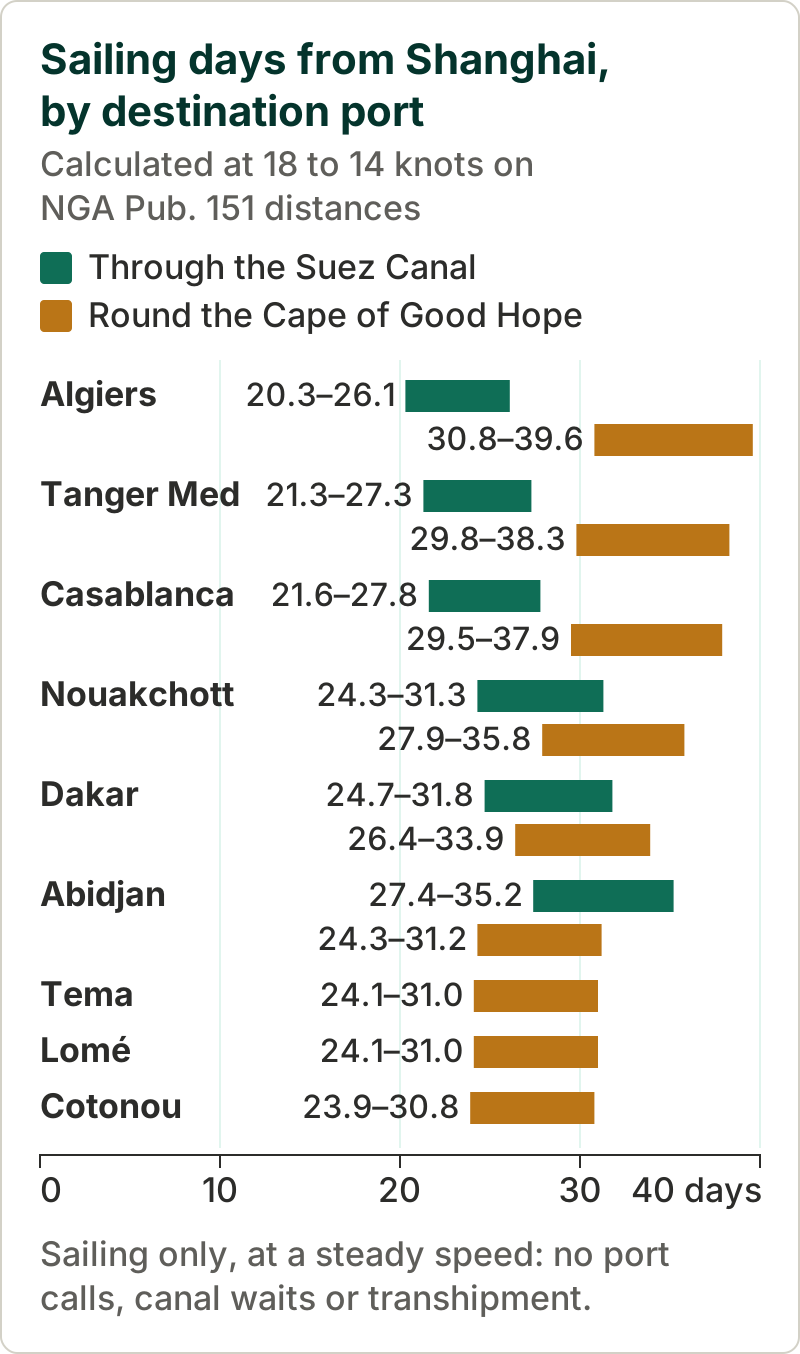
Sailing days by destination port
Sailing time is distance divided by speed. At 16 knots a ship covers 16 × 24 = 384 miles a day, so Shanghai to Casablanca through the canal takes 9,351 ÷ 384 = 24.4 days. No single speed applies: the World Bank’s container port index notes that ships can slow down between calls when port stays are short, and must speed up to recover unplanned hours in port. In a peer-reviewed study of slow steaming, 24 knots is a typical “full” speed for a container ship, 21 knots is “slow” steaming, 18 knots “extra slow” and 15 knots “super slow” (Maloni, Paul and Gligor, 2013). Table 1 uses a band of 18 to 14 knots, from extra slow steaming to just below super slow: this guide’s own assumption, not a published average.
Table 1. Sea distance and sailing time from Shanghai, by destination port (distances: NGA Pub. 151; days at an assumed 18 to 14 knots: The Tea Trade’s calculation)
| Destination port | Shorter route | Miles | Sailing days | Longer route | Miles | Sailing days |
|---|---|---|---|---|---|---|
| Algiers | Suez | 8,756 | 20.3–26.1 | Cape | 13,305 | 30.8–39.6 |
| Tanger Med (Strait of Gibraltar point) | Suez | 9,185 | 21.3–27.3 | Cape | 12,868 | 29.8–38.3 |
| Casablanca | Suez | 9,351 | 21.6–27.8 | Cape | 12,727–12,737 | 29.5–37.9 |
| Nouakchott | Suez | 10,514 | 24.3–31.3 | Cape | 12,034 | 27.9–35.8 |
| Dakar | Suez | 10,672 | 24.7–31.8 | Cape | 11,396 | 26.4–33.9 |
| Abidjan | Cape | 10,498 | 24.3–31.2 | Suez | 11,841 | 27.4–35.2 |
| Tema | Cape | 10,405 | 24.1–31.0 | – | – | – |
| Lomé (Aného) | Cape | 10,401 | 24.1–31.0 | – | – | – |
| Cotonou | Cape | 10,346 | 23.9–30.8 | – | – | – |
Pub. 151 has no entry for Tanger Med, so its row uses the Strait of Gibraltar junction point (35°57′N, 5°45′W). Pub. 151 gives no Cape distance for Casablanca or Lomé: the Casablanca range lies between its figures for El Jadida and Mohammedia, the ports on either side, and the Lomé row uses Aného, 22 minutes of longitude east of Lomé. For Cotonou, the 2,560 miles are the figure in Pub. 151’s Cape of Good Hope table; Cotonou’s own entry prints 857 miles, which is inconsistent with that table and with the neighbouring ports (Aného 2,615, Tema 2,619). Through the Sunda Strait instead of Singapore, Pub. 151’s Cape route from Shanghai is 87 miles shorter.
 Sources: NGA, Pub. 151 Distances Between Ports (2001); calculation in this guide
Suez or the Cape: the Red Sea diversions since December 2023
UNCTAD said in September 2025 that geopolitical tensions affecting the Red Sea “have forced costly rerouting around the Cape of Good Hope”. IMF PortWatch, which counts ship transits from AIS position data, dates the shift: container ship transits through the Suez Canal fell from 584 in November 2023 to 285 in January 2024, while those round the Cape rose from 169 to 527.
The diversion has lasted. Averaging PortWatch’s daily counts, 9.1 container ships a day used the canal from 1 January to 4 October 2026, against 19.1 in 2023, and 19.6 a day rounded the Cape, against 6.2 (The Tea Trade’s calculation). Of the container cargo that PortWatch estimates passed through the canal or round the Cape, the canal’s share was 82% in 2023, 13% in 2025 and 34% in September 2026, when 13.4 million tonnes went through it: more than twice its 2025 monthly average, but 43% of its 2023 one (The Tea Trade’s calculation).
 Source: IMF PortWatch, daily chokepoint transit calls (2019 to 4 October 2026)
For tea, the effect depends on the port. Round the Cape, Tanger Med is 3,683 miles further from Shanghai, 8.5 to 11.0 more days at the assumed 18 to 14 knots; Algiers is 4,549 miles further (10.5 to 13.5 days), Casablanca about 3,380 (7.8 to 10.1 days), Nouakchott 1,520 (3.5 to 4.5 days) and Dakar 724 (1.7 to 2.2 days) (The Tea Trade’s calculation). Ports on the Gulf of Guinea are unaffected, since the Cape is their shorter route anyway. Of the seven Shanghai–Tanger Med services listed by the port authority in 2025, the one marked as sailing through the Suez Canal took 29 days, the shortest of the seven.
Transhipment hubs and real schedules
Computed days assume one ship sailing non-stop. Liner services call at several ports on the way, and a container may change ship at a hub. The Tanger Med Port Authority’s 2025 booklet of maritime connections gives each weekly service’s scheduled transit time: from Shanghai, seven services take 29 to 58 days to Tanger Med (median 37), and from Ningbo, five take 27 to 55 days (median 38). Over Pub. 151’s 9,185 miles, the Suez service’s 29 days are an average of 13.2 knots, port calls included (9,185 ÷ (29 × 24); The Tea Trade’s calculation).
Tanger Med handled 10.24 million TEU in 2024, according to the port authority’s annual report as cited by China’s Ministry of Commerce (MOFCOM), which also reports that transhipment made up 47.9% of the cargo handled by Morocco’s ports that year. The booklet lists weekly links to more than 180 ports in 70 countries, including every destination port in this guide except Algiers.
Table 2. Scheduled transit time from Tanger Med to North and West African ports, 2025 (source: Tanger Med Port Authority)
| From Tanger Med to | Weekly services listed | Transit time (days) |
|---|---|---|
| Casablanca | 6 | 1–7 |
| Nouakchott | 3 | 4–8 |
| Dakar | 5 | 4–11 |
| Abidjan | 4 | 9–14 |
| Tema | 5 | 10–12 |
| Lomé | 3 | 11–15 |
| Cotonou | 2 | 15–16 |
Add the time a container waits at the hub for its connection, which the booklet does not give. The World Bank’s port index shows both patterns among its sample sea legs on Africa trades: Hong Kong–Tema for ships of 5,000 to 8,500 TEU, sailing direct from Asia, and Algeciras–Tema, from southern Spain, for ships of 1,500 to 5,000 TEU. West Africa has hubs of its own. MOFCOM’s 2025 country guides (对外投资合作国别(地区)指南) describe Lomé as West Africa’s only natural deep-water port, and Cotonou as one of the region’s main re-export ports, serving Niger, Burkina Faso and Mali, with 60% to 70% of its imports moving on to Nigeria.
Time in port at each end
The World Bank’s Container Port Performance Index (CPPI) measures the total time a container ship spends in port, from arrival at the port limits or anchorage to departure from the berth. Its 2023 edition, published in 2024, ranks 405 ports and breaks port time down by region: the average port call lasted 40.5 hours in 2023; in sub-Saharan African ports, ships took an average of 29.7 hours just to get from arrival to the berth, against 9.1 hours worldwide.
Table 3. Destination ports: what they handle and their CPPI rank (sources: MOFCOM 2025 country guides; World Bank, CPPI 2023, Table E.1, and CPPI 2025, Annex 2)
| Port | What MOFCOM reports | CPPI 2023 rank (of 405) | CPPI 2025 rank (of 400) |
|---|---|---|---|
| Tanger Med | 10.24 million TEU in 2024 | 4 | 6 |
| Casablanca | One of Morocco’s main ports | 332 | 365 |
| Algiers | 70% of Algeria’s containers, 30% of its imports | 346 | 379 |
| Nouakchott | Over 90% of Mauritania’s import and export cargo | 358 | 304 |
| Dakar | 880,000 TEU in 2024 | 381 | 144 |
| Abidjan | Over 90% of Côte d’Ivoire’s imports and exports | 353 | 381 |
| Tema | 1.206 million TEU in 2022 | 376 | 376 |
| Lomé | West Africa’s only natural deep-water port | 318 | 347 |
| Cotonou | 90% of Benin’s foreign trade | 402 | 324 |
Chinese ports rank far higher: the 2023 table puts Yangshan 1st, Ningbo 12th, Xiamen 31st, Fuzhou 38th and Shanghai 116th. Ranks move from year to year. In September 2025 the World Bank named Dakar among the ports with noteworthy improvements between 2020 and 2024, and its sixth edition, published in June 2026 with 2025 data, puts Dakar 144th of 400 ports.
Clearing the tea takes time too. In Ghana, cargo not cleared within 21 days (60 days for vehicles) is forfeited to the State under section 53 of the Customs Act, 2015 (Act 891), then valued and gazetted for public auction, Ghana’s customs division said in a statement published by the Ghana Ports and Harbours Authority in February 2021.
Inland legs to Mali, Burkina Faso and Niger
Tea for the Sahel continues from the coast by road or rail. MOFCOM’s 2025 guides put Bamako 1,270 km by road from Dakar and 1,115 km from Abidjan, its two main routes; Ouagadougou 1,145 km by rail from Abidjan, while the road through Pô to Ghana is Burkina Faso’s main route for imports and exports; and Niamey 1,245 km by road from Lomé. The guides to Mali and Niger, in files dated April and February 2026, describe two links as out of use: the Dakar–Bamako railway, halted since May 2018, and the 1,060 km road from Cotonou to Niamey, unusable because the Niger–Benin border, closed after 26 July 2023, had not reopened. Abidjan’s transit cargo for Mali and Burkina Faso is covered in our Côte d’Ivoire tea imports guide, and the routes, transit rules and border status in our guide to Sahel tea trade corridors. Transit to Chad is covered in our guide to Cameroon and Chad tea imports.
Before you book: what to check
- The route. Ask whether the service sails through the Suez Canal or round the Cape: for Algiers, Tanger Med and Casablanca the difference is about 8 to 14 days at sea at 18 to 14 knots. Who books the freight, and so chooses the service, follows from the Incoterm (tea Incoterms and landed cost).
- Direct or transhipped. Ask for the hub and the connecting service. From Tanger Med alone, scheduled legs to the ports in this guide took 1 to 16 days in 2025.
- The loading port. Xiamen and Fuzhou are 558 and 390 miles nearer Singapore than Shanghai, 0.9 to 1.7 days at 18 to 14 knots.
- Arrival. Allow for waiting time at the port of discharge and for clearance: in Ghana, cargo still uncleared after 21 days is forfeited to the State.
- The tea. Four to eight weeks, roughly the range of the Tanger Med schedules from China, is a long time in a closed box: see keeping tea fresh in transit and, on condensation in containers, tea container capacity.
Distances, schedules and rankings in this guide were checked in October 2026.
Questions and answers
How long does sea freight take from China to Morocco?
On Pub. 151's distances, Shanghai is 9,351 nautical miles from Casablanca through the Suez Canal, about 22 to 28 days' sailing at an assumed 18 to 14 knots, and about 12,730 round the Cape, 30 to 38 days (The Tea Trade's calculation). Scheduled services take longer: the Tanger Med Port Authority listed 29 to 58 days from Shanghai to Tanger Med in 2025.
How long does shipping from China to Ghana or Côte d'Ivoire take?
Round the Cape of Good Hope, Tema is 10,405 nautical miles from Shanghai and Abidjan 10,498 (Pub. 151), about 24 to 31 days' sailing at an assumed 18 to 14 knots (The Tea Trade's calculation). A container that changes ship at Tanger Med then needs 10 to 12 days to Tema or 9 to 14 days to Abidjan on the services the port authority listed in 2025.
Do ships from China to West Africa go through the Suez Canal?
Not for the Gulf of Guinea: for Abidjan the Cape route is 1,343 nautical miles shorter (Pub. 151; The Tea Trade's calculation). For Dakar and Nouakchott the Suez route is shorter by 724 and 1,520 nautical miles, about 2 and 4 days' sailing at an assumed 18 to 14 knots.
Are container ships still avoiding the Red Sea in 2026?
Mostly. From 1 January to 4 October 2026, IMF PortWatch data show 9.1 container ships a day through the Suez Canal on average, against 19.1 in 2023. In September 2026 the canal carried an estimated 13.4 million tonnes of container cargo, more than twice its 2025 monthly average but 43% of its 2023 average (The Tea Trade's calculation).
How long do ships wait in West African ports?
In 2023, container ships in sub-Saharan African ports took an average of 29.7 hours from arrival at the port limits or anchorage to the berth, against 9.1 hours worldwide, according to the World Bank's Container Port Performance Index. In the index's 2025 ranking, published in June 2026, Dakar was 144th of 400 ports and Cotonou, Lomé, Tema and Abidjan between 324th and 381st.
How is tea carried on to Mali, Burkina Faso and Niger?
By road or rail from a coastal port. According to MOFCOM's 2025 country guides, Bamako is 1,270 km by road from Dakar and 1,115 km from Abidjan, Ouagadougou 1,145 km by rail from Abidjan, and Niamey 1,245 km by road from Lomé. MOFCOM's guide to Niger, in a file dated February 2026, said the 1,060 km road from Cotonou to Niamey could not be used because the Niger–Benin border, closed after 26 July 2023, had not reopened.
Sources
- 1. US National Geospatial-Intelligence Agency (NGA): Pub. 151, Distances Between Ports, 11th edition, 2001 (public-domain copy) · everyspec.com
- 2. IMF PortWatch: daily chokepoint transit calls, Suez Canal and Cape of Good Hope, container ships, yearly totals 2019–2026 (data to 4 October 2026) · services9.arcgis.com
- 3. IMF PortWatch: daily chokepoint transit calls, Suez Canal and Cape of Good Hope, container ships, monthly totals 2023–2026 (data to 4 October 2026) · services9.arcgis.com
- 4. IMF PortWatch: description of the daily chokepoints dataset (definitions and data source) · arcgis.com
- 5. UNCTAD: press conference on the Review of Maritime Transport 2025, Geneva, 24 September 2025 (transcript, UN Geneva newsroom) · unognewsroom.org
- 6. World Bank: The Container Port Performance Index 2023, a comparable assessment of performance based on vessel time in port (2024) · documents1.worldbank.org
- 7. World Bank: The Container Port Performance Index 2025, a comparable assessment of performance based on vessel time in port (sixth edition, 2026; scores and ranks in Annex 2) · documents1.worldbank.org
- 8. World Bank: Methodology note, Container Port Performance Index, 10 June 2026 · thedocs.worldbank.org
- 9. World Bank: Port performance varies across the globe amid continuing shocks, press release, 22 September 2025 · worldbank.org
- 10. Tanger Med Port Authority: Maritime connections 2025 (booklet) · tangermed.ma
- 11. Ghana Ports and Harbours Authority: Customs advises importers to clear goods on time or risk forfeiting them to State, 17 February 2021 · ghanaports.gov.gh
- 12. MOFCOM, Chinese Academy of International Trade and Economic Cooperation and Chinese Embassy: country guide for outbound investment and cooperation, Morocco, 2025 edition (in Chinese) · mofcom.gov.cn
- 13. MOFCOM and others: country guide, Algeria, 2025 edition (in Chinese) · mofcom.gov.cn
- 14. MOFCOM and others: country guide, Mauritania, 2025 edition (in Chinese) · mofcom.gov.cn
- 15. MOFCOM and others: country guide, Senegal, 2025 edition (in Chinese) · mofcom.gov.cn
- 16. MOFCOM and others: country guide, Côte d'Ivoire, 2025 edition (in Chinese) · mofcom.gov.cn
- 17. MOFCOM and others: country guide, Ghana, 2025 edition (in Chinese) · mofcom.gov.cn
- 18. MOFCOM and others: country guide, Togo, 2025 edition (in Chinese) · mofcom.gov.cn
- 19. MOFCOM and others: country guide, Benin, 2025 edition (in Chinese) · mofcom.gov.cn
- 20. MOFCOM and others: country guide, Mali, 2025 edition (in Chinese) · mofcom.gov.cn
- 21. MOFCOM and others: country guide, Burkina Faso, 2025 edition (in Chinese) · mofcom.gov.cn
- 22. MOFCOM and others: country guide, Niger, 2025 edition (in Chinese) · mofcom.gov.cn
- 23. Maloni, Paul and Gligor: Slow steaming impacts on ocean carriers and shippers, Maritime Economics & Logistics 15 (2), 2013, pp. 151–171 (peer-reviewed) · doi.org