Incoterms for tea: FOB, CFR, CIF and the landed cost
Incoterms for tea: who pays freight and bears risk under FOB, CFR, CIF, FCA, CPT, CIP and DAP, and a worked landed-cost example for green tea in Morocco.
Key facts
- Incoterms® 2020, the International Chamber of Commerce's trade terms in force since 1 January 2020, reserve FOB, CFR and CIF for sea and inland waterway transport, and ICC's free checklist advises FCA, CPT or CIP for goods that travel in containers.
- Under Incoterms® 2020, a seller on CIF terms must insure the goods to at least the Institute Cargo Clauses (C) and a seller on CIP terms to the clauses (A), according to ICC; French customs (for CIF) and ICC Academy (for CIP) put the minimum cover at 110% of the price.
- Morocco levies its ad valorem import duties on the c.i.f. value of imports (WTO Trade Policy Review, 2024), so a tea buyer on FOB terms adds sea freight and insurance to the price before applying the 2.5% or 30% duty on green tea (2026 rates).
- China records its exports at FOB value and its imports at CIF value, its National Bureau of Statistics states, so MOFCOM's average of US$3,043 per tonne for tea exported to Morocco in 2025 leaves out sea freight and insurance.
- In this guide's hypothetical example, 20 tonnes of green tea with a customs value of US$64,000 pay US$14,912 in duty, parafiscal tax and VAT at Moroccan customs in packings of 20 kg or more, against US$36,032 in packs under 20 kg (2026 rates).
Incoterms® 2020, the trade terms of the International Chamber of Commerce (ICC), decide who books and pays the freight and insurance on a tea shipment and where the risk passes to the buyer: once the tea is on board the vessel under FOB, CFR and CIF, and when it is handed to the carrier under FCA, CPT and CIP. ICC’s free checklist keeps FOB, CFR and CIF for goods loaded straight on board and points container shipments to FCA, CPT or CIP. The Incoterm does not set the duty: Morocco charges its 2.5% or 30% on green tea (2026 rates) on a CIF-type customs value, so a buyer on FOB terms adds freight and insurance before applying the rate.
Incoterms 2020: what each rule means for a tea shipment
ICC sells the rules themselves; this guide relies on what it publishes free: its checklist and flowcharts, web pages, ICC Academy articles and an introduction to Incoterms® 2020 whose author, an adviser to the drafting group, notes that it gives his own views, not the rules. The 2020 edition entered into force on 1 January 2020, and ICC’s Incoterms pages, checked in October 2026, announce no successor.
The eleven rules fall into two families. FAS, FOB, CFR and CIF are for sea and inland waterway transport, where the seller delivers by placing the goods on board a vessel (alongside it, for FAS). EXW, FCA, CPT, CIP, DAP, DPU and DDP work for any mode or modes of transport. This guide covers seven of them.
Seven Incoterms® 2020 rules: delivery, freight and insurance (ICC introduction, checklist and web page; ICC Academy for the insurance column)
| Rule (place named after it) | Transport | Seller delivers, and the risk passes | Main freight paid by | Insurance the seller must buy |
|---|---|---|---|---|
| FCA, Free Carrier (place of delivery) | Any mode | Loaded on the buyer’s vehicle, if the named place is the seller’s premises; elsewhere, placed at the disposal of the buyer’s carrier | Buyer | None |
| CPT, Carriage Paid To (destination) | Any mode | Handed over to the carrier the seller contracted | Seller | None |
| CIP, Carriage and Insurance Paid To (destination) | Any mode | As CPT | Seller | Institute Cargo Clauses (A) or similar |
| DAP, Delivered at Place (destination) | Any mode | At the buyer’s disposal at the named destination, not unloaded | Seller | None |
| FOB, Free on Board (port of shipment) | Sea, inland waterway | On board the vessel at the named port of shipment | Buyer | None |
| CFR, Cost and Freight (port of destination) | Sea, inland waterway | On board the vessel at the port of shipment | Seller | None |
| CIF, Cost Insurance and Freight (port of destination) | Sea, inland waterway | As CFR | Seller | Institute Cargo Clauses (C) or similar, at least |
In all seven, the seller clears the goods for export and the buyer for import: even under DAP, where the seller carries the risk to the named place, ICC’s checklist leaves import formalities and duties to the buyer.
The named place does not mean the same thing in every rule. In the F rules (FCA, FAS, FOB) and the D rules it is where the seller delivers, so it is where the risk passes. In the C rules (CPT, CIP, CFR, CIF) it is the destination to which the seller pays the carriage; delivery, and the risk, pass earlier, in China.
FOB vs CIF for tea: two ports, one risk point
FOB and CIF transfer the risk at the same moment: when the tea is on board the vessel at the port of shipment. What differs is who books and pays the voyage, and who insures it.
- Under FOB, the buyer contracts the carriage from the named port of shipment, as in “FOB Ningbo”, and decides whether and how to insure.
- Under CFR and CIF, the seller contracts and pays the carriage to the named port of destination, as in “CIF Casablanca”, and under CIF also buys the insurance. The tea still travels at the buyer’s risk from loading: the named destination never becomes the place of delivery, as the introduction to the rules stresses.
A CIF buyer therefore carries the risk of a voyage it did not book, covered by insurance it did not choose. That is why the level of cover matters.
Insurance under CIF and CIP: clauses C or A, and 110%
The 2020 edition sets a different minimum cover for the two rules that include insurance. Under CIF, the Institute Cargo Clauses (C), which cover a list of named risks, remain the default; under CIP, the seller must now buy cover complying with the Institute Cargo Clauses (A), which cover all risks, both subject to listed exclusions. The parties may agree on more cover under CIF, or less under CIP.
Under both rules the cover must be at least the price plus 10%, or 110%: French customs give that minimum for CIF, ICC Academy for CIP. A CIF buyer who wants wider cover than clauses (C) should write it into the contract.
Containers: why ICC points to FCA, CPT and CIP
ICC’s free checklist advises FCA when goods travel in containers or by multimodal transport, or are delivered to an inland or port terminal, and CPT or CIP when the seller pays the main carriage; it keeps FOB, CFR and CIF for general cargo or bulk lifted on board, and FOB also for containers the seller itself loads on board. ICC Academy likewise calls FCA the appropriate rule for containers or pallets moving by several modes, and FOB a rule for port-to-port shipments only. The introduction’s author, giving his own view rather than the rules, agrees: a seller who hands containerised goods to a carrier before loading is well advised to sell FCA rather than FOB.
The reason lies in the delivery point. Under FOB the risk passes only once the goods are on board, so a container already handed over at the terminal stays at the seller’s risk while it sits in the carrier’s hands. Under FCA the risk passes at the handover, at the place named in the contract.
Letters of credit for sea shipments frequently call for an on-board bill of lading, which a carrier normally issues only once the goods are on board, after FCA delivery. Incoterms® 2020 therefore added an FCA option: the parties can agree that the buyer will have its carrier issue an on-board bill of lading to the seller after loading, which the seller passes on, typically through the banks. In Morocco, paying before customs record the goods is possible by documentary credit or collection against the original bill of lading (Office des Changes, 2026), as our guide to importing green tea into Morocco explains. The bill of lading a Libyan letter of credit calls for is described in our guide to Libya’s letter of credit rules.
The named place: FOB Ningbo is not FOB Shanghai
The place written after the three letters does as much work as the letters. The introduction to the rules recommends writing the rule, the place and the edition, as in “CIF Shanghai Incoterms® 2020”, warns that leaving out the year can cause problems, and asks for the port, place or point to be named as precisely as possible. French customs put it the same way: the named place marks where transport costs pass to the buyer.
For tea from China:
- FOB names the port of shipment. “FOB Ningbo” and “FOB Shanghai” are two different offers: the seller pays to get the tea on board at that port, and the buyer books its freight from there. Compare offers on the same port. Sailing distances from Shanghai, Xiamen and Fuzhou to African ports are compared in our guide to China–Africa tea shipping times.
- FCA names a place of delivery. Name the terminal, depot or warehouse exactly. At the seller’s warehouse, the trucking to the port becomes the buyer’s cost and, in Morocco, part of the customs value.
- CFR and CIF name the destination. “CIF Casablanca” fixes where the seller’s freight ends, not where the risk passes; name the port of loading too if it matters to you.
- Terminal and handling charges. ICC’s checklist notes that many disputes concern loading, unloading, terminal handling, container and customs charges, even under a clearly chosen rule, and suggests spelling out the split in the contract.
Customs value is not the Incoterm
The Incoterm allocates costs and risks between seller and buyer; it does not decide how customs value the goods, and the introduction to the rules lists tariffs among the matters the rules do not deal with.
Under the WTO Customs Valuation Agreement, the customs value is the transaction value, the price actually paid or payable, adjusted under Article 8, whose paragraph 2 lets each member include or exclude the transport to the port or place of importation, the related loading, unloading and handling charges, and the cost of insurance.
Morocco includes them. The valuation articles of its Customs and Indirect Taxes Code, as notified to the WTO in 1998, add the transport costs up to the goods’ entry into Moroccan territory, the related loading, unloading and handling charges and the cost of insurance, on objective and quantifiable data only (Article 20 sexies). The WTO’s 2024 review confirms that Morocco levies its ad valorem duties on the c.i.f. value of imports and has applied the Valuation Agreement since 5 October 1998.
In practice, for green tea entering Morocco:
- On CIF or CIP terms, the invoice already includes the freight and the insurance.
- On FOB, CFR or FCA terms, the importer adds what the price leaves out, freight, insurance or both, and keeps the invoices that prove them.
- Insurance means the premium. Customs add the cost of insurance; the 110% minimum under CIF and CIP is a sum insured, not an amount added to the value.
Senegal works the same way: its customs duty, statistical fee, PCS and ECOWAS levy on tea are charged on the customs (CIF) value, as our guide to West African tea import duties explains. For the EU, duty and import VAT on tea are set out in our guide to importing Chinese tea into the EU.
China’s export figures are FOB
China’s National Bureau of Statistics states that China records imports at their CIF value (到岸价格) and exports at their FOB value (离岸价格), the split recommended by the UN’s trade-statistics manual, IMTS 2010, which notes that most countries value imports on a CIF-type basis because their customs do. China’s export figures for tea therefore stop at the Chinese border: MOFCOM’s 2025 report puts tea exported to Morocco at 91,393 tonnes worth US$278.1 million, an average of US$3,043 per tonne, an FOB-type unit value that mixes grades and pack sizes. It is neither a price nor a landed cost.
Worked example: landed cost of green tea in Morocco
Landed cost here means everything the buyer pays to get the tea into its warehouse: price, freight, insurance, duty and taxes, then port, handling and transport costs. The prices below are invented round numbers to show the arithmetic, not market prices; the rates are Morocco’s, checked in September and October 2026.
Assumptions (replace them with your own figures):
- Lot (hypothetical): 20,000 kg of green tea in one 40 ft high cube, within the range our guide to tea container capacity works out for that box.
- Price (hypothetical): US$3.00 per kg FOB, so US$60,000.
- Sea freight (hypothetical): US$3,800 for the container.
- Insurance (hypothetical): a premium of US$200 for cover of 110% of the CIF value, US$70,400, the CIF minimum.
- Rates: import duty of 2.5% on packings with a content of 20 kg or more and 30% below 20 kg; parafiscal import tax (TPI) of 0.25%; import VAT of 20%.
- Bases: duty on the customs value, and TPI too, according to the WTO’s 2015 review of Morocco; VAT on the customs value plus the duty and taxes due on import (General Tax Code, Article 121).
Worked example: 20 tonnes of green tea entering Morocco, in US dollars (hypothetical prices, Morocco’s 2026 rates; calculated)
| Step | Item | Packings of 20 kg or more | Packs under 20 kg |
|---|---|---|---|
| 1 | FOB value, 20,000 kg × US$3.00 (hypothetical) | 60,000 | 60,000 |
| 2 | Sea freight (hypothetical) | 3,800 | 3,800 |
| 3 | Insurance premium (hypothetical) | 200 | 200 |
| 4 | Customs value, CIF: 1 + 2 + 3 | 64,000 | 64,000 |
| 5 | Import duty: 2.5% or 30% of line 4 | 1,600 | 19,200 |
| 6 | Parafiscal import tax: 0.25% of line 4 | 160 | 160 |
| 7 | VAT base: 4 + 5 + 6 | 65,760 | 83,360 |
| 8 | Import VAT: 20% of line 7 | 13,152 | 16,672 |
| 9 | Paid at customs: 5 + 6 + 8 | 14,912 | 36,032 |
| 10 | Port, handling, broker, storage, inland transport | your figures | your figures |
| 11 | Landed cost before VAT: 7 + 10 | 65,760 + line 10 | 83,360 + line 10 |
| 12 | Per kg before line 10, VAT excluded | 3.29 | 4.17 |
The pack size alone moves US$17,600 of duty, 27.5% of the customs value, and since VAT is charged on the duty too, another US$3,520 of VAT: US$21,120 more at customs for the same tea in smaller packs, or 88 cents more per kg before VAT. The example holds the price constant; in practice, smaller packs also cost more to pack.
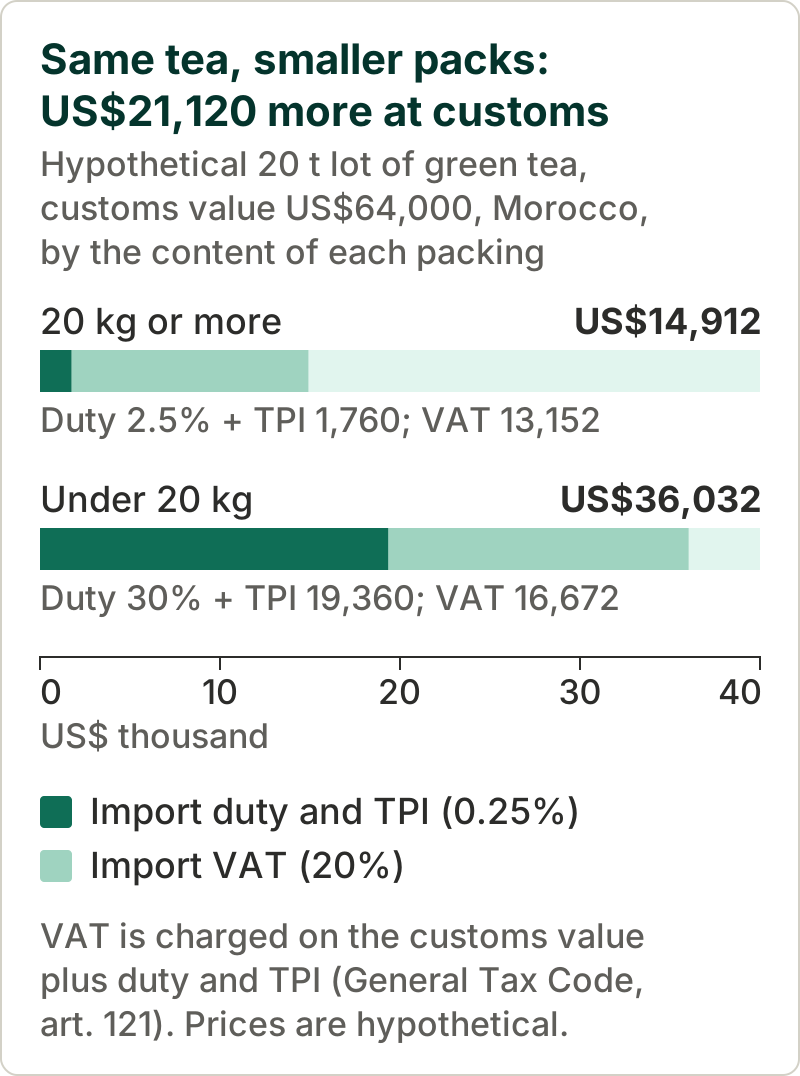 Sources: Moroccan Customs, ADIL (September 2026); WTO Trade Policy Review of Morocco, 2015 (TPI base); General Tax Code, Article 121; hypothetical prices; calculation in this guide
VAT. If your sales of the tea are subject to VAT, the import VAT is deductible from the VAT you charge (General Tax Code, Article 101, 2021 edition): it weighs on cash flow rather than cost, so line 12 leaves it out. Without that deduction, the cost per kg before line 10 becomes US$3.95 and US$5.00.
Line 10. Fill it in with your broker: terminal handling and port charges at the port of discharge, the broker’s (transitaire’s) fees and any inspection costs, storage (the WTO’s 2024 review lists a storage tax of 4–14% of the customs value for goods left more than three days in customs), transport to your warehouse, and bank charges for a documentary credit or collection. Ask which of these customs add to the value.
On other terms. Bought CIF Casablanca at the same hypothetical US$64,000, the tea has the same customs value, the invoice replacing lines 1 to 3; what changes is who books the ship and the cover, clauses (C) unless agreed otherwise. If you buy FCA at the seller’s warehouse, your trucking and terminal charges in China join line 2.
Which Incoterm for a container of tea?
ICC’s checklist suggests giving the main carriage to whichever party can obtain the cheapest or most efficient transport. Within that choice:
- You book the freight: FCA, naming the container terminal or the seller’s warehouse, rather than FOB; add the on-board bill of lading option if your bank needs that document.
- The seller books the freight: CPT, or CIP if you want the seller to insure on clauses (A), rather than CFR or CIF.
- The seller carries the risk to Morocco: DAP at the named place, with import clearance and duty still yours.
- Goods lifted straight on board: this is where FOB, CFR and CIF fit.
Before you sign, check that the contract states the rule, the precise place and “Incoterms® 2020”, who pays terminal handling at each end, the insurance clauses and sum insured, and the documents due, such as the bill of lading and the insurance certificate (see our guide to Chinese tea export documents). The packing decides the tariff line, and so the duty: see our guide to tea HS codes.
This guide is general information, checked in October 2026, and not legal advice: confirm rates, bases and charges with your customs broker before you ship.
Questions and answers
What is the difference between FOB and CIF for tea?
Under both, the risk passes to the buyer when the tea is on board the vessel at the port of shipment. Under FOB the buyer books and pays the sea freight from the named port of shipment; under CIF the seller pays the freight to the named port of destination and insures the goods to at least the Institute Cargo Clauses (C), for at least 110% of the price.
Which Incoterm should I use for a container of tea?
ICC's checklist points goods that travel in containers to FCA when the buyer books the freight, and to CPT or CIP when the seller does: under those rules the seller delivers by handing the goods to a carrier, at its premises or a terminal, rather than on board. It keeps FOB, CFR and CIF for goods loaded directly on board the vessel.
Is Moroccan import duty on tea calculated on the FOB or the CIF value?
On a CIF-type value. Morocco's Customs Code, in the version notified to the WTO in 1998, adds the transport, handling and insurance costs up to the goods' entry into Morocco, and the WTO's 2024 review confirms that ad valorem duties are levied on the c.i.f. value. In 2026 green tea pays 2.5% in packings of 20 kg or more and 30% in smaller ones.
How much insurance must the seller buy under CIF?
Under Incoterms® 2020, cover complying at least with the Institute Cargo Clauses (C) or similar clauses (ICC), for at least the price of the goods plus 10%, or 110% (French customs). The buyer can ask in the contract for wider cover, such as the clauses (A) that CIP requires.
When does the risk pass to the buyer under FOB, CFR and CIF?
When the goods are on board the vessel at the port of shipment, under all three. Under CFR and CIF the seller still pays the freight to the named destination, but the tea travels at the buyer's risk from the moment it is loaded.
How do I calculate the landed cost of tea imported into Morocco?
Start from the CIF value: the FOB price plus freight and insurance. Add the import duty (2.5% or 30% in 2026) and the 0.25% parafiscal import tax, then 20% VAT on that total, and finally port, broker and transport costs. The import VAT is deductible if your sales of the tea are subject to VAT.
Sources
- 1. ICC: Incoterms® 2020, overview and key changes (checked October 2026) · iccwbo.org
- 2. ICC: Incoterms® rules, overview page (checked October 2026) · iccwbo.org
- 3. ICC: Introduction to Incoterms® 2020, free text (copy published by ICC Switzerland) · icc-switzerland.ch
- 4. ICC: Incoterms® 2020 Checklist and Flowcharts, ICC Publication 817E (2022) · library.iccwbo.org
- 5. ICC Academy: CPT and CIP Incoterms® 2020 explained, 20 June 2025 · academy.iccwbo.org
- 6. ICC Academy: FCA and FOB Incoterms® 2020 explained, 19 November 2024 · academy.iccwbo.org
- 7. ICC Academy: CFR and CIF Incoterms® 2020 explained, 21 August 2024 · academy.iccwbo.org
- 8. ICC Academy: Incoterms® 2020 C rules vs D rules, risk transfer explained, 20 January 2026 · academy.iccwbo.org
- 9. WTO: Agreement on Implementation of Article VII of the GATT 1994 (Customs Valuation Agreement) · wto.org
- 10. WTO: Morocco's notification of the valuation articles of its Customs and Indirect Taxes Code, G/VAL/N/1/MAR/1, 12 November 1998 (code in French) · docs.wto.org
- 11. WTO: Trade Policy Review of Morocco, Secretariat report WT/TPR/S/453 (2024) · wto.org
- 12. WTO: Trade Policy Review of Morocco, Secretariat report WT/TPR/S/329 (December 2015) · wto.org
- 13. Morocco's tax administration (DGI): General Tax Code, Article 121 on import VAT, online edition (checked October 2026, in French) · tax.gov.ma
- 14. Morocco's Ministry of Economy and Finance: General Tax Code, 2021 edition, Articles 101 and 121 (in French) · finances.gov.ma
- 15. Moroccan Customs: Circular 6619/210 of 26 December 2024 on the 2025 finance law (in French) · douane.gov.ma
- 16. Moroccan Customs: ADIL tariff database (checked September 2026) · douane.gov.ma
- 17. Office des Changes: General Instruction on Foreign Exchange Operations 2026 (IGOC, in French) · oc.gov.ma
- 18. National Bureau of Statistics of China: scope and classification of total imports and exports, 29 November 2024 (in Chinese) · stats.gov.cn
- 19. UN Statistics Division: International Merchandise Trade Statistics, Concepts and Definitions 2010 · unstats.un.org
- 20. MOFCOM: China export monthly statistical report, tea, December 2025 (in Chinese) · wms.mofcom.gov.cn
- 21. French Customs: The new Incoterms® 2020 rules and the customs value (in French) · douane.gouv.fr