Libya tea imports: black and green tea, China's share
Libya tea imports: suppliers declared 29,898 t in 2025, 70% black or partly fermented, mostly Sri Lankan, 30% green, mostly Chinese. Duty and payment rules.
Key facts
- Exporting countries declared 29,898 tonnes of tea for Libya in 2025, 63.3% of it from Sri Lanka, almost all black tea, and 33.0% from China, mostly green tea, so black or partly fermented tea made up 70.0% of the total (UN Comtrade; The Tea Trade's calculation).
- China declared 9,862 tonnes of tea worth US$29.3 million for Libya in 2025, up 48.5% in volume on 2024 and 97.0% on 2015, and 87.2% of that volume was green tea in packs of 3 kg or less, according to China's declarations to UN Comtrade.
- Libya's latest report to UN Comtrade, for 2019, recorded 18,479 tonnes of tea imports, 71.3% of them black or partly fermented tea, and in each year it reported from 2016 to 2019 its value for tea from China equals the value China declared, to the dollar.
- The latest tariff data Libya has reported to UNCTAD, for 2021, show a 0% customs duty on all four tea subheadings; the IMF reported in 2009 that Libya's service fee on imports had been raised from 4% to 10%, the rate MOFCOM's 2021 country guide still gives.
- Under Central Bank of Libya Circular 2025/10 of 6 April 2025, an import letter of credit must be covered in full from the importer's account, is advised only after the central bank approves it, and is paid 30 days after the documents reach the Libyan bank.
Libya’s tea imports have to be read in its suppliers’ statistics, because Libya’s latest report to UN Comtrade covers 2019. In 2025 exporting countries declared 29,898 tonnes of tea for Libya, 70.0% of it black or partly fermented: Sri Lanka 18,929 tonnes, almost all black tea, and China 9,862 tonnes worth US$29.3 million, up 48.5% on 2024, with 87.2% of it green tea in packs of 3 kg or less, according to their declarations to UN Comtrade (shares are our calculation). The latest tariff data Libya has reported show no duty on tea (2021), and imports are paid under the Central Bank of Libya’s rules, by letter of credit or, since 2026, by capped direct transfers (checked October 2026).
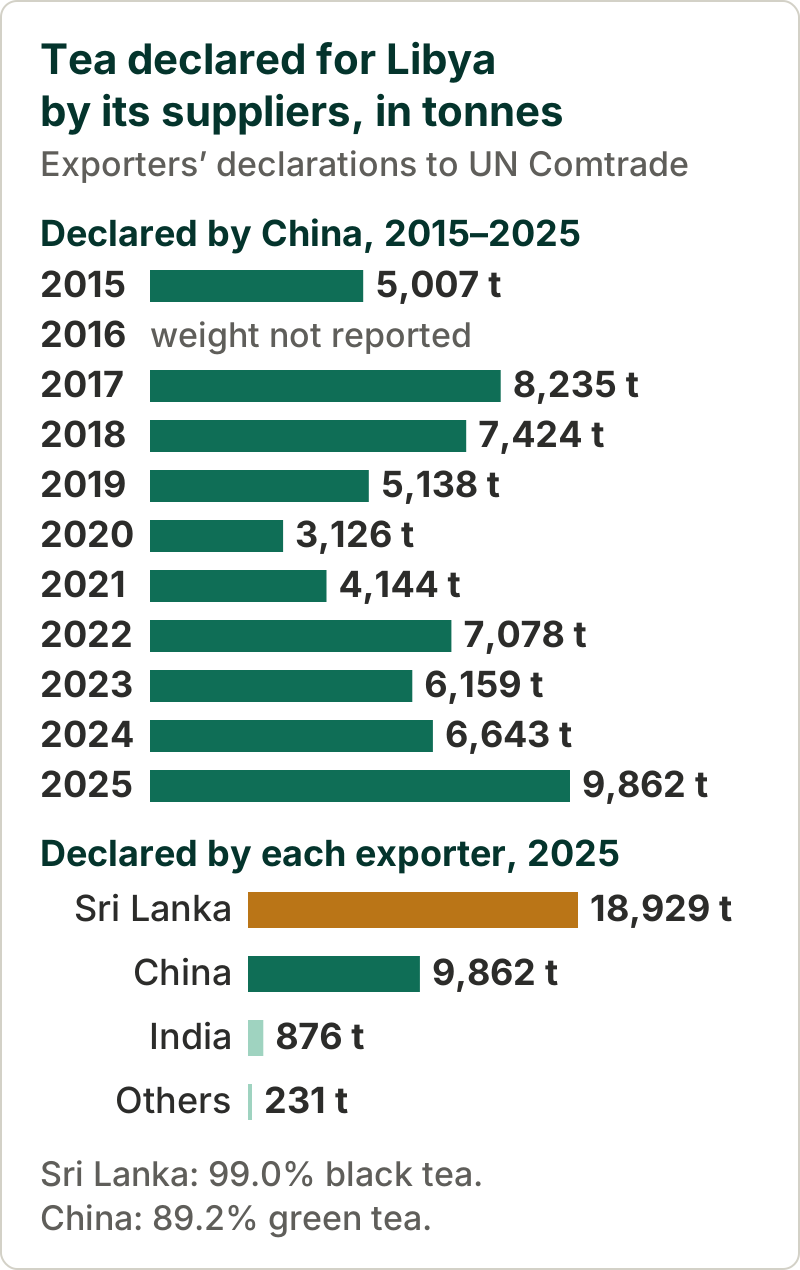
Libya tea imports from China, 2015–2025
In Chinese documents, where the country appears as 利比亚, Libya was the 17th destination for Chinese tea by volume in 2015, the 14th in 2025 and the 18th by value in 2025, as our guides to Chinese tea export markets, 2015–2025 and China’s 2025 tea exports show. The decade was uneven: after 8,235 tonnes in 2017, China’s shipments fell to 3,126 tonnes in 2020, then more than tripled by 2025.
China’s tea exports to Libya, 2015–2025 (HS 0902, all tea; source: UN Comtrade, China’s declarations)
| Year | Volume (t) | Value (US$ million, FOB) | Unit value (US$/kg) | Green tea, share of volume | Share of the green tea in packs of 3 kg or less |
|---|---|---|---|---|---|
| 2015 | 5,007.0 | 14.38 | 2.87 | 100% | 98.2% |
| 2016 | not reported | 9.91 | – | – | – |
| 2017 | 8,234.7 | 20.49 | 2.49 | 100% | 97.3% |
| 2018 | 7,423.9 | 23.24 | 3.13 | 98.0% | 89.9% |
| 2019 | 5,137.7 | 16.99 | 3.31 | 89.5% | 88.7% |
| 2020 | 3,125.8 | 11.02 | 3.52 | 99.5% | 100% |
| 2021 | 4,144.0 | 16.56 | 4.00 | 99.6% | 100% |
| 2022 | 7,078.2 | 25.02 | 3.53 | 98.7% | over 99.9% |
| 2023 | 6,158.8 | 27.25 | 4.42 | 98.2% | 97.2% |
| 2024 | 6,643.2 | 22.35 | 3.37 | 94.1% | 99.8% |
| 2025 | 9,862.1 | 29.31 | 2.97 | 89.2% | 97.7% |
China’s 2016 declaration gives a value but no weight; the 683 tonnes UN Comtrade shows for that year are its own estimate and are not used here. Unit values (value ÷ volume) and shares are The Tea Trade’s calculation. The 2023 average is lifted by 168 tonnes of green tea in larger packings (HS 0902.20) declared at US$5.6 million, or US$33.27 per kg; the statistics do not say why.
 Source: UN Comtrade, exporters’ declarations (2015–2025)
The 2025 shipments were mostly small packs of green tea: 8,597 tonnes under HS 0902.10 (green tea in packs of 3 kg or less), 203 tonnes under 0902.20 and 1,063 tonnes of black or partly fermented tea in packs of 3 kg or less (0902.30). Black tea, absent from China’s declarations for Libya in 2015–2017, made up 10.8% of the volume in 2025. The small-pack green tea came to US$2.83 per kg, against US$3.99 in 2021 (our calculation); a unit value mixes grades and packing, so it is not a price. Our guide to tea HS codes explains the four subheadings.
Sri Lanka’s black tea: the larger part of Libya’s tea imports
Sri Lanka declared 18,929 tonnes of tea worth US$78.2 million for Libya in 2025, 83.9% more than the 10,292 tonnes of 2024, and 99.0% of that volume was black tea in packs of 3 kg or less (HS 0902.30), according to its declarations to UN Comtrade. That is 1.9 times China’s volume and 2.7 times its value (our calculation).
Tea declared for Libya by exporting countries, 2025 (HS 0902; source: UN Comtrade, exporters’ declarations available on 13 October 2026)
| Exporter | Volume (t) | Value (US$ million, FOB) | Share of volume | Main subheading |
|---|---|---|---|---|
| Sri Lanka | 18,929.4 | 78.17 | 63.3% | 0902.30, black tea in packs of 3 kg or less: 99.0% |
| China | 9,862.1 | 29.31 | 33.0% | 0902.10, green tea in packs of 3 kg or less: 87.2% |
| India | 876.0 | 2.52 | 2.9% | 0902.40, black tea in larger packings: 88.9% |
| Egypt | 146.1 | 1.95 | 0.5% | 0902.30, black tea in packs of 3 kg or less: 99.1% |
| Saudi Arabia | 79.5 | 0.99 | 0.3% | 0902.30, black tea in packs of 3 kg or less: 98.7% |
| Nine other countries | 5.3 | 0.06 | under 0.1% | mixed |
| Total | 29,898.4 | 113.00 | 100% |
Shares are The Tea Trade’s calculation. Egypt’s weight is a UN Comtrade estimate, and countries that had not yet reported their 2025 trade are missing. Adding up the 14 declarations by subheading, black or partly fermented tea (0902.30 and 0902.40) came to 20,914 tonnes, 70.0% of the total, and green tea to 8,984 tonnes, 97.9% of it from China (our calculation).
Set against the 7,458,555 people the World Bank counts in Libya for 2025, those 29,898 tonnes come to about 4.0 kg of tea per resident (29,898,429 kg ÷ 7,458,555 = 4.01; our calculation). This is what suppliers declared shipping, not consumption: no Libyan figure shows stocks, or tea re-exported to neighbouring countries.
What Libya’s own trade statistics show
UN Comtrade holds Libya’s own trade reports in the Harmonized System for eight years only, 2007–2010 and 2016–2019; the 2019 data were released in October 2022 (checked October 2026). In 2019 Libya recorded 18,479 tonnes of tea imports worth US$64.3 million, 66.7% of the volume from Sri Lanka and 30.6% from China, and black or partly fermented tea (0902.30 and 0902.40) made up 71.3% of it.
Libya’s tea imports as recorded by Libya, 2016–2019 (HS 0902; source: UN Comtrade, Libya’s declarations)
| Year | All origins (t) | From Sri Lanka (t) | From China (t) | Value of tea from China, in Libya’s record and in China’s declaration |
|---|---|---|---|---|
| 2016 | 16,292.8 | 12,645.1 | 3,285.8 | US$9,912,279 in both |
| 2017 | 20,512.5 | 11,609.5 | 8,234.7 | US$20,486,581 in both |
| 2018 | 7,691.7 | none recorded | 7,396.1 | US$23,240,608 in both |
| 2019 | 18,478.5 | 12,329.4 | 5,653.3 | US$16,985,463 in both |
The United Nations recommends that exporters value goods free on board (FOB) and importers at cost, insurance and freight (CIF), which includes freight and insurance. Libya’s values are recorded in UN Comtrade as CIF, yet the value Libya recorded for tea from China equals China’s declared FOB value, to the dollar, in all four years, and its values for tea from Sri Lanka in 2016, 2017 and 2019 are within US$2 of Sri Lanka’s. Libya’s 2018 report shows no tea at all from Sri Lanka, which has no 2018 report in UN Comtrade to compare. The statistics do not say how Libya compiled these figures.
The Central Bank of Libya’s own report on foreign trade in 2021–2024 cites the International Trade Centre’s Trade Map database as the source of its tables. In June 2025 the IMF wrote that Libya’s main economic statistics come out late and with inconsistencies.
Libya’s import duty on tea: 0% on record
The latest tariff data Libya has reported to UNCTAD’s TRAINS database, for 2021, show a 0% duty on all four tea subheadings, green or black, in small packs or large, as in 2006 and 2020.
The 2021 edition of the country guide to Libya by China’s Ministry of Commerce (MOFCOM) gives the background: from 1 August 2005 Libya abolished customs duties on all imports except tobacco and charged an import service fee of 4% of the value of goods instead, raised to 10% by Decision No. 26 of the General People’s Committee and applied from late February 2009. The IMF’s 2009 review of Libya’s economy also reported that the “service fee” on imports had been raised from 4% to 10%. The same guide lists 81 goods that pay a 2% production tax and a consumption tax of 25% or 50%; tea is not among them. No current Libyan text confirming the service fee or its rate could be found (checked October 2026).
The legal frame is Customs Law No. 10 of 2010, published by the Libyan Customs Authority. Imports pay the taxes in the customs tariff plus other taxes and fees before release (Article 5); the tariff is set by decision of the General People’s Committee, as the government was then called (Article 6); and service fees may be charged for sealing, stamping, analysis and customs officers’ work (Article 192). Declarations are lodged by the owner of the goods, an accepted agent or a licensed customs broker (مخلص جمركي, Articles 87 and 91).
The IMF reported that Libya collected no revenue from taxes on goods and services in 2021–2024, and only a small share of its tax revenue from customs. In April 2026 its staff advised raising customs and excise duties to regional levels, so check the charges before each contract.
Paying for tea in Libya: letters of credit and the dinar
Controls imposed on 30 April 2015 required the central bank’s approval for import letters of credit, according to the IMF, and Article 1201 of Commercial Activity Law No. 23 of 2010 requires payments for imports and exports to use banking methods approved by the Central Bank of Libya (CBL), as the CBL recalled in August 2025. Payment terms in general are compared in our guide to tea export payment terms.
What Circular 2025/10 asks of a letter of credit
The CBL’s rules for foreign currency in force since 6 April 2025, Circular 2025/10, replaced all its earlier circulars on the same purposes. For a commercial letter of credit:
- Approval and cover. Banks decide on credits for any goods that may legally be imported, for applicants holding a valid CBL code, but advise a credit only after the central bank approves it through its system. The credit is covered 100% from the applicant’s account, with no financing; a commercial credit may not exceed US$3 million, and the applicant’s account must be at least a year old.
- Pro forma invoice. It must come from the exporting company or the manufacturer, or one of their agents registered in the exporting country, and give the type, description, weight, quantity, price and origin of the goods; pro forma invoices from general trading companies are not accepted.
- Documents. An insurance policy on the goods, based on the pro forma; an inspection certificate from an inspection company that holds a CBL code and is accredited to ISO/IEC 17020:2012 and ISO 9001:2015 by the Libyan Accreditation Centre, with photographs and analysis certificates from accredited international laboratories.
- Bill of lading. Except for bulk cargo, it may not be issued, or show a sailing date, before the credit is advised, and it must give the vessel’s name and IMO number, the credit number and the pro forma number.
- Payment. The Libyan bank pays 30 days after it receives the documents from the correspondent bank, a condition written into the credit.
- After arrival. Within three months of receiving the documents, the importer must give the bank the original customs declarations proving entry through an official point of entry.
Three later circulars add to these rules. Since 1 November 2025, applicants for a letter of credit must register in the Customs Authority’s tracking system for goods shipped to Libya, known as ACI (Circular 2025/24 of 21 August 2025). Since 19 February 2026, licensed exchange companies may make direct transfers abroad for companies and small traders, up to US$100,000 per transfer and US$300,000 a year per company (Circular 2026/6). The request names the supplier, with its IBAN and bank code, and attaches an invoice under three months old giving the HS code, quantities, origin and ports; payment may go only to that supplier. Since 5 May 2026, banks may also make direct transfers abroad for small traders, craftsmen and small companies whose imports do not exceed US$500,000 a year: up to US$100,000 every three months, covered in full in dinars, against a pro forma invoice and an undertaking to bring the goods in through official points of entry (Circular 2026/14). MOFCOM’s 2021 guide noted that letters of credit between Chinese and Libyan banks still had to be opened through a bank in a third country.
The dinar and the foreign exchange tax
The dinar is pegged to the IMF’s special drawing right (SDR). The changes that affected import payments, by date:
- 3 January 2021. The CBL devalued the dinar to SDR 0.1555, about 4.5 dinars per US dollar, and raised the limits for letters of credit (IMF, 2025).
- March and November 2024. A 27% tax on foreign currency purchases, imposed in March 2024, was cut to 15% in November (IMF, 2025); a fee on the official exchange rate was imposed by Decision No. 86 of 2024 of the Speaker of the House of Representatives, dated 20 November 2024 (CBL Circular 2026/3).
- Summer 2024. A six-week standoff over the leadership of the CBL disrupted its operations until an agreement in late September 2024 (IMF, 2025).
- 6 April 2025. The dinar was devalued by 13.3% to SDR 0.1349, or 5.57 dinars per dollar (IMF, 2025).
- 14 January 2026. The CBL board devalued the dinar by 14.7% against the SDR, to SDR 0.1150 per dinar (CBL statement of 18 January 2026). On 3 February the CBL told banks that this is the prevailing rate, as the fee under Decision No. 86 does not apply to requests filed through its cover-request system (Circular 2026/3).
- March and April 2026. On 15 March 2026 the CBL said it would resume selling foreign currency for all purposes at the official rate, after a letter from the Speaker about abolishing “the tax imposed on some goods”. On 16 March it told banks that the official rate for all purposes is the one set by its board in January, as published in its daily bulletin (Circular 2026/10), and on 10 April IMF staff welcomed the decision to abolish the foreign exchange tax.
- 13 October 2026. The CBL quoted the US dollar at 6.4168 dinars buying and 6.449 selling.
Inspection, standards and labels
Libya’s standards body is the National Center for Standardization and Metrology (المركز الوطني للمواصفات والمعايير القياسية). Its website publishes a 2026 catalogue of Libyan standards, but no entries could be read there in October 2026, so whether a Libyan standard for tea is in force, and whether it is mandatory, could not be verified. Circular 2025/10 still tells banks to check that the invoice matches the inspection certificate, the health certificate and Libyan standards, and that prices fit the goods.
MOFCOM’s 2021 guide adds four points that could not be checked against a Libyan text: Libya’s inspection authority largely follows European standards; goods that had passed Chinese inspection were inspected again; customs asked for a commercial invoice, a certificate of origin legalised by the Libyan embassy and naming the Libyan importer, a bill of lading and a packing list; and the contents must be marked on inner packs as well as on outer cartons. How the Chinese certificates are issued is explained in our guide to Chinese tea export documents.
What could not be verified (October 2026)
- Libya’s own figures after 2019, and how its 2016–2019 figures were compiled.
- The current tariff and service fee: the 0% duty comes from 2021 tariff data, the 10% fee from the IMF’s 2009 report and a 2021 Chinese government guide.
- A Libyan standard or labelling rule for tea, including the language required on labels.
- Re-exports: whether some of the tea shipped to Libya moves on to neighbouring countries.
Checklist for exporters and importers in 2026
- Market. Suppliers declared about 29,900 tonnes of tea for Libya in 2025, 70.0% of it black or partly fermented and 63.3% from Sri Lanka; China’s green tea came 97.7% in packs of 3 kg or less.
- Buyer. A valid CBL code, an account at least a year old and ACI registration; smaller buyers may pay by direct transfer through their bank or a licensed exchange company.
- Credit. A pro forma in the exporter’s or manufacturer’s name; shipment only after the credit is advised; payment 30 days after the documents reach the Libyan bank.
- Documents. Insurance policy, inspection certificate with photographs and laboratory certificates, a health certificate if the credit asks for one, and a bill of lading with the vessel’s IMO number, the credit number and the pro forma number.
- Packs and ports. Mark the contents on inner packs as well as cartons; Tripoli, Benghazi, Misrata and Khoms are the main seaports (both MOFCOM, 2021).
- Charges. 0% duty in the latest tariff data (2021); ask a licensed customs broker for the current service fee and any new duty.
This is general information, checked in October 2026, not legal or financial advice: have the importer’s bank and a licensed customs broker in Libya confirm each rule before shipping.
Questions and answers
How much tea does Libya import?
Libya's own latest figures are for 2019, when it recorded 18,479 tonnes of tea imports. Its suppliers declared 29,898 tonnes of tea for Libya in 2025: 18,929 t from Sri Lanka, 9,862 t from China and 876 t from India (UN Comtrade, data available in October 2026).
Does Libya buy more green tea or black tea?
More black tea. Black or partly fermented tea made up 70.0% of the 29,898 tonnes declared for Libya in 2025, most of it from Sri Lanka, and green tea 30.0%, 97.9% of it from China (UN Comtrade; The Tea Trade's calculation). Libya's own 2019 figures put black and partly fermented tea at 71.3% of its tea imports.
What is the import duty on tea in Libya?
0% on all tea subheadings in the latest tariff data Libya has reported to UNCTAD, for 2021. MOFCOM's 2021 country guide says Libya abolished customs duties on all imports except tobacco from 1 August 2005 and charged an import service fee instead; the IMF reported in 2009 that the fee had been raised from 4% to 10%, the rate the 2021 guide still gives. No current Libyan text on that fee could be found (checked October 2026).
How do Libyan importers pay for tea from China?
By letter of credit under Central Bank of Libya Circular 2025/10: the credit is covered in full from the importer's account, approved by the central bank before it is advised and paid 30 days after the documents arrive. Since 2026, direct transfers are also allowed: through licensed exchange companies, up to US$300,000 a year per company (Circular 2026/6), and through banks for small importers buying up to US$500,000 a year, up to US$100,000 every three months (Circular 2026/14).
What documents does a Libyan letter of credit ask for?
Circular 2025/10 lists a pro forma invoice from the exporter or manufacturer, not from a general trading company, an insurance policy, an inspection certificate from an accredited inspection company, and a bill of lading dated after the credit is advised that shows the vessel's IMO number, the credit number and the pro forma number.
What is the ACI system for goods shipped to Libya?
It is the Libyan Customs Authority's tracking system for goods shipped to Libya. Under Central Bank of Libya Circular 2025/24 of 21 August 2025, importers applying for a letter of credit have had to register in it since 1 November 2025.
Sources
- 1. Central Bank of Libya: Circular 2025/10 on the rules for dealing in foreign exchange, 6 April 2025 (in Arabic) · cbl.gov.ly
- 2. Central Bank of Libya: Circular 2025/24 on the tracking system for goods shipped to Libya (ACI), 21 August 2025 (in Arabic) · cbl.gov.ly
- 3. Central Bank of Libya: Circular 2026/3 on the prevailing exchange rate of the Libyan dinar, 3 February 2026, with the bank's statement of 18 January 2026 on the new rate (in Arabic) · cbl.gov.ly
- 4. Central Bank of Libya: Circular 2026/6 on direct external transfers through exchange companies, 19 February 2026 (in Arabic) · cbl.gov.ly
- 5. Central Bank of Libya: Circular 2026/14 allowing banks in Libya to make direct external transfers for small importers, 5 May 2026 (in Arabic) · cbl.gov.ly
- 6. Libyan Customs Authority: Law No. 10 of 2010 on customs (in Arabic) · customs.gov.ly
- 7. UNCTAD TRAINS via WITS: applied duties reported by Libya on tea, HS 0902.10 to 0902.40, all years · wits.worldbank.org
- 8. UN Comtrade: tea exports to Libya declared by every reporting country, by HS subheading, 2025 · comtradeapi.un.org
- 9. UN Comtrade: Libya's tea imports by partner, 2019 (Libya's latest report) · comtradeapi.un.org
- 10. IMF: Libya, 2025 Article IV consultation, press release and staff report (Country Report No. 25/148, June 2025) · imf.org
- 11. IMF: Socialist People's Libyan Arab Jamahiriya, 2009 Article IV consultation, staff report (Country Report No. 09/294, September 2009) · imf.org
- 12. MOFCOM, Chinese Academy of International Trade and Economic Cooperation and Chinese Embassy in Libya: country guide for outbound investment and cooperation, Libya, 2021 edition (in Chinese) · mofcom.gov.cn