Senegal green tea imports: attaya, customs and data
Senegal green tea imports: 24,449 t from China in 2025 (US$98.4m), China's 2nd market by value. Attaya, Senegal's own data, DPI, port of Dakar, Mali.
Key facts
- China exported 24,449 tonnes of tea worth US$98.4 million to Senegal in 2025, up 61.4% in volume, which made Senegal the third destination for Chinese tea by volume and the second by value, according to MOFCOM and UN Comtrade.
- Senegal's statistics agency, ANSD, recorded 8,774 tonnes of tea imports worth 4,077 million CFA francs in 2024, half as many tonnes again as in 2020, and Senegal's figures in UN Comtrade show 11,285 tonnes in 2025, 92.6% of them from China.
- From 2021 to 2025 Senegal recorded 45.2% of the tonnes of tea that China declared for it and, year by year, 7.1% to 16.2% of the declared value (The Tea Trade's calculation from UN Comtrade data).
- Senegal recorded 894 tonnes of tea exports to Mali in 2024 and again in 2025, over 80% of its tea exports, while Mali, which records imports by country of origin, recorded 2.4 tonnes of tea from Senegal in 2024 (UN Comtrade).
- Since 1 May 2024, all goods worth 500,000 CFA francs FOB or more imported into Senegal, and every 'personalised' container whatever its value, need a prior import declaration (DPI), and customs procedures have been fully paperless since 1 January 2024, according to Senegal's customs.
Senegal is China’s third tea market by volume and its second by value: China declared 24,449 tonnes of tea worth US$98.4 million for it in 2025, up 61.4% in volume, according to China’s Ministry of Commerce (MOFCOM) and UN Comtrade. Nearly all of it is green tea, the tea of attaya, which is traditionally served in three stages. Senegal’s own statistics record about half as much: 45.2% of the tonnes China declared for it over 2021–2025 (UN Comtrade), and 8,774 tonnes of tea imports from all origins in 2024, according to the national statistics agency (ANSD). Since 1 May 2024, all goods worth 500,000 CFA francs FOB or more, and every “personalised” container, have needed a prior import declaration (DPI), according to Senegal’s customs.
Senegal tea imports from China: 24,449 tonnes in 2025
In China’s export statistics, where it appears as 塞内加尔, Senegal received 24,448.9 tonnes of tea in 2025, worth US$98.4 million, up 61.4% in volume and 62.5% in value on 2024, at an average of US$4,024.6 per tonne, according to MOFCOM’s December 2025 report. That made it China’s second tea market by value, behind Morocco, and its third by volume, behind Morocco and Uzbekistan (UN Comtrade). Senegal was already third by volume in 2015, as our guide to Chinese tea export markets shows.
The jump of 2025 followed four flat years. China declared between 15,145 and 17,156 tonnes a year for Senegal from 2021 to 2024 (table below), and the growth did not carry into 2026: from January to April, China shipped 5,893.7 tonnes to Senegal, 18.2% less than a year earlier, worth US$24.6 million (−12.7%), which put Senegal sixth by value (MOFCOM). No later MOFCOM report could be opened in mid-October 2026.
The tea leaves China already packed. In 2025 China declared 96.2% of the green tea it shipped to Senegal under HS 0902.10, green tea in immediate packings of 3 kg or less, and the rest under 0902.20, other green tea (UN Comtrade; The Tea Trade’s calculation).
Attaya: why Senegal buys Chinese green tea
Tea in Senegal means attaya (also written ataya). According to the Senegalese Tourism Promotion Agency (Agence sénégalaise de promotion touristique, ASPT), which works under the technical supervision of the ministry in charge of tourism, attaya “fait l’objet d’un véritable rituel”: it comes with a true ritual. In the agency’s description, the tea used is green tea from China, mint leaves are added, and the service traditionally proceeds in three stages: the first glass is more bitter, the second stronger and the third smoother.
Researchers describe the social side. An ethnographic study of Pikine, an urban area in the Dakar region, based on eleven months of fieldwork between 2011 and 2013, follows young men “who gather together daily” at a street-corner hangout, the koñ; its title is “Tea and Young Men’s Gatherings in Pikine, Senegal” (Sebastian Prothmann, City & Society, 2019). Across the border, a 2013 study of Mali’s street tea groups, the grins, describes tea “offert en trois verres successifs” (served in three successive glasses), notes that identical tea groups exist in neighbouring countries, “ataya au Sénégal”, and reports that the tea drunk in Mali is largely imported from China and repackaged by many traders under their own brands (Julien Bondaz, Cahiers d’études africaines).
That is the tea Senegal buys. Green tea made up 96.8% of the 11,285 tonnes of tea Senegal recorded importing in 2025, and black and partly fermented tea the other 3.2% (UN Comtrade, figures reported by Senegal; The Tea Trade’s calculation).
What Senegal’s own statistics show (ANSD)
Senegal’s national statistics agency, the Agence nationale de la statistique et de la démographie (ANSD), publishes the country’s trade figures each year in its Note d’analyse du commerce extérieur (NACE). According to the 2024 edition (July 2025), the data come mainly from the customs computer system and cover general trade, including movements into and out of customs warehouses; imports are valued at cost, insurance and freight (CIF) and attributed to their country of origin. Tea has its own line in ANSD’s product tables.
Senegal’s tea imports, 2020–2024 (source: ANSD, NACE 2024 edition, Tables 12 and 13)
| Year | Tonnes | Value (million CFA francs) | Value per kg (CFA francs) |
|---|---|---|---|
| 2020 | 5,849 | 2,831 | 484 |
| 2021 | 6,605 | 3,655 | 553 |
| 2022 | 8,214 | 7,351 | 895 |
| 2023 | 8,178 | 3,289 | 402 |
| 2024 | 8,774 | 4,077 | 465 |
Value per kg is The Tea Trade’s calculation (value ÷ tonnes).
Tonnes rose by half between 2020 and 2024, and in 2024 Senegal imported five times as much tea as coffee by weight: 8,774 against 1,742 tonnes (ANSD). Values move far more than volumes: ANSD valued the tea of 2022 at more than twice the tea of 2023, for almost the same tonnage. For 2025, Senegal’s figures in UN Comtrade show 11,285 tonnes worth US$12.1 million, 29.3% more than the 8,725 tonnes it reported to UN Comtrade for 2024. China supplied 92.6% of the 2025 tonnage; Switzerland (372 t), Mauritania (182 t), France (68 t) and India (49 t) most of the rest.
Senegal also files the same tea under a different code. In 2025 its figures put 7,861 tonnes of the green tea from China, 76.4%, under HS 0902.20, other green tea, and 2,428 tonnes under 0902.10, the reverse of China’s declarations; in 2024 the share under 0902.20 was 68.6% (UN Comtrade; The Tea Trade’s calculation). Both codes carry the same customs duty under the ECOWAS common external tariff, so the difference shows in the statistics, not in the duty paid.
Why Senegal records about half the tea China declares
Tea from China to Senegal: China’s declarations and Senegal’s records (HS 0902; source: UN Comtrade)
| Year | Declared by China (t) | Recorded by Senegal (t) | Senegal ÷ China, tonnes | Declared by China, FOB (US$ million) | Recorded by Senegal, CIF (US$ million) |
|---|---|---|---|---|---|
| 2021 | 16,340.5 | 6,315.8 | 38.7% | 69.93 | 6.07 |
| 2022 | 17,156.4 | 7,898.0 | 46.0% | 68.76 | 11.13 |
| 2023 | 16,677.8 | 7,946.5 | 47.6% | 69.14 | 4.90 |
| 2024 | 15,145.2 | 7,950.8 | 52.5% | 60.54 | 5.44 |
| 2025 | 24,448.9 | 10,448.1 | 42.7% | 98.40 | 10.74 |
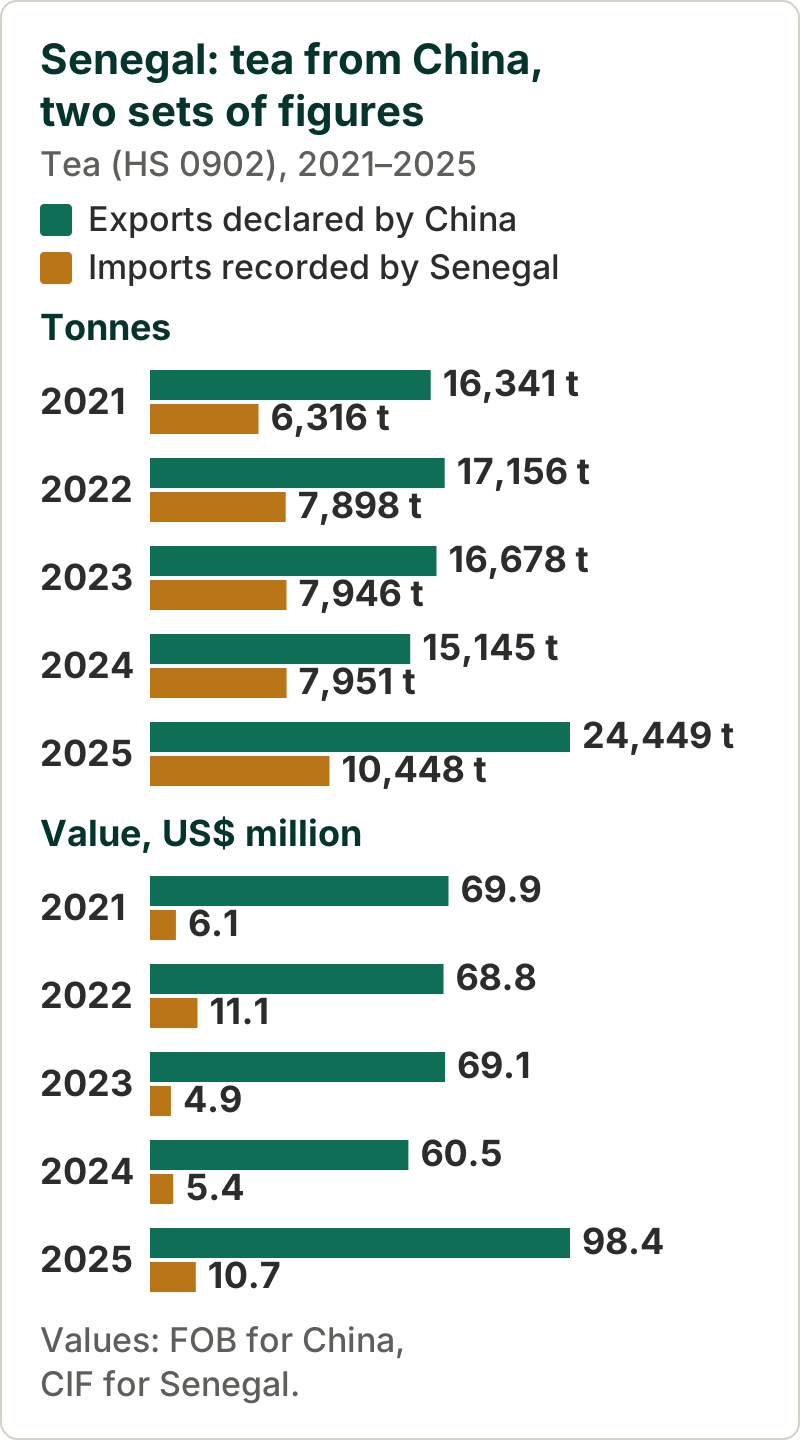 Source: UN Comtrade, figures reported by China and by Senegal (2021–2025)
Over the five years Senegal recorded 45.2% of the tonnes China declared for it, and between 7.1% and 16.2% of the value each year (The Tea Trade’s calculation). Exports are valued free on board (FOB) and imports CIF, so Senegal’s values should be the higher ones. Instead, its tea from China came to US$0.62 to US$1.41 per kg, against US$4.00 to US$4.28 per kg in China’s declarations (value ÷ volume). ANSD states that the customs value it uses has been the transaction value since 2001, under the World Trade Organization’s agreement on customs valuation; the statistics do not say why the two sets of values differ so widely.
For the tonnes, the United Nations recommendations for trade statistics (IMTS 2010) point to one cause. Exporters record the last destination known when the goods leave, importers the country of origin, and goods that only cross a country on their way to a third one are left out of its trade. Tea that China declares for Dakar but that travels on to Bamako in customs transit therefore counts as a sale to Senegal in China’s figures and as an import from China in Mali’s, never as an import in Senegal’s. Mali recorded 2,891 tonnes more Chinese tea than China declared for it in 2024 (9,499.8 against 6,608.4 tonnes; The Tea Trade’s calculation from UN Comtrade). Some of that tea may have been declared for Senegal, but the statistics do not say through which port it came and do not follow individual consignments: this is an interpretation, not a measured fact.
Onward trade to Mali along the Dakar–Bamako corridor
Some tea also leaves Senegal as recorded exports. Senegal reports a single export flow, re-exports included, and it recorded 894 tonnes of tea exports to Mali in 2024 and again in 2025.
Senegal’s recorded tea exports, 2023–2025 (HS 0902; source: UN Comtrade via WITS, figures reported by Senegal)
| Year | All destinations (t) | Mali (t) | Mali’s share |
|---|---|---|---|
| 2023 | 801.2 | 631.0 | 78.8% |
| 2024 | 1,114.2 | 894.0 | 80.2% |
| 2025 | 1,038.2 | 894.1 | 86.1% |
In 2025 The Gambia (63 t), Côte d’Ivoire (48 t) and Guinea (11 t) took most of the rest. Mali’s own figures show almost none of this tea: 6.5 tonnes from Senegal in 2023 and 2.4 tonnes in 2024, against 12,879.4 and 9,499.8 tonnes from China. Because Mali records the country of origin, Chinese tea sold on from Dakar would appear there as Chinese, which fits both sets of figures, though the data cannot confirm it. No 2025 figures for Mali were available in UN Comtrade in mid-October 2026.
The corridor runs by road. The metre-gauge railway from Dakar to Bamako, 1,287 km long of which 646 km in Senegal, has been halted since May 2018, according to MOFCOM’s 2025 guide to Senegal. Senegal launched the rehabilitation of the Dakar–Tambacounda–Kidira line in February 2023: the first phase, Dakar to Tambacounda (465 km), was finished in June 2024, and the second had not started (MOFCOM). Road distances to Bamako and the ECOWAS transit rules are set out in our guide to Sahel tea trade corridors.
Importing tea into Senegal: DPI, paperless clearance and the port of Dakar
The first formality falls to the importer, who files a prior import declaration (déclaration préalable d’importation, DPI) in advance. Since 1 May 2024 it has been required for all goods worth 500,000 CFA francs FOB or more and for every “personalised” container (conteneur personnalisé), whatever its value, except personal effects, goods under diplomatic privilege, social operations such as donations to the State or the Red Cross, and used vehicles, according to Senegal’s customs (notice of 29 April 2024). The DPI comes from an import verification programme set up by decree in 1991 and run under contracts with inspection companies. In January 2020, French customs described its threshold as 1,000,000 CFA francs FOB, with a verification certificate after inspection in the country of origin or shipment for goods worth 3,000,000 CFA francs FOB or more. The last contract ended on 31 December 2020; customs took over, and its directorate for intelligence, risk analysis and value (DRAV), created in March 2021, now manages the DPI. Ask the importer’s broker whether any inspection applies to a shipment. Food imports also need a food import declaration (déclaration d’importation de produits alimentaires, DIPA), according to MOFCOM’s 2025 guide, and the certificates issued in China are covered in our guide to Chinese tea export documents.
Clearance is electronic. Senegal’s customs say the full dematerialisation of customs procedures took effect on 1 January 2024 in all customs units connected to their computer system, GAINDÉ. The documents that accompany the declaration are collected and sent electronically through ORBUS, a module built into GAINDE, as French customs described it in 2020.
The customs units based at the Port autonome de Dakar collect 95% of customs revenue, according to Senegal’s customs (meeting of 22 April 2025). The port, built in 1857, handled 22.9 million tonnes of goods in 2023 and 880,000 twenty-foot equivalent units (TEU) of containers in 2024, against 650,000 in 2020, according to ANSD figures reported by MOFCOM. A paperless single window for the removal of goods, led by the port together with customs, was launched in May 2023 to cut port delays and costs. In September 2024 the director general of customs said it was “pas encore à la hauteur de toutes les attentes” (not yet up to all expectations), pointing to the need for one window to pay all the fees due at removal and to slow issue of delivery orders. On 3 June 2025 the port, customs and port operators signed two protocols, one of which puts the paperless single window into operation. A new deep-water port is being developed at Ndayane (MOFCOM).
Standards, labels and taxes on tea in Senegal
Senegal has no national standard of its own for tea. The database of the Senegalese Standards Association (Association sénégalaise de normalisation, ASN) lists 150 Senegalese standards in its agri-food domain, from table salt to vinegar, and none for tea; the tea standards in its catalogue, such as ISO 11287 for green tea, are international ISO standards (checked 14 October 2026). Prepackaged foods come under the general labelling standard NS ECOSTAND 050 (2015), and “All marking and labeling requirements are in French”, according to the US International Trade Administration (May 2024). What a tea label must show in Senegal, Morocco, Côte d’Ivoire and the EU is compared in our guide to tea labelling requirements.
On arrival, tea pays the ECOWAS customs duty and the community levies, then Senegal’s own tax on tea, VAT and other national charges. All of them, with their legal references, are in our West Africa tea import duties guide. One trap: MOFCOM’s 2025 guide lists a 3.8% “consumption tax” on coffee and tea, which is not the rate set by the tea articles of Senegal’s General Tax Code (edition updated to January 2025, the latest posted by the tax administration in October 2026). Rely on the code.
What this means for tea exporters and importers
- Market size. China declared 15,145 to 24,449 tonnes a year for Senegal in 2021–2025, while Senegal recorded 6,316 to 10,448 tonnes from China. Use one series and say which; never mix them in one calculation.
- Destination on the declaration. If the tea is going on to Mali, agree with the buyer whether China’s export declaration names Senegal or Mali, and whether the goods cross Senegal in transit or are cleared in Dakar.
- Before loading. Check that the importer has filed the DPI and the DIPA, whether an inspection applies, and that the labels are in French.
- Tariff code. China declares most of this tea under HS 0902.10 and Senegal records most of it under 0902.20. Agree the code with the buyer and the customs broker, even though the duty is the same.
- Charges. Allow for the duty, levies, tea tax and VAT in the duties guide, plus the fees due when the goods are removed from the port.
This is general information, not legal or tax advice: have a customs broker in Dakar confirm the procedure, documents and rates before each shipment.
Questions and answers
How much tea does Senegal import?
China declared 24,449 tonnes of tea worth US$98.4 million for Senegal in 2025 (MOFCOM). Senegal's own figures are lower: 8,774 tonnes in 2024 according to the statistics agency ANSD, and 11,285 tonnes in 2025 in UN Comtrade, 92.6% of them from China.
What is attaya?
Attaya (also written ataya) is Senegal's tea service: green tea from China with mint, traditionally served in three stages and, according to the Senegalese Tourism Promotion Agency (ASPT), surrounded by a true ritual. An ethnographic study, 'Tea and Young Men's Gatherings in Pikine, Senegal' (City & Society, 2019), follows young men who meet daily at a street-corner hangout in the Dakar region.
Why does Senegal record less tea than China declares?
From 2021 to 2025 Senegal recorded 38.7% to 52.5% of the tonnes China declared for it. Under UN rules for trade statistics, China records the last known destination and goods only in transit through Senegal are left out of its imports, so tea declared for Dakar but carried on to Mali in customs transit counts only on China's side. The statistics do not say how much of the gap that explains.
What does Senegal require before tea is shipped?
A prior import declaration (DPI) for goods worth 500,000 CFA francs FOB or more and for every 'personalised' container since 1 May 2024, according to Senegal's customs, and a food import declaration (DIPA), according to MOFCOM's 2025 guide. Labelling requirements are in French. Have the importer's customs broker confirm the full list.
Does tea for Mali go through Dakar?
Some does. Senegal recorded 894 tonnes of tea exports to Mali in 2025, 86.1% of its tea exports, and more can cross Senegal in customs transit, which UN rules leave out of Senegal's trade figures. The Dakar–Bamako railway has been halted since May 2018, according to MOFCOM, so the tea travels by road.
Does Senegal have its own standard for tea?
No Senegalese tea standard appears among the 150 agri-food standards in the database of the national standards body, ASN (checked October 2026). Prepackaged foods come under the general labelling standard NS ECOSTAND 050 (2015), and labelling requirements are in French.
Sources
- 1. Senegal, Directorate General of Customs: generalisation of the prior import declaration (DPI), notice of 29 April 2024 (archived copy, in French) · web.archive.org
- 2. Senegal, Directorate General of Customs: full dematerialisation of customs procedures, in force since 1 January 2024 (in French) · douanes.sn
- 3. Senegal, ANSD: Note d'analyse du commerce extérieur (NACE), 2024 edition, July 2025 (in French) · ansd.sn
- 4. Senegal, Directorate General of Taxes and Estates (DGID): General Tax Code, annotated edition updated to January 2025 (in French) · dgid.sn
- 5. Senegalese Standards Association (ASN): database of standards, agri-food domain (in French) · asn.sn
- 6. Senegalese Tourism Promotion Agency (ASPT): ataya (in French) · visitezlesenegal.com
- 7. MOFCOM and 中国食品土畜进出口商会: China export monthly statistical report, tea, December 2025 (in Chinese) · wms.mofcom.gov.cn
- 8. MOFCOM and 中国食品土畜进出口商会: China export monthly statistical report, tea, April 2026 (in Chinese) · wms.mofcom.gov.cn
- 9. MOFCOM, Chinese Academy of International Trade and Economic Cooperation and Chinese Embassy in Senegal: country guide for outbound investment and cooperation, Senegal, 2025 edition, file dated February 2026 (in Chinese) · mofcom.gov.cn
- 10. UN Comtrade via WITS: Senegal's tea imports (HS 0902) by partner, 2025 · wits.worldbank.org
- 11. UN Comtrade via WITS: China's tea exports (HS 0902) by partner, 2025 · wits.worldbank.org
- 12. United Nations Statistics Division: International Merchandise Trade Statistics, Concepts and Definitions 2010 (2011) · unstats.un.org