Cameroon and Chad tea imports: duty, transit and data
Cameroon and Chad tea imports: 8,228 t and 12,894 t from China in 2025, at US$0.91 and US$1.16/kg, lowest of its top 20 by volume. CEMAC duty, VAT, transit.
Key facts
- Chad was the ninth destination for Chinese tea by volume in 2025, with 12,894 tonnes worth US$15.0 million, and Cameroon the seventeenth, with 8,228 tonnes worth US$7.5 million, according to China's figures in UN Comtrade.
- At US$1.16 per kg for Chad and US$0.91 for Cameroon, the unit values of China's 2025 tea exports to the two countries were the lowest among its 20 largest tea markets by volume; 96.8% and 98.4% of the tonnes were green tea in packings over 3 kg (The Tea Trade's calculation from UN Comtrade).
- Cameroon and Chad, both members of the Central African customs union CEMAC, reported a 30% duty on green tea in every year of their tariff data up to 2023 (UNCTAD); the rate on tea under the CEEAC–CEMAC tariff Cameroon has applied since 1 January 2026 could not be confirmed (October 2026), and Cameroon's General Tax Code, 2026 edition, also levies a 25% excise duty on imported tea, with 19.25% VAT charged on the value plus duty and excise.
- Cameroon's own customs figures recorded 1.8 tonnes of tea from China in 2023, against 10,173 tonnes declared by China for Cameroon that year, while Chad has no data in UN Comtrade after 1995 (UN Comtrade, checked October 2026).
- About 79% of Chad's imports pass through the port of Douala, according to the World Bank, which put freight transit from Douala to N'Djamena at 20 days in February 2022 and still in June 2026.
Chad was the ninth destination for Chinese tea by volume in 2025, with 12,894 tonnes worth US$15.0 million, and Cameroon the seventeenth, with 8,228 tonnes worth US$7.5 million, according to China’s figures in UN Comtrade. At US$1.16 and US$0.91 per kg, their unit values were the lowest among China’s 20 largest tea markets by volume, and almost all of the tea was green tea in packings over 3 kg (The Tea Trade’s calculation). Both countries belong to the Central African customs union, CEMAC, and both reported a 30% duty on green tea in their tariff data up to 2023; Cameroon applies a harmonised CEEAC–CEMAC tariff from 1 January 2026, whose rate on tea could not be confirmed, and charges a 25% excise duty on imported tea. Tea for Chad lands at Douala: about 79% of Chad’s imports pass through the port, according to the World Bank.
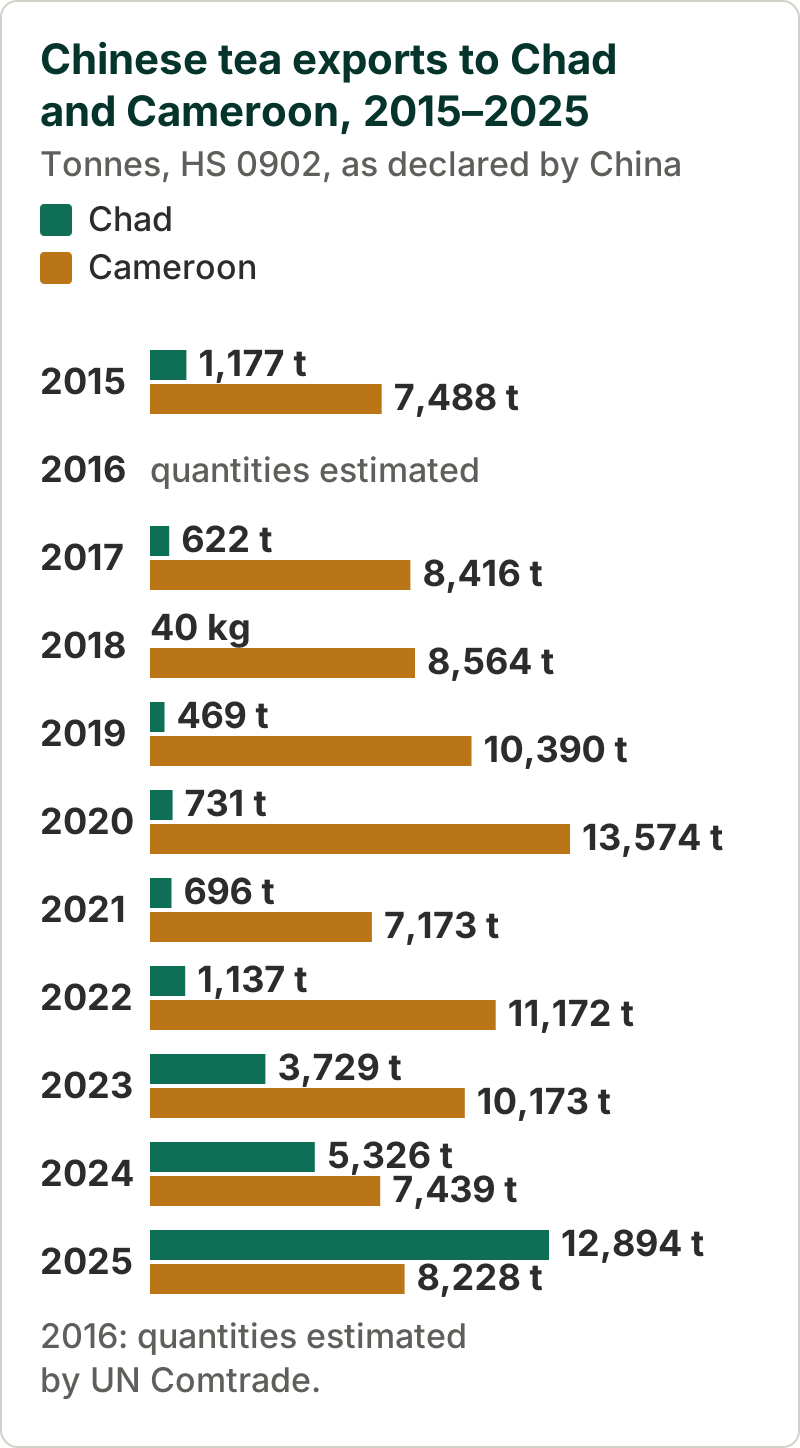
China’s tea exports to Chad and Cameroon, 2015–2025
Chad (乍得 in Chinese) and Cameroon (喀麦隆), 25th and 32nd by value in 2025, are absent from the monthly tea reports of China’s Ministry of Commerce (MOFCOM), which name the ten largest markets by value, so the series below are China’s declarations to UN Comtrade. Together the two took 21,122 tonnes in 2025, 5.0% of China’s tea export volume, and tea made up 2.7% of the value of China’s exports to Chad, against 0.17% for Cameroon (The Tea Trade’s calculation).
China’s tea exports to Chad and Cameroon, 2015–2025 (HS 0902; source: UN Comtrade, figures reported by China; unit values: The Tea Trade’s calculation)
| Year | Chad (t) | Chad (US$ million) | Chad (US$/kg) | Cameroon (t) | Cameroon (US$ million) | Cameroon (US$/kg) |
|---|---|---|---|---|---|---|
| 2015 | 1,177 | 1.13 | 0.96 | 7,488 | 6.38 | 0.85 |
| 2016 | estimated | 0.65 | – | estimated | 5.62 | – |
| 2017 | 622 | 0.70 | 1.13 | 8,416 | 7.40 | 0.88 |
| 2018 | 40 kg | <0.01 | – | 8,564 | 8.14 | 0.95 |
| 2019 | 469 | 0.87 | 1.86 | 10,390 | 12.20 | 1.17 |
| 2020 | 731 | 1.82 | 2.49 | 13,574 | 16.17 | 1.19 |
| 2021 | 696 | 2.49 | 3.59 | 7,173 | 10.55 | 1.47 |
| 2022 | 1,137 | 1.83 | 1.61 | 11,172 | 16.47 | 1.47 |
| 2023 | 3,729 | 5.38 | 1.44 | 10,173 | 18.33 | 1.80 |
| 2024 | 5,326 | 7.86 | 1.48 | 7,439 | 11.53 | 1.55 |
| 2025 | 12,894 | 14.96 | 1.16 | 8,228 | 7.47 | 0.91 |
UN Comtrade flags China’s 2016 quantities as estimates, so they are left out. Unit value = FOB value ÷ net weight.
 Source: UN Comtrade, exports reported by China (2015–2025)
The two markets moved in opposite directions. Chad took less than 1,200 tonnes a year until 2022, then 3,729 in 2023 and 12,894 in 2025, up 142.1% on 2024, climbing from 42nd place by volume in 2015 and 48th in 2020 to ninth, as our guide to Chinese tea export markets shows. Cameroon was 13th in 2015 and 10th in 2020, when it took 13,574 tonnes, and 17th in 2025. Of the tonnes China declared for the two countries together, Chad’s share rose from 9.2% in 2022 to 61.0% in 2025 (The Tea Trade’s calculation). The statistics do not say why.
Pack sizes and the lowest unit values in China’s top 20 by volume
In every year with reliable figures, over 90% of the tea China declared for each country was green tea in packings over 3 kg (Chad’s 40 kg of 2018 aside), under HS 0902.20 (other green tea) rather than 0902.10, green tea in immediate packings of 3 kg or less. Apart from 49 tonnes in 2017–2019, China declared no black or partly fermented tea for either of them. Why the 3 kg line matters is explained in our guide to tea HS codes.
Green tea in packings over 3 kg (HS 0902.20) in China’s tea exports to Chad and Cameroon: share of volume and unit value (source: UN Comtrade, figures reported by China; The Tea Trade’s calculation)
| Year | Chad: share of volume | Chad: US$/kg | Cameroon: share of volume | Cameroon: US$/kg |
|---|---|---|---|---|
| 2015 | 94.9% | 0.94 | 96.2% | 0.80 |
| 2020 | 90.9% | 2.26 | 98.2% | 1.18 |
| 2023 | 99.3% | 1.41 | 98.2% | 1.79 |
| 2024 | 98.5% | 1.45 | 98.6% | 1.54 |
| 2025 | 96.8% | 1.12 | 98.4% | 0.88 |
Bulk packing explains only part of the gap. In 2025 Chad was the third destination for China’s green tea in packings over 3 kg and Cameroon the sixth, yet their unit values were 38% and 30% of the average for that subheading (The Tea Trade’s calculation):
China’s exports of green tea in packings over 3 kg (HS 0902.20), six largest destinations by volume, 2025 (source: UN Comtrade via WITS; unit values: The Tea Trade’s calculation)
| Destination | Volume (t) | Value (US$ million) | Unit value (US$/kg) |
|---|---|---|---|
| Morocco | 91,128 | 277.1 | 3.04 |
| Uzbekistan | 28,840 | 60.1 | 2.09 |
| Chad | 12,484 | 14.0 | 1.12 |
| Algeria | 11,622 | 40.8 | 3.51 |
| Russia | 11,413 | 25.3 | 2.22 |
| Cameroon | 8,096 | 7.1 | 0.88 |
| All destinations | 231,614 | 684.9 | 2.96 |
Small packs were low too: US$2.34 per kg for Chad and US$2.82 for Cameroon in 2025, against about US$4 for West Africa’s buyers of that format, as our guide to green tea export unit values shows.
The level has moved. Cameroon’s unit value for larger packings rose from US$0.80 per kg in 2015 to US$1.79 in 2023, then fell to US$0.88 in 2025, down 42.9% on 2024; Chad’s fell 22.5% in 2025, to US$1.12 (The Tea Trade’s calculation). China records exports free on board (FOB) at its own border (National Bureau of Statistics of China), so transport to Central Africa is not in these figures, and neither the HS nor China’s eight-digit tariff lines record grade. As far as the data go, the low unit values come from the format, bulk green tea, and from values per kilo at the bottom of China’s large markets for it; what tea it is, the statistics do not say.
Cameroon’s import records show almost none of this tea
Chad has no annual data in UN Comtrade after 1995, so China’s declarations are its only series. Cameroon reports its trade, 2023 being the latest year in October 2026, but hardly registers Chinese tea:
Tea from China to Cameroon: China’s declarations and Cameroon’s records (HS 0902; source: UN Comtrade via WITS and the Comtrade API)
| Year | Declared by China (t) | Recorded by Cameroon (t) | Recorded as a share of declared |
|---|---|---|---|
| 2015 | 7,488 | 60.1 | 0.80% |
| 2017 | 8,416 | 11.6 | 0.14% |
| 2018 | 8,564 | 84.4 | 0.99% |
| 2019 | 10,390 | 17.6 | 0.17% |
| 2020 | 13,574 | 28.0 | 0.21% |
| 2021 | 7,173 | 63.5 | 0.89% |
| 2022 | 11,172 | 17.0 | 0.15% |
| 2023 | 10,173 | 1.8 | 0.02% |
2016 is left out: China’s quantities for it are estimates. Shares: The Tea Trade’s calculation.
The gap is specific to tea. In 2023 Cameroon recorded US$1,572.7 million of imports of all goods from China, 42.3% of the US$3,715.0 million China declared, but 0.08% of the value of the tea (The Tea Trade’s calculation from UN Comtrade). Its tea imports from all origins came to 30.3 tonnes that year, 58.5% of it black or partly fermented tea in packs of 3 kg or less, and 1.6 tonnes of green tea in larger packings.
Under UN recommendations for trade statistics (IMTS 2010), goods only passing through a country are left out of its trade, and China records exports under the country where they are known to be consumed, used or processed (National Bureau of Statistics of China). Tea crossing Cameroon in transit to Chad should therefore count as China’s exports to Chad, not as Cameroon’s imports; the tonnes in the table were declared for Cameroon. Cameroon did record 243.6 tonnes of tea exports to Chad in 2023, and none in 2022. The statistics do not explain the gap.
Tea duty in the Central African customs union (CEMAC)
Cameroon and Chad are two of the six members of the Economic and Monetary Community of Central Africa (CEMAC), with the Central African Republic, Congo, Gabon and Equatorial Guinea, and belong to the Economic Community of Central African States (CEEAC) (MOFCOM, 2025). CEMAC countries have applied a common external tariff to goods from third countries since 2000. Updated to the 2022 Harmonized System, it has five bands: 0% for certain cultural and aviation goods, 5% for basic necessities, 10% for raw materials and capital goods, 20% for intermediate goods and 30% for daily consumer goods, according to the WTO’s 2023 review of the CEMAC countries, which puts the average on coffee and tea lines at 28.5%.
Tea sat in its top band. Both countries reported a 30% duty on green tea, in packs of 3 kg or less and in larger packings alike, in every year of tariff data they sent to UNCTAD, the latest being 2023 (UNCTAD TRAINS). Pack size changes the statistics, not the duty.
The CEEAC–CEMAC tariff from 1 January 2026
Two CEEAC decisions of 18 October 2024 approved a harmonised CEEAC–CEMAC common external tariff (n°14/CEEAC/CCEG/XXV/24) and a harmonised customs code (n°5/CEEAC/CCEG/XXV/24). Cameroon’s finance law for 2026 (Law No. 2025/012 of 17 December 2025) applies both from 1 January 2026 (sections 21 and 22). Neither the law nor the customs directorate’s circular of 18 May 2026 on applying it gives rates, and no published schedule could be found in October 2026, so the duty on tea under the new tariff is not confirmed here. No equivalent text was found for Chad.
VAT and other import charges in Cameroon and Chad
Both countries also levy three community charges on the CIF value of goods from outside the zone: the community integration tax (TCI, 1%), the community integration contribution (CCI, 0.4%) and the OHADA levy (0.05%), 1.45% in all (WTO, 2023).
Import charges on green tea from China, as published (checked October 2026; sources: Cameroon’s General Tax Code, 2026 edition; WTO review of the CEMAC countries, 2023; UNCTAD TRAINS; Cameroon’s 2026 finance law; US Department of Commerce)
| Charge | Cameroon | Chad |
|---|---|---|
| Customs duty, tariff data to 2023 | 30% | 30% |
| Customs duty from 2026 | CEEAC–CEMAC tariff from 1 January 2026; rate for tea not confirmed | No 2026 text found |
| TCI, CCI and OHADA levy | 1.45% of CIF value | 1.45% of CIF value |
| Excise duty | 25% of value plus duty, plus 5% of it for the communes | None listed for tea |
| VAT | 19.25% (17.5% plus 10% of it for the communes) of value plus duty and excise | 18% (2023) |
| Other charges | Special excise of 1% on imports; customs IT fee 0.45% of FOB value; African integration contribution 0.2%; prepayment of 2% or 10% of customs value, by tax regime | Statistical fee 2% and income-tax down payment 4% of CIF value; African Union levy 0.2% |
Cameroon’s General Tax Code (2026 edition, article 142 and annex II) lists imported tea, heading 0902, among the goods subject to excise duty at the general rate, 25% of the customs value plus duty; tea grown in Cameroon does not pay it (WTO, 2023). VAT is then charged on the value plus duty and excise. On tea with a customs value of 100, the 30% duty adds 30, the excise 32.5 and the VAT 31.3 (19.25% of 162.5): 93.8 in all, before the excise surcharge, community levies and other charges (The Tea Trade’s calculation).
In Chad, the down payment rises to 15% for unregistered companies (WTO, 2023); the 2026 finance law could not be checked, as the finance ministry’s website could not be opened.
The Douala–N’Djamena corridor and transit to Chad
Chad has no coastline, and the port of Douala is its only viable sea access: about 79% of Chad’s imports pass through it, according to a World Bank project document of October 2021, which puts about 80% of Central Africa’s transit traffic on the Douala–N’Djamena and Douala–Bangui corridors. N’Djamena lies 1,700 to 1,970 km from Douala, depending on the source (WTO; World Bank; MOFCOM), and Douala handles 95% of Cameroon’s own trade (MOFCOM).
From Douala, freight goes by rail to Ngaoundéré, a line carrying about 40% of the corridor’s freight, or by road, then on by road. From Ngaoundéré, trucks reach N’Djamena through northern Cameroon and the Kousseri border crossing, or eastward through Moundou and the Koutéré crossing; the security situation in Cameroon’s Far North shifted truckers to the eastern route, which carried almost 375,000 tonnes in 2019 against 20,000 tonnes through Kousseri (World Bank, 2022, from Chad’s national land freight bureau). The road haulage is shared between Chadian (65%) and Cameroonian (35%) hauliers (WTO, 2023).
Freight transit time from the port of Douala to N’Djamena (days; source: World Bank, Cameroon-Chad Transport Corridor project, results report of 30 July 2026)
| Leg | February 2022 | June 2026 | Target, June 2032 |
|---|---|---|---|
| Rail, Douala port to Ngaoundéré | 7.1 | 7.1 | 5.0 |
| Unloading and loading at Ngaoundéré | 1.7 | 1.7 | 1.0 |
| Road, Ngaoundéré to N’Djamena | 4.2 | 4.2 | 2.2 |
| Customs clearance at destination | 7.0 | 7.0 | 4.0 |
| Total | 20.0 | 20.0 | 12.2 |
Add the sea voyage, compared for Gulf of Guinea ports in our guide to China–Africa tea shipping times.
On the way, tea for Chad stays under customs control. Goods in transit through Cameroon need a bank guarantee equal to all the duties and taxes payable (customs takes 20 days to clear the bond of a transit operation), and lorries carry GPS beacons, at CFAF 50,000 each, until they leave the country; Cameroon’s land freight bureau (BGFT) charges CFAF 500 and CFAF 2,000 per journey (WTO, 2023). CEMAC’s transit regulation of 28 October 2010 provides a single guarantee valid in all member states (WTO, 2023); in January 2022 the World Bank found the linked customs systems needed for CEMAC’s new transit regime not fully in place, and the freight bureaus of Cameroon (BGFT) and Chad (BNFT) allocating transit loads without transparency.
Cargo entering Cameroon’s ports needs an electronic cargo tracking note, the BESC (bordereau électronique de suivi des cargaisons), issued by the Cameroon National Shippers’ Council (CNCC) under an order of 11 July 2006 (WTO, 2023); filed less than two days before the ship arrives, it is validated only after a penalty (CNCC). For goods in transit, the CNCC suspended the BESC on 15 June 2026 until further notice (checked October 2026). Chad has its own note: tracking notes managed by the Chad Shippers’ Council (COC-Tchad), which has an office in Douala, are mandatory for imports and must be validated before each shipment (WTO, 2023). Chad abolished its pre-shipment inspection programme in 2018 (WTO, 2023), while Cameroon requires pre-shipment inspection of imports in the exporting country (US Department of Commerce, 2026), the subject of our guide to pre-shipment conformity for tea in Africa.
What this means for tea exporters and importers
- Market size. China declared 21,122 tonnes of tea for the two countries in 2025, 61.0% of it for Chad. Chad has no national series and Cameroon’s records capture almost none of it, so size these markets with China’s figures.
- Format and duty. Almost all of it is bulk green tea under HS 0902.20, at 30% duty in the tariff data up to 2023; confirm the rate under the 2026 CEEAC–CEMAC tariff before costing a shipment.
- Taxes. Allow for the 1.45% community levies; in Cameroon, 25% excise and 19.25% VAT; in Chad, the 2% statistical fee, the down payment and 18% VAT (2023).
- Documents and time. Have Chad’s tracking note validated by COC-Tchad before loading, check Cameroon’s BESC and inspection rules, and allow about 20 days from Douala to N’Djamena.
This is general information, not legal or tax advice: have a customs broker in Douala or N’Djamena confirm the procedure, documents and rates before each shipment.
Questions and answers
How much tea does Chad import from China?
China declared 12,894 tonnes of tea worth US$15.0 million for Chad in 2025, up 142.1% on 2024, almost all of it green tea in packings over 3 kg (UN Comtrade). Chad's own trade figures are not in UN Comtrade after 1995, so China's declarations are the only series.
How much tea does Cameroon import from China?
China declared 8,228 tonnes worth US$7.5 million for Cameroon in 2025, and between 7,173 and 13,574 tonnes a year from 2017 to 2025 (UN Comtrade). Cameroon's own customs figures record only a few tonnes of tea from China: 1.8 tonnes in 2023.
What is the import duty on tea in Cameroon and Chad?
30% on green tea, in packs of 3 kg or less and in larger packings alike, in the tariff data both countries reported up to 2023, the top band of the CEMAC common external tariff (UNCTAD TRAINS), plus 1.45% of community levies on the CIF value (WTO, 2023). Cameroon applies the harmonised CEEAC–CEMAC tariff from 1 January 2026; its rate for tea could not be confirmed in a published schedule (checked October 2026).
What is the VAT on imported tea in Cameroon and Chad?
In Cameroon, 19.25%: 17.5% plus a surcharge of 10% of the VAT for the communes, charged on the customs value plus duty and the 25% excise duty that imported tea pays (General Tax Code, 2026 edition). In Chad, the standard rate was 18% in the WTO's 2023 review.
Why do Chinese tea exports to Chad and Cameroon have such low unit values?
Almost all of it is green tea in packings over 3 kg, the format with lower unit values, and even within that format Chad's US$1.12 and Cameroon's US$0.88 per kg in 2025 were 38% and 30% of China's average for that subheading (The Tea Trade's calculation from UN Comtrade). Customs data do not record grade, so they cannot say more.
How does tea reach Chad?
Through the port of Douala in Cameroon, then by rail to Ngaoundéré and by road to N'Djamena. The World Bank put the freight transit time from Douala to N'Djamena at 20 days, including 7 days of customs clearance at destination, in February 2022 and again in June 2026.
Sources
- 1. Cameroon, Directorate General of Customs: 2026 Finance Law (Law No. 2025/012 of 17 December 2025), provisions relating to customs duties and taxes, English text · douanes.cm
- 2. Cameroon, Directorate General of Taxation: General Tax Code, official edition updated to 1 January 2026 (in French) · impots.cm
- 3. Cameroon National Shippers' Council (CNCC): communiqué suspending the BESC for goods in transit, 15 June 2026 (in French) · cncc.cm
- 4. WTO: Trade Policy Review of the Central African Economic and Monetary Community (CEMAC) countries, report by the Secretariat, WT/TPR/S/445, 16 August 2023 · wto.org
- 5. WTO: Trade Policy Review of the CEMAC countries, report by the Secretariat, Annex 1, Cameroon (WT/TPR/S/445, 2023) · wto.org
- 6. WTO: Trade Policy Review of the CEMAC countries, report by the Secretariat, Annex 5, Chad (WT/TPR/S/445, 2023) · wto.org
- 7. UNCTAD TRAINS via WITS: applied MFN duty reported by Cameroon on other green tea (HS 0902.20), all years to 2023 · wits.worldbank.org
- 8. UN Comtrade: China's tea exports to Cameroon and Chad by HS subheading (0902.10 to 0902.40), 2025 · comtradeapi.un.org
- 9. UN Comtrade via WITS: China's tea exports (HS 0902) by partner, 2025 · wits.worldbank.org
- 10. UN Comtrade via WITS: Cameroon's tea imports (HS 0902) by partner, 2023 · wits.worldbank.org
- 11. World Bank: Cameroon-Chad Transport Corridor (P167798), project information document, concept stage (8 October 2021) · documents1.worldbank.org
- 12. World Bank: Cameroon-Chad Transport Corridor (P167798), implementation status and results report no. 7 (30 July 2026) · documents1.worldbank.org