Sahel tea trade corridors: Mali, Burkina Faso and Niger
Sahel tea trade: China declared 22,176 t of tea for Mali, Niger and Burkina Faso in 2025. Port corridors, ISRT transit and the rules in force after ECOWAS.

Key facts
- China declared 22,176 tonnes of tea worth US$75.9 million for Mali, Niger and Burkina Faso in 2025, against 9,066 tonnes in 2015, according to the export figures China reported to UN Comtrade.
- In 2024 Mali, Niger and Burkina Faso recorded 25,404 tonnes of tea imported from China, 1.49 times the 17,052 tonnes China declared for them, against 3.99 times in 2019 (The Tea Trade's calculation from UN Comtrade).
- China's Ministry of Commerce puts the Bamako–Dakar and Bamako–Abidjan roads, which carry most of Mali's imports and exports, at 1,270 km and 1,115 km, and reports that the Dakar–Bamako railway has been halted since May 2018.
- Under ECOWAS Convention A/P.4/5/82 of 29 May 1982, goods in inter-state road transit cross member states free of duties and taxes under one sealed declaration, against security covering at least the duties and taxes payable.
- On 29 January 2025, when Mali, Burkina Faso and Niger left ECOWAS, the community asked authorities to keep treating goods from the three under its trade liberalisation scheme until its heads of state settle future relations; in July 2026 they extended their chief negotiator's mandate to December 2026.
Mali, Burkina Faso and Niger have no coastline, so their tea from China is landed at a port such as Dakar, Abidjan, Lomé or Cotonou and carried inland by road, or by rail from Abidjan, under customs transit. China declared 22,176 tonnes of tea worth US$75.9 million for the three countries in 2025, against 9,066 tonnes in 2015, according to the figures China reported to UN Comtrade; the three recorded more tea from China than China declared for them in every year from 2017 to 2024. They left the Economic Community of West African States (ECOWAS) on 29 January 2025. As of October 2026 their latest tariff data, for 2023, showed 10% duty on green tea, and no official text found had replaced ECOWAS’s request of that day to keep treating goods from the three under its trade liberalisation scheme.
China’s tea exports to Mali, Niger and Burkina Faso, 2015–2025
In China’s export statistics the three markets appear as 马里 (Mali), 尼日尔 (Niger) and 布基纳法索 (Burkina Faso). Over ten years the tea China declared for them grew by 144.6%, and their share of China’s tea export volume rose from 2.8% to 5.3% (The Tea Trade’s calculation from UN Comtrade). Niger grew fastest, to 4.1 times its 2015 volume, and has taken more Chinese tea than Mali in five of the last seven years. Mali swings more: 11,956 tonnes in 2023, 6,608 tonnes in 2024 (−44.7%), then 10,326 tonnes in 2025 (+56.3%). Burkina Faso takes 429 to 1,119 tonnes a year.
China’s tea exports to Mali, Niger and Burkina Faso, 2015–2025 (HS 0902, tonnes, and total value in US$ million; source: UN Comtrade, figures reported by China)
| Year | Mali | Niger | Burkina Faso | Total (t) | Total value (US$ million) |
|---|---|---|---|---|---|
| 2015 | 5,888.3 | 2,703.8 | 474.2 | 9,066.3 | 41.1 |
| 2016 | – | – | – | – | 33.2 |
| 2017 | 4,972.6 | 1,986.3 | 542.5 | 7,501.4 | 30.6 |
| 2018 | 5,591.2 | 2,004.0 | 429.3 | 8,024.5 | 32.1 |
| 2019 | 3,771.9 | 4,013.2 | 664.1 | 8,449.1 | 31.2 |
| 2020 | 3,230.3 | 4,729.7 | 744.4 | 8,704.4 | 28.2 |
| 2021 | 5,496.0 | 6,011.7 | 566.9 | 12,074.6 | 45.2 |
| 2022 | 9,249.0 | 7,296.8 | 930.1 | 17,475.9 | 64.2 |
| 2023 | 11,956.4 | 6,767.8 | 1,119.4 | 19,843.7 | 70.1 |
| 2024 | 6,608.4 | 9,736.6 | 706.8 | 17,051.8 | 53.5 |
| 2025 | 10,325.9 | 11,081.8 | 768.6 | 22,176.2 | 75.9 |
China’s 2016 weights in UN Comtrade are UN estimates, not reported figures, and are not shown. Totals and changes are The Tea Trade’s calculation.
In 2025 China declared 99.8% of its tea for Mali and all of it for Burkina Faso as green tea in packs of 3 kg or less (HS 0902.10), and no black tea for any of the three. Niger was the exception, with 3,925 tonnes, 35.4% of its tea, declared as other green tea (HS 0902.20), the subheading that covers packs over 3 kg. China’s Ministry of Commerce (MOFCOM) lists tea among China’s main exports to Mali and to Niger in its 2025 country guides. China’s other markets are compared in our guide to Chinese tea export markets.
What Mali, Niger and Burkina Faso record: more tea than China declares
All three report their imports to UN Comtrade, and in every year from 2017 to 2024 they recorded more tea from China than China declared for them: 3.7 to 4.0 times as much in 2017–2020, 2.9 times in 2021, then 1.3 to 1.7 times in 2022–2024 (The Tea Trade’s calculation).
Tea from China to Mali, Niger and Burkina Faso: China’s declarations and the three countries’ records (HS 0902, tonnes; source: UN Comtrade)
| Year | Declared by China | Recorded by Mali | Recorded by Niger | Recorded by Burkina Faso | Recorded, total |
|---|---|---|---|---|---|
| 2017 | 7,501.4 | 16,314.7 | 10,586.7 | 3,424.1 | 30,325.6 |
| 2018 | 8,024.5 | 16,455.1 | 10,620.1 | 2,757.3 | 29,832.5 |
| 2019 | 8,449.1 | 18,820.7 | 13,458.6 | 1,405.8 | 33,685.2 |
| 2020 | 8,704.4 | 21,014.7 | 9,961.9 | 1,319.0 | 32,295.6 |
| 2021 | 12,074.6 | 21,654.4 | 10,340.7 | 3,388.1 | 35,383.2 |
| 2022 | 17,475.9 | 17,311.1 | 7,900.7 | 5,113.8 | 30,325.6 |
| 2023 | 19,843.7 | 12,879.4 | 7,970.5 | 4,174.3 | 25,024.2 |
| 2024 | 17,051.8 | 9,499.8 | 11,950.8 | 3,953.7 | 25,404.3 |
Burkina Faso’s 2021 weight is a UN estimate. In October 2026 only Niger had reported 2025 data: 8,397 tonnes from China, less than the 11,082 tonnes China declared for it.
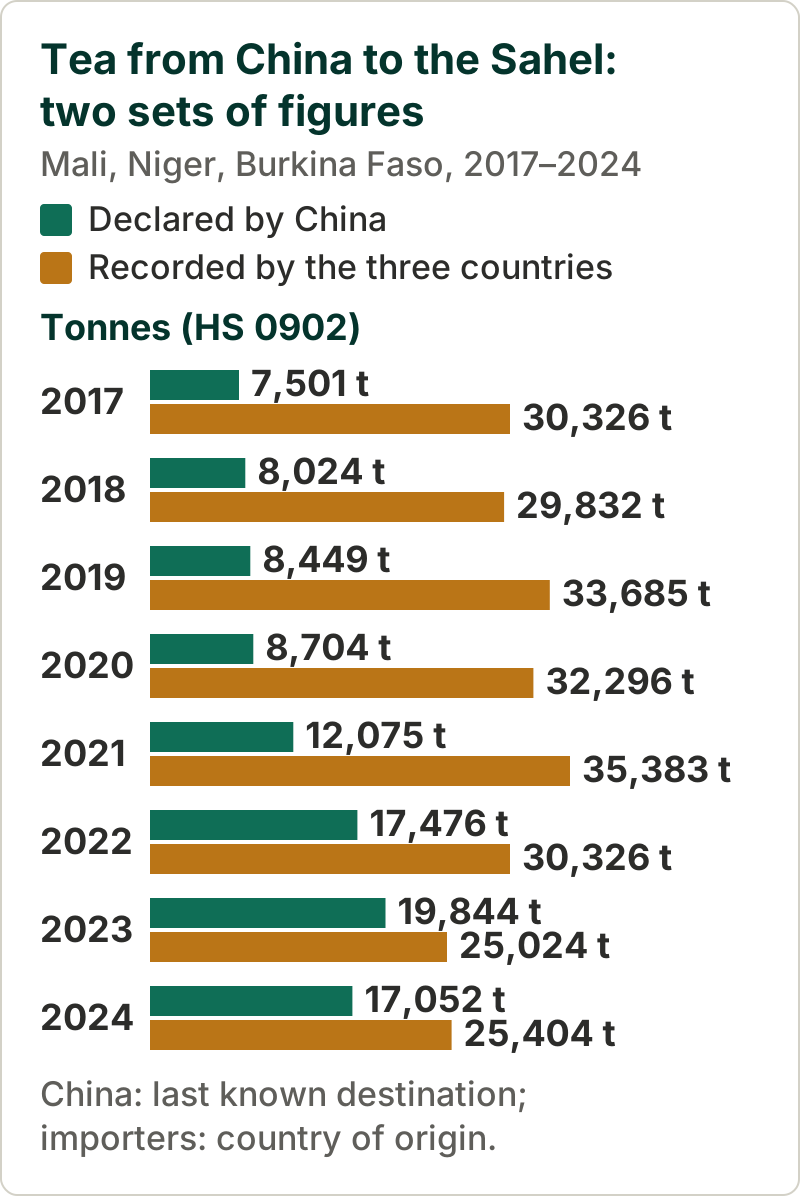 Source: UN Comtrade, figures reported by China and by Mali, Niger and Burkina Faso (2017–2024)
The United Nations recommendations for trade statistics (IMTS 2010) show how such a gap arises: importers record the country of origin, exporters the last destination known when the goods leave, and goods simply carried through a country are left out of its imports. Tea that China declares for a coastal country but that is sold on to Bamako or Niamey therefore counts as a sale to that country in China’s figures and as an import from China in Malian or Nigerien ones. Côte d’Ivoire shows the reverse gap: in 2025 China declared 16,701 tonnes of tea for it, 12.6 times the 1,322 tonnes Côte d’Ivoire recorded from China (The Tea Trade’s calculation from UN Comtrade data read in October 2026). China’s declarations for the three rose from a quarter of what they recorded in 2019 to 79.3% in 2023 and 67.1% in 2024, which is consistent with more Sahel-bound tea being declared for its final destination; that is an interpretation, not a measured fact.
Values disagree more: in 2024 the three valued their tea from China at US$1.18 per kg including cost, insurance and freight (CIF), against US$3.14 per kg free on board (FOB) in China’s declarations (value ÷ volume; The Tea Trade’s calculation), and the statistics do not say why. China supplied 90.8% of Mali’s recorded tea imports by volume in 2024 and 96.1% of Niger’s in 2025, but only 57.4% of Burkina Faso’s 6,890 tonnes in 2024, when India supplied 37.0%.
Port corridors to Bamako, Ouagadougou and Niamey
MOFCOM’s 2025 country guides (对外投资合作国别(地区)指南) describe each country’s routes to the sea.
Main transport corridors of Mali, Burkina Faso and Niger (source: MOFCOM country guides, 2025 editions)
| Inland country | Outlet | Route and distance | Status in the guides |
|---|---|---|---|
| Mali | Dakar (Senegal) | Road, 1,270 km; railway via Bamako to Koulikoro, 1,287 km | Road one of two main routes; railway halted since May 2018 |
| Mali | Abidjan (Côte d’Ivoire) | Road, 1,115 km | One of two main routes |
| Mali | Lomé (Togo) | Road through Burkina Faso, 1,600 km | Other route |
| Mali | Conakry (Guinea) | Road, 1,100 km | Other route |
| Burkina Faso | Ghana | Road from Ouagadougou through Pô | Main import and export route |
| Burkina Faso | Abidjan | Railway Abidjan–Ouagadougou–Kaya, 1,260 km | Freight only since COVID-19 |
| Burkina Faso | Togo, Benin | Road through Fada N’Gourma | International route |
| Niger | Cotonou (Benin) | Road, 1,060 km | Unusable: border closed since July 2023 |
| Niger | Lomé | Road through Fada N’Gourma, 1,245 km | International route |
| Niger | Abidjan | Road to Ouagadougou, 540 km, then railway, 1,145 km | International route |
| Niger | Lagos (Nigeria) | Road through Maradi to Kano, then railway | International route |
According to MOFCOM, the roads to Dakar and Abidjan carry most of Mali’s imports and exports, and the Dakar–Bamako railway has not run since May 2018. The port of Abidjan’s transit figures for Mali and Burkina Faso are set out in our Côte d’Ivoire tea imports guide, and Burkina Faso’s main road to the sea runs to Ghana, whose tea trade is covered in our guide to Ghana’s green tea imports.
Niger’s goods travel mainly through Benin and Togo, MOFCOM says, but the border between Niger and Benin has been closed since July 2023, so the Cotonou route cannot be used. On 16 June 2026 the two countries’ expert committees handed in their reports on reopening it to their heads of state, according to a joint communiqué of the two governments; it gave no reopening date, and no official announcement of a reopening was found in October 2026. Sailing times from China to these ports are compared in our guide to China–Africa tea shipping times. Transit to Chad is covered in our guide to Cameroon and Chad tea imports.
How tea moves in transit: the ECOWAS ISRT regime
Tea for the three crosses a coastal state in customs transit, duties suspended, and pays duty in the country of destination. The common framework is the ECOWAS inter-state road transit regime (ISRT; transit routier inter-États, TRIE, in French), set up by Convention A/P.4/5/82, signed in Cotonou on 29 May 1982 for the member states, Mali, Niger and Upper Volta, now Burkina Faso, among them. Goods travel by road from a customs office in one member state to one in another, through others, free of duties, taxes and restrictions while in transit:
- One declaration and seals. The goods move under an ISRT declaration in a numbered booklet of four leaflets, sealed, on a route and within a time limit set by the office of departure; transit offices check the seals and inspect the goods only if they suspect irregularities (articles 5, 6, 14, 15 and 18).
- No unloading on the way, except under customs supervision or after an accident (articles 1 and 20 to 23).
- A guarantee covering at least the duties and taxes payable and possible penalties (article 27). Under Supplementary Convention A/SP.1/5/90, signed in Banjul on 29 May 1990, each state designates a national guarantor, and each guarantee covers a single operation from the office of departure to the office of final destination (articles 3 and 4).
- Agreed routes: each state lists, with its neighbours, the routes and customs offices open to inter-state transit (article 39).
On 22 June 2025 ECOWAS heads of state called for the Interconnected System for the Management of Goods in Transit (SIGMAT) to be fully operational across the region.
Mali’s Customs Code, Law 2022-013 of 23 June 2022, defines international transit as carrying goods under customs control in suspension of duties, taxes and prohibitions, and provides that road transit between Mali and an ECOWAS member state is governed by the regime in force within ECOWAS (article 195). In October 2026 Malian customs still published, as its transit rules, Order 09-3014/MEF-SG of 19 October 2009.
Mali, Burkina Faso and Niger after ECOWAS: what is in force (October 2026)
ECOWAS heads of state acknowledged on 15 December 2024 that, under Article 91 of the community’s Revised Treaty of 1993, the three countries would cease to be members on 29 January 2025.
Official decisions on trade with Mali, Burkina Faso and Niger, December 2024 to July 2026 (sources: ECOWAS, Mali Presidency, MOFCOM; checked October 2026)
| Date | Issuer | What it says |
|---|---|---|
| 15 December 2024 | ECOWAS heads of state, 66th ordinary session | Membership ends on 29 January 2025; 29 January to 29 July 2025 set as a transition period |
| 29 January 2025 | ECOWAS press statement | Goods and services from the three to be treated under the ECOWAS Trade Liberalisation Scheme (ETLS) and investment policy until heads of state settle future relations |
| 28 March 2025 | Alliance of Sahel States (AES), the three countries’ confederation, as reported by MOFCOM | 0.5% levy on the customs value of imports from outside the confederation; AES-origin goods, humanitarian aid, diplomatic goods and goods in transit exempt |
| 16 April 2025 | Mali, Council of Ministers | Mentions the setting up of the confederal levy, without a rate |
| 22 June 2025 | ECOWAS heads of state, 67th ordinary session | A chief negotiator to seek an orderly withdrawal that minimises regional market disruption |
| 23 March 2026 | ECOWAS | Lansana Kouyaté appointed chief negotiator |
| 19 July 2026 | ECOWAS heads of state, 69th ordinary session | Negotiator’s mandate extended to December 2026; talks with the three as a single group only |
MOFCOM’s Niger guide dates the levy 1 April 2025, and the text of the AES decision was not found on an official website.
Tariffs. No official text found has changed the duty on tea. The three reported 10% on green tea, packed or in bulk, in every year of tariff data from 2001 to 2023, the latest available in October 2026 (UNCTAD TRAINS). They remain members of the West African Economic and Monetary Union (WAEMU, UEMOA in French), whose common external tariff has applied since 1 January 2000, according to MOFCOM. Mali’s Customs Code defines the common external tariff as that of ECOWAS, and in October 2026 Mali’s customs website still posted the ECOWAS tariff, in a file dated 5 April 2023; MOFCOM’s 2025 Niger guide lists green tea at 10%. The levies and VAT added on arrival, and the open question of the ECOWAS levy, are covered in our West Africa tea import duties guide.
Transit. No official text found says whether, or how, the ISRT convention applies to goods bound for the three since 29 January 2025. ECOWAS’s statement of that day deals with goods coming from them and does not mention transit, and Mali’s Customs Code still refers road transit with ECOWAS states to the ECOWAS regime.
What this means for tea exporters and importers
- The destination on the export declaration. China records the last destination known when the tea leaves, so tea declared for Dakar and sold on to Bamako counts as a sale to Senegal. Agree with the buyer which country goes on the declaration.
- The route. Choose the port with the buyer and the forwarder, and check the Benin–Niger border before routing tea for Niger through Cotonou.
- Transit. Expect duties to be suspended in the coastal country against a guarantee, and paid in Bamako, Ouagadougou or Niamey.
- Checks before shipment. Mali’s customs say the country ended pre-shipment inspection: since 1 January 2018 a company mandated by the government has checked import documents only, and goods are scanned on arrival. Burkina Faso’s import procedures on its trade ministry’s portal, updated in late 2024, include no inspection before shipment, although no text ending its 2004 inspection programme was found and customs still collect a contribution to the verification programme of 1% of the FOB value. Ask the buyer which programme applies. Our guide to pre-shipment inspection for tea in West and Central Africa compares the rules country by country.
- Charges. Allow for the 10% duty plus the levies and VAT of the country of destination, and ask its customs whether the AES and ECOWAS levies are collected.
This is general information, not legal or tax advice: have a customs broker in the country of destination confirm the route, transit procedure, documents and rates before each shipment.
Questions and answers
How does tea from China reach Mali, Burkina Faso and Niger?
By sea to a coastal port, then by road, or by rail from Abidjan to Ouagadougou, under customs transit. China's Ministry of Commerce names Dakar and Abidjan as Mali's two main routes, the road to Ghana through Pô as Burkina Faso's main import route, and Benin and Togo as Niger's usual outlets, although Niger's border with Benin has been closed since July 2023.
How much tea does China export to Mali, Niger and Burkina Faso?
In 2025 China declared 11,082 tonnes of tea for Niger, 10,326 tonnes for Mali and 769 tonnes for Burkina Faso: 22,176 tonnes worth US$75.9 million (UN Comtrade). The three countries' own figures recorded more tea from China than China declared for them in every year from 2017 to 2024.
Do Mali, Burkina Faso and Niger still apply the ECOWAS tariff?
Their latest tariff data, for 2023, show 10% duty on green tea, as in every year since 2001 (UNCTAD TRAINS), and in October 2026 Mali's customs website still gave the ECOWAS common external tariff as its tariff. China's Ministry of Commerce also reports a 0.5% AES levy on imports from outside the confederation, dated 28 March 2025 in its Mali guide and 1 April 2025 in its Niger guide; no official text of the levy was found. Confirm current charges with each country's customs.
Is the Cotonou–Niamey corridor open?
China's Ministry of Commerce says the border between Niger and Benin has been closed since July 2023 and the Cotonou route cannot be used. On 16 June 2026 the two countries' expert committees handed in their reports on reopening it, with no date announced, according to a joint communiqué of the two governments, and no official announcement of a reopening was found in October 2026. Check its status before routing tea through Cotonou.
What is ISRT (TRIE) transit?
It is the ECOWAS inter-state road transit regime (transit routier inter-États, TRIE), set up by Convention A/P.4/5/82 of 29 May 1982. Goods travel by road from a customs office in one state to one in another without paying duties and taxes on the way, sealed, on a set route and time limit, under one declaration and a guarantee covering at least the duties and taxes payable.
Why do China's tea figures for Mali differ from Mali's own?
Under UN recommendations (IMTS 2010), China records the last destination known when the tea leaves and Mali records the country of origin, so tea China declares for a coastal country but that ends up in Mali counts as a sale to that country in China's figures and as an import from China in Mali's. Mali recorded 21,654 tonnes of tea from China in 2021, when China declared 5,496 tonnes for it.
Sources
- 1. ECOWAS: press statement on the withdrawal of Burkina Faso, Mali and Niger, 29 January 2025 · ecowas.int
- 2. ECOWAS: final communiqué of the 69th ordinary session of the Authority of Heads of State and Government, Lungi, 19 July 2026 · ecowas.int
- 3. ECOWAS: Convention A/P.4/5/82 relating to inter-state road transit of goods, Cotonou, 29 May 1982 · ecowas.int
- 4. Mali: Law 2022-013 of 23 June 2022 on the Customs Code, Official Journal special issue 9 of 7 July 2022 (in French) · douanes.gouv.ml
- 5. Niger, Government: Benin–Niger border, the two expert committees hand in their reports to the heads of state (joint communiqué), 16 June 2026 (in French) · gouv.ne
- 6. UN Comtrade: China's tea exports (HS 0902) to Mali, Niger, Burkina Faso and the world, 2025 · comtradeapi.un.org
- 7. UN Comtrade: tea imports (HS 0902) recorded by Mali, Niger and Burkina Faso, from China and from the world, 2024 · comtradeapi.un.org
- 8. UNCTAD TRAINS via WITS: applied MFN duty reported by Mali, Burkina Faso and Niger on green tea (HS 0902.10 and 0902.20), all years · wits.worldbank.org
- 9. United Nations Statistics Division: International Merchandise Trade Statistics, Concepts and Definitions 2010 (2011) · unstats.un.org
- 10. MOFCOM, Chinese Academy of International Trade and Economic Cooperation and Chinese Embassy in Mali: country guide for outbound investment and cooperation, Mali, 2025 edition (in Chinese) · mofcom.gov.cn
- 11. MOFCOM, Chinese Academy of International Trade and Economic Cooperation and Chinese Embassy in Niger: country guide for outbound investment and cooperation, Niger, 2025 edition (in Chinese) · mofcom.gov.cn
- 12. MOFCOM, Chinese Academy of International Trade and Economic Cooperation and Chinese Embassy in Burkina Faso: country guide for outbound investment and cooperation, Burkina Faso, 2025 edition (in Chinese) · mofcom.gov.cn
- 13. Mali, Directorate General of Customs: Technical Expertise Centre (CET) and the modern import control programme (in French) · douanes.gouv.ml
- 14. Mali, Presidency: communiqué of the Council of Ministers of 28 May 2025 (in French) · koulouba.ml
- 15. Burkina Faso, Ministry of Commerce, Burkina Trade Portal: full import procedure for edible oils via OuagaRinter, updated 4 December 2024 (in French) · burkinatradeportal.bf
- 16. Burkina Faso, Ministry of Commerce, Burkina Trade Portal: customs prepayment step of a full import procedure, updated 12 November 2024 (in French) · burkinatradeportal.bf
- 17. WTO: Trade Policy Review of the WAEMU countries, annex 2, Burkina Faso (WT/TPR/S/362, 2017, in French) · wto.org