Ghana green tea imports: data, Ghana FDA rules, 2026 taxes
Ghana green tea imports: China declared 18,075 t in 2025 (−53.2%), Ghana recorded under 3,300 t. ICUMS at Tema, Ghana FDA rules, 2026 VAT and levies.
Key facts
- China declared 18,075 tonnes of tea worth US$72.4 million for Ghana in 2025, down 53.2% in volume from 38,622 tonnes in 2024, which made Ghana the fifth destination for Chinese tea after two years in second place by volume, according to MOFCOM and UN Comtrade.
- In 2024 Ghana was the first destination for Chinese green tea in packs of 3 kg or less (HS 0902.10), with 38,449 tonnes, 29.7% of China's exports under that code, according to The Tea Trade's calculation from UN Comtrade data.
- Ghana's own customs statistics recorded 1,673 to 3,285 tonnes of tea imports from all origins in 2025, depending on the weight field used, and 103 to 951 tonnes from China, while China declared 18,075 tonnes of tea for Ghana, according to the figures both countries report to UN Comtrade.
- Since 1 January 2026, when Ghana's Value Added Tax Act, 2025 (Act 1151) took effect, VAT has been 15% and the NHIL and GETFund levies 2.5% each, an effective rate of 20%, and the 1% COVID-19 Health Recovery Levy has been abolished, according to the Ghana Revenue Authority.
- Prepackaged tea imported into Ghana must be registered with Ghana's Food and Drugs Authority (Ghana FDA), covered by an electronic import permit and still have at least two-thirds of its shelf life when it is cleared, under a Ghana FDA guideline in force since 2 July 2025.
Ghana was the fifth destination for Chinese tea in 2025: China declared 18,075 tonnes worth US$72.4 million for it, down 53.2% from 38,622 tonnes in 2024, when only Morocco ranked higher, according to China’s Ministry of Commerce (MOFCOM) and UN Comtrade. Almost all of it is green tea in packs of 3 kg or less, yet Ghana’s own customs statistics recorded only 1,673 to 3,285 tonnes of tea imports from all origins in 2025, depending on the weight field, 103 to 951 of them from China. Tea is cleared through ICUMS, the customs system of the Ghana Revenue Authority (GRA); prepackaged tea must be registered with Ghana’s Food and Drugs Authority (Ghana FDA); and since 1 January 2026 VAT and two levies have come to an effective 20%, on top of the 10% ECOWAS duty.
Ghana in China’s tea export statistics, 2015–2025
In China’s statistics, where it appears as 加纳, the tea declared for Ghana grew 4.5-fold from 2015 to 2024, from 8,628 to 38,622 tonnes (The Tea Trade’s calculation), as Ghana rose from 12th destination by volume to third in 2020 and second, behind Morocco, in 2023 and 2024 (UN Comtrade). Our guide to Chinese tea export markets compares the other destinations. The Chinese provinces that ship this tea are compared in our guide to China’s tea exports by province.
China’s tea exports to Ghana, 2015–2025 (HS 0902, all tea; sources: MOFCOM, UN Comtrade via WITS)
| Year | Volume (t) | Value (US$ million) | Unit value (US$/kg) | Share of China’s volume | Rank by value |
|---|---|---|---|---|---|
| 2015 | 8,628.5 | 38.7 | 4.48 | 2.7% | 12th |
| 2016 | 16,939.9 | 74.6 | 4.40 | 5.2% | 6th |
| 2017 | 19,780.9 | 85.5 | 4.32 | 5.6% | 4th |
| 2018 | 14,883.1 | 64.5 | 4.34 | 4.1% | 7th |
| 2019 | 16,462.1 | 71.8 | 4.36 | 4.5% | 5th |
| 2020 | 18,730.4 | 79.8 | 4.26 | 5.4% | 6th |
| 2021 | 22,831.9 | 103.3 | 4.52 | 6.2% | 5th |
| 2022 | 24,510.5 | 104.8 | 4.27 | 6.5% | 5th |
| 2023 | 35,289.7 | 141.7 | 4.02 | 9.6% | 4th |
| 2024 | 38,622.5 | 153.7 | 3.98 | 10.3% | 2nd |
| 2025 | 18,074.8 | 72.4 | 4.00 | 4.3% | 5th |
Figures for 2016–2025 come from MOFCOM’s December reports, whose top-ten tables by value list Ghana every year from 2016, and 2015 from UN Comtrade; unit values (value ÷ volume) and shares are The Tea Trade’s calculation. UN Comtrade matches MOFCOM from 2017; its 2016 quantity for Ghana, 4,228 tonnes, is an estimate, although the values match.
Almost all of it is green tea packed in China: 99.6% of the 2024 tonnage and 98.2% of the 2025 tonnage went under HS 0902.10, green tea in packs of 3 kg or less. In 2024 Ghana was the first destination for such tea, with 38,449 tonnes, 29.7% of China’s 129,297 tonnes (The Tea Trade’s calculation from UN Comtrade).
Ghana was not among the ten markets MOFCOM details for January to April 2026, so China’s tea exports to it in those months were worth less than the tenth market’s US$17.5 million (Algeria); no later MOFCOM report was online by mid-October 2026. China’s total tea exports month by month are tracked in our guide to China’s tea exports by month.
What Ghana’s own import statistics show
Ghana’s own figures, reported to UN Comtrade, barely overlap with China’s. They carry two weights: the quantity field, which WITS publishes and the chart below uses, and a net-weight field, equal to it until 2019 and higher from 2021. By quantity, Ghana’s tea imports from all origins ranged from 686 to 2,325 tonnes a year in 2015–2025 (2016, 2017 and 2019 are UN Comtrade estimates; 2020 has no data); by net weight, they peaked at 3,285 tonnes in 2025. Either way, Ghana’s record from China came to 0.3% to 5.3% of what China declared for Ghana (The Tea Trade’s calculation).
Tea from China recorded by Ghana, 2015–2025 (tonnes, HS 0902; * UN Comtrade estimate; source: UN Comtrade)
| Year | Quantity | Net weight |
|---|---|---|
| 2015 | 194.6 | 194.6 |
| 2016 | 117.6* | 117.6* |
| 2017 | 119.0 | 119.0 |
| 2018 | 136.6 | 136.6 |
| 2019 | 101.2 | 101.2 |
| 2020 | no data | no data |
| 2021 | 152.6 | 318.6 |
| 2022 | 63.2 | 129.0 |
| 2023 | 106.5 | 206.0 |
| 2024 | 141.8 | 661.2 |
| 2025 | 102.7 | 950.7 |
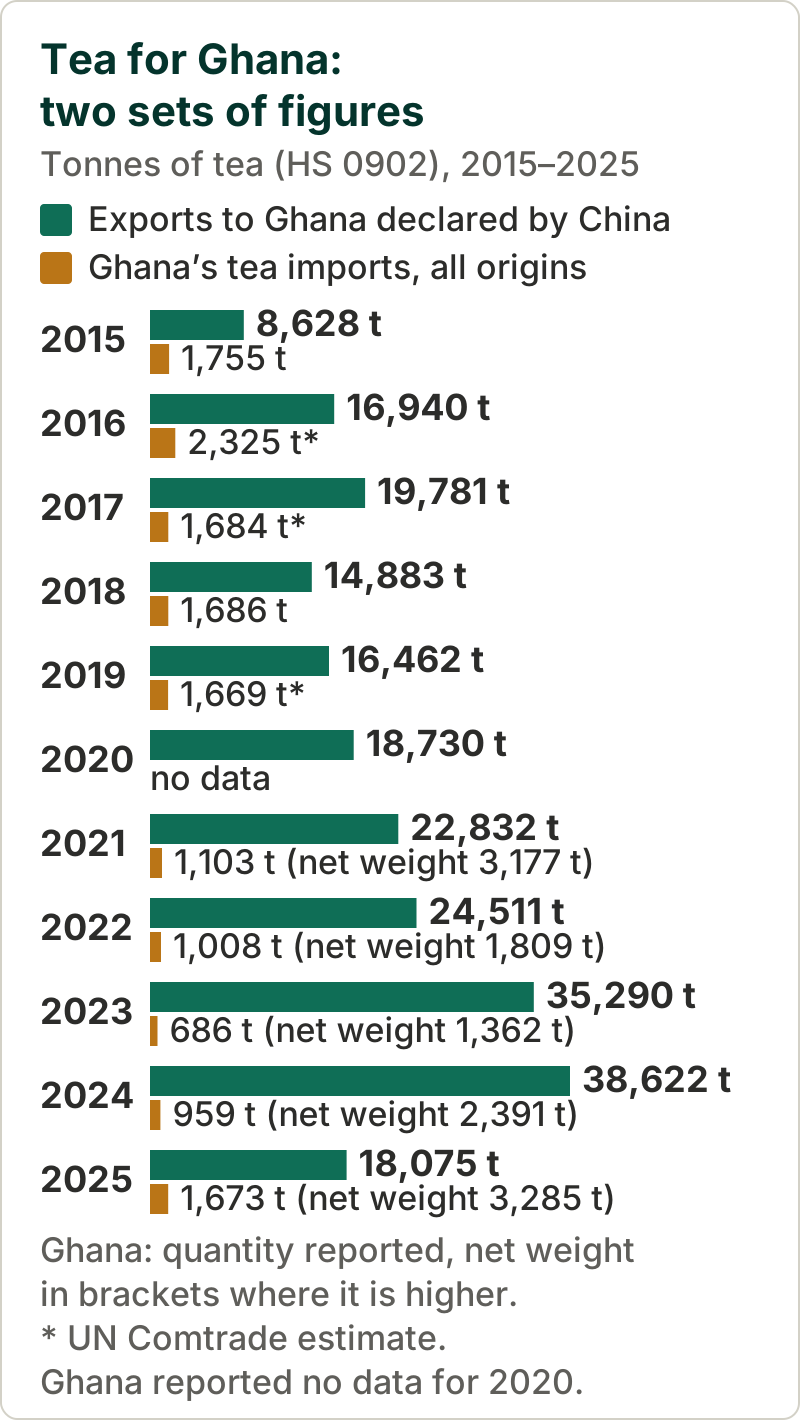 Sources: UN Comtrade, figures reported by China and by Ghana; MOFCOM for China’s 2016 figure
Re-exports do not close the gap: Ghana recorded 6.7 tonnes of tea exports in 2024, mostly to Côte d’Ivoire. What Ghana does record is mostly black tea, and mostly not Chinese: in 2024 black tea (HS 0902.30 and 0902.40) made up 74.2% of the quantity and 54.5% of the net weight, and Sri Lanka supplied 504 tonnes, 52.5% of the quantity; in 2025 Sri Lanka, India and Kenya supplied 80.3% of it (The Tea Trade’s calculation from UN Comtrade).
Transit to the Sahel: what the mirror data can and cannot show
UN recommendations for trade statistics (IMTS 2010) exclude from a country’s imports goods only carried through it to a known third country, whatever the customs procedure. Ghana is such a corridor: its seaports handled 1,210,372 tonnes of transit and transshipment imports in 2025, 1,209,378 of them at Tema (Ghana Shippers’ Authority). In an April 2023 review of the decline of transit trade in 2022, the authority put Burkina Faso first among transit destinations (307,141 of the 473,165 tonnes counted in the period reviewed), ahead of Mali, Côte d’Ivoire, Togo and Niger. GRA lists transit goods among those generally exempt from duty.
The landlocked countries’ figures allow a check: importers record goods by country of origin, so tea declared by China for Ghana that went on to Burkina Faso, Mali or Niger should appear in their imports from China, on top of what China declared for them. In 2024 the three recorded 8,353 tonnes more tea from China than China declared for them, and in 2023 5,181 tonnes more. Even if all of it had crossed Ghana, it would cover about 22% of the roughly 38,000 tonnes missing from Ghana’s 2024 records, whichever weight is used, and 15% in 2023 (The Tea Trade’s calculation).
Tea from China: recorded by Burkina Faso, Mali and Niger, and declared for them by China, 2024 (tonnes, HS 0902; source: UN Comtrade via WITS; differences and totals: The Tea Trade’s calculation)
| Importing country | Recorded by the importer from China | Declared by China | Difference |
|---|---|---|---|
| Burkina Faso | 3,953.7 | 706.8 | +3,246.9 |
| Mali | 9,499.8 | 6,608.4 | +2,891.4 |
| Niger | 11,950.8 | 9,736.6 | +2,214.2 |
| Total | 25,404.3 | 17,051.8 | +8,352.5 |
Differences in 2023: Burkina Faso +3,054.8 tonnes, Mali +923.0, Niger +1,202.8.
Togo shows the same pattern: it recorded 96 tonnes of tea from China in 2024, against 5,707 tonnes declared by China, and tea declared for Togo fell from 17,637 tonnes in 2020 to 2,582 in 2025. No statistic reviewed shows what becomes of the rest of the tea declared for Ghana; the overland routes are covered in our guide to Sahel tea trade corridors.
Clearing tea at Tema: ICUMS and the documents
Tema, Ghana’s main port, handled 19.9 million tonnes in 2025, 64% of the cargo through Ghana’s two seaports, Tema and Takoradi (Ghana Shippers’ Authority). Clearance runs on the Integrated Customs Management System (ICUMS), a single window for documents and payments that GRA introduced in June 2020 to succeed the PAARS and GCMS systems. GRA’s import procedure, checked in October 2026:
- Documents. The original bill of lading or waybill, an attested invoice, a packing list, the Import Declaration Form (IDF) from the Ministry of Trade, the importer’s Taxpayer Identification Number (TIN) or Ghana Card PIN, and the permits the goods require, such as those of the Ghana FDA and the Ghana Standards Authority (GSA).
- Declaration. The clearing agent submits it in ICUMS, before or after the goods arrive; GRA says clearance at the ports currently requires a clearing agent by law.
- Assessment and payment. ICUMS takes the declaration through classification, valuation and approval, and the agent pays the duties and taxes at a participating bank using the tax bill generated.
- Examination. By risk: red for mandatory physical examination, yellow for a digital scan, green for release at the gate with an automatic scan on the way out of the terminal.
Our guide to Chinese tea export documents covers the exporter’s invoice, packing list, bill of lading and test reports; the Ghana FDA asks for a certificate of analysis for each product and variant it registers.
Ghana FDA registration for imported tea
Ghana’s Food and Drugs Authority (Ghana FDA) controls imported food under the Public Health Act, 2012 (Act 851). Its guideline FDA/ICD/GDL-02/05, in force since 2 July 2025, covers prepackaged food, defined as food packaged in advance in a container ready for offer to the consumer, as tea in retail packs is:
- only importers licensed by the FDA may import (Part 7, section 122(1) of the Act);
- each product must be registered with the FDA before import (section 97); an unregistered consignment gets a temporary code and is cleared under detention, then registered, and the FDA may also seize it, order its re-export, or fine or prosecute the importer;
- each consignment needs an approved electronic permit (eMDA) before import, quoting the product’s name and brand, FDA registration number and HS code; it carries a verification fee based on the FOB value and can take up to one working day after payment;
- the food must have at least two-thirds of its shelf life left at clearance from the port;
- every consignment is physically inspected at the port or at the importer’s premises; non-conforming lots are detained if they can reasonably be brought into conformity, and rejected ones are re-exported or destroyed, in both cases at the importer’s expense;
- under-declaring the FOB value costs the missing fee plus a 100% penalty.
The FDA’s registration requirements for imported prepackaged foods (form FDA/FER/RQT-02, effective 1 June 2020) list a registration form, an application letter, the importer’s business registration certificate, a certificate of analysis for each product and variant, and samples. Registration is renewed every three years; a clearing agent may register products for a client only if the client tells the FDA so in writing.
Ghana Standards Authority: high-risk goods and labels
Food products head the list of high-risk goods on the GSA’s import inspection page, which says the GSA has inspected these goods since 2003 as the competent authority appointed by the Ministry of Trade and Industry; since 2020, however, the GSA no longer inspects products regulated by the Ghana FDA, mainly food, cosmetics and pharmaceuticals, according to the WTO’s 2022 review of Ghana. Its import inspection page (checked October 2026) says importers of these goods must register with the GSA, buy the applicable Ghana Standards and declare their imports to it; each consignment should come with a certificate of analysis (CoA) or of conformance (CoC), and depending on the risk rating the label and quality attributes are inspected visually on entry. The page still names the declaration platform used before ICUMS: ask the GSA how to declare now. The Ghana FDA guideline adds that imports must comply with existing Ghana Standards; no Ghana Standard specific to tea was found in the sources reviewed.
The GSA’s labelling requirements under the General Labelling Rules, 1992 (L.I. 1541) include, for food:
- the product name, which a trade mark or brand name may not replace;
- the list of ingredients and the net content;
- the date of manufacture and the expiry or use-by date;
- storage conditions and instructions for use;
- the manufacturer’s name and address, the country of origin and the batch or lot number.
Information in a language other than English must be translated into English, and goods that do not comply may be impounded.
Import duty, VAT and levies on tea in Ghana in 2026
Ghana has applied the ECOWAS common external tariff (CET) since 1 February 2016, according to MOFCOM’s 2025 country guide, and its tariff data show the change for green tea: 20% duty in every year reported up to 2013, 10% from 2016 to 2023, the latest year available (UNCTAD TRAINS). The 10% duty, which also applies to black tea, and the 0.5% ECOWAS levy are explained in our West Africa tea import duties guide. Ghana’s own taxes changed on 1 January 2026, when the Value Added Tax Act, 2025 (Act 1151) took effect.
Ghana’s other charges on tea imported from China, as of October 2026 (source: Ghana Revenue Authority)
| Charge | Rate | Notes |
|---|---|---|
| African Union import levy | 0.2% | On the CIF value of goods from outside the African Union; Act 952, since 12 January 2018 |
| VAT | 15% | Base on imports: value for customs duty plus import duties and other taxes |
| National Health Insurance Levy (NHIL) | 2.5% | Same base as VAT since 1 January 2026 |
| GETFund levy | 2.5% | Same base as VAT since 1 January 2026 |
| COVID-19 Health Recovery Levy | abolished | Was 1%; abolished from 1 January 2026 |
GRA puts VAT, NHIL and GETFund together at an effective 20%; ask a broker how the two levies are computed on an import declaration. GRA’s tariff page also lists an import excise duty, examination and processing fees, a special import levy, an import levy, an interest charge and state warehouse rent, without rates or saying which apply to tea.
What this means for tea exporters and importers
- Two series. China declared 14,900 to 38,600 tonnes of tea a year for Ghana in 2016–2025, against at most 3,300 tonnes recorded by Ghana from all origins: do not mix the two in one calculation.
- Volatility. Volume fell 53.2% in 2025 after rising in eight of nine years from 2016 to 2024; one year is a weak basis for planning.
- Before loading. Check the importer’s Ghana FDA licence, product registration and eMDA permit, English labels under L.I. 1541, and that the tea will keep at least two-thirds of its shelf life until it clears Tema; ask the GSA whether its importer registration still applies to tea.
This is general information, not legal or tax advice: have a licensed clearing agent in Tema confirm the procedure, documents and rates before each shipment.
Questions and answers
How much tea does Ghana import from China?
China declared 18,075 tonnes of tea worth US$72.4 million for Ghana in 2025, after 38,622 tonnes in 2024 (MOFCOM). Ghana's own statistics record far less: 1,673 to 3,285 tonnes of tea imports from all origins in 2025, depending on the weight field used, and 103 to 951 tonnes from China (UN Comtrade).
What is the import duty on tea in Ghana?
10% under the ECOWAS common external tariff, on green and black tea, in packs or in bulk (UNCTAD TRAINS, 2023 data). Tea from outside ECOWAS also pays a 0.5% ECOWAS levy (ECOWAS protocol of 1996) and tea from outside the African Union a 0.2% levy (African Union Import Levy Act, 2017), both on the CIF value, and VAT, NHIL and GETFund come to an effective 20% since 1 January 2026 (Ghana Revenue Authority).
Does imported tea need Ghana FDA registration?
Yes, if it is prepackaged. The importer must be licensed by Ghana's Food and Drugs Authority (Ghana FDA), the product registered before it is imported and each consignment covered by an electronic permit. The registration file includes a certificate of analysis and samples, and registration is renewed every three years (Ghana FDA, 2020 and 2025).
How is tea cleared at Tema port?
Through the Ghana Revenue Authority's ICUMS system, in use since June 2020. A clearing agent lodges the declaration with the bill of lading, attested invoice, packing list, Import Declaration Form, tax number and the permits of the Ghana FDA and the Ghana Standards Authority; ICUMS classifies, values and approves it, and the duties are paid at a bank before examination.
Why are Ghana's tea import figures so much lower than China's export figures?
The statistics do not say. UN rules exclude goods in transit from a country's imports, but even if all the extra Chinese tea recorded by Burkina Faso, Mali and Niger in 2024 had crossed Ghana, it would cover only about a fifth of the gap (our calculation from UN Comtrade). No statistic reviewed shows what becomes of the rest.
What must a tea label show in Ghana?
Under the General Labelling Rules, 1992 (L.I. 1541), as listed by the Ghana Standards Authority: the product name, ingredients, net content, dates of manufacture and expiry, storage conditions, the manufacturer's name and address, the country of origin and the batch number. Information in another language must be translated into English.
Sources
- 1. Ghana Revenue Authority: notice to all VAT registered taxpayers on the Value Added Tax Act, 2025 (Act 1151) · gra.gov.gh
- 2. Ghana Revenue Authority: VAT on imports and exports · gra.gov.gh
- 3. Ghana Revenue Authority: public notice on the implementation of the African Union Import Levy Act, 2017 (Act 952), 2 January 2018, as published by the Ghana Shippers' Authority · shippers.org.gh
- 4. Ghana Revenue Authority: import procedures · gra.gov.gh
- 5. Food and Drugs Authority, Ghana: guideline on processing of import permit and clearance of prepackaged foods (FDA/ICD/GDL-02/05, 2 July 2025) · fdaghana.gov.gh
- 6. Food and Drugs Authority, Ghana: requirements for registration of imported pre-packaged foods (FDA/FER/RQT-02, effective 1 June 2020) · fdaghana.gov.gh
- 7. Ghana Standards Authority: import inspection · gsa.gov.gh
- 8. Ghana Shippers' Authority: Ghana's maritime trade review 2025 (April 2026) · shippers.org.gh
- 9. MOFCOM and 中国食品土畜进出口商会: China export monthly statistical report, tea, December 2025 (in Chinese) · wms.mofcom.gov.cn
- 10. MOFCOM: archive of the monthly tea export reports, with the December reports for 2016 to 2024 and the April 2026 report (in Chinese) · wms.mofcom.gov.cn
- 11. UN Comtrade: Ghana's tea imports (HS 0902) from the world and from China, 2025, quantity and net weight · comtradeapi.un.org
- 12. UN Comtrade via WITS: China's exports of green tea in packs of 3 kg or less (HS 0902.10) by partner, 2024 · wits.worldbank.org
- 13. WTO: Trade Policy Review, Ghana, Secretariat report (WT/TPR/S/427, 17 May 2022) · wto.org