Tea labelling requirements: Morocco, West Africa, EU
Tea labelling requirements compared: Arabic in Morocco, French in Senegal and Côte d'Ivoire, the EU's Regulation 1169/2011 and Codex: name, lot, dates, origin.
Key facts
- Morocco's Decree 2-12-389 of 22 April 2013 on food labelling requires the mandatory information to be written in Arabic, other languages being optional, and requires imported prepacked food to give the name and address of its importer as well as those of its producer (Articles 8 and 11).
- Côte d'Ivoire's Decree 92-487 of 26 August 1992 requires the mandatory label particulars of prepacked food to be written in French, the country's official language, or to include at least one easily understood translation (Article 6).
- Senegal applies NS ECOSTAND 050, a mandatory labelling standard based on the Codex general standard, which requires French labels showing a batch number, the country of origin, a manufacturing date and a durability date, according to the USDA's report of April 2025.
- Under Regulation (EU) No 1169/2011, applied since 13 December 2014, plain tea is exempt from the nutrition declaration (Annex V), and a pack marketed under the name of an operator established outside the EU must give the name and address of the importer into the EU (Articles 8 and 9).
- The Codex General Standard for the Labelling of Prepackaged Foods (CXS 1-1985, last amended in 2024) requires every container to be marked to identify the producing factory and the lot, and food that keeps more than three months to show at least the month and year of its durability date.
Tea labelling requirements are set by the country where the tea is sold, not by China. Morocco’s Decree 2-12-389 of 22 April 2013 requires the mandatory information in Arabic, including the importer’s name and address, the lot and the country of origin or provenance; Côte d’Ivoire (Decree 92-487 of 26 August 1992) and Senegal (standard NS ECOSTAND 050, according to the US Department of Agriculture) require French; and the EU’s Regulation (EU) No 1169/2011 lists twelve mandatory particulars, of which plain tea is spared the nutrition declaration. The Codex General Standard for the Labelling of Prepackaged Foods (CXS 1-1985, last amended in 2024) asks for the same core items: the name of the food, the net contents, a responsible operator, the origin where leaving it out would mislead, the lot and a date (texts checked October 2026).
Tea labelling requirements by market
The table shows what a retail pack of plain tea must carry. Senegal’s standard is available only in print, so its column follows the summary of the US Department of Agriculture (USDA) of April 2025.
Mandatory particulars on a retail pack of plain tea, by market (sources: the texts cited below; Senegal as summarised by the USDA, 2025; checked October 2026)
| Particular | Morocco | Senegal | Côte d’Ivoire | European Union | Codex |
|---|---|---|---|---|---|
| Language | Arabic; others optional | French | French, or an easily understood translation | One easily understood where sold | One acceptable to the consumer |
| Name of the food | Regulatory or Codex name, not a brand | Codex or national name | Sales name, not a brand | Legal, customary or descriptive name, not a brand | A name showing the true nature of the food |
| Net quantity | In grams or kilograms | In metric units | Required | Required | By weight |
| Lot | Required, unless a barcode meets recognised standards | Required | Only on packs not presented as such to consumers, “where it exists” | Required, unless the date gives day and month | Factory and lot |
| Date | Year alone allowed beyond 18 months | Manufacturing and durability dates, each with day, month and year | Date until which the food keeps its properties | Year alone allowed beyond 18 months | At least month and year beyond 3 months |
| Origin | Always; for tea, the provenance too if it differs | Required | If leaving it out could mislead; both origin and provenance if repacked | If leaving it out could mislead | If leaving it out would mislead |
| Importer | Named, with the producer | Manufacturer, or its local distributor or importer | Manufacturer, packer or seller | The EU importer if the brand owner is outside the EU | One of manufacturer, packer, distributor, importer, exporter or vendor |
Plain tea needs no list of ingredients: single-ingredient foods are exempt in Côte d’Ivoire (Decree 92-487, Article 14) and under Codex (section 4.2.1), and in the EU and Morocco when their name identifies the ingredient (Regulation 1169/2011, Article 19; Decree 2-12-389, Article 14). Tea with no added ingredient other than flavourings that leave its nutritional value unchanged is also exempt from the nutrition declaration in the EU and Morocco (point 8 of Annex V and of Annex IV respectively). Tea with added mint or flavourings needs a list of ingredients.
Language: Arabic in Morocco, French in Senegal and Côte d’Ivoire
Morocco requires product information in Arabic, other languages being optional (Decree 2-12-389, Article 8); an order of the agriculture minister can exempt some imported products. Mandatory mentions must be printed with the Arabic letter mīm (م) at least 1 mm high and, for other languages, an x-height of at least 1.2 mm, or no less than 0.7 mm and 0.9 mm on packs whose largest face is under 80 cm² (Article 12).
Côte d’Ivoire requires the mandatory particulars in French, its official language, or with at least one easily understood translation, placed where they are visible, indelible and clearly legible (Decree 92-487, Article 6). In Senegal, NS ECOSTAND 050 requires French labels, and when the original label is not in French, a French label must be applied before export or at the port (USDA, 2025); the US Department of Commerce’s guide (May 2024) agrees that all marking and labelling requirements are in French.
In the EU, the language must be one easily understood where the food is marketed, and each member state may require one or more official EU languages (Regulation 1169/2011, Article 15); the x-height must be at least 1.2 mm, or 0.9 mm on packs whose largest surface is under 80 cm² (Article 13).
Several texts allow a sticker on tea packed with another market’s label. The Codex standard accepts a supplementary label in the required language instead of relabelling, if it reflects the original fully and accurately (section 8.2), and Morocco lets holders of imported products ask for their labelling to be brought into compliance (Article 30). Algeria, which requires the information mainly in Arabic, bans overprinting or adding to label mentions apart from some mentions omitted at origin (Executive Decree 13-378, Articles 6 and 7; see our guide to importing green tea into Algeria). Mauritania requires French and/or Arabic, according to the WTO’s 2018 review cited in our guide to Mauritania’s tea trade.
Morocco: what Decree 2-12-389 and the tea decree add
Decree 2-12-389 (Official Bulletin No. 6152 of 16 May 2013), amended in 2015 and 2018, applies to imported food and makes every importer responsible for the labelling of the products it markets (Articles 3 and 4). Besides the items in the table, its 14 mandatory mentions include any special storage conditions and the number of the sanitary authorisation or approval, in the format set by ONSSA, the national food safety office (Articles 11 and 28 bis). The name and net quantity must share one field of vision, the mentions must be indelible (Article 13), and a label may not claim that a food prevents, treats or cures a disease (Article 7), as in Côte d’Ivoire (Decree 92-487, Article 4).
The date of minimum durability is introduced, in the decree’s French text, by « à consommer de préférence avant le… » or « … avant fin… », and ONSSA’s services may ask for the evidence behind it (Article 24). An importer must also make sure that at least a quarter of a product’s durability remains when it imports it, and give the production date in the accompanying documents (Article 4): a tea given 24 months’ durability must arrive with at least 6 months left (24 ÷ 4 = 6; The Tea Trade’s calculation).
Decree 2-13-711 of 4 March 2015 applies these rules to tea at every stage of marketing and adds three of its own (Articles 5 and 6):
- the sales name of a flavoured tea must state the nature of the flavouring;
- when the country of origin differs from the place of provenance, the label must say so, in the same field of vision and typeface as the other mandatory mentions;
- a blend of teas that names one origin must name the others with their proportions.
The decree also treats the sale of bulk tea as unlawful (Article 9). Authorisation of packers and duty by pack size are covered in our guide to importing green tea into Morocco.
Senegal and Côte d’Ivoire: West Africa’s labelling texts
No UEMOA or ECOWAS regulation setting label particulars for traders was found for this guide (checked October 2026); the texts below are national.
Senegal: NS ECOSTAND 050
According to the USDA’s report of 24 April 2025, NS ECOSTAND 050 is obligatory, is based on the Codex general standard in its 1991 revision and applies to prepackaged foods sold wholesale, at retail, for catering or as samples. Its French label carries the items in the table, the ingredients and instructions for use, and the durability date is introduced by « À consommer de préférence avant le… ».
The standard is obtained in print from the Association sénégalaise de normalisation (ASN), so its own text could not be checked here. The USDA also reports that Senegal adopted 25 new ECOWAS standards at national level in 2024, still going through formal approval in April 2025. Senegal’s tea import figures and customs formalities are covered in our guide to Senegal’s green tea imports.
Côte d’Ivoire: Decree 92-487 and the VoC check
Decree 92-487 of 26 August 1992 on the labelling and presentation of foodstuffs, published in the Journal officiel of 1 October 1992, is still cited as the basis of labelling rules by the USDA (January 2026). Its seven mandatory particulars (Article 7) are those in the table except the lot, plus the list of ingredients, any special storage conditions and, where needed, instructions for use. A repacked food must give both its origin and its provenance, and a food whose nature is changed by processing in a second country takes that country as its origin. The sales name, net quantity, date and storage conditions must share one field of vision (Article 8). The date is a use-by date only for food perishable within six weeks or whose shelf life is set by health rules, and otherwise a date of optimal use (Article 20).
Since 1 July 2026, tea shipped to Côte d’Ivoire has needed a certificate of conformity before shipment under the VoC programme when the covered goods in a consignment exceed 1 million CFA francs FOB, as our guide to Côte d’Ivoire’s tea imports explains. The Ministry of Commerce’s procedure guide, which sets that threshold, completes the standards used in those checks with generic national deviations, “in particular the languages accepted for markings and instructions”.
EU tea labelling under Regulation (EU) No 1169/2011
The regulation has applied since 13 December 2014, and its nutrition declaration since 13 December 2016 (Article 55). Its Article 9 lists twelve mandatory particulars, from the name of the food to a nutrition declaration. Plain tea is spared two of them: the list of ingredients, for a single-ingredient food whose name identifies the ingredient (Article 19), and the nutrition declaration, for tea and tea extracts with no added ingredient other than flavourings that leave the nutritional value unchanged (Article 16 and Annex V). The name of the food is its legal, customary or a descriptive name, never replaced by a brand (Article 17), and it must sit in the same field of vision as the net quantity (Article 13).
The operator responsible for the food information is the one under whose name the food is marketed or, if that operator is not established in the Union, the importer into the Union market (Article 8), and the label gives its name and address (Article 9). Tea packed in China under a Chinese company’s name therefore carries the EU importer’s details; under an EU buyer’s name, the buyer’s. The country of origin is compulsory only where leaving it out might mislead consumers (Article 26). The rules for the materials of tea bags themselves are set out in our guide to tea bag materials and standards. Duties, VAT and border checks on tea entering the EU are covered in our guide to importing Chinese tea into the EU.
Dates and lot numbers on tea
The EU and Morocco use three bands of shelf life with the same limits, 3 and 18 months, while the Codex standard asks for at least the month and year for any food that keeps more than three months (Regulation 1169/2011, Annex X; Decree 2-12-389, Article 24; Codex, section 4.7.1).
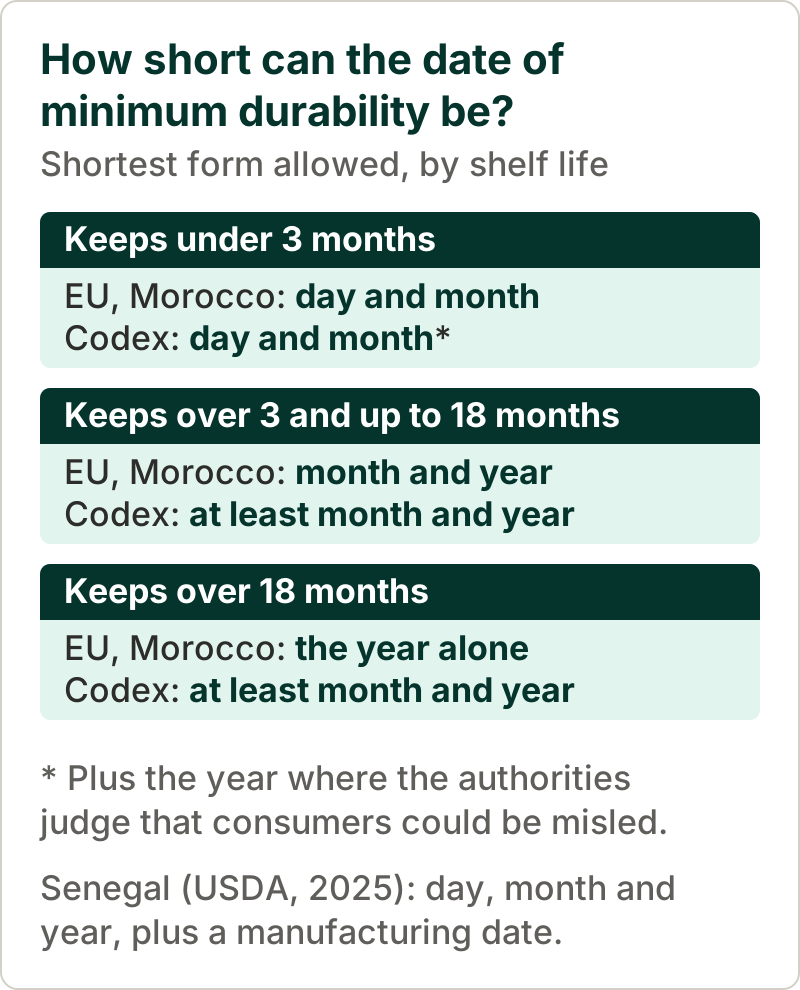 Sources: Regulation (EU) No 1169/2011, Annex X; Morocco, Decree 2-12-389, Article 24; Codex CXS 1-1985 (amended in 2024), section 4.7.1; USDA, Senegal FAIRS report (April 2025)
Tea is in none of the lists of foods exempted from a date: Annex X of the EU regulation, Annex V of Morocco’s decree, Article 21 of Côte d’Ivoire’s decree and the Codex standard’s illustrative list. A full day-month-year date is accepted by every text read for this guide, and in the EU it also lets the lot mark be left out.
Under Codex, each container must be marked, in code or in clear, to identify the producing factory and the lot (section 4.6). The EU requires a lot mark, set by the producer or packer or by the first seller established in the Union and preceded by the letter L unless it is clearly distinguishable, but not when the date consists at least of the day and month, uncoded and in that order (Directive 2011/91/EU, Articles 3 and 5). Morocco drops the lot for packs with a barcode that meets recognised standards (Decree 2-12-389, Article 14), and Côte d’Ivoire’s decree asks for it only on packs not presented as such to the consumer (Article 9).
Bulk cartons and trade packs
The Codex standard covers prepackaged food offered as such to consumers or for catering (section 1). In the EU, prepacked food sold before the retail stage may carry its particulars on accompanying commercial documents, but the name, date, storage conditions and operator must also appear on the external packaging, and a business that supplies food not intended for the final consumer, such as tea for repacking, must give its customer enough information to meet its own duties (Regulation 1169/2011, Article 8). Morocco likewise requires the name, net quantity, date, producer and importer, origin and authorisation number on the outer packaging of products sold before the consumer stage (Decree 2-12-389, Article 4). In Côte d’Ivoire, packs not presented as such to the consumer carry the sales name, the lot where there is one and the date, and the other particulars may appear on delivery documents (Decree 92-487, Article 9).
China’s export rules defer to the destination. Under Order No. 249 of China’s customs (GACC, 海关总署), in force since 1 January 2022, export food must meet the importing country’s standards or the contract, and China’s national food safety standards only where none of these, nor any treaty to which China is a party, sets a requirement (Article 38). The marks that Chinese producers put on export cartons are covered in our guide to tea export packaging formats.
Checklist for a tea label
- Language: Arabic for Morocco, French for Senegal and Côte d’Ivoire, the required language in each EU country of sale.
- Name and quantity: a name that says what the tea is, such as “green tea”, with any brand or grade code beside it, and the net weight in the same field of vision.
- Operator and origin: producer and importer for Morocco, the EU importer when the brand owner is outside the EU; China as the country of origin, and the provenance when the tea was shipped from or repacked in another country.
- Lot and date: a lot mark and a full day-month-year date on every pack, plus a manufacturing date for Senegal.
- Morocco imports: at least a quarter of the durability left on arrival, and the production date in the documents.
- Cartons: name, lot and date on each trade carton, matching the labels and the commercial documents.
This guide is general information, checked in October 2026, not legal advice: confirm the rules with the importer and the destination’s authorities before printing packs.
Questions and answers
What must a tea label show in Morocco?
Under Decree 2-12-389, in Arabic: the name of the product, the net quantity, the date of minimum durability, any special storage conditions, the names and addresses of the producer and, for imported tea, the importer, the country of origin or place of provenance, the lot and the sanitary authorisation or approval number. Decree 2-13-711 adds that a tea label must name the provenance when it differs from the origin.
Do tea labels have to be in French in Senegal and Côte d'Ivoire?
Yes. Côte d'Ivoire's Decree 92-487 requires the mandatory particulars in French, the official language, or with at least one easily understood translation (Article 6). In Senegal, the mandatory standard NS ECOSTAND 050 requires French labels, and when the original label is not in French, a French label must be applied before export or at the port, according to the USDA (2025).
Does plain tea need a list of ingredients or a nutrition table?
Not in the EU or Morocco. A single-ingredient food whose name identifies the ingredient needs no list of ingredients, and tea with no added ingredient other than flavourings that leave its nutritional value unchanged is exempt from the nutrition declaration (Regulation 1169/2011, Article 19 and Annex V; Decree 2-12-389, Article 14 and Annex IV). Tea with added mint or flavourings needs a list of ingredients.
Is a lot number required on tea packs?
The Codex standard requires every container to be marked to identify the factory and the lot. The EU requires a lot mark, preceded by the letter L unless it is clearly distinguishable, but drops it when the durability date gives at least the day and month (Directive 2011/91/EU). Morocco requires it unless the pack carries a barcode that meets recognised standards (Decree 2-12-389, Article 14).
How must the durability date be written on a tea pack?
In the EU and Morocco, the day, the month and possibly the year, in that order; the month and year are enough for food that keeps more than 3 and up to 18 months, and the year alone for food that keeps longer. The Codex standard asks for at least the month and year beyond three months, and Senegal's standard for a full date plus a manufacturing date, according to the USDA (2025).
Can a sticker in the local language be added to imported tea?
The Codex standard allows a supplementary label carrying the mandatory information in the required language instead of relabelling, provided it reflects the original label fully and accurately. Senegal accepts French labels applied before export or at the port (USDA, 2025), and Morocco's labelling decree lets holders of imported products ask for their labelling to be brought into compliance (Article 30).
Sources
- 1. ONSSA: Decree 2-12-389 of 22 April 2013 setting the conditions and methods of labelling food products, consolidated with Decrees 2-15-218 and 2-18-44 (in French) · onssa.gov.ma
- 2. ONSSA: Decree 2-13-711 of 4 March 2015 on the quality and safety of marketed tea (English translation) · onssa.gov.ma
- 3. Côte d'Ivoire: Decree 92-487 of 26 August 1992 on the labelling and presentation of foodstuffs, Journal officiel of 1 October 1992 (FAOLEX copy, in French) · faolex.fao.org
- 4. Côte d'Ivoire, Ministry of Commerce: procedure guide for verifying the conformity of imported goods with standards (VoC), version 1.2 (in French) · commerce.gouv.ci
- 5. EUR-Lex: Regulation (EU) No 1169/2011 on the provision of food information to consumers, consolidated version of 1 April 2025 · eur-lex.europa.eu
- 6. EUR-Lex: Directive 2011/91/EU on indications or marks identifying the lot to which a foodstuff belongs, 13 December 2011 · eur-lex.europa.eu
- 7. Codex Alimentarius Commission: General Standard for the Labelling of Prepackaged Foods, CXS 1-1985, amended in 2024 · fao.org
- 8. GACC: Order No. 249, Administrative Measures on Import and Export Food Safety, 12 April 2021 (in Chinese) · gov.cn
- 9. European Commission: Food information to consumers, legislation · food.ec.europa.eu
- 10. USDA Foreign Agricultural Service: Senegal, FAIRS Country Report Annual SG2025-0005, 24 April 2025 · apps.fas.usda.gov
- 11. USDA Foreign Agricultural Service: Côte d'Ivoire, FAIRS Country Report Annual - 2025, IV2025-0010, 5 January 2026 · apps.fas.usda.gov
- 12. US International Trade Administration: Senegal Country Commercial Guide, labeling and marking requirements (6 May 2024) · trade.gov