Mauritania's green tea trade: imports, rules and data
Mauritania tea imports: 20,117 t from China in 2025 (US$83.2m), China's 4th market. Mauritania's own customs data, non-ECOWAS tariff, import rules, port.

Key facts
- China exported 20,117 tonnes of tea worth US$83.2 million to Mauritania in 2025, up 26.8% in volume, which made Mauritania the fourth destination for Chinese tea by volume and by value, according to MOFCOM and UN Comtrade.
- Mauritania's own customs figures recorded 17,903 tonnes of tea from China in 2024, 2,043 tonnes more than China declared for Mauritania, but valued at US$21.1 million against China's US$66.0 million (UN Comtrade).
- Mauritania, which withdrew from ECOWAS in December 2000 according to ECOWAS and signed an association agreement with it in 2017, reported a 10% duty on green tea in its tariff data for 2020 to 2023, against 13% in its data for 2014 to 2019, according to UNCTAD's TRAINS database.
- Mauritania ended in 2014 the pre-shipment inspection programme it had run since 1994, and its customs service now assesses the value of imports itself, according to the WTO's 2018 Trade Policy Review.
- Mauritania's 2023 census counted 4,927,532 residents, so the 17,327 tonnes of tea the country recorded importing that year came to about 3.5 kg of tea imports per resident (The Tea Trade's calculation: imports ÷ census population, from UN Comtrade and ANSADE data).
Mauritania buys almost all its tea from China, and a great deal of it for a country of under 5 million people. China declared 20,117 tonnes of tea worth US$83.2 million for Mauritania in 2025, up 26.8% in volume, which made it the fourth destination for Chinese tea by volume and by value, according to China’s Ministry of Commerce (MOFCOM) and UN Comtrade: about 4 kg for each resident counted by the 2023 census (The Tea Trade’s calculation). Mauritania’s own customs figures record more tonnes from China than China declares, 17,903 against 15,860 in 2024, but at about a third of China’s declared value. The country left the Economic Community of West African States (ECOWAS) in 2000, according to ECOWAS, yet its tariff data for 2020 to 2023 show the ECOWAS rate of 10% on green tea, and it ended pre-shipment inspection in 2014, according to the WTO.
Mauritania tea imports from China, 2023–2025
In China’s export statistics, where it appears as 毛里塔尼亚, Mauritania has moved up a place in each of the last two years: sixth destination by volume in 2023, fifth in 2024 and fourth in 2025, behind Morocco, Uzbekistan and Senegal (see China’s 2025 tea exports). By value it ranked seventh in 2023 and fourth in 2024 and 2025. Its rise from eighth place by volume in 2015 is traced in our guide to Chinese tea export markets.
China’s tea exports to Mauritania, 2023–2025 (HS 0902, all tea; sources: MOFCOM, UN Comtrade via WITS)
| Year | Volume (t) | Volume change | Value (US$ million) | Unit value (US$/kg) | Share of China’s tea export volume | Rank by volume | Rank by value |
|---|---|---|---|---|---|---|---|
| 2023 | 15,825.5 | +25.7% | 67.16 | 4.24 | 4.3% | 6th | 7th |
| 2024 | 15,860.4 | +0.2% | 65.95 | 4.16 | 4.2% | 5th | 4th |
| 2025 | 20,116.7 | +26.8% | 83.22 | 4.14 | 4.8% | 4th | 4th |
Volumes, values and changes come from MOFCOM’s December reports, which match UN Comtrade. Unit values (value ÷ volume), shares and ranks are The Tea Trade’s calculation from UN Comtrade. How these unit values compare with China’s other green tea markets is shown in our guide to green tea export unit values.
Almost all of this tea is green tea packed before it leaves China. China declared every kilogram of its 2024 and 2025 tea for Mauritania under HS 0902.10, green tea in immediate packings of 3 kg or less, and all but 2.4 tonnes of it in 2023. Morocco, China’s first market, is the opposite case: it takes almost all its green tea in packings over 3 kg.
The growth carried into 2026. In December 2025 alone, Mauritania was China’s second tea market by value, with 1,896.8 tonnes (+56.5% on December 2024), and it kept second place, behind Morocco only, from January to April 2026: 8,472.2 tonnes (+49.4%) worth US$35.5 million (+57.5%), at an average export value of US$4.19 per kg, according to MOFCOM. No later MOFCOM report could be opened in early October 2026. China’s total tea exports for later months are tracked in our guide to China’s tea exports by month.
Tea also weighs in the bilateral trade. MOFCOM’s 2025 country guide to Mauritania names tea first among the goods China mainly exports there, ahead of light industrial and textile goods, building materials, hardware and household appliances. In 2025 tea made up 6.6% of the value of all China’s exports to Mauritania: US$83.2 million out of US$1,263.3 million (The Tea Trade’s calculation from UN Comtrade).
A large tea importer for a population of 4.9 million
Mauritania’s fifth general census, taken from 25 December 2023 to 8 January 2024, counted 4,927,532 residents, 29.4% of them in Nouakchott, according to the national statistics agency, ANSADE. Set against that count, the 17,327 tonnes of tea Mauritania recorded importing in 2023 come to about 3.5 kg per person (17,327,150 kg ÷ 4,927,532 = 3.52), and the 20,117 tonnes China declared for 2025 to about 4.1 kg (20,116,670 kg ÷ 4,927,532 = 4.08; The Tea Trade’s calculation). These are imports per resident, not consumption: they make no allowance for stocks or for tea that leaves the country.
Tea counts among the basic foods. The State had entrusted a state-controlled trading company with selling sugar, rice and tea to low-income households at affordable prices across the country, until the company was put into liquidation in January 2018, according to the WTO’s 2018 Trade Policy Review. MOFCOM’s country guide notes that Mauritanians customarily serve tea to guests, a custom it calls “three cups of tea” on meeting, and that green tea is boiled with a little sugar and fresh mint juice and is a must when receiving guests.
What Mauritania’s own import statistics show
Mauritania reports its trade to UN Comtrade, and its figures give a second view of the same flow. The latest year available in early October 2026 was 2024, when the country recorded 18,339 tonnes of tea imports worth US$21.4 million, 97.6% of the volume from China. Sri Lanka (259 t), Senegal (65 t), Singapore (56 t), Kenya (38 t) and India (17 t) supplied the rest, and green tea made up 98.4% of the volume.
Tea from China to Mauritania: China’s declarations and Mauritania’s records (HS 0902; source: UN Comtrade via WITS)
| Year | Exports declared by China (t) | Imports from China recorded by Mauritania (t) | Difference (t) | Value declared by China (US$ million, FOB) | Value recorded by Mauritania (US$ million, CIF) |
|---|---|---|---|---|---|
| 2022 | 12,591.6 | 16,666.6 | +4,075.0 | 55.95 | 21.94 |
| 2023 | 15,825.5 | 16,873.3 | +1,047.8 | 67.16 | 21.98 |
| 2024 | 15,860.4 | 17,903.4 | +2,042.9 | 65.95 | 21.07 |
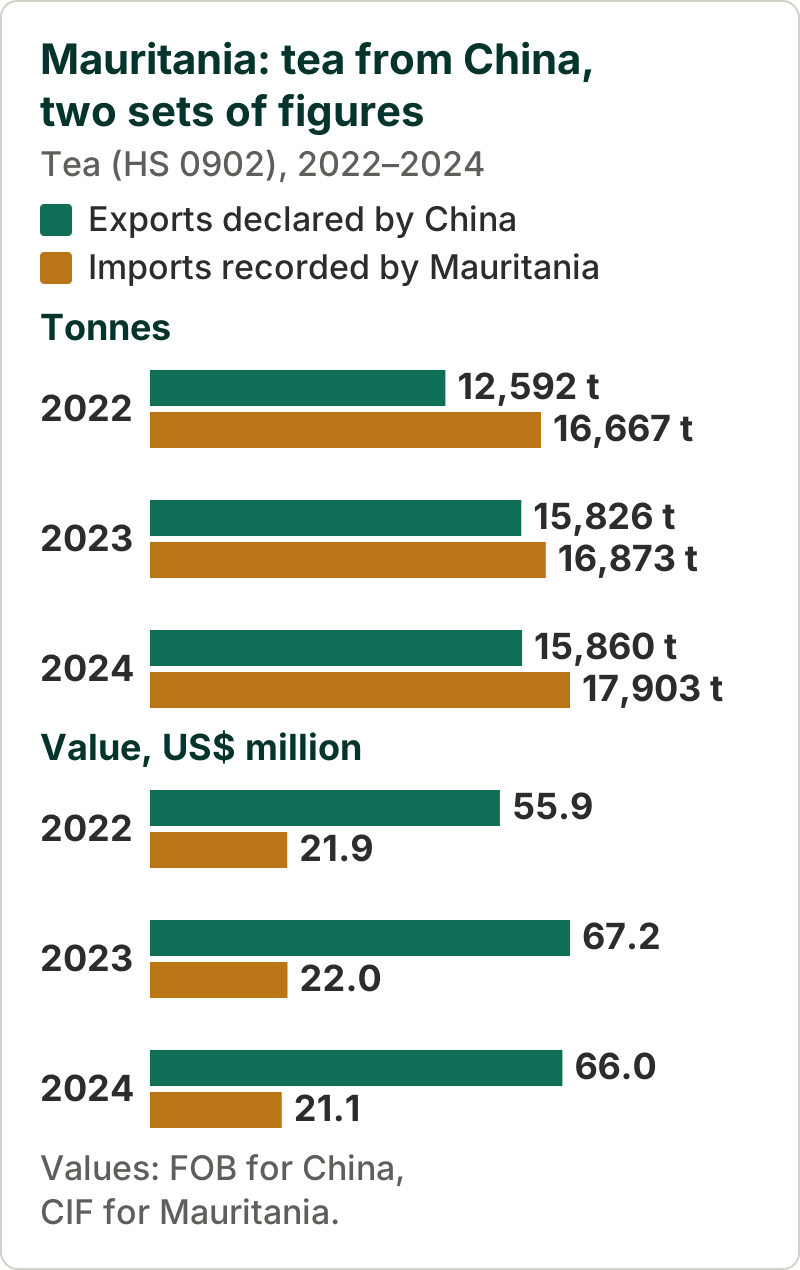 Source: UN Comtrade via WITS, figures reported by China and by Mauritania (2022–2024)
The two series disagree in opposite directions. In tonnes, Mauritania recorded more Chinese tea than China declared for it in each year, 16.2% more over 2022–2024. In value, Mauritania’s figures came to only 32% to 39% of China’s: US$1.18 to US$1.32 per kg at import, against US$4.16 to US$4.44 per kg at export (The Tea Trade’s calculation). Côte d’Ivoire shows the reverse gap in tonnes, with China declaring far more tea than the country records, as our Côte d’Ivoire tea imports guide explains.
The pack sizes differ as well. In 2024 China declared all its tea for Mauritania as green tea in packings of 3 kg or less (HS 0902.10), but Mauritania’s figures put 4,862 tonnes of the Chinese green tea, 27.2%, under HS 0902.20, the code for other green tea, including packings over 3 kg. Both codes carry the same 10% duty in Mauritania’s tariff data, so the difference shows in the statistics rather than in the duty rate.
Why the two sets of figures differ
The United Nations recommendations for trade statistics (IMTS 2010) cover the usual reasons why an exporter’s and an importer’s figures part ways. Applied to Mauritania, none of them explains both gaps:
- Valuation. Exports are valued free on board (FOB) at the exporter’s border, imports at cost, insurance and freight (CIF), so Mauritania’s values should be higher than China’s, not a third of them.
- Partner country. Importers record the country of origin, exporters the country of last known destination. Tea that China declared for another country but that ended up in Mauritania would count as Chinese in Mauritania’s figures only, which could explain part of the extra tonnes.
- Timing. Tea shipped late in one year can be recorded by Mauritania in the next, which moves tonnes between years but hardly changes a three-year total.
- Re-exports. Mauritania’s own figures record no tea exports to Mali or Senegal in 2022–2024, Mali’s 2023 figures show no tea from Mauritania, and Senegal recorded 300 tonnes from Mauritania in 2024, 1.6% of what Mauritania imported that year. Little tea appears to move on to the neighbours. The Gambia’s tea re-exports are examined in our guide to Gambia tea re-exports and Guinea imports.
The value gap is harder to read. According to the WTO’s 2018 review, Mauritania’s customs took valuation back in-house after pre-shipment inspection ended, set up a national valuation office in 2015, and applied the transaction-value method first to three, then to eight high-revenue products (hydrocarbons, new vehicles, clinker, telecommunications, rice, cigarettes, iron bars and condensed milk), with 23 planned by March 2018. Tea was not among the eight. That fits tea being valued at import on a different basis from Chinese export declarations, but the statistics do not say why: this is an interpretation, not a measured fact. Both series agree on the order of magnitude, roughly 16,000 to 20,000 tonnes of Chinese tea a year in 2023–2025.
Mauritania’s tea tariff: outside ECOWAS, on its common tariff
Mauritania was one of the 15 states that signed the ECOWAS Treaty in Lagos on 28 May 1975, and the community’s only Arabic-speaking member until it withdrew in December 2000, according to ECOWAS; the WTO’s 2018 review dates its exit to December 1999. In 2017 it signed a new association agreement with the community. Under it, the WTO’s 2018 review explains, Mauritania rejoined the ECOWAS trade liberalisation scheme and was to apply the common external tariff (CET) from January 2019. Its finance ministry says the country has adopted the CET; our West Africa tea import duties guide gives the legal references and every charge on arrival.
Applied duty on green tea in Mauritania, by year of tariff data (HS 0902.10 and 0902.20; source: UNCTAD TRAINS via WITS)
| Years with data | Green tea in packs of 3 kg or less | Other green tea |
|---|---|---|
| 2001, 2006–2011 | 5% | 5% |
| 2014, 2015, 2017–2019 | 13% | 13% |
| 2020–2023 | 10% | 10% |
No data were reported for 2002–2005, 2012, 2013 or 2016, and 2023 was the latest year available in October 2026. The drop from 13% to 10% came in the first year Mauritania reported its tariff in the 2017 version of the Harmonized System, the version on which, according to its finance ministry, its CET was first based. In 2017 its national tariff had four rates, 0%, 5%, 13% and 20%, the top one applying mainly to final consumer goods (WTO, 2018). Mauritania’s WTO commitments allow far more: it has bound all its agricultural tariff lines, and coffee, tea, maté and spices at 75%.
On top of the duty, Mauritania levies a statistical fee of 1% of the customs value, according to the finance ministry’s 2024 tax expenditure report, and VAT at the standard rate of 16% under the General Tax Code (official 2023 edition).
Importing tea into Mauritania: registration, declaration and labels
The WTO’s 2018 review gives the most detailed public account of Mauritania’s import formalities that could be found, but some rules may have changed since, not least with the Customs Code instituted by Law 2026.015 of 24 May 2026. As described in 2018:
- Registration. Every regular importer must be entered in the central register of importers and must obtain a tax identification number (numéro d’immatriculation fiscal, NIF) from customs if it imports at least 30 million old ouguiyas (about US$86,000) a year; any company with capital above 5 million old ouguiyas (US$14,000) needs a NIF as well.
- Import authorisation. In principle every import needs an authorisation from the Ministry of Commerce, but in practice it is not asked for at clearance; new importers often apply for one because their suppliers request it.
- Declaration. Goods are declared by licensed customs brokers (commissionnaires en douane agréés) or by persons specially authorised. The detailed declaration must come with the commercial documents proving the purchase, the transport document and, where applicable, a sanitary or phytosanitary certificate, and a computer fee of 3,000 old ouguiyas (US$8.6) is charged per declaration.
- No pre-shipment inspection. The pre-shipment inspection programme that a private inspection company had run since 1994 ended in 2014. Customs now assesses value and tariff classification itself. The rules of neighbouring countries are compared in our guide to pre-shipment inspection for tea.
The customs clearance guide published by the Directorate General of Customs in 2026 describes clearance in the SYDONIA World system, from the detailed declaration to the release order, and mentions no inspection or certificate of conformity before shipment (checked October 2026). MOFCOM’s 2025 guide adds that Mauritania accepts quality inspection certificates issued by Chinese inspection authorities, and that animal and plant health checks on entry are compulsory, led by the ministries of health and of agriculture.
Labelling is compulsory for food. Labels must be in French and/or Arabic and should state the nature of the product, its ingredients and quantity, the place of production and the expiry dates, according to the WTO’s 2018 review; MOFCOM’s 2025 guide also lists the net weight and the production date. The rules of Morocco, Senegal, Côte d’Ivoire and the EU are compared in our guide to tea labelling requirements.
The port of Nouakchott, built with Chinese aid
Mauritania’s main commercial port is the Port autonome de Nouakchott, known as the Port de l’Amitié, or Friendship Port (友谊港 in Chinese sources). A public industrial and commercial establishment, it receives most of the country’s imports, according to the WTO’s 2018 review. China built it as aid: according to MOFCOM’s country guide, the deep-water port was completed in September 1986 and began operating in 1988 with a design capacity of 900,000 tonnes a year, and China has since helped expand its berths, build a sand barrier and dredge it through concessional loans and grants.
Traffic has outgrown that design many times over. The WTO puts it at under 400,000 tonnes in 1987 and 3.8 million tonnes in 2015, an average rise of 9.5% a year, with container traffic up from 56,500 twenty-foot equivalent units (TEU) in 1988 to 117,000 TEU in 2015; MOFCOM reports that the port passed 6 million tonnes for the first time in 2024. Neither source gives tea traffic. From Nouakchott, roads run east to Mali through Néma and south to Senegal through Rosso (MOFCOM), but the trade statistics record little tea taking them. Mali’s main routes to the sea are set out in our guide to Sahel tea trade corridors. Sailing times from China to Nouakchott, through the Suez Canal or round the Cape, are compared in our guide to China–Africa tea shipping times.
What this means for tea exporters and importers
- Market size. Both sets of figures put Mauritania’s intake of Chinese tea at roughly 16,000 to 20,000 tonnes a year, almost all of it green tea in packs of 3 kg or less. Mauritania’s values are about a third of China’s, so do not mix the two series in one calculation.
- Tariff code. Agree the code with the buyer and the customs broker: China declares this tea under HS 0902.10, while Mauritania’s figures put 27.2% of it under 0902.20 in 2024. Both codes carried 10% duty in the latest tariff data (2023).
- Before loading. Check that the importer is registered and holds a NIF, that a licensed broker will lodge the declaration and that the labels are in French and/or Arabic. Pre-shipment inspection ended in 2014 (WTO, 2018), and the 2026 customs guide mentions none.
- Taxes. Allow for the 10% duty, the 1% statistical fee and 16% VAT, plus the other charges listed in the duties guide.
This is general information, not legal or tax advice: have a customs broker in Nouakchott confirm the procedure, documents and rates before each shipment.
Questions and answers
How much tea does Mauritania import?
China declared 20,117 tonnes of tea worth US$83.2 million for Mauritania in 2025 (MOFCOM). Mauritania's own latest figures, for 2024, show 18,339 tonnes of tea imports from all origins, 97.6% of them from China (UN Comtrade).
What is the import duty on tea in Mauritania?
10% on green tea, in packs of 3 kg or less and in bulk, in the tariff data Mauritania reported for 2020 to 2023 (UNCTAD TRAINS). Among other charges, a 1% statistical fee on the customs value and 16% VAT are added, according to the finance ministry and the General Tax Code.
Is Mauritania a member of ECOWAS?
No. Mauritania, one of the 15 states that signed the ECOWAS Treaty in 1975, withdrew in December 2000, according to ECOWAS. It signed an association agreement with the community in 2017, and its finance ministry says it has adopted the ECOWAS common external tariff.
Does tea shipped to Mauritania need a pre-shipment inspection?
Mauritania ended its pre-shipment inspection programme in 2014, according to the WTO's 2018 review, and the customs clearance guide published in 2026 mentions no inspection or certificate of conformity before shipment. Labels on food must be in French and/or Arabic.
Why do Mauritania's tea import figures differ from China's export figures?
In 2022–2024 Mauritania recorded more tonnes of tea from China than China declared for it, at only 32% to 39% of China's declared value. Different valuation, partner attribution and timing explain some mirror gaps, but not a value gap of this size; the statistics do not say why.
What is Mauritania's main port for imports?
The Port autonome de Nouakchott, known as the Friendship Port (Port de l'Amitié), receives most of the country's imports (WTO, 2018). China built it as aid; it was completed in 1986 and passed 6 million tonnes of traffic for the first time in 2024, according to MOFCOM.
Sources
- 1. MOFCOM and 中国食品土畜进出口商会: China export monthly statistical report, tea, December 2025 (in Chinese) · wms.mofcom.gov.cn
- 2. MOFCOM and 中国食品土畜进出口商会: China export monthly statistical report, tea, December 2024 (in Chinese) · wms.mofcom.gov.cn
- 3. MOFCOM and 中国食品土畜进出口商会: China export monthly statistical report, tea, December 2023 (in Chinese) · wms.mofcom.gov.cn
- 4. MOFCOM and 中国食品土畜进出口商会: China export monthly statistical report, tea, April 2026 (in Chinese) · wms.mofcom.gov.cn
- 5. MOFCOM, Chinese Academy of International Trade and Economic Cooperation and Chinese Embassy in Mauritania: country guide for outbound investment and cooperation, Mauritania, 2025 edition (in Chinese) · mofcom.gov.cn
- 6. UN Comtrade via WITS: China's tea exports (HS 0902) by partner, 2025 · wits.worldbank.org
- 7. UN Comtrade via WITS: China's tea exports (HS 0902) by partner, 2024 · wits.worldbank.org
- 8. UN Comtrade via WITS: China's tea exports (HS 0902) by partner, 2023 · wits.worldbank.org
- 9. UN Comtrade via WITS: China's tea exports (HS 0902) by partner, 2022 · wits.worldbank.org
- 10. UN Comtrade via WITS: China's exports of green tea in packs of 3 kg or less (HS 0902.10) by partner, 2025 · wits.worldbank.org
- 11. UN Comtrade via WITS: China's exports of other green tea (HS 0902.20) by partner, 2025 · wits.worldbank.org
- 12. World Customs Organization: HS Nomenclature 2022 edition, Chapter 9, coffee, tea, maté and spices · wcoomd.org
- 13. UN Comtrade: China's tea exports to Mauritania by HS subheading (0902.10 to 0902.40), 2024 · comtradeapi.un.org
- 14. UN Comtrade: China's tea exports to Mauritania by HS subheading (0902.10 to 0902.40), 2023 · comtradeapi.un.org
- 15. UN Comtrade: China's exports of all goods to Mauritania, 2025 · comtradeapi.un.org
- 16. UN Comtrade via WITS: Mauritania's tea imports (HS 0902) by partner, 2024 · wits.worldbank.org
- 17. UN Comtrade via WITS: Mauritania's tea imports (HS 0902) by partner, 2023 · wits.worldbank.org
- 18. UN Comtrade via WITS: Mauritania's tea imports (HS 0902) by partner, 2022 · wits.worldbank.org
- 19. UN Comtrade: Mauritania's tea imports by HS subheading (0902.10 to 0902.40), world and China, 2024 · comtradeapi.un.org
- 20. UN Comtrade via WITS: Mauritania's tea exports (HS 0902) by partner, 2024 · wits.worldbank.org
- 21. UN Comtrade via WITS: Senegal's tea imports (HS 0902) by partner, 2024 · wits.worldbank.org
- 22. UN Comtrade via WITS: Mali's tea imports (HS 0902) by partner, 2023 · wits.worldbank.org
- 23. United Nations Statistics Division: International Merchandise Trade Statistics, Concepts and Definitions 2010 (2011) · unstats.un.org
- 24. UNCTAD TRAINS via WITS: applied MFN duty reported by Mauritania on green tea in packs of 3 kg or less (HS 0902.10), all years · wits.worldbank.org
- 25. UNCTAD TRAINS via WITS: applied MFN duty reported by Mauritania on other green tea (HS 0902.20), all years · wits.worldbank.org
- 26. WTO: Trade Policy Review, Mauritania, report by the Secretariat (WT/TPR/S/371, 24 April 2018, in French) · wto.org
- 27. ECOWAS: Creation (History) · ecowas.int
- 28. Mauritania, ANSADE: General Population and Housing Census 2023, population of wilayas, moughataas and communes (leaflet, in French and Arabic) · admin.ansade.mr
- 29. Mauritania, Directorate General of Customs: import and export clearance procedures guide (2026, in French) · douanes.mr
- 30. Mauritania, Ministry of Economy and Finance: draft 2025 Finance Law, explanatory memorandum on the customs tariff (October 2024, in French) · finances.gov.mr
- 31. Mauritania, Ministry of Finance: 2024 tax expenditure report (published December 2025, in French) · finances.gov.mr
- 32. Mauritania, Directorate General of Taxes: General Tax Code, official 2023 edition (in French) · finances.gov.mr
- 33. Mauritania, Ministry of Finance: 2026 supplementary finance law (cover dated July 2026, in French) · finances.gov.mr