Gambia tea re-exports and Guinea imports: what the data show
Gambia tea re-exports tested: China declared 8,638 t for The Gambia in 2025, 3.6 kg per person, but Gambian customs record far less. Guinea: 0.3 kg.

Key facts
- China declared 8,638 tonnes of tea worth US$31.0 million for The Gambia in 2025, about 3.6 kg for each of the 2,422,712 people counted by its 2024 census, against 1.3 kg per person for Senegal (The Tea Trade's calculation from UN Comtrade, Gambia Bureau of Statistics and World Bank data).
- In 2024 The Gambia's own customs statistics recorded 3,965 tonnes of tea imports from all origins, 3,300 of them from China, while China declared 8,376 tonnes of tea for The Gambia, according to UN Comtrade.
- The Gambia recorded 131 tonnes of tea re-exports in 2024, 124 of them to Senegal, although the WTO Secretariat's Trade Policy Review report of December 2025 names tea among the goods The Gambia has historically re-exported to Guinea, Guinea-Bissau, Liberia, Mali, Mauritania and Senegal.
- China declared 5,179 tonnes of tea for Guinea in 2025, up 35.8%, about 0.3 kg for each of the 17,521,167 residents counted by Guinea's 2025 census (The Tea Trade's calculation from UN Comtrade and INS data).
- Tea imported into The Gambia pays 10% customs duty under the ECOWAS common external tariff (UNCTAD TRAINS, 2023 data), then four border charges totalling 3.2% of the CIF value and 15% VAT, according to the WTO Secretariat's Trade Policy Review report of December 2025.
China declared 8,638 tonnes of tea for The Gambia in 2025, about 3.6 kg for each person counted by the country’s 2024 census and more than twice the figure for Senegal, according to UN Comtrade and The Tea Trade’s calculation. That fits the role of re-export hub that the World Trade Organization (WTO) and a 2007 study led by the World Bank describe for The Gambia, tea included. Yet The Gambia’s own customs recorded only 3,965 tonnes of tea imports and 131 tonnes of tea re-exports in 2024, so the statistics cannot show where the rest of China’s tonnage goes. Guinea (Conakry) does not fit the pattern: the 5,179 tonnes China declared for it in 2025 come to about 0.3 kg per resident.
Chinese tea exports to The Gambia and Guinea, 2015–2025
Figures from China’s customs (海关总署), reported to UN Comtrade, are the only series covering both countries up to 2025. In 2025 The Gambia was the 16th destination for Chinese tea by volume and Guinea the 21st (The Tea Trade’s ranking from UN Comtrade; see our guide to Chinese tea export markets).
China’s tea exports to The Gambia and Guinea, 2015 and 2020–2025 (HS 0902, all tea; source: UN Comtrade via WITS, figures reported by China)
| Year | The Gambia (t) | The Gambia (US$ million) | Guinea (t) | Guinea (US$ million) |
|---|---|---|---|---|
| 2015 | 4,627.3 | 18.93 | 2,632.5 | 7.18 |
| 2020 | 5,534.5 | 21.92 | 3,251.3 | 11.79 |
| 2021 | 5,973.7 | 21.34 | 3,543.5 | 13.17 |
| 2022 | 5,616.6 | 19.74 | 3,264.8 | 12.10 |
| 2023 | 8,048.2 | 29.53 | 3,528.8 | 14.04 |
| 2024 | 8,376.4 | 30.41 | 3,813.2 | 15.62 |
| 2025 | 8,638.3 | 31.00 | 5,179.1 | 20.97 |
Between 2015 and 2025 the tonnage rose 86.7% for The Gambia and 96.7% for Guinea, against 28.9% for China’s tea exports as a whole, with jumps in 2023 for The Gambia (+43.3%) and in 2025 for Guinea (+35.8%). Almost all of it is green tea packed in China: in 2025, 99.2% of the tea declared for The Gambia and all of Guinea’s fell under HS 0902.10, green tea in immediate packings of 3 kg or less. The average export value was US$3.59 per kg for The Gambia and US$4.05 for Guinea (value ÷ volume; The Tea Trade’s calculation). In 2025 Guinea-Bissau, Sierra Leone and Liberia each received less than 450 tonnes from China.
Chinese tea per person: The Gambia stands out, Guinea does not
The Gambia’s 2024 Population and Housing Census counted 2,422,712 people, according to the Gambia Bureau of Statistics (GBoS). Guinea’s fourth general census (RGPH-4), taken in 2025, counted 17,521,167 residents, according to the preliminary results of its National Statistics Institute (INS). Against China’s 2025 declarations, that gives 8,638,330 kg ÷ 2,422,712 = 3.57 kg per person in The Gambia and 5,179,146 kg ÷ 17,521,167 = 0.30 kg in Guinea (The Tea Trade’s calculation).
Tea from China per resident, 2025 (China’s declared exports ÷ population; sources: UN Comtrade via WITS, GBoS, INS, World Bank)
| Country | China’s exports (t) | Population (source) | kg per resident |
|---|---|---|---|
| The Gambia | 8,638.3 | 2,422,712 (2024 census) | 3.57 |
| The Gambia | 8,638.3 | 2,822,093 (World Bank) | 3.06 |
| Mauritania | 20,116.7 | 5,315,065 (World Bank) | 3.78 |
| Senegal | 24,448.9 | 18,931,966 (World Bank) | 1.29 |
| Mali | 10,325.9 | 25,198,821 (World Bank) | 0.41 |
| Guinea | 5,179.1 | 15,099,727 (World Bank) | 0.34 |
| Guinea | 5,179.1 | 17,521,167 (2025 census) | 0.30 |
| Guinea-Bissau | 46.1 | 2,249,515 (World Bank) | 0.02 |
The World Bank’s 2025 estimate is 16% above The Gambia’s census count and 14% below Guinea’s, which does not change the order. On either count China declares 2.4 to 2.8 times as much tea per person for The Gambia as for Senegal, which almost encloses it, and less for Guinea than for Mali. These figures measure China’s declarations, not what each country imports or consumes, and they do not prove re-exports on their own: China declares even more per person for Mauritania, yet Mauritania’s statistics show little tea moving on, as our guide to Mauritania’s green tea trade explains.
What The Gambia’s own customs statistics record
The Gambia’s own figures, reported to UN Comtrade, tell another story.
Tea from China to The Gambia: China’s declarations and The Gambia’s records, 2020–2024 (HS 0902; source: UN Comtrade via WITS)
| Year | Declared by China (t) | Recorded by The Gambia, from China (t) | Recorded by The Gambia, all origins (t) | Share of China’s tonnage recorded | Tea re-exports recorded (t) |
|---|---|---|---|---|---|
| 2020 | 5,534.5 | 3,442.2 | 4,150.1 | 62.2% | – |
| 2021 | 5,973.7 | 2,209.5 | 3,113.9 | 37.0% | – |
| 2022 | 5,616.6 | 584.9 | 1,452.4 | 10.4% | – |
| 2023 | 8,048.2 | 1,240.9 | 2,205.2 | 15.4% | – |
| 2024 | 8,376.4 | 3,299.8 | 3,965.3 | 39.4% | 130.9 |
“–”: no tea exports or re-exports reported. Shares: The Tea Trade’s calculation.
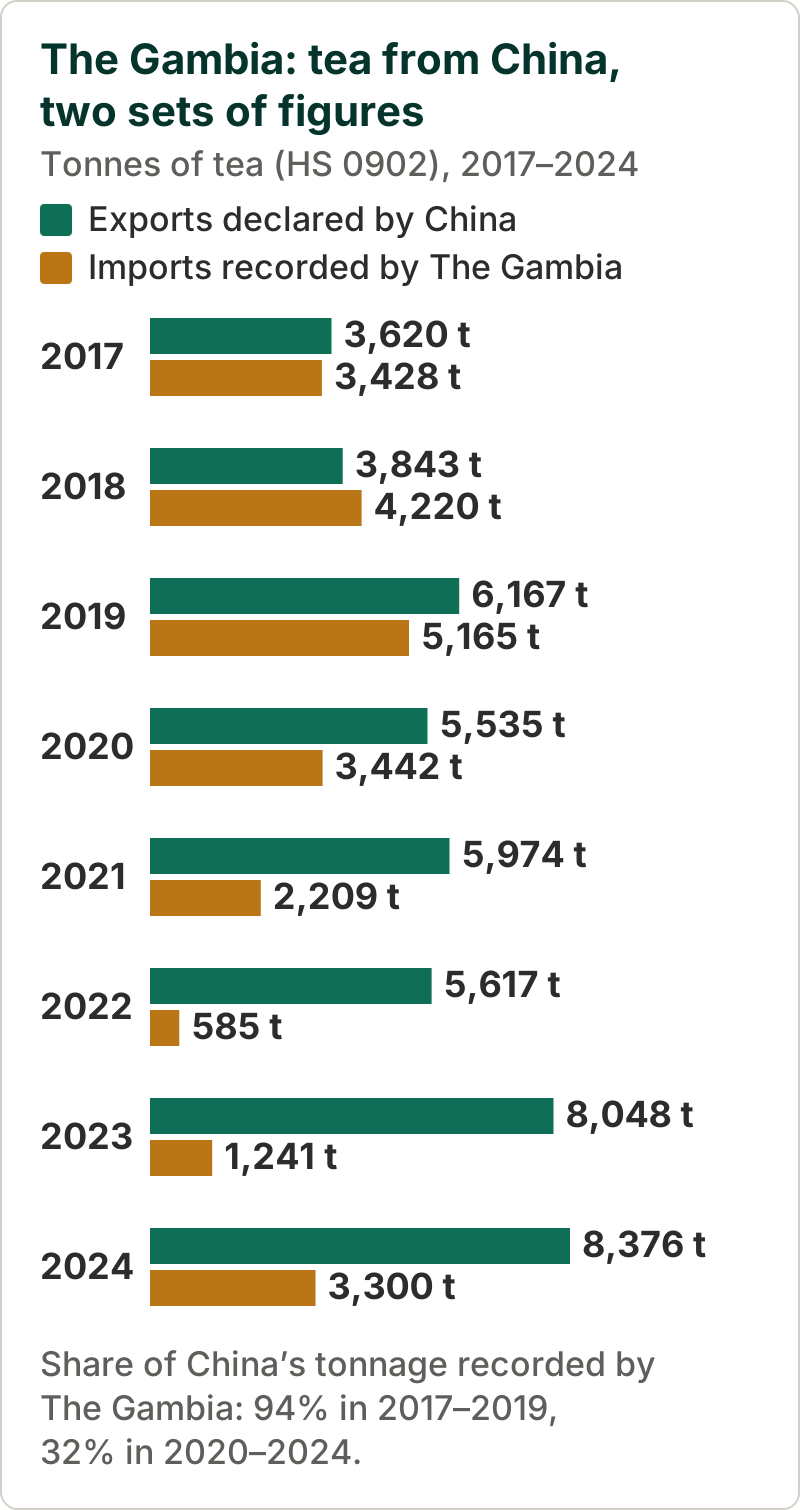 Source: UN Comtrade via WITS, figures reported by China and by The Gambia (2017–2024)
The two series were close in 2017–2019, when The Gambia recorded 94.0% of the tonnage China declared for it, then parted: over 2020–2024 The Gambia recorded 10,777 tonnes of tea from China against 33,549 tonnes declared by China, 32.1%, leaving 22,772 tonnes that appear in China’s statistics but not in Gambian imports (The Tea Trade’s calculation). Values differ even more: US$0.30 to US$0.57 per kg (CIF) in The Gambia’s records for 2020–2024, against US$3.51 to US$3.96 per kg (FOB) in China’s declarations, a gap the statistics do not explain.
Recorded re-exports are small. The Gambia reported no tea exports for 2020 to 2023 and 130.9 tonnes in 2024, all re-exports (124.0 tonnes to Senegal, 6.9 to Guinea-Bissau), equal to 1.6% of what China declared for The Gambia that year.
What Senegal, Mali and Guinea-Bissau record
Tea re-exported through customs should appear in the neighbours’ imports, as tea from The Gambia or, since importers record the origin, as tea from China. Their statistics show little of either:
- Senegal recorded no tea from The Gambia, Guinea or Guinea-Bissau in 2024. Its 7,951 tonnes of tea from China came to 52.5% of what China declared for Senegal, showing no surplus of Chinese tea that could have arrived overland.
- Mali recorded no tea from The Gambia or Guinea in 2024, but 9,500 tonnes from China, 2,891 tonnes more than China declared for Mali. That extra tea was presumably declared by China for another country; the statistics do not say which. Our guide to Sahel tea corridors covers Mali’s supply routes.
- Guinea-Bissau, whose latest figures are for 2018, recorded 385 tonnes of tea imports that year: 266 tonnes from Senegal and 83 tonnes from The Gambia, which recorded only 2.5 tonnes of tea exports to it.
How official sources describe The Gambia’s re-export trade
The WTO Secretariat’s report for the Trade Policy Review of The Gambia, dated December 2025, calls the port of Banjul a key re-export hub for Senegal, Mali and Guinea-Bissau. Citing the national transport policy, it puts the re-export trade at about 15% of GDP, 20% of government revenue and 85% of total exports, and names tea among the foreign goods The Gambia has historically distributed, with textiles, vehicles, rice, sugar and construction materials, to Guinea, Guinea-Bissau, Liberia, Mali, Mauritania and Senegal. In the review’s balance-of-payments table, based on data from the Gambian authorities, re-exports reached US$309.9 million in 2024, 85.3% of goods exports, while the customs-based figures reported to UN Comtrade show total merchandise exports of US$49.6 million. The review describes re-exports as mainly energy products and foodstuffs, and adds that a significant share of exports goes through informal channels with Senegal, Guinea and Guinea-Bissau.
The most detailed study is older: the Diagnostic Trade Integration Study of July 2007, led by the World Bank, found no reliable data on re-exports, then estimated at about 80% of total exports. Official re-exports averaged about 1% of merchandise imports in 2000–2005 and Senegal’s statistics showed almost none of the main re-export goods arriving from The Gambia, so the study concluded that border records were poor, that most re-exports crossed unofficially, or both. It listed tea among the main re-exported goods, found wholesale green tea 23.1% dearer in Dakar than in Banjul in October 2006, and put import taxes on tea at 28.3% in The Gambia against 37.3% in Senegal at the end of 2006. Observers it cites placed about half of Gambian re-exports in Senegal and a quarter in Guinea.
Transit, re-exports and unrecorded trade
The United Nations’ recommendations for trade statistics (IMTS 2010) explain how a flow can vanish between two sets of figures:
- Transit. Goods simply carried through a country to a known third country are left out of its imports and exports, whatever the customs procedure.
- Re-exports. Goods that change owner after entering a country, outside a transit procedure, and leave it unchanged count as imports, then re-exports.
- Partner country. Importers record the country of origin, exporters the last known destination: tea declared by China for The Gambia and moved on in transit would appear as Chinese tea in the next country’s imports, and in neither Gambian series.
Gambian customs provide for both. Goods in customs transit pay no Gambian duty or tax if they are produced intact under customs seal at the office of destination, within 15 working days unless extended, and goods can wait in a customs warehouse without paying duties and taxes, according to the Gambia Revenue Authority (GRA; checked October 2026).
The statistics stop there: transit, unrecorded cross-border trade and timing could each explain part of the missing tonnes, but no source reviewed measures how much tea takes each path.
Importing tea into The Gambia: GRA rules and charges
The Gambia has applied the five-band ECOWAS common external tariff since 2017, according to the WTO; our West Africa tea import duties guide covers that tariff and other members’ levies. Duties on tea have not always matched Senegal’s:
Applied duty on green tea, by year of tariff data (HS 0902.10 and 0902.20, same rate on both; source: UNCTAD TRAINS via WITS)
| Country | Rates reported |
|---|---|
| The Gambia | 10% (2003); 20% (2007–2009); 10% (2010–2013, 2017–2023) |
| Guinea | 7% (1998, 2004); 20% (2005, 2008–2013); 10% (2017–2023) |
| Senegal | 10% (every year from 2001 to 2023) |
Years not listed had no data; 2023 was the latest available in October 2026.
Charges on tea imported into The Gambia from China (sources: UNCTAD TRAINS via WITS, 2023 data, for the duty rate; WTO Trade Policy Review report, December 2025, for the rest)
| Charge | Rate | Base |
|---|---|---|
| Customs duty (ECOWAS common external tariff) | 10% | CIF value |
| ECOWAS levy | 0.5% | CIF value, imports from outside ECOWAS |
| African Union levy | 0.2% | CIF value, imports from outside the African Union |
| Customs processing fee | 1.5% | CIF value, all imports |
| Gambia National Single Window fee | 1.0% | CIF value |
| VAT | 15% | price after import and excise duties |
The four border charges add up to 3.2% of the CIF value. The GRA’s FAQ page still shows older figures, such as a 1% ECOWAS levy and a 1.55% processing fee, which the WTO says are out of date. Senegal, by comparison, charges 18% VAT and a 5% tea tax under its General Tax Code, on top of the duty and community levies.
Customs procedure, according to the same WTO report (the Customs and Excise Act 2010 is the main customs law):
- Documents. The Single Administrative Document, a commercial invoice showing the CIF value, the bill of lading or air waybill, packing lists and the importer’s Tax Identification Number, filed in ASYCUDA World (since 2022).
- Declarants. The importer’s authorised staff or a licensed clearing agent, who must be a Gambian citizen and lodge a GMD 1 million security deposit.
- Controls. No general pre-shipment inspection; in 2024, 61% of goods by value went through the red lane for physical inspection.
- Road transit. Goods moving under the ECOWAS Inter-State Road Transit (ISRT) scheme pay a 0.35% transit levy and an escort fee of GMD 500 to 1,000 for a customs officer from Banjul to the exit border.
- Prohibition. Exhausted tea is a prohibited import (Eighth Schedule, Part A).
A Gambia–Senegal Trade and Transit Cooperation Agreement of March 2020 aims, in part, to speed up goods bound for Guinea-Bissau and Guinea; the automated transit system (SIGMAT) that the two countries agreed to adopt was still pending in 2025, according to the WTO.
Guinea: a destination for Gambian re-exports more than a hub
Guinea’s own figures stop in 2016: 3,663 tonnes of tea imports, 2,925 of them (79.8%) from China, and no tea exports, close to the 2,633 to 2,869 tonnes China declared for Guinea in 2015 and 2017 (China’s 2016 tonnage in UN Comtrade is incomplete). The sources reviewed describe Guinea mainly as a market supplied through The Gambia, in the 2007 study, the WTO review and the 2020 agreement alike. None of the sources reviewed for this guide describes Guinea re-exporting tea to its neighbours.
Guinea’s Customs Code, Law L/2015/007/AN of 25 May 2015, requires goods to be declared by their holders or owners or by licensed customs brokers (commissionnaires en douane agréés). It defines re-exportation as sending goods abroad unchanged after they entered without paying the duties and taxes for home use, and lets goods move in transit between customs offices, other than by sea, with duties suspended. Clearance runs through ASYCUDA World and the GUCEG foreign trade single window, where traders file declarations of intent to import, pay online and can simulate the duties, taxes and fees on a tariff line (checked October 2026). Guinea’s VAT and other border charges could not be confirmed from an official text. Guinea’s import inspection rules are covered in our guide to pre-shipment inspection for tea.
What this means for tea exporters and importers
- Market size. China’s figures put The Gambia at 8,000 to 8,600 tonnes a year in 2023–2025 and Guinea at 3,500 to 5,200 tonnes. The Gambia’s own records are far lower: read China’s figure neither as Gambian consumption nor as proof of onward sales.
- Transit or home use. If the buyer will move the tea on to Senegal, Mali or Guinea-Bissau, agree before shipping whether it travels in customs transit, under seal with duties suspended, or is cleared for home use in The Gambia; the duties and documents differ.
- Charges. In The Gambia, budget for the 10% duty, 3.2% in border charges and 15% VAT, and have a licensed clearing agent confirm them. In Guinea, check your tariff line on the GUCEG simulator and use a licensed broker in Conakry.
This is general information, not legal or tax advice: have a customs broker confirm the procedure, documents and rates before each shipment.
Questions and answers
Does The Gambia re-export Chinese tea to Senegal and its other neighbours?
Official sources say it has long re-exported tea: the WTO Secretariat's December 2025 review report names tea among the goods The Gambia has historically re-exported to its neighbours, and a 2007 study led by the World Bank found that most re-exports went unrecorded. The Gambia's customs recorded only 131 tonnes of tea re-exports in 2024, so the size of the flow is not measured.
How much tea does China export to The Gambia?
8,638 tonnes worth US$31.0 million in 2025, according to China's figures in UN Comtrade, which made The Gambia the 16th destination for Chinese tea by volume. 99.2% of it was green tea in packs of 3 kg or less.
How much tea does Guinea import?
China declared 5,179 tonnes of tea worth US$21.0 million for Guinea in 2025, all green tea in packs of 3 kg or less (UN Comtrade). Guinea's own latest trade statistics, for 2016, recorded 3,663 tonnes of tea imports, 79.8% of them from China.
What import duties and taxes apply to tea in The Gambia?
A 10% customs duty under the ECOWAS common external tariff (UNCTAD TRAINS, 2023 data), then, according to the WTO Secretariat's December 2025 review report, a 0.5% ECOWAS levy, a 0.2% African Union levy, a 1.5% processing fee and a 1% single window fee on the CIF value, and 15% VAT. Have a licensed clearing agent confirm the current rates.
Why do The Gambia's tea import figures differ from China's export figures?
The Gambia recorded 94.0% of the tonnage China declared for it in 2017–2019 but only 32.1% in 2020–2024. Goods carried through a country in transit are left out of its imports, and much regional trade goes unrecorded, but no source measures what explains the gap.
Is Guinea a re-export hub for Chinese tea?
The figures do not show it. China's 2025 shipments come to about 0.3 kg per Guinean resident, far less than in The Gambia or Senegal, and the sources reviewed describe Guinea mainly as a destination of goods re-exported from The Gambia.
Sources
- 1. Gambia Bureau of Statistics: The Gambia 2024 Population and Housing Census, preliminary report (August 2024) · gbosdata.org
- 2. Guinea, National Statistics Institute (INS): fourth general population and housing census (RGPH-4, 2025), preliminary results (in French) · stat-guinee.org
- 3. Gambia Revenue Authority: Customs and Excise FAQs (checked October 2026) · gra.gm
- 4. Guinea: Customs Code, Law L/2015/007/AN of 25 May 2015, as amended by the 2017 Finance Law (Journal officiel, in French) · journal-officiel.sgg.gov.gn
- 5. WTO: Trade Policy Review, The Gambia, report by the Secretariat (WT/TPR/S/482, 17 December 2025), WTO iLibrary · wto-ilibrary.org
- 6. UN Comtrade via WITS: China's tea exports (HS 0902) by partner, 2025 · wits.worldbank.org
- 7. UN Comtrade via WITS: The Gambia's tea imports (HS 0902) by partner, 2024 · wits.worldbank.org
- 8. UN Comtrade: The Gambia's tea re-exports (HS 0902) by partner, 2024 · comtradeapi.un.org
- 9. World Bank, World Development Indicators: total population (SP.POP.TOTL), 2023–2025, eight West African countries · api.worldbank.org
- 10. UNCTAD TRAINS via WITS: applied MFN duty reported by The Gambia, Guinea and Senegal on green tea (HS 0902.10 and 0902.20), all years · wits.worldbank.org
- 11. United Nations Statistics Division: International Merchandise Trade Statistics, Concepts and Definitions 2010 (2011) · unstats.un.org
- 12. Integrated Framework, Diagnostic Trade Integration Study led by the World Bank: The Gambia, From Entrepôt to Exporter and Eco-tourism (July 2007) · webfs.oecd.org