Uzbekistan green tea imports: duty, route and data
Uzbekistan green tea imports: 29,217 t from China in 2025, China's 2nd market by volume. 0% duty in bulk, 10–15% on packs of 3 kg or less, 12% VAT.
Key facts
- China exported 29,217 tonnes of tea worth US$61.5 million to Uzbekistan in 2025, up 17.3% in volume, which made Uzbekistan the second destination for Chinese tea by volume after Morocco, according to MOFCOM and UN Comtrade.
- Under Presidential Resolution PP-3818 of 29 June 2018, in its edition of 16 February 2026, Uzbekistan charges no import duty on tea in packings over 3 kg, but 10% (at least US$0.20 per kg) or 15% (at least US$0.30 per kg) on tea in immediate packings of 3 kg or less.
- In 2025, 98.7% of the tea China declared for Uzbekistan was green tea in packings over 3 kg (HS 0902.20), against 99.2% in 2015, according to The Tea Trade's calculation from UN Comtrade data.
- Uzbekistan's National Statistics Committee recorded 15,553 tonnes of tea imports worth US$23.3 million in January–June 2025, of which 12,475 tonnes, or 80.2%, came from China (share: The Tea Trade's calculation).
- Uzbekistan is doubly landlocked and does not border China; it has cross-border railways to Kazakhstan, Kyrgyzstan and Turkmenistan, and a China–Kyrgyzstan–Uzbekistan railway project was officially launched in December 2024, according to MOFCOM's 2025 country guides.
Uzbekistan’s green tea imports come mostly from China, which declared 29,217 tonnes of tea worth US$61.5 million for it in 2025, up 17.3% in volume, making Uzbekistan the second destination for Chinese tea by volume after Morocco, according to China’s Ministry of Commerce (MOFCOM) and UN Comtrade. Almost all of it, 98.7%, was green tea in packings over 3 kg, which Uzbekistan’s tariff lets in free of duty, while tea in packs of 3 kg or less pays 10% or 15% under Presidential Resolution PP-3818 (checked October 2026). Uzbekistan’s own statistics show China supplying about four-fifths of its tea imports, and the tea arrives overland: the country is doubly landlocked and has no border with China.
Uzbekistan’s tea imports from China, 2015–2025
In China’s export statistics, where it appears as 乌兹别克斯坦, Uzbekistan was the second destination for Chinese tea by volume in 2015, 2020 and 2025, and third in 2023 and 2024, behind Morocco and Ghana (UN Comtrade). It also took 29,217 of the 38,730 tonnes China declared for the five Central Asian countries in 2025, against 3,330 for Kazakhstan, 3,051 for Tajikistan, 1,956 for Turkmenistan and 1,176 for Kyrgyzstan (UN Comtrade).
China’s tea exports to Uzbekistan, 2015–2025 (HS 0902; source: UN Comtrade, figures declared by China)
| Year | Volume (t) | Value (US$ million) | Unit value (US$/kg) | Share of China’s tea export volume |
|---|---|---|---|---|
| 2015 | 26,795 | 50.41 | 1.88 | 8.2% |
| 2016 | not available | 31.51 | – | – |
| 2017 | 24,178 | 42.52 | 1.76 | 6.8% |
| 2018 | 24,622 | 47.04 | 1.91 | 6.8% |
| 2019 | 20,488 | 36.16 | 1.77 | 5.6% |
| 2020 | 23,032 | 40.37 | 1.75 | 6.6% |
| 2021 | 28,655 | 56.10 | 1.96 | 7.8% |
| 2022 | 24,941 | 55.24 | 2.21 | 6.6% |
| 2023 | 27,228 | 52.10 | 1.91 | 7.4% |
| 2024 | 24,920 | 53.35 | 2.14 | 6.7% |
| 2025 | 29,217 | 61.53 | 2.11 | 7.0% |
Unit values (FOB value ÷ volume) and shares (of the annual totals in MOFCOM’s December reports) are our calculation. For 2016, UN Comtrade holds only a UN estimate of the quantity, not China’s figure, so no volume is shown.
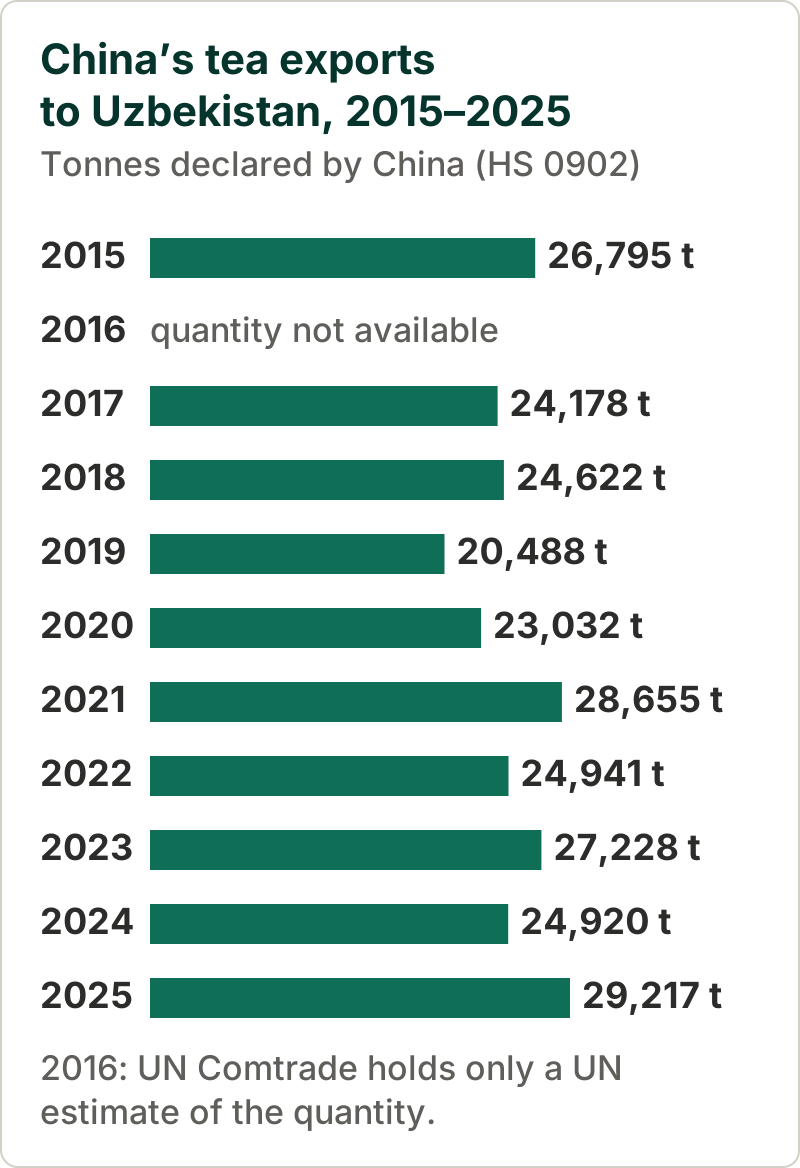 Source: UN Comtrade, tea exports reported by China (2015–2025)
Over the decade China’s tea exports to Uzbekistan grew 9.0%, much less than China’s total (+28.9%, see our guide to Chinese tea export markets), so Uzbekistan’s share of China’s tea export volume slipped from 8.2% to 7.0%. Value rose faster, by 22.1%, as the unit value went from US$1.88 to US$2.11 per kg. Among China’s ten largest markets by volume in 2025, only Chad, another buyer of green tea in packings over 3 kg, had a lower unit value (our calculation).
MOFCOM’s December reports agree: 29,217.4 tonnes and US$61.53 million in 2025 (+17.3% in volume, +15.4% in value), and 24,902.5 tonnes in 2024, 17.9 tonnes below the UN Comtrade figure. By value, Uzbekistan ranked eighth in 2024 and ninth in 2025. From January to April 2026, China shipped 9,137 tonnes to Uzbekistan (+0.3%) worth US$19.9 million (+11.2%), US$2.18 per kg; of the ten markets MOFCOM lists by value, only Morocco took more tonnes, and Uzbekistan made up 76.4% of the volume for the five Central Asian countries (中亚五国) (MOFCOM; unit value and share our calculation). Tea weighs little in the bilateral trade: its US$53.3 million in 2024 was under 0.5% of China’s US$11.77 billion of exports to Uzbekistan (Chinese customs figures quoted by MOFCOM; our calculation).
Bulk green tea: 98.7% in packings over 3 kg
China declares almost all its tea for Uzbekistan under HS 0902.20, other green tea, the code for green tea that is not in immediate packings of 3 kg or less. In 2025 that came to 28,840 tonnes, 98.7% of the total, against 99.2% in 2015; green tea in immediate packings of 3 kg or less (HS 0902.10) amounted to 123 tonnes, and black and partly fermented tea to 255 tonnes (UN Comtrade). Unit values were US$2.09 per kg in bulk and US$7.12 per kg in small packs (our calculation), but customs values include the packing and mix grades, so they are not prices. The codes are explained in our guide to HS codes for tea.
Uzbekistan’s own records show the same format. In 2024 it recorded 26,478 tonnes of Chinese tea under 0902.20, 99.8% of all the green tea it imported in packings over 3 kg, and only 131 tonnes under 0902.10. Its green tea in small packs, 626 tonnes in all, came mainly from Russia (199 t), the United Arab Emirates (133 t), China (131 t) and Kazakhstan (72 t) (UN Comtrade). The statistics show neither grades nor who packs the tea after import. Morocco, China’s first tea market, also buys almost only larger packings, under a tariff that likewise charges far less on large packings than on small ones (importing green tea into Morocco).
Uzbekistan import duty on tea: 0% in bulk, 10% or 15% in packs
Uzbekistan sets its own import duties, by presidential resolution. It belongs to the CIS free trade area, but it is only an observer in the Eurasian Economic Union, whose members include Kazakhstan and Kyrgyzstan, and at the WTO (MOFCOM). The rates for tea are set in Annex 1 to Presidential Resolution PP-3818 of 29 June 2018, in force since 1 January 2019 and amended since. The text checked in October 2026 is the edition of 16 February 2026, the latest listed, in the 2022 Harmonized System.
Import duty on tea in Uzbekistan (Annex 1 to Resolution PP-3818, edition of 16 February 2026; descriptions translated from Russian)
| National code | Description | Duty |
|---|---|---|
| 0902 (lines not listed below) | Tea, whether or not flavoured | 0% |
| 0902100009, 0902300009 | Other tea in immediate packings of a net weight of 3 kg or less | 10%, but at least US$0.20 per kg |
| 0902100001, 0902300001 | Tea in immediate packings of a net weight of 3 kg or less, in single-use packaging | 15%, but at least US$0.30 per kg |
Green and black tea are treated alike: only the packing decides, and the resolution does not define single-use packaging. Both minimums take over below a customs value of US$2.00 per kg (US$0.20 ÷ 10% and US$0.30 ÷ 15%): packed tea valued at US$1.50 per kg pays US$0.20 or US$0.30 per kg, an effective 13.3% or 20.0%, and tea valued at US$5.00 per kg pays US$0.50 or US$0.75 (our calculation).
The bulk rate has not always been zero. Uzbekistan’s tariff data in UNCTAD’s TRAINS database show 5% on other green tea and 30% on green tea in packs of 3 kg or less in every year with data from 2006 to 2015. The original text of PP-3818 set 0% on all tea; the edition of 4 April 2019 shows 10% and 15% on packed tea, and that of 1 January 2020 adds the minimums of US$0.20 and US$0.30 per kg. TRAINS records 0% on other green tea in 2020 and 2021, the latest years it holds for Uzbekistan.
These are base rates, for goods from the 47 countries to which Uzbekistan grants most-favoured-nation treatment, China among them (MOFCOM). Goods from other countries, or of unestablished origin, used to pay double rates (MOFCOM); since 28 February 2026 they pay an additional duty instead, from 5% where the base rate is up to 10% to 20% where it is 30% or more, which also applies, save in one case, when the certificate of origin is missing or in doubt (Law ZRU-1097 of 27 November 2025, amending the Customs Code). Uzbekistan was still negotiating its WTO accession in 2026: on 7 May its government reported bilateral talks completed with 33 countries and set full membership in 2026 as the goal.
VAT and customs fees on imported tea
Imported tea also pays VAT at 12%, Uzbekistan’s standard rate since 1 January 2023, when it was cut from 15%, according to MOFCOM; the rates are set in article 258 of the Tax Code. Customs fees are set by the government and charged in soums. The customs committee’s online calculator, tarif.customs.uz, estimates duties and fees from the country of departure, the weight and the value of the goods (MOFCOM).
Certificate of conformity and plant quarantine
Conformity assessment is the job of the Uzbek Agency for Technical Regulation, which now reports to the Cabinet of Ministers. It replaced the former standardisation agency on 2 June 2021, under the investment and trade ministry, and was placed directly under the government in February 2024 (MOFCOM).
According to MOFCOM’s 2025 guide, Uzbekistan’s list of goods subject to mandatory inspection covers 61 groups, mainly everyday goods such as meat, fish and vegetables. Goods on the list need a certificate of conformity issued or recognised in Uzbekistan, which the supplier hands to customs with the import declaration; without it, customs stop the goods until they have been tested or the foreign certificate recognised. Consignments worth over US$10,000 of goods such as meat, dairy products, oilseeds, beverages and tobacco are also inspected before unloading, and MOFCOM’s list of them does not mention tea. MOFCOM’s guide does not say whether tea is on the mandatory list, so ask the importer to confirm with the agency before shipping (checked October 2026).
Plant health is a separate check: foreign plant goods need a quarantine permit from the Agency for Plant Protection and Quarantine, part of the Ministry of Agriculture since early 2023, MOFCOM says. Whether that covers processed tea, and calls for a phytosanitary certificate from China, is for the importer to confirm; China’s customs issue such certificates when the importing country requires them, as our guide to Chinese tea export documents explains.
The overland route from China
Uzbekistan is doubly landlocked: neither it nor any of its five neighbours has a coastline (MOFCOM). It borders Kazakhstan to the north, Kyrgyzstan and Tajikistan to the east and south-east, Turkmenistan to the west and Afghanistan to the south, but not China, so tea from China has to cross at least one other country. When goods must go by sea, Uzbekistan uses ports abroad, such as Poti in Georgia, Chabahar in Iran, Klaipėda in Lithuania and Kuryk in Kazakhstan (MOFCOM).
- Rail through Kazakhstan. Uzbekistan’s railways, about 6,118 km long, have cross-border lines to Kazakhstan, Kyrgyzstan and Turkmenistan. Kazakhstan has 31 railway border crossings with China, Russia, Uzbekistan, Kyrgyzstan and Turkmenistan, and its southern transit corridor serves both China and the Central Asian countries (MOFCOM’s country guides).
- Road through Kyrgyzstan. Kyrgyzstan’s roads connect with those of China, Kazakhstan, Uzbekistan and Tajikistan. Its road crossings with China are Torugart, Irkeshtam and Bedel, the last open only in phases and with limited capacity (MOFCOM).
- A railway in progress. The China–Kyrgyzstan–Uzbekistan railway (中吉乌铁路) project, at the head of Kyrgyzstan’s railway plan for 2022–2026, was officially launched in December 2024 and has entered substantive implementation (MOFCOM).
Inside Uzbekistan, road carried 1.4 billion of the 1.52 billion tonnes of freight moved in 2024 (92%), rail 73.9 million (4.9%) (MOFCOM). Trade statistics do not record which route tea takes. China records each export under its country of final destination, where the goods are known to be consumed, used or processed (National Bureau of Statistics of China), so tea bound for Uzbekistan counts as Uzbekistan’s whatever its route.
What Uzbekistan’s own statistics show
The National Statistics Committee publishes tea imports from time to time, and in each release below about four-fifths of the tonnes come from China.
Uzbekistan’s tea imports in the National Statistics Committee’s releases (source: stat.uz; China’s share: our calculation)
| Period | Tea imports | Value (US$ million) | From China | China’s share |
|---|---|---|---|---|
| 2021 | 32.2 thousand t | 42.8 | 25.8 thousand t | 80.1% |
| January–February 2025 | 5.8 thousand t | 8.5 | 4,720.5 t | 81.4% |
| January–June 2025 | 15,553 t | 23.3 | 12,475 t | 80.2% |
| January 2026 | 2,570 t | 3.8 | 2,122 t | 82.6% |
After China, the main suppliers in January–June 2025 were Kenya (659 t), Iran (538 t), Kazakhstan (468 t) and India (382 t). January 2026 was 421 tonnes below January 2025.
Uzbekistan also reports to UN Comtrade, which fills in whole years. In 2024 it recorded 33,324 tonnes of tea imports worth US$50.6 million, a total that includes some quantities estimated by the UN; 26,798 tonnes (80.4%) came from China, followed by Kenya (1,650 t), Iran (1,268 t), India (960 t), Russia (571 t), Kazakhstan (525 t) and the United Arab Emirates (499 t). For 2021, use the committee’s figure: the 7,624 tonnes in UN Comtrade is a UN estimate, although the value, US$42.8 million, matches.
Tea from China to Uzbekistan: China’s declarations and Uzbekistan’s records (HS 0902; source: UN Comtrade)
| Year | Declared by China (t) | Recorded by Uzbekistan (t) | Difference (t) | Value declared by China (US$ million, FOB) | Value recorded by Uzbekistan (US$ million, CIF) |
|---|---|---|---|---|---|
| 2022 | 24,941.4 | 25,671.1 | +729.7 | 55.24 | 28.61 |
| 2023 | 27,228.4 | 28,449.4 | +1,221.0 | 52.10 | 31.71 |
| 2024 | 24,920.4 | 26,797.6 | +1,877.3 | 53.35 | 30.60 |
The tonnages are close, with Uzbekistan recording 2.9% to 7.5% more each year, but its values are only 52% to 61% of China’s: US$1.11 to US$1.14 per kg at import, against US$1.91 to US$2.21 per kg at export (our calculation), although import values include freight and insurance and export values do not. Mauritania’s figures show a similar gap, and our guide to Mauritania’s green tea trade sets out why two countries’ trade figures can differ; the statistics do not say why Uzbekistan’s values are lower.
Set against the 38,236,704 people living in Uzbekistan on 1 January 2026 (National Statistics Committee), China’s 29,217 tonnes of 2025 come to about 0.76 kg per resident (29,217,364 kg ÷ 38,236,704 = 0.76; our calculation): imports per resident, not consumption. MOFCOM’s guide notes that everyday meals in Uzbekistan are not complete without naan, a baked flatbread, and tea.
What this means for tea exporters and importers
- Market size. China declared between 20,488 and 29,217 tonnes of tea a year for Uzbekistan in 2015–2025 (no quantity for 2016), and Uzbekistan’s figures show about 31,000 to 36,000 tonnes a year of tea imports from all origins in 2022–2024 (the 2024 total partly estimated by the UN), about four-fifths of them from China. Do not mix the two series’ values in one calculation.
- Pack size. Tea in packings over 3 kg pays no duty; tea in immediate packings of 3 kg or less pays 10% or 15%, with minimums of US$0.20 or US$0.30 per kg. Agree the pack weight and the national code with the buyer before production.
- Taxes. Allow for 12% VAT and customs fees; the customs calculator gives an estimate.
- Before loading. Send a certificate of origin, so that the base rate applies, and have the importer confirm whether tea needs a certificate of conformity or a plant quarantine permit.
- Route. Plan for an overland route across Kazakhstan or Kyrgyzstan; the China–Kyrgyzstan–Uzbekistan railway was still being implemented in MOFCOM’s 2025 guides.
This is general information, not legal or tax advice: have a customs broker in Uzbekistan confirm the rates, documents and procedure before each shipment.
Questions and answers
How much tea does Uzbekistan import from China?
China declared 29,217 tonnes of tea worth US$61.5 million for Uzbekistan in 2025 (MOFCOM, UN Comtrade). Uzbekistan's own figures show 26,798 tonnes from China in 2024, 80.4% of its tea imports, a total partly estimated by the UN (UN Comtrade), and 12,475 tonnes in January–June 2025 (National Statistics Committee).
What is the import duty on tea in Uzbekistan?
There is no duty on tea in packings over 3 kg. Tea in immediate packings of 3 kg or less pays 10%, at least US$0.20 per kg, or 15%, at least US$0.30 per kg, when it is in single-use packaging, under Presidential Resolution PP-3818 (edition of 16 February 2026, checked October 2026). Since 28 February 2026, tea without a certificate of origin also pays an additional duty under the Customs Code.
What VAT applies to imported tea in Uzbekistan?
12%, the standard rate since 1 January 2023, when it was cut from 15%, according to MOFCOM's 2025 country guide. Customs fees are added; the customs committee's calculator at tarif.customs.uz gives an estimate.
Does Uzbekistan import bulk or packed tea from China?
Bulk. In 2025, 98.7% of the tea China declared for Uzbekistan was green tea in packings over 3 kg (HS 0902.20), and in 2024 Uzbekistan recorded 26,478 tonnes of Chinese tea under that code against 131 tonnes in small packs (UN Comtrade).
Does tea need a certificate of conformity in Uzbekistan?
Goods on Uzbekistan's mandatory inspection list, 61 groups mainly of everyday goods such as meat, fish and vegetables, need a certificate of conformity issued or recognised in Uzbekistan, according to MOFCOM's 2025 guide. The guide does not say whether tea is on the list, so ask the importer to check with the Uzbek Agency for Technical Regulation.
How does tea get from China to Uzbekistan?
Overland, across at least one other country, because Uzbekistan is doubly landlocked and has no border with China. Its railways connect with those of Kazakhstan, which has rail crossings into China; Kyrgyzstan's roads reach China at Torugart and Irkeshtam; and a China–Kyrgyzstan–Uzbekistan railway project was launched in December 2024 (MOFCOM).
Sources
- 1. Uzbekistan, President: Resolution PP-3818 of 29 June 2018 on foreign economic activity and customs tariff regulation, Annex 1, import customs duty rates, consolidated edition of 16 February 2026 (in Russian) · lex.uz
- 2. Uzbekistan: Law ZRU-1097 of 27 November 2025 amending the Customs Code (articles 300-1 and 366), in force 28 February 2026 (in Russian) · lex.uz
- 3. Uzbekistan, National Statistics Committee: How much tea was imported to Uzbekistan? (January–June 2025), 5 August 2025 · stat.uz
- 4. Uzbekistan, National Statistics Committee: tea imports in 2021 (Uzbekistan imported 1.9 tonnes of tea from Germany), 15 February 2022 (in Russian) · stat.uz
- 5. Government of Uzbekistan: progress of accession to the World Trade Organization reviewed, 7 May 2026 (in Russian) · gov.uz
- 6. MOFCOM and 中国食品土畜进出口商会: China export monthly statistical report, tea, December 2025 (in Chinese) · wms.mofcom.gov.cn
- 7. MOFCOM, Chinese Academy of International Trade and Economic Cooperation and Chinese Embassy in Uzbekistan: country guide for outbound investment and cooperation, Uzbekistan, 2025 edition (in Chinese) · mofcom.gov.cn
- 8. MOFCOM, Chinese Academy of International Trade and Economic Cooperation and Chinese Embassy in Kazakhstan: country guide for outbound investment and cooperation, Kazakhstan, 2025 edition (in Chinese) · mofcom.gov.cn
- 9. MOFCOM, Chinese Academy of International Trade and Economic Cooperation and Chinese Embassy in Kyrgyzstan: country guide for outbound investment and cooperation, Kyrgyzstan, 2025 edition (in Chinese) · mofcom.gov.cn
- 10. UN Comtrade via WITS: China's tea exports (HS 0902) by partner, 2025 · wits.worldbank.org
- 11. UN Comtrade: China's tea exports to Uzbekistan by HS subheading (0902.10 to 0902.40), 2025 · comtradeapi.un.org
- 12. UN Comtrade via WITS: Uzbekistan's tea imports (HS 0902) by partner, 2024 · wits.worldbank.org