Tea export packaging: bulk cartons to retail packs
Tea export packaging: each pack's net weight sets the HS code (3 kg) and Morocco's duty (20 kg); liners guard against damp; China's GB 23350 skips exports.
Key facts
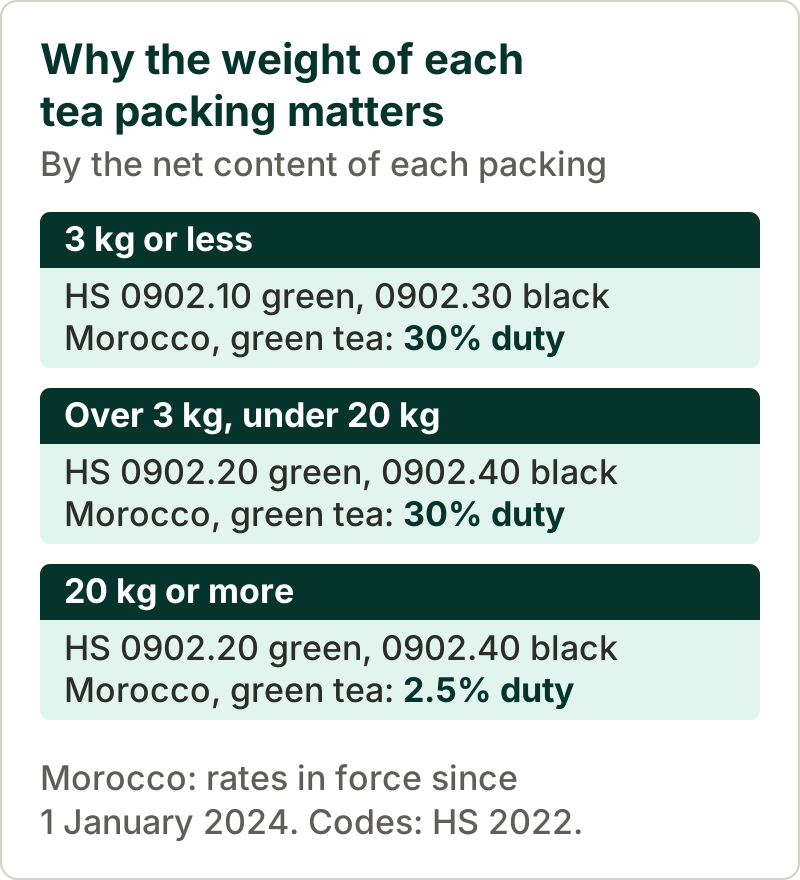
- In the World Customs Organization's HS 2022 nomenclature, tea in immediate packings of a content not exceeding 3 kg falls under subheadings 0902.10 (green) and 0902.30 (black and partly fermented), and tea in larger packings under 0902.20 and 0902.40.
- Since 1 January 2024, Morocco has charged 2.5% import duty on green tea in packings with a content of 20 kg or more and 30% on smaller packings, according to Moroccan customs circulars and the WTO's 2024 Trade Policy Review.
- China's grade standards GB/T 14456.4-2016 and GB/T 14456.5-2016 cap moisture at 7.0% for every grade of gunpowder and chunmee green tea, and Shenzhen's local standard DB4403/T 88-2020, repealed on 25 August 2025, suggested laminates based on aluminium foil or metallised film as a moisture barrier for tea packs.
- Under Amendment No. 2 to China's mandatory standard GB 23350-2021, tea sold in China may have no more than three layers of packaging from 1 March 2025, but China's market regulator (SAMR) states that the standard does not apply to food exported from China or to transport packaging.
- Under GACC Order No. 249, in force since 1 January 2022, Chinese export food producers must mark the transport packaging with their record-filing number, the product name, the production batch number and the production date.
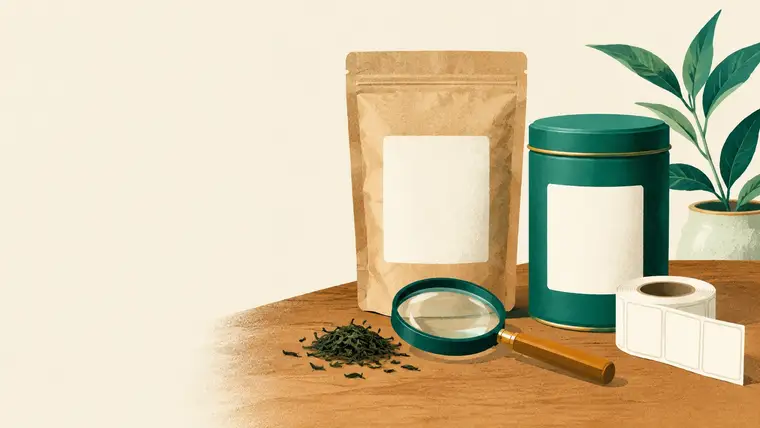
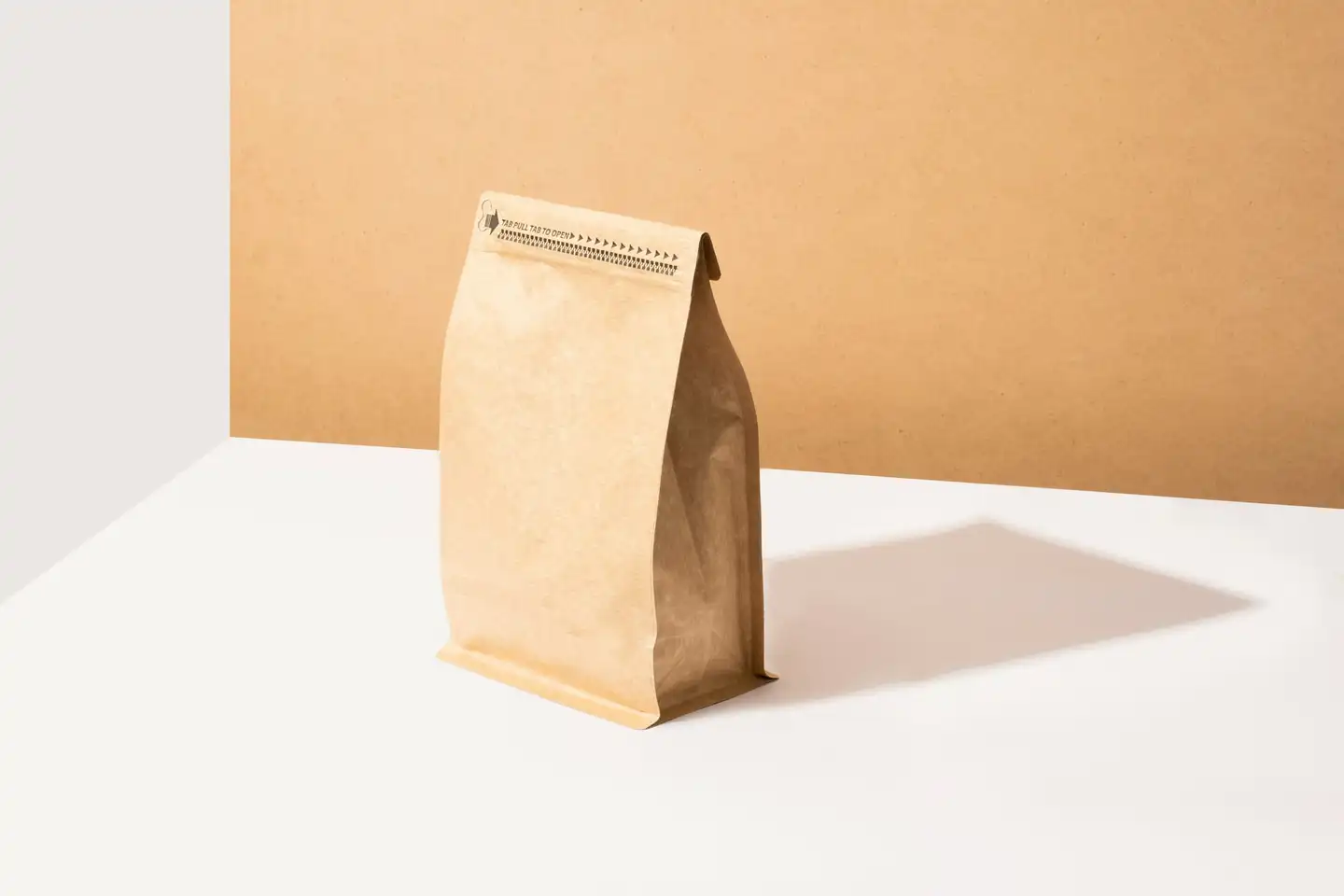
Tea export packaging comes in two broad formats: bulk packs, such as cartons, cases or sacks lined with an inner bag, and small packs, such as tins, boxes, pouches and tea bags, filled before the tea leaves China. The net weight of each immediate packing sets the HS subheading, with 3 kg as the dividing line in the World Customs Organization’s nomenclature, and in Morocco green tea in packings of 20 kg or more pays 2.5% duty instead of 30%. Liners based on aluminium foil or metallised film serve as a moisture barrier, and China’s gunpowder and chunmee standards cap moisture at 7.0%.
Why pack weight matters: HS codes and Morocco’s 20 kg line
Within each type of tea, the Harmonized System splits by the content of each immediate packing. In its 2022 edition, green tea “in immediate packings of a content not exceeding 3 kg” is 0902.10 and other green tea is 0902.20; black and partly fermented tea split the same way into 0902.30 and 0902.40. The guide to HS codes for tea explains how customs services read “immediate packing”.
The split shows in the trade. In 2025 China exported 145,506 tonnes of green tea in immediate packings of 3 kg or less and 231,614 tonnes in other packings, so 38.6% of its green tea by volume left in small packs (China’s figures in UN Comtrade; share calculated). Senegal (23,527 t), Mauritania (20,117 t), Ghana (17,757 t), Côte d’Ivoire (16,511 t) and Mali (10,303 t) took the most small-pack green tea, while Morocco alone took 91,128 tonnes in larger packings, 39.3% of that subheading. For Tunisia’s imports by packing, see our guide to tea imports into Tunisia.
Morocco draws a second line at 20 kg. Since 1 January 2024 its tariff has charged 30% duty on green tea in packings of 3 kg or less and in packings over 3 kg and under 20 kg, and 2.5% on packings with a content of 20 kg or more (customs circular 6619/210; WTO Trade Policy Review, 2024). Decree 2-13-711 of 4 March 2015 also requires tea to be packed in closed, clean and dry containers, requires establishments that pack tea to be authorised and lists the sale of bulk tea among unlawful practices. Rates, VAT and the sanitary authorisation are covered in the guide to importing green tea into Morocco.
 Sources: World Customs Organization, HS 2022; Moroccan Customs, circular 6619/210 (2024); WTO Trade Policy Review of Morocco (2024)
Tea export packaging formats: bulk cartons, retail packs and tea bags
The table lists the formats described by reference works, a Shenzhen standard (repealed in August 2025) and US customs rulings; none of them sets a standard net weight for Chinese export tea.
Tea packaging formats described in reference and official sources
| Format | What the source describes | Source |
|---|---|---|
| Bulk packs | Cases of wood, plywood, or corrugated or kraft board, bags or baskets, holding loose tea, small packs or compressed tea; cases lined with foil paper (or foil-paper cans) or with plastic bags under vacuum with nitrogen | China Agriculture Press reference on tea packaging inspection |
| International standard cases | Plywood and paperboard cases of 400 × 400 × 600 mm or 400 × 500 × 600 mm, generally used by India, Sri Lanka, Kenya and Indonesia | same |
| Outer cartons and wooden cases | Rigid containers that can take knocks in handling; inner bags of polyethylene, polypropylene or laminate that meet food-contact standards; vacuum or nitrogen packing recommended | Shenzhen standard DB4403/T 88-2020, repealed on 25 August 2025 |
| Chests and sacks | Light plywood chests lined with aluminium foil and one or two plies of parchment paper; paper and jute bags of 25–60 kg | GDV cargo handbook |
| Pouches in bulk cartons | Small foil pouches packed in bulk cartons weighing up to 50 lb (22.7 kg) each | US Customs ruling N203765, 2012 |
| Retail tins and boxes | The same foil pouches in tins or paper boxes of 1 lb (0.45 kg) net or less, put up for retail sale | same |
| Small bulk bags | Loose black tea in 5 lb (2.27 kg) metallised film bags | US Customs ruling N354721, 2025 |
| Retail packs | Tins, boxes, bags, jars and tea bags | China Agriculture Press reference |
The US rulings show how the outer pack can move tea between subheadings: US Customs and Border Protection put the same pouches of green tea under 0902.20 in bulk cartons of up to 50 lb and under 0902.10 in retail tins or boxes of a pound or less, while 5 lb bags of loose black tea went to 0902.30, the small-pack subheading.
Tea bags have their own Chinese standards: GB/T 24690-2018 Teabag (袋泡茶), in force since 1 June 2018, and GB/T 25436-2023 Filter paper for teabags (茶叶滤纸), in force since 1 April 2024, which replaced the separate standards for heat-seal and non-heat-seal filter paper. Tea bag materials are compared in our guide to tea bag materials and standards.
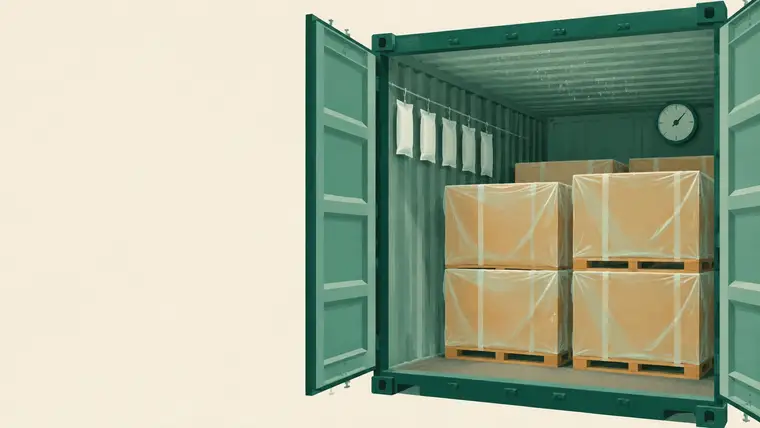
Carton size also decides how well a container fills: the GDV handbook notes that cartons can be sized to fill containers almost completely, and the guide to tea container capacity works through the counts for 20 ft and 40 ft boxes.
Moisture barrier: why inner liners and foil laminates are used
Dry tea takes up water from the air. The GDV handbook describes the sorption isotherms of two black teas as rising steeply, “reflecting the tea’s strong hygroscopicity”, and calls mouldy or musty tea worthless. China’s standards cap moisture at 7.0% for every grade of gunpowder and chunmee (GB/T 14456.4-2016 and GB/T 14456.5-2016; see the guide to gunpowder tea grades). The international green tea standard, ISO 11287:2011, sets no moisture limit for tea as received; it requires “closed, clean, and dry containers made of material which does not affect the quality of the tea”.
Shenzhen’s local standard on tea packaging, storage and transport, DB4403/T 88-2020, in force from 1 October 2020 until its repeal on 25 August 2025, listed three protective measures for packs:
- Moisture: laminates based on aluminium foil or metallised film may be used as a moisture barrier.
- Oxidation: airtight plastic or laminated bags with vacuum packing, but more breathable materials for dark and compressed teas.
- Light: light-proof packaging.
The same standard required transport packaging to keep tea from light, damp and air, paper in contact with tea to meet GB 4806.8, and inner polyethylene, polypropylene or laminated bags to meet GB 4806.7.
A study by the Indian Institute of Packaging (online 2024, in print 2026) tested ten bulk export packs on Indian orthodox black tea from Assam, stored at 38 °C and 90% relative humidity for four months. The tea’s moisture rose during storage from 2.93% at the start, against a critical level of 7.00%. The packs that lasted longest, 105 days, were a sandwich bag and a polypropylene woven sack with an LDPE-EVOH-LDPE liner, and four-ply multiwall paper sacks with a 7 µm aluminium foil/poly liner or a 12 µm metallised PET/poly liner; the authors estimate 315 days for them at 27 °C and 65% relative humidity. They note that EVOH coextruded with LDPE has one of the lowest oxygen permeabilities, and that aluminium foil and metallised PET give a superior oxygen barrier and a good moisture barrier. These results concern that black tea in those bulk packs; the study did not test Chinese green tea.
Storage after packing counts too. The Shenzhen standard recommended keeping green tea at no more than 10 °C and 50% relative humidity, and dark and compressed teas at no more than 25 °C and 70%, and required stock checks, including the moisture of the stacks, every month, or every week from April to September. The storage of pu-erh is covered in our guide to pu-erh tea grades.
Chinese standards for tea packaging and storage
Chinese standards on tea packaging and storage (SAMR records checked October 2026; GB 4806.1: USDA, April 2026)
| Standard | Subject | In force since | Status |
|---|---|---|---|
| GB/T 30375-2013 | Tea storage (茶叶贮存) | 22 June 2014 | In force; revision awaiting approval |
| GB 23350-2021 | Restricting excessive packaging of foods and cosmetics (mandatory) | 1 September 2023 | In force, amended in 2022 and 2024; a third amendment open for comment |
| GB 4806.1-2016 | Food contact materials and articles: general safety requirements (mandatory) | 19 October 2017 | In force |
| GH/T 1070-2011 | General rules for tea packaging (茶叶包装通则), supply and marketing sector | 1 July 2011 | In force |
| NY/T 1999-2011 | Packaging, transport and storage of tea, agriculture sector | 1 December 2011 | In force |
| BB/T 0078-2018 | General technical requirements for tea packaging, packaging sector | 1 July 2019 | In force |
| SN/T 0912-2000 | Inspection of the packaging of imported and exported tea, inspection sector | 1 November 2000 | In force |
| GB/T 24690-2018 | Teabag (袋泡茶) | 1 June 2018 | In force |
| GB/T 25436-2023 | Filter paper for teabags (茶叶滤纸) | 1 April 2024 | In force |
| GB/T 191-2025 | Graphical symbols for handling and storage of packages | 1 March 2026 | In force, replacing GB/T 191-2008 |
| DB4403/T 88-2020 | Tea packaging, storage and transport, Shenzhen local standard (茶叶包装贮运技术规范) | 1 October 2020 | Repealed on 25 August 2025 |
The grade standards point to these texts: the gunpowder, chunmee and jasmine tea standards, GB/T 14456.4-2016, GB/T 14456.5-2016 and GB/T 22292-2017, all refer packaging to GH/T 1070 and storage to GB/T 30375.
GB/T 30375: tea storage
GB/T 30375-2013, Tea storage (茶叶贮存), is a recommended national standard. It was published on 31 December 2013 and took effect on 22 June 2014. A review on 17 May 2021 concluded that it should be revised. The revision, plan 20251082-T-442, was issued on 30 April 2025 with a 12-month schedule; it is to replace the 2013 edition in full and to take effect six months after publication. In October 2026 the official record still listed the plan as awaiting approval and the 2013 edition as current. The standard’s requirements for tea warehouses are summarised in the guide to keeping tea fresh in transit.
GB 23350-2021: excessive packaging rules for tea sold in China
GB 23350-2021 is China’s mandatory standard against excessive packaging of food and cosmetics, in force since 1 September 2023. It covers the sales packaging of food produced, sold and imported in China. According to the State Administration for Market Regulation (SAMR, 市场监管总局), it does not apply to food exported from China or to transport packaging.
For tea sold in China, Amendment No. 2 has applied since 1 March 2025 (official record); a Q&A on it published by local market regulators dates its release to 25 March 2024. According to that Q&A and China Quality News, SAMR’s newspaper, it tightened the rules for tea:
- Layers: no more than three, against four before. The inner film bags of tea bags, and the paper, plastic or foil wrapped tight around compressed tea, do not count as layers.
- Void ratio: the “necessary space coefficient” k (必要空间系数) used to assess a pack’s void ratio is now 9.0 for compressed tea and 13.0 for other tea; under Amendment No. 1 of 2022, it was 13.0 for tea and related products.
- Weight and materials: the packaging of tea, tea products or flavoured tea may weigh no more than 8 times the product it holds, and tea packaging may not use precious metals or hongmu (红木) hardwoods.
Tea produced before 1 March 2025 that meets the earlier text may be sold until the end of its shelf life. A third amendment was open for public comment in October 2026.
GB 4806: food-contact materials
China’s food-contact framework starts with GB 4806.1-2016, released on 19 October 2016 and in force since 19 October 2017. Substances migrating from a material must not endanger human health or change the food’s composition, structure, colour, smell or taste, and products must carry a statement of conformity and a “for food contact” mention or a spoon-and-chopsticks symbol, unless their food use is obvious. Product standards add specific limits, for example GB 4806.7-2023 for plastics, GB 4806.8-2022 for paper and board, GB 4806.9-2023 for metals and GB 4806.13-2023 for composite materials, as listed by the US Department of Agriculture in April 2026.
For tea leaving China, GACC Order No. 249, in force since 1 January 2022, requires export food producers to make sure that packaging and transport meet food safety requirements (Article 45). Export food must meet the importing country’s standards or the contract, plus any special treaty requirements; where none of these sets a requirement, it must meet China’s national food safety standards (Article 38).
Export cartons: marks, inspection and wooden cases
- Marks. Under Order No. 249 (Article 46), the export food producer marks the transport packaging with its record-filing number, the product name, the production batch number and the production date. Where the importing country or the contract requires otherwise, the directly affiliated customs office (直属海关) can agree to other marks, provided the product stays traceable.
- Shipping marks. The China Agriculture Press reference lists seven kinds of marks for tea cases: the main shipping mark (唛头), secondary marks, the product name, the package number, the destination, the net weight (or gross and net weight) and the country or place of origin. Pack marking for Libya is covered in our guide to Libya’s import rules.
- Handling symbols. China’s standard for them is GB/T 191-2025, a modified adoption of ISO 780:2015, in force since 1 March 2026.
- Inspection. SN/T 0912-2000, the inspection sector’s rules for inspecting the packaging of imported and exported tea (进出口茶叶包装检验规程), was still listed as in force in October 2026. Separately, the China Agriculture Press reference lists nine tests in tea packaging inspection, from the thickness and moisture of case boards to the strength and moisture resistance of tea cases, with checks of filter paper, fluorescent substances and aluminium foil.
- Wood. In countries that apply ISPM 15, the wood packaging standard of the International Plant Protection Convention, solid-wood cases, crates and pallets must be treated and marked; packaging made wholly of processed wood, such as plywood, is exempt.
Keep names, net weights, marks and lot numbers identical on the cartons and on the papers listed in the guide to Chinese tea export documents.
Tea labelling: EU and Morocco pointers
Labelling will be covered in a guide of its own. The main texts are:
- European Union: Regulation (EU) No 1169/2011 on the provision of food information to consumers, applied since 13 December 2014. Packaging materials fall under the food-contact framework, Regulation (EC) No 1935/2004, and plastics under Regulation (EU) No 10/2011.
- Morocco: Decree 2-13-711 makes tea labelling follow Decree 2-12-389 on the labelling of food products, and requires the label to name the country of origin when it differs from the place of provenance.
Packaging checklist for a tea purchase contract
- Net weight of each immediate packing, which sets the HS subheading; for Morocco, a content of at least 20 kg per packing if the 2.5% rate is wanted.
- Inner bag or liner: material and structure, sealing, and vacuum or nitrogen flushing if wanted.
- Outer pack: carton, case or sack, outside dimensions and stacking strength, with ISPM 15 treatment for solid wood.
- Food-contact compliance: a declaration of compliance with the destination’s rules for every material that touches the tea.
- Moisture: a maximum at loading, for example 7.0% for gunpowder or chunmee, tested with method GB 5009.3-2016 (the grade standards cite GB/T 8304, withdrawn in 2017).
- Marks and labels: the Order No. 249 marks, the buyer’s shipping mark and handling symbols on cartons, and the destination’s label on retail packs.
This guide is general information, checked in October 2026, not legal advice: confirm the requirements with the importing country’s authorities or a customs broker before shipping.
Questions and answers
How is tea packed for export?
Either in bulk packs, such as cartons, cases or sacks with an inner bag of plastic, foil or metallised laminate, or in small packs filled before shipment. A Chinese reference on tea packaging inspection lists cases, bags and baskets for bulk tea, and tins, boxes, bags, jars and tea bags for small packs.
What size are tea export cartons?
None of the sources consulted sets one for Chinese export tea. A Chinese reference notes that India, Sri Lanka, Kenya and Indonesia generally use cases of 400 × 400 × 600 mm or 400 × 500 × 600 mm, known as international standard cases; size cartons with the container in mind.
Does the pack size change the HS code for tea?
Yes. Green tea in immediate packings of 3 kg or less is 0902.10 and other green tea 0902.20; black and partly fermented tea split the same way into 0902.30 and 0902.40 (HS 2022). Customs services can read 'immediate packing' differently, so state the net weight of each inner pack on the invoice and packing list.
Why do tea cartons have a foil or plastic liner?
Tea takes up moisture from the air, and China's gunpowder and chunmee standards cap it at 7.0%. Shenzhen's standard DB4403/T 88-2020, repealed on 25 August 2025, suggested aluminium foil or metallised laminates as a moisture barrier, and airtight, vacuum-packed bags against oxidation.
Does China's excessive packaging standard apply to exported tea?
No. SAMR states that GB 23350-2021 covers the sales packaging of food produced, sold and imported in China, and does not apply to food exported abroad or to transport packaging. For tea sold in China, its Amendment No. 2 has limited packs to three layers since 1 March 2025.
What marks go on a Chinese tea export carton?
Under GACC Order No. 249, the producer's record-filing number, the product name, the production batch number and the production date. Where the importing country or the contract requires other marks, the customs office can agree to them, provided the product stays traceable.
Sources
- 1. World Customs Organization: HS Nomenclature 2022 edition, Chapter 9, coffee, tea, maté and spices · wcoomd.org
- 2. UN Comtrade via WITS: China exports of green tea in immediate packings of 3 kg or less, HS 0902.10, 2025 · wits.worldbank.org
- 3. UN Comtrade via WITS: China exports of other green tea, HS 0902.20, 2025 · wits.worldbank.org
- 4. Moroccan Customs: Circular 6619/210 of 26 December 2024 on the 2025 finance law (in French) · douane.gov.ma
- 5. WTO: Trade Policy Review of Morocco, Secretariat report WT/TPR/S/453, March 2024 · wto.org
- 6. ONSSA: Decree 2-13-711 of 4 March 2015 on the quality and safety of marketed tea (English translation) · onssa.gov.ma
- 7. National public service platform for standards information: GB/T 30375-2013 Tea storage, record and 2021 review (in Chinese) · std.samr.gov.cn
- 8. National public service platform for standards information: revision plan 20251082-T-442 for Tea storage (in Chinese) · std.samr.gov.cn
- 9. National public service platform for standards information: GB 23350-2021 Requirements of restricting excessive package, foods and cosmetics (in Chinese) · std.samr.gov.cn
- 10. National public service platform for standards information: Amendment No. 2 to GB 23350-2021, in force 1 March 2025 (in Chinese) · std.samr.gov.cn
- 11. SAMR: Questions and answers on GB 23350-2021 and its Amendment No. 1, 31 August 2023 (in Chinese) · samr.gov.cn
- 12. Liaoning Administration for Market Regulation: text of Amendment No. 1 to GB 23350-2021, approved 24 May 2022 (in Chinese) · scjg.ln.gov.cn
- 13. China Quality News (SAMR newspaper): Amendment No. 2 to the national standard on excessive packaging released, 8 April 2024 (in Chinese) · m.cqn.com.cn
- 14. Jingtai County People's Government: questions and answers on Amendment No. 2 to GB 23350-2021, 30 September 2024 (in Chinese) · jingtai.gov.cn
- 15. USDA Foreign Agricultural Service: GAIN report CH17015, General safety requirements for food-contact materials and articles (GB 4806.1-2016), 31 March 2017 · apps.fas.usda.gov
- 16. USDA Foreign Agricultural Service: FAIRS Country Report Annual, China, CH2026-0026, 2 April 2026 · apps.fas.usda.gov
- 17. GACC: Order No. 249, Administrative Measures on Import and Export Food Safety, 12 April 2021 (in Chinese) · gov.cn
- 18. Shenzhen Administration for Market Regulation: DB4403/T 88-2020 Technical specification for tea packages storage and logistics, repealed on 25 August 2025 (in Chinese) · amr.sz.gov.cn
- 19. National public service platform for standards information: record of DB4403/T 88-2020, repealed on 25 August 2025 (in Chinese) · std.samr.gov.cn
- 20. National public service platform for standards information: tea packaging standards, with GH/T 1070-2011, NY/T 1999-2011, BB/T 0078-2018 and SN/T 0912-2000 (in Chinese) · std.samr.gov.cn
- 21. National public service platform for standards information: GB/T 24690-2018 Teabag (in Chinese) · std.samr.gov.cn
- 22. National public service platform for standards information: GB/T 25436-2023 Filter paper for teabags (in Chinese) · std.samr.gov.cn
- 23. National public service platform for standards information: GB/T 191-2025 Graphical symbols marking for handling and storage of packages (in Chinese) · std.samr.gov.cn
- 24. GB/T 14456.4-2016 Green tea, Part 4: Gunpowder tea, official record (in Chinese) · openstd.samr.gov.cn
- 25. National public service platform for standards information: GB/T 14456.5-2016 Green tea, Part 5: Mee tea (in Chinese) · std.samr.gov.cn
- 26. National public service platform for standards information: GB/T 22292-2017 Jasmine tea (in Chinese) · std.samr.gov.cn
- 27. ISO 11287:2011 Green tea, definition and basic requirements, sample pages · cdn.standards.iteh.ai
- 28. China Agriculture Press, 智汇三农 knowledge platform: tea packaging inspection (in Chinese) · pwsannong.com
- 29. German Insurance Association (GDV), Transport Information Service: Tea · tis-gdv.de
- 30. Bhattacharjee D. et al. (2026), Estimation of shelf life and development of packaging standards for bulk packaging of orthodox tea for export, Asian Journal of Dairy and Food Research 45(4): 662–669 · doi.org
- 31. US Customs and Border Protection: ruling N203765 on green, white, oolong and black tea from China, 7 March 2012 · rulings.cbp.gov
- 32. US Customs and Border Protection: ruling N354721 on the classification and origin of black tea, 29 October 2025 · rulings.cbp.gov
- 33. IPPC: ISPM 15, Regulation of wood packaging material in international trade · ippc.int
- 34. European Commission: Food information to consumers, legislation · food.ec.europa.eu
- 35. European Commission: Food contact materials, legislation · food.ec.europa.eu
- 36. National Health Commission: catalogue of national food safety standards, including GB 5009.3-2016 and GB 5009.4-2016 (in Chinese) · nhc.gov.cn