Pu-erh tea grades: raw, ripe, loose and pressed
Pu-erh tea grades come from China's GB/T 22111-2008: only loose ripe pu-erh is graded, special grade to grade 10. Moisture caps run from 12.0% to 13.0%.
Key facts
- China's national standard GB/T 22111-2008 (地理标志产品 普洱茶) defines pu-erh as tea made from Yunnan large-leaf sun-dried green tea within a protected area spanning 11 prefectures and cities of Yunnan, in two types: raw (生茶) and ripe (熟茶).
- Under GB/T 22111-2008, the only finished pu-erh with grades is loose ripe pu-erh, graded from special grade (特级) through grades 1 to 10, 11 grades in all; pressed pu-erh, raw or ripe, has no grades.
- GB/T 22111-2008 caps moisture at 13.0% for raw pu-erh, 12.0% for loose ripe and 12.5% for pressed ripe pu-erh, and requires at least 28.0% tea polyphenols in raw pu-erh but allows no more than 15.0% in ripe pu-erh.
- China has protected pu-erh (普洱茶) as a geographical indication since 13 May 2008, and the EU has protected the name Pu'er Cha since 1 March 2021 under the EU–China agreement on geographical indications.
- China exported 1,401 tonnes of ripe pu-erh in 2025, 0.33% of its tea export volume and 3.02% less than in 2024, according to the China Tea Marketing Association; China's tariff lines for it are 0902.3031 and 0902.4031.
Pu-erh tea grades are set by China’s national standard GB/T 22111-2008 (地理标志产品 普洱茶), which defines pu-erh as tea made from the sun-dried green tea of Yunnan large-leaf bushes inside a protected area spanning 11 prefectures and cities of Yunnan. Of the finished teas, only loose ripe pu-erh (熟茶) is graded: special grade, then grades 1 to 10, 11 grades in all. Pressed pu-erh, raw (生茶) or ripe, carries no grade, and moisture is capped at 13.0% for raw pu-erh and at 12.0% (loose) or 12.5% (pressed) for ripe. China exported 1,401 tonnes of ripe pu-erh in 2025, according to the China Tea Marketing Association.
What pu-erh is under GB/T 22111-2008
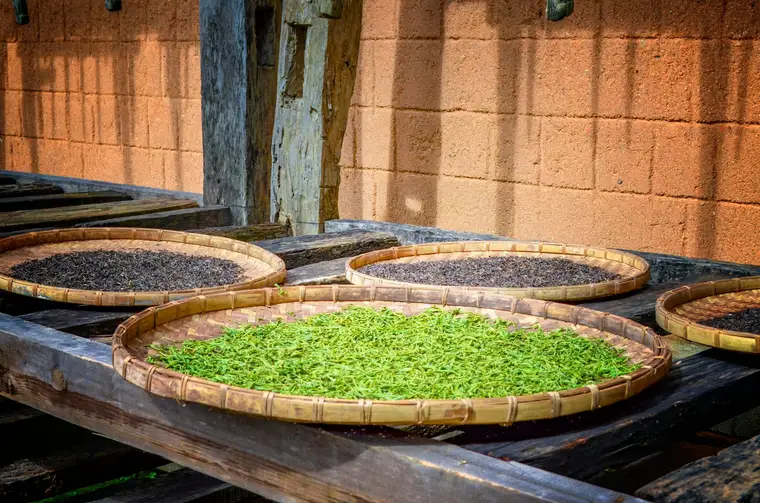
GB/T 22111-2008 defines pu-erh (普洱茶, “Puer tea” in the standard’s English title) as tea made from Yunnan large-leaf sun-dried green tea (晒青茶) grown within the geographical-indication area and processed there by specific methods. Yunnan large-leaf tea (云南大叶种茶) is the collective name for the tree-type and small-tree-type large-leaf varieties of Yunnan’s tea districts, and the standard names mainly recognised local populations of Camellia sinensis var. assamica as suited to pu-erh. Pu-erh comes in two types, raw (普洱茶(生茶), sheng) and ripe (普洱茶(熟茶), shou). Ripe pu-erh is made by post-fermentation (后发酵), which the standard describes as the transformation of sun-dried green tea or raw pu-erh under the combined action of microbes, enzymes, moist heat and oxidation.
The standard was published on 17 June 2008 and took effect on 1 December 2008. Its official record names China’s intellectual property office (CNIPA, 国家知识产权局) as the competent authority and shows a review on 4 August 2025 that concluded it should remain in force (继续有效); the 2008 edition is still listed as current (checked October 2026). Yunnan’s earlier, mandatory provincial standard for pu-erh, DB53/103-2006, was repealed on 28 February 2014.
The international standard ISO 20715:2023 lists ripe pu-erh as a type of dark tea and sun-dried green tea as a type of green tea; our guide to the six Chinese tea types compares the processing steps.
Raw and ripe pu-erh: loose and pressed forms
The standard sorts pu-erh by type and by form. Ripe pu-erh comes loose (散茶) or pressed (紧压茶), but raw pu-erh only pressed: the standard has no loose raw pu-erh, and the loose leaf that is pressed into raw pu-erh is sun-dried green tea, graded on its own scale.
Pu-erh products, processing and grades (GB/T 22111-2008, clauses 5 and 6.5)
| Product | Processing | Form | Grades |
|---|---|---|---|
| Sun-dried green tea (晒青茶), the raw material | spreading the fresh leaf, fixing, rolling, breaking up, drying in the sun | loose | six described, special grade to grade 10 |
| Raw pu-erh (生茶) | refining sun-dried green tea, steaming and pressing, drying | pressed | none |
| Ripe pu-erh, loose (熟茶散茶) | post-fermenting sun-dried green tea, drying, refining | loose | 11: special grade, grades 1 to 10 |
| Ripe pu-erh, pressed (熟茶紧压茶) | pressing loose ripe pu-erh and drying it; or pressing and drying refined sun-dried green tea, then post-fermenting it | pressed | none |
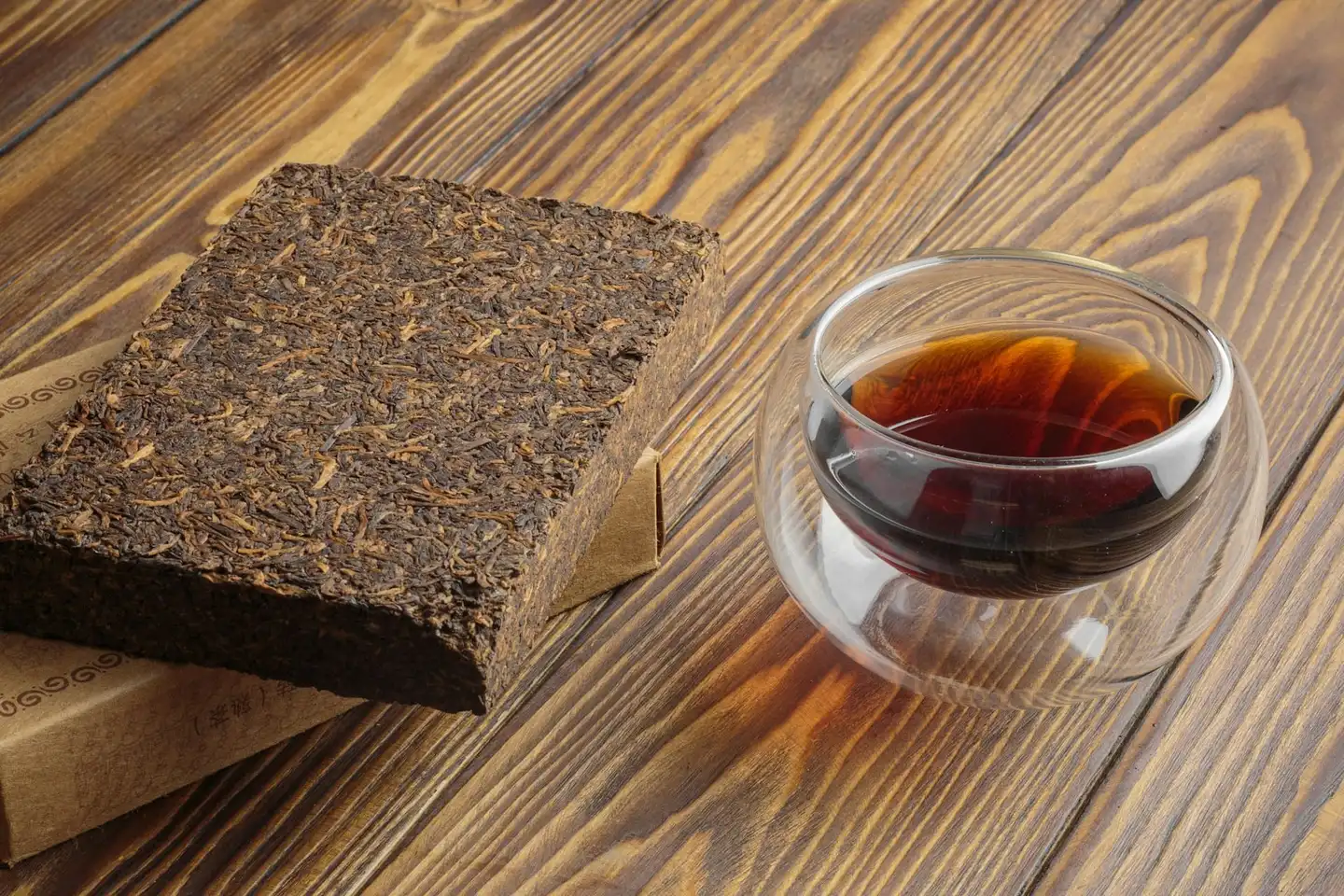
Pressed pu-erh comes in round cakes (圆饼形), bowl shapes (碗臼形), squares (方形), columns (柱形) and other shapes and sizes. It has no physical reference sample either: the producer keeps its own, and the standard’s evaluation method compares the appearance of a lot with it. Pressed raw pu-erh must be dark green, well shaped and moderately compressed, with no layers peeling off, and where finer tea is sprinkled on the surface (洒面茶) it must cover the core; it should give a clean aroma, a strong, full taste, a bright liquor and a plump, yellow-green infused leaf. Pressed ripe pu-erh must be reddish-brown, with a deep red, bright liquor, a distinctive aged aroma (陈香), a mellow, full taste with a sweet aftertaste and a reddish-brown infused leaf.
Ripe pu-erh grades: special grade to grade 10
Loose ripe pu-erh has 11 grades, special grade (特级) and grades 1 (一级) to 10 (十级). Physical reference samples are made for the odd-numbered grades (逢单) and renewed every three years, and each sample marks the lowest quality acceptable for its grade. The sensory table describes six grades: special, 1, 3, 5, 7 and 9. Down the scale, the leaf goes from tight and fine, with visible tips, to coarse and loose with stalks, and the liquor from vivid red to brownish-red.
Sensory requirements, loose ripe pu-erh (GB/T 22111-2008, Table 3)
| Grade | Leaf and evenness | Colour and cleanliness | Aroma and taste | Liquor and infused leaf |
|---|---|---|---|---|
| Special (特级) | Tight, fine; even | Reddish-brown, glossy, tips visible; clean | Rich aged aroma; rich, mellow, sweet, brisk | Vivid red, bright; reddish-brown, soft, tender |
| Grade 1 (一级) | Tight; even | Reddish-brown, glossy, tips rather visible; clean | Strong aged aroma; rich, mellow, sweet aftertaste | Deep red, bright; reddish-brown, rather tender |
| Grade 3 (三级) | Fairly tight; even | Brown, glossy, some tips; clean, with tender stalks | Rich, pure aged aroma; mellow, full, sweet aftertaste | Deep red, bright; reddish-brown, fairly tender |
| Grade 5 (五级) | Firm; regular | Brown, fairly glossy; fairly even, a few stalks | Fairly rich aged aroma; strong, full, sweet aftertaste | Dark red, bright; reddish-brown, not tender |
| Grade 7 (七级) | Fairly firm; fairly regular | Brown, dull; fairly even, with stalks | Pure aged aroma; mellow, sweet aftertaste | Brownish-red, fairly deep; reddish-brown, coarse, firm |
| Grade 9 (九级) | Coarse, loose; irregular | Brown, slightly mottled; uneven, with stalks and flakes | Plain aged aroma; pure, sweet aftertaste | Brownish-red, fairly deep; reddish-brown, coarse, loose |
Sun-dried green tea and fresh-leaf grades
The standard also grades the raw material. Sun-dried green tea, the crude tea that is pressed into raw pu-erh or post-fermented into ripe pu-erh, is described at six grades: special and grades 2, 4, 6, 8 and 10. Fresh leaf is graded from special grade to grade 5 by the share of shoots: special-grade leaf must be at least 70% one bud with one leaf, while grade 5 needs at least 50% one bud with three or four leaves (Table 1).
Sensory requirements, sun-dried green tea (GB/T 22111-2008, Table 2)
| Grade | Leaf and evenness | Colour and cleanliness | Aroma and taste | Liquor and infused leaf |
|---|---|---|---|---|
| Special (特级) | Plump, tender, tight, buds and down visible; even | Green, glossy; a few tender stems | Fresh, rich aroma; rich, mellow, sweet aftertaste | Yellow-green, clear; soft, tender, buds visible |
| Grade 2 (二级) | Plump, sturdy, tight, downy; even | Green, glossy; tender stems | Fresh, fairly rich aroma; strong, full | Yellow-green, bright; tender, even |
| Grade 4 (四级) | Tight; fairly even | Dark green, glossy; a few stalks and flakes | Fresh aroma; mellow, full | Greenish-yellow; plump, thick |
| Grade 6 (六级) | Firm; fairly even | Deep green; stalks and flakes | Pure; mellow | Greenish-yellow; plump, sturdy |
| Grade 8 (八级) | Coarse, firm; fairly even | Yellow-green; rather many stalks and flakes | Plain; plain | Greenish-yellow, slightly cloudy; coarse, sturdy |
| Grade 10 (十级) | Coarse, loose; uneven | Yellowish-brown; many stalks and flakes | Coarse, old; coarse, thin | Yellow, cloudy; coarse, old |
Pu-erh moisture, ash and polyphenol limits
Physical and chemical requirements (GB/T 22111-2008, Tables 4 to 6, % by mass)
| Parameter | Sun-dried green tea | Raw pu-erh (pressed) | Ripe pu-erh, loose | Ripe pu-erh, pressed |
|---|---|---|---|---|
| Moisture, max | 10.0% | 13.0% | 12.0% | 12.5% |
| Total ash, max | 7.5% | 7.5% | 8.0% | 8.5% |
| Dust, max | 0.8% | no limit | 0.8% | no limit |
| Water extract, min | 35.0% | 35.0% | 28.0% | 28.0% |
| Tea polyphenols | min 28.0% | min 28.0% | max 15.0% | max 15.0% |
| Crude fibre, max | no limit | no limit | 14.0% | 15.0% |
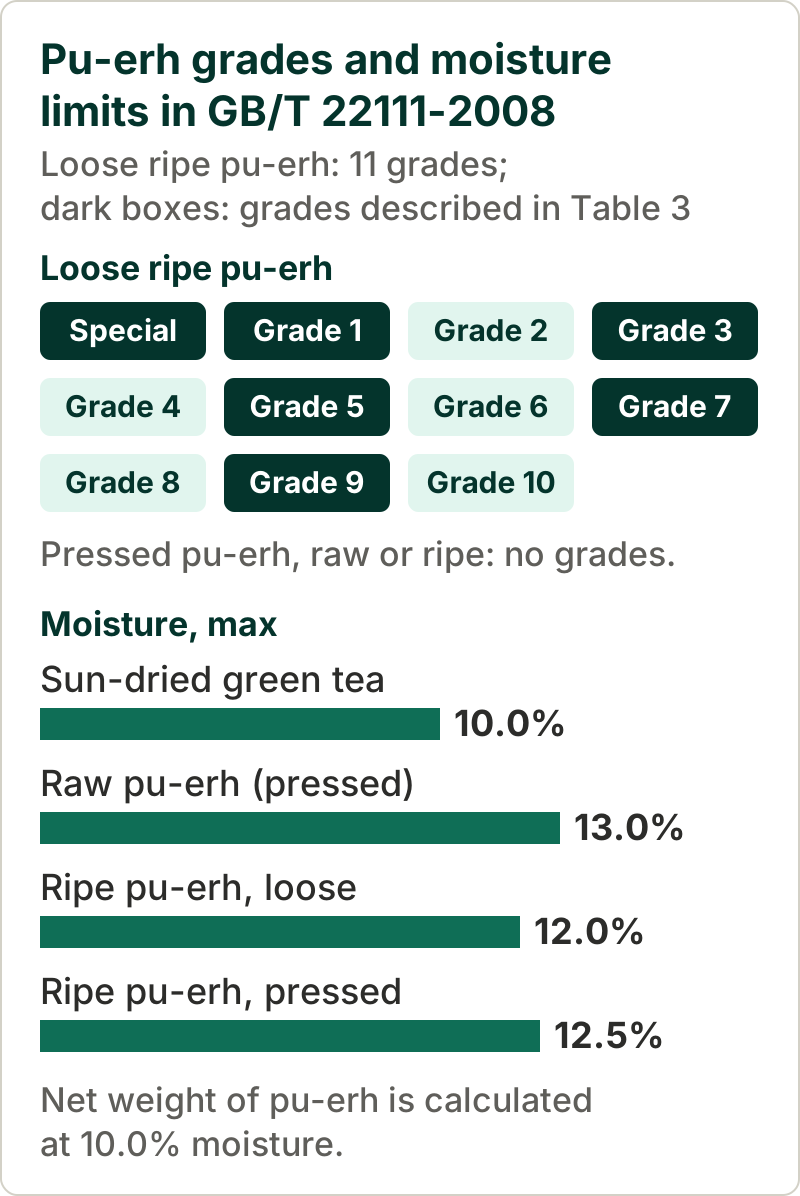 Source: China’s national standard GB/T 22111-2008, clause 5 and Tables 3 to 6 (2008)
Polyphenols run the other way for the two types: raw pu-erh needs at least 28.0%, ripe pu-erh may hold no more than 15.0%. ISO 20715 describes post-fermentation as a stage that allows microbial activity and promotes the polymerisation of polyphenols. For raw and ripe pu-erh, net weight is calculated at a moisture of 10.0% (计重水分).
Raw pu-erh changes in storage. The standard notes that, kept as it prescribes, raw pu-erh moves towards pressed ripe pu-erh in sensory quality and chemistry, so its sensory description and its 28.0% polyphenol minimum apply only at factory release (clause 8.4.2.3). Moisture is tested by GB/T 8304, total ash by GB/T 8306, dust by GB/T 8311, water extract by GB/T 8305, crude fibre by GB/T 8310 and polyphenols by GB/T 8313. GB/T 8304 and GB/T 8306 were withdrawn on 2 March 2017; the current methods are GB 5009.3-2016 for moisture and GB 5009.4-2016 for ash. Each batch is released after checks of sensory quality, moisture, polyphenols and net content, plus dust for loose tea and ash for pressed tea, and a type inspection of every requirement is due every six months.
Safety limits in the standard
Table 7 of the standard adds safety limits for sun-dried green tea and pu-erh: lead at 5.0 mg/kg, rare earths at 2.0 mg/kg, 13 pesticides at 0.1 to 20 mg/kg, coliforms at 300 MPN per 100 g, and no Salmonella, Shigella, Staphylococcus aureus or haemolytic streptococci. Other safety indicators follow China’s national rules. These are Chinese limits of 2008: a buyer abroad applies the destination’s own, such as the EU’s maximum residue levels for tea, with a test report per lot.
Labels, packing and long-term storage
The pack must state 普洱茶(生茶) or 普洱茶(熟茶), and colour may tell them apart, for example green for raw and brown for ripe. The label also shows the net content, the maker’s name and address, the production date, the storage period (保存期), the storage conditions, the grade and the standard number. Packing must be sturdy, clean and moisture-proof, fit for long-distance transport and in line with China’s commerce standards SB/T 10035 and SB/T 10036. In transit, the tea must be protected from rain, damp and sun and kept apart from toxic, harmful or odorous goods; in store, it needs clean, ventilated, dark, dry and odour-free warehouses.
On storage time, the standard says only that pu-erh is suitable for long-term storage (适宜长期保存) under these conditions. China’s revised labelling standard for prepackaged food, GB 7718-2025, applies from 16 March 2027 and requires an expiry date (保质期到期日), but the official questions and answers of the National Health Commission (September 2025) and of the market regulator, SAMR (August 2026), let pu-erh and dark tea that keep under suitable storage give that date as “long-term storage” (长期保存), provided their safety and quality stay stable and within their standards under the storage conditions on the label; our guide to tea labelling requirements covers the rules.
Pu’er Cha, a protected name in China and the EU
China has protected pu-erh as a geographical indication since 13 May 2008, under notice No. 60 of 2008 of its former quality inspection administration (AQSIQ), and the geographical-indication portal of China’s Ministry of Commerce (MOFCOM) lists the name as a certification mark (证明商标) as well. The protected area is made up of 639 townships in 75 counties of 11 prefectures and cities of Yunnan: Pu’er, Xishuangbanna, Lincang, Kunming, Dali, Baoshan, Dehong, Chuxiong, Honghe, Yuxi and Wenshan (Annex A of the standard). The standard places the part of Yunnan suited to pu-erh between 21°10′ and 26°22′ N and between 97°31′ and 105°38′ E, with tea gardens mainly at 1,000 to 2,100 m, on slopes of 25° or less.
In the EU, Pu’er Cha has been protected since 1 March 2021, when the EU–China agreement on geographical indications, signed on 14 September 2020, entered into force; it is No. 7 of the 100 Chinese names on the agreement’s Annex III. The specification filed with the EU, whose applicant is the People’s Government of Yunnan Province, repeats the standard’s types, ripe-tea grades and limits, and names the Yunnan Provincial Bureau of Quality and Technical Supervision as the control body.
Pu-erh in China’s tariff and export statistics
China’s tariff gives ripe pu-erh its own lines: 0902.3031 for immediate packings of 3 kg or less and 0902.4031 for larger ones, next to other dark tea (0902.3039 and 0902.4039). All four sit under the HS subheadings for black and partly fermented tea, 0902.30 and 0902.40. The lines appear in the 2021 tariff, MOFCOM still listed them in its December 2024 report, and the tariff adjustment tables for 2023 to 2026 did not change them (checked October 2026). Raw pu-erh has no line of its own; our guide to tea HS codes explains the structure. The HS 2028 text, in force from 1 January 2028, names dark tea as a fermented tea under the same two subheadings.
China exported 1,401 tonnes of ripe pu-erh in 2025, 0.33% of its tea export volume and 44 tonnes (3.02%) less than in 2024, according to the China Tea Marketing Association (CTMA), which draws on customs data; it imported 1.4 tonnes. Other dark tea added 472 tonnes of exports. MOFCOM counts the two ripe pu-erh lines in its “speciality tea” group, and the six-digit figures China reports to UN Comtrade mix ripe pu-erh with black tea and oolong, so neither series shows pu-erh alone. The sources reviewed give no destinations for Chinese pu-erh; the wider picture is in China’s tea exports in 2025.
Exports are small next to output. Dark tea made up 12.26% of China’s 3.64 million tonnes of crude tea in 2025, or 446,500 tonnes (CTMA), against 1,873 tonnes of ripe pu-erh and other dark tea exported. The sources give no output figure for pu-erh alone.
What to put in a pu-erh purchase specification
- Type and form: 普洱茶(生茶) or 普洱茶(熟茶), loose or pressed, and for pressed tea the shape and unit weight.
- Grade and reference: for loose ripe pu-erh, the grade (特级, or 一级 to 十级), GB/T 22111-2008 and the number of the sealed contract sample. Pressed pu-erh has no grade, so the sealed sample is the only reference.
- Limits: moisture ≤13.0% for raw, ≤12.0% for loose ripe or ≤12.5% for pressed ripe pu-erh (GB 5009.3-2016; the standard cites GB/T 8304, withdrawn in 2017); total ash ≤7.5%, ≤8.0% or ≤8.5% (GB 5009.4-2016; the standard cites GB/T 8306, withdrawn in 2017); dust ≤0.8% for loose ripe pu-erh (GB/T 8311); polyphenols ≥28.0% for raw pu-erh at release or ≤15.0% for ripe (GB/T 8313).
- Net weight: calculated at the standard’s 10.0% moisture.
- Origin: grown and processed within the protected area, as GB/T 22111-2008 requires.
- Year and storage: the production date and storage record behind any year printed on a cake or any “aged” claim.
- Customs line: 0902.3031 or 0902.4031 at Chinese export for ripe pu-erh, by the net weight of each immediate packing; agree the line for raw pu-erh with the buyer and the customs broker.
- Residues and microbiology: the destination’s limits, with a test report per lot. For the EU, contaminant limits are set out in our guide to EU contaminant limits for tea.
- Disputes: a retained sample. The standard allows a retest of it, or of a double sample from the same lot, but not for tea that has spoiled, is contaminated or smells off, nor after a failed safety limit.
How to compare pu-erh samples
The standard’s evaluation methods (Annexes B and C) brew 5 g of tea in a 250 mL standard cup filled with boiling water for 5 minutes, then judge liquor colour, aroma, taste and infused leaf, with aroma and taste weighing most. For loose ripe pu-erh, 150 g to 200 g is spread on a tray and compared with the reference sample of its grade. A deep red, bright liquor is good and a dark or cloudy one poor. A sour note, heavy bitterness or astringency counts against the tea, and off or strange flavours mark it as substandard. An infused leaf that is mottled, dull, charred or mushy like mud is poor.
Questions and answers
What are the grades of pu-erh tea?
China's standard GB/T 22111-2008 grades only loose ripe pu-erh: special grade (特级), then grades 1 to 10, 11 grades in all. Its sensory table describes the special grade and grades 1, 3, 5, 7 and 9. Pressed pu-erh, raw or ripe, has no grades.
What is the difference between raw and ripe pu-erh?
Both start as sun-dried green tea from Yunnan large-leaf bushes. Raw pu-erh (生茶) is refined and steam-pressed, while ripe pu-erh (熟茶) goes through post-fermentation, a microbial stage. Under GB/T 22111-2008, raw pu-erh needs at least 28.0% tea polyphenols and ripe pu-erh may hold no more than 15.0%.
Are pu-erh cakes graded?
No. GB/T 22111-2008 sets no grades and no physical reference sample for pressed pu-erh, raw or ripe, whether it comes as round cakes, bowl shapes, squares or columns. Each type has one sensory description and one set of limits.
What moisture content should pu-erh have?
No more than 13.0% for raw pu-erh, 12.0% for loose ripe and 12.5% for pressed ripe pu-erh under GB/T 22111-2008, tested by method GB/T 8304 (withdrawn in 2017; now GB 5009.3-2016), with net weight calculated at 10.0% moisture. Sun-dried green tea, the raw material, is capped at 10.0%.
Is pu-erh a protected geographical indication?
Yes. China has protected pu-erh (普洱茶) since 13 May 2008, for 639 townships in 75 counties of 11 prefectures and cities of Yunnan, among them Pu'er, Xishuangbanna and Lincang. The EU has protected Pu'er Cha since 1 March 2021, as No. 7 on Annex III of the EU–China agreement.
What is the HS code for pu-erh tea?
China classifies ripe pu-erh under HS 0902.30 for immediate packings of 3 kg or less and under 0902.40 otherwise, with its own tariff lines, 0902.3031 and 0902.4031. Raw pu-erh has no line of its own.
Sources
- 1. National public service platform for standards information: GB/T 22111-2008 Product of geographical indication, Puer tea, record and 2025 review (in Chinese) · std.samr.gov.cn
- 2. GB/T 22111-2008 Product of geographical indication, Puer tea, full text in China's official standards reading system (in Chinese) · openstd.samr.gov.cn
- 3. European Commission GI register (eAmbrosia): technical specification of the geographical indication Pu'er Cha · ec.europa.eu
- 4. EUR-Lex: Agreement between the European Union and the Government of the People's Republic of China on cooperation on, and protection of, geographical indications, OJ L 408I, 4 December 2020 (Annex III, entry 7) · eur-lex.europa.eu
- 5. MOFCOM intellectual property portal: Chinese tea names on Annex III of the China–EU agreement on geographical indications (in Chinese) · ipr.mofcom.gov.cn
- 6. MOFCOM intellectual property portal: the China–EU agreement on geographical indications, signature, entry into force and the two lists (in Chinese) · ipr.mofcom.gov.cn
- 7. National public service platform for standards information: DB53/103-2006 Puer tea, Yunnan provincial standard, record (in Chinese) · std.samr.gov.cn
- 8. National Health Commission: questions and answers on GB 7718-2025, the national food safety standard for labelling prepackaged food, 25 September 2025 (in Chinese) · nhc.gov.cn
- 9. State Administration for Market Regulation: questions and answers on implementing the Measures for the supervision and administration of food labelling, 28 August 2026 (in Chinese) · samr.gov.cn
- 10. National Health Commission: catalogue of national food safety standards as of September 2025, with replacement dates (in Chinese) · nhc.gov.cn
- 11. State Council Tariff Commission: 2021 agreement tariff rate table (annex 7, with the 8-digit lines of heading 0902, in Chinese) · gss.mof.gov.cn
- 12. MOFCOM: China export monthly statistical report, tea, December 2024, with the code list of each tea group (in Chinese) · wms.mofcom.gov.cn
- 13. China Tea Marketing Association: China's tea imports and exports in 2025, 20 January 2026 (in Chinese) · ctma.com.cn
- 14. China Tea Marketing Association: 2025 tea production and sales analysis, part 1 (association's news-portal account, 9 April 2026, in Chinese) · sohu.com
- 15. World Customs Organization: HS Nomenclature 2022 edition, Chapter 9, coffee, tea, maté and spices · wcoomd.org
- 16. World Customs Organization: amendments to the HS Nomenclature in force from 1 January 2028 (NG0304Ba) · wcoomd.org
- 17. ISO 20715:2023, Tea — Classification of tea types (preview pages) · cdn.standards.iteh.ai
- 18. National Health Commission: catalogue of national food safety standards, including GB 5009.3-2016 and GB 5009.4-2016 (in Chinese) · nhc.gov.cn