Chinese green tea grades: the six parts of GB/T 14456
Chinese green tea grades follow GB/T 14456: six parts, four processing types, grades from special grade down, codes only for gunpowder and mee tea (chunmee).
Key facts
- China's national green tea standard, GB/T 14456, has six parts: basic requirements (2017), large-leaf green tea (2018), and medium and small-leaf green tea, gunpowder, mee tea and steamed green tea (all 2016), all listed as in force on China's standards platform in October 2026.
- Parts 2 to 6 of China's green tea standard GB/T 14456 cap moisture at 7.0% and total ash at 7.5%, except sun-dried large-leaf green tea (晒青), which may hold 9.0% moisture under GB/T 14456.2-2018.
- Under GB/T 14456.3-2016, medium and small-leaf pan-fired green tea, whether long, round or flat, and baked green tea each have six grades, special grade and grades 1 to 5, with dust capped at 1.0% for the top three grades and 1.5% for the rest.
- GB/T 14456.2-2018 grades large-leaf pan-fired and baked green tea from special grade to grade 3 and sun-dried green tea to grade 5, with at most 0.8% dust and at least 36.0% water extract for every type.
- In China's green tea standard GB/T 14456, grades are set in Parts 2 to 6, and only the gunpowder (Part 4) and mee tea (Part 5) parts give them export codes, such as 3505 or 41022; the mee tea part codes all four of its teas, chunmee among them.
Chinese green tea grades are set by GB/T 14456, China’s national green tea standard, in six parts: basic requirements, large-leaf green tea, medium and small-leaf green tea, gunpowder, mee tea (which includes chunmee) and steamed green tea, all listed as in force in October 2026. The standard sorts green tea by processing into pan-fired (炒青), baked (烘青), sun-dried (晒青) and steamed (蒸青) tea, and grades most products from special grade (特级) down to grade 3 or grade 5; of the parts that set grades, only the gunpowder and mee tea parts, which cover chunmee, give them export codes. Parts 2 to 6 cap moisture at 7.0%, or 9.0% for sun-dried large-leaf tea, and total ash at 7.5%.
GB/T 14456: the six parts of China’s green tea standard
GB/T 14456 began as a single green tea standard, GB/T 14456-1993, which Part 1 replaced in 2008, when Part 2 was also issued; Parts 3 to 6 followed in 2016. Part 1 sets basic requirements for green tea, Parts 2 and 3 grade green tea by the leaf size of the tea variety, and Parts 4 to 6 cover three products: gunpowder, mee tea and steamed green tea. All six are recommended national standards (推荐性, the “T” in GB/T) rather than mandatory ones, so a contract should name the part, the year and the grade it relies on.
GB/T 14456, green tea: the six parts (official records, checked 14 October 2026)
| Part | Title | Edition in force (since) | Products | Grades |
|---|---|---|---|---|
| 1 | Basic requirements (基本要求) | GB/T 14456.1-2017 (1 February 2018) | Green tea in general: Parts 2 to 6 require it | Set in Parts 2 to 6 |
| 2 | Large-leaf green tea (大叶种绿茶) | GB/T 14456.2-2018 (1 June 2018) | Steamed, pan-fired, baked, sun-dried | Special grade to grade 3; sun-dried to grade 5 |
| 3 | Medium and small-leaf green tea (中小叶种绿茶) | GB/T 14456.3-2016 (1 January 2017) | Pan-fired (long, round, flat), baked | Special grade, grades 1 to 5 |
| 4 | Gunpowder (珠茶) | GB/T 14456.4-2016 (1 January 2017) | Gunpowder | 3505, 9372 to 9375 |
| 5 | Mee tea (眉茶) | GB/T 14456.5-2016 (1 January 2017) | Chunmee (zhenmei), yucha, xiumei, gongxi | Chunmee: 41022, 9371 to 9366 |
| 6 | Steamed green tea (蒸青茶) | GB/T 14456.6-2016 (1 January 2017) | Steamed green tea | Special grade, grades 1 to 5, flake tea |
Part 1 is a modified adoption of the international standard ISO 11287:2011, which defines green tea and its basic requirements; because of the ISO copyright, the official online reader does not show its text, and this guide does not quote its limits. Each part was reviewed on 24 March 2021 with the conclusion that it should be revised, but on 14 October 2026 China’s national standards platform still listed all six editions as in force, its database of standard plans showed no plan to revise them, and no new edition had been published. Official English versions of Parts 4, 5 and 6 were published on 31 December 2021, and of Parts 2 and 3 on 28 December 2022; none is listed for the current Part 1.
Pan-fired, baked, sun-dried and steamed: the four processing types
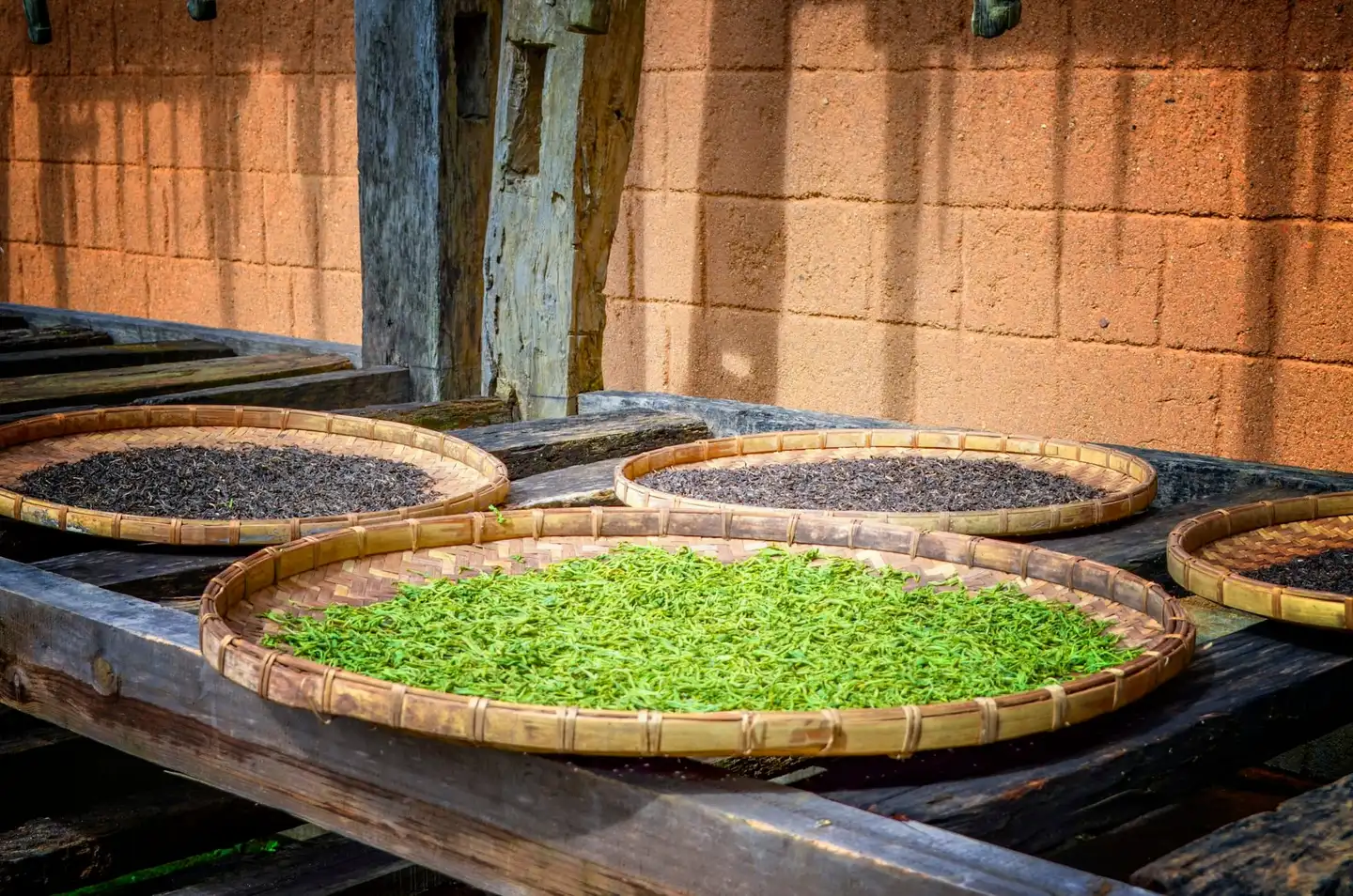
Part 2 divides large-leaf green tea by processing into pan-fired (炒青, chaoqing), baked (烘青, hongqing), steamed (蒸青, zhengqing) and sun-dried (晒青, shaiqing) green tea. Three of the names describe how the leaf is dried, the fourth how it is fixed (杀青), the step that heats the fresh leaf. It defines all four:
- Pan-fired (炒青): fresh leaf fixed at high temperature in a pan or a drum, rolled, part-baked, then dried in a pan (炒干), and sieved, sorted and blended.
- Baked (烘青): fixed in the same way and rolled, then dried entirely by baking (全烘干燥).
- Sun-dried (晒青): fixed in a hot pan, rolled and dried in the sun.
- Steamed (蒸青): fixed with steam, then part-baked, rolled and dried, and finished by frying in a rotating drum (滚炒) and sieving.
Part 3 defines pan-fired and baked tea by the same difference in drying, and Part 6 defines steamed green tea as tea fixed with steam, then rolled, dried and shaped. The official English terms are not consistent: Part 2 calls 炒青 “pan-fried” and 烘青 “roasted” green tea, while Part 3 calls them “roasting” and “baked” green tea. Writing the Chinese term on a contract avoids the confusion.
In Part 2 the processing type changes one limit only: sun-dried green tea may hold up to 9.0% moisture, against 7.0% for the other three types. Sun-dried tea from Yunnan’s large-leaf varieties is also the raw material of pu-erh, and the pu-erh standard, GB/T 22111-2008, sets its own 10.0% moisture limit for that sun-dried tea. China’s jasmine tea standard, GB/T 22292-2017, likewise sorts jasmine tea by its base tea: baked, pan-fired, broken or flake.
Large-leaf green tea grades (GB/T 14456.2-2018)
Part 2 covers green tea made from large-leaf tea varieties (大叶种, “dayezhong” in its English title) by spreading, fixing, rolling, drying and shaping. It grades each processing type separately:
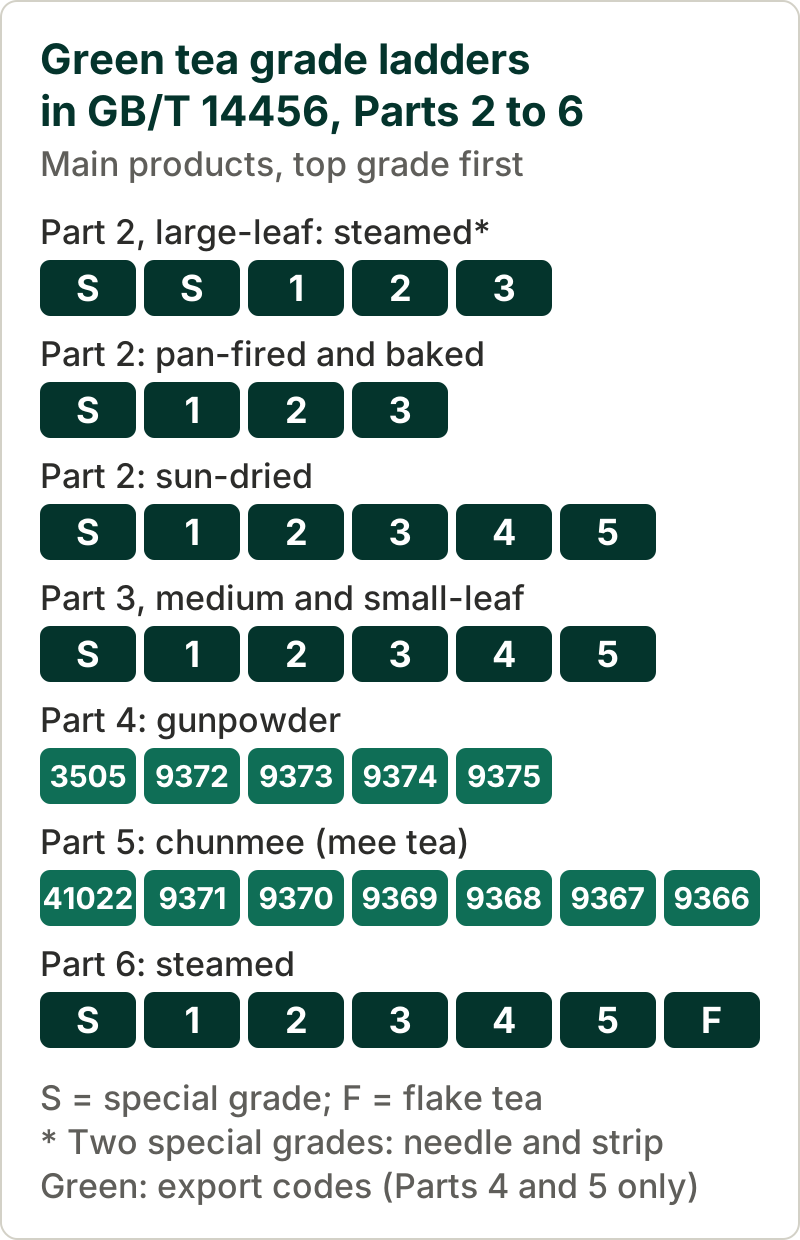
- Steamed: a special grade in two shapes, needle (针形) and strip (条形), then grades 1 to 3.
- Pan-fired and baked: special grade, then grades 1 to 3.
- Sun-dried: special grade, then grades 1 to 5.
The standard describes the special grades of pan-fired, baked and sun-dried tea as plump and tender (肥嫩), and the baked, sun-dried and needle-shaped steamed special grades as showing white down (白毫显露). Down each ladder the leaf turns coarser and less even, stalks and coarse leaf or flakes appear, and the glossy colour gives way to a mottled, yellowish or brownish one. Each grade has a physical reference sample that marks its lower limit of quality, renewed every three years.
The 2018 edition replaced that of 2008, which split pan-fired, baked and sun-dried tea into crude tea (毛茶) and refined tea (精制茶). It dropped that split, replaced the old limit on broken tea and dust (碎末茶) with a dust limit, and added tea polyphenols and catechins. Its physical and chemical limits are the same for all four types, apart from moisture: at most 0.8% dust, the lowest dust limit in Parts 2 to 6, and at least 36.0% water extract. Polyphenols (at least 16.0%) and catechins (at least 11.0%) are reference values only.
Medium and small-leaf green tea grades (GB/T 14456.3-2016)
Part 3 covers green tea from medium and small-leaf varieties: pan-fired tea, which it splits by shape into long (长炒青), round (圆炒青) and flat (扁炒青) tea, and baked tea. Each of the four products has six grades, special grade and grades 1 to 5, and each grade a physical reference sample marking its lower limit of quality, renewed every four years rather than three.
Medium and small-leaf green tea: special grade against grade 5, dry leaf (GB/T 14456.3-2016, Tables 1 to 4)
| Product | Special grade (特级) | Grade 5 (五级) |
|---|---|---|
| Long pan-fired (长炒青) | Tight, fine, showing tips; green, glossy; a few tender stems | Coarse, loose; greenish yellow, dull; yellow coarse leaf, stalks and flakes |
| Round pan-fired (圆炒青) | Fine, round, heavy; deep green, glossy; clean | Coarse, flattened; greenish yellow, slightly dull; coarse lumps |
| Flat pan-fired (扁炒青) | Flat, straight, smooth; green, glossy; very clean | Fairly flat, slightly coarse and loose; greenish yellow, slightly dull; yellow coarse flakes |
| Baked (烘青) | Fine, tight, showing tips; green, glossy; a few tender stems | Coarse, loose; yellow, slightly dull; many stalks, coarse leaves and flakes |
In the cup, the special grades taste fresh and mellow, or strong and full for round tea, and grade 5 tastes coarse and thin, slightly less so for flat tea. Dust is capped at 1.0% from special grade to grade 2 and at 1.5% for grades 3 to 5, and water extract must reach 36.0% and 34.0% respectively. Unlike Part 2, Part 3 sets its minimum tea polyphenols (13%) and catechins (8%) as requirements, not reference values.
Where gunpowder and chunmee fit: Parts 4 and 5
Gunpowder and chunmee are refined teas. Part 4 defines gunpowder (珠茶) as refined from round pan-fired green tea (圆炒青), and Part 5 defines mee tea (眉茶) as refined from long pan-fired green tea (长炒青), two of the shapes that Part 3 also grades as finished products; both parts require that raw tea to meet Part 1. Of the parts that set grades, they are the only ones that attach an export code to each grade, “according to processing and export needs”. Gunpowder has five grades, from special grade 3505 down to 9375. Part 5 divides mee tea into four products, chunmee (珍眉, zhenmei), yucha (雨茶), xiumei (秀眉) and gongxi (贡熙), and codes every grade of each; chunmee’s seven grades run from 41022 to 9366. The codes, the sensory tables and the labels sellers add, such as “AAA”, are explained in our guides to gunpowder tea grades and chunmee tea grades.
The gunpowder part also allows glutinous rice paste (糯米糊) to be added during shaping, by tradition.
 Source: China’s national standards GB/T 14456.2-2018, GB/T 14456.3-2016, GB/T 14456.4-2016, GB/T 14456.5-2016 and GB/T 14456.6-2016
Steamed green tea grades (GB/T 14456.6-2016)
Part 6 defines steamed green tea (蒸青茶) as tea made from fresh leaf and tender stems by steam fixing, rolling, drying and shaping, and grades it from special grade to grade 5, followed by flake tea (片茶). The special grade is tight and straight, green and glossy, with a clean fragrance and a fresh, mellow taste. Grade 5 is fairly coarse and loose, dull and dark, with broken pieces, and flake tea is made of leaf flakes with fine veins that give a thin, astringent cup.
Instead of a dust limit, Part 6 caps broken tea and dust together: 3.0% from special grade to grade 2 and 6.0% for grades 3 to 5, with no limit for flake tea. Water extract must reach 36.0%, 34.0% and 32.0% in those three bands, tea polyphenols 14%, 12% and 11%, and catechins 9%, 8% and 7%. Part 6 sets no physical reference sample. Part 2 also grades steamed green tea made from large-leaf varieties, on its own ladder.
Physical and chemical limits compared across the parts
Physical and chemical limits in GB/T 14456 (% by mass; sources: Parts 2 to 6 in the official online reader, checked October 2026)
| Part and product | Grades | Dust, max | Water extract, min | Tea polyphenols, min | Catechins, min |
|---|---|---|---|---|---|
| 2, large-leaf, all four types | all | 0.8 | 36.0 | 16.0 (reference) | 11.0 (reference) |
| 3, medium and small-leaf | special grade to grade 2 | 1.0 | 36.0 | 13 | 8 |
| 3, medium and small-leaf | grades 3 to 5 | 1.5 | 34.0 | 13 | 8 |
| 4, gunpowder | 3505, 9372, 9373 | 1.0 | 35.0 | 14 | 9 |
| 4, gunpowder | 9374, 9375 | 1.5 | 33.0 | 12 | 8 |
| 5, chunmee (zhenmei) | all seven | 1.0 | 36.0 | 14 | 9 |
| 6, steamed | special grade to grade 2 | 3.0 (broken tea and dust) | 36.0 | 14 | 9 |
| 6, steamed | grades 3 to 5 | 6.0 (broken tea and dust) | 34.0 | 12 | 8 |
| 6, steamed | flake tea | none | 32.0 | 11 | 7 |
Moisture is capped at 7.0% and total ash at 7.5% in every grade of Parts 2 to 6, except sun-dried large-leaf green tea, which may hold 9.0% moisture under Part 2. Crude fibre, acid-insoluble ash and water-soluble ash are reference values in all five parts. In Part 5, the other mee teas follow their own columns: xiumei and gongxi, for example, may hold 1.5% dust with at least 34.0% water extract.
Famous green teas and their own standards
Several famous green teas also have their own national geographical-indication (GI, 地理标志) standard: Longjing, for example, is defined by GB/T 18650-2008. Which green tea names are protected in China and in the EU, and under which standards, is set out in our guide to Chinese green tea geographical indications. For matcha, see our guide to Chinese matcha.
The grade does not change the customs code. In the Harmonized System (2022 edition), green tea falls under subheading 0902.10 in immediate packings of 3 kg or less and under 0902.20 otherwise, whatever its grade; the national lines and the 3 kg test are explained in our guide to HS codes for tea.
What to put in a green tea purchase specification
- Standard and product: the part with its year and the product in Chinese, for example GB/T 14456.3-2016, long pan-fired green tea (长炒青绿茶), grade 2, since the English names vary between parts.
- Grade and sample: a sealed contract sample for the grade. Parts 2 and 3 tie each grade to a physical reference sample marking its lower limit of quality, renewed every three years (Part 2) or four years (Part 3); Parts 4 and 5 renew theirs every three years, and Part 6 sets none.
- Limits: moisture at most 7.0% (9.0% for sun-dried tea) and total ash 7.5%, plus the dust and water-extract values of the part and grade band in the table above.
- Methods: Part 2 tests moisture with China’s food safety method GB 5009.3, while Parts 3 to 6 still cite GB/T 8304, a tea method withdrawn on 2 March 2017 and replaced by GB 5009.3-2016, so name the method you accept. Parts 2 to 6 measure dust, or broken tea and dust, with GB/T 8311.
- Rice paste: if you buy gunpowder, state whether you accept the glutinous rice paste its part allows.
- Release check: Parts 2 to 6 require each batch to pass a factory check of sensory quality, moisture, dust (broken tea and dust in Part 6) and net content before release, and Parts 4 and 6 add total ash; ask for the release certificate or report of each lot.
- Residues: Parts 2 to 6 refer contaminants and pesticide residues to China’s food safety standards GB 2762 and GB 2763; for export, write in the destination’s limits and ask for a test report per lot.
- Disputes: Parts 2 to 6 settle a dispute by retesting the retained sample or a double sample drawn from the same lot.
Questions and answers
What are the grades of Chinese green tea?
China's standard GB/T 14456 grades most products from special grade (特级) down to grade 3 or grade 5, and its steamed green tea part adds flake tea (片茶) below grade 5. Of the parts that set grades, only the gunpowder and mee tea parts, which cover chunmee, give their grades export codes, such as 3505 or 41022.
What is the difference between pan-fired and baked green tea?
The drying. In China's standard GB/T 14456.2-2018, both are fixed in a hot pan or drum and rolled; pan-fired green tea (炒青) is then finished by pan-drying, while baked green tea (烘青) is dried entirely by baking. GB/T 14456.3-2016 defines the two by the same difference.
How much moisture is allowed in Chinese green tea?
At most 7.0% under Parts 2 to 6 of GB/T 14456, except sun-dried large-leaf green tea (晒青), which may hold up to 9.0% under Part 2. The same parts cap total ash at 7.5%.
Is there a Chinese standard for steamed green tea?
Yes. GB/T 14456.6-2016, in force since 1 January 2017, grades steamed green tea (蒸青茶) from special grade to grade 5, followed by flake tea. GB/T 14456.2-2018 grades steamed green tea from large-leaf varieties on its own ladder.
Is GB/T 14456 still in force?
Yes. China's national standards platform listed all six parts as in force on 14 October 2026. Each was reviewed on 24 March 2021 with the conclusion that it should be revised, but no revision plan or new edition had been issued.
Do Chinese green tea grades have export codes?
Only in two of the parts of GB/T 14456 that set grades: the gunpowder part (Part 4), with grades 3505 and 9372 to 9375, and the mee tea part (Part 5), which codes all four of its teas; its chunmee grades run from 41022 to 9366. Parts 2, 3 and 6 name their grades only in words, from special grade (特级) to grade 3 or 5.
Sources
- 1. National public service platform for standards information: GB/T 14456.1-2017 Green tea, Part 1: Basic requirements, record and 2021 review (in Chinese) · std.samr.gov.cn
- 2. National public service platform for standards information: GB/T 14456.2-2018 Green tea, Part 2: Dayezhong green tea, record and 2021 review (in Chinese) · std.samr.gov.cn
- 3. National public service platform for standards information: GB/T 14456.3-2016 Green tea, Part 3: Green tea made from medium and small-leaf varieties, record and 2021 review (in Chinese) · std.samr.gov.cn
- 4. National public service platform for standards information: GB/T 14456.4-2016 Green tea, Part 4: Gunpowder tea, record and 2021 review (in Chinese) · std.samr.gov.cn
- 5. National public service platform for standards information: GB/T 14456.5-2016 Green tea, Part 5: Mee tea, record and 2021 review (in Chinese) · std.samr.gov.cn
- 6. National public service platform for standards information: GB/T 14456.6-2016 Green tea, Part 6: Steamed green tea, record and 2021 review (in Chinese) · std.samr.gov.cn
- 7. National public service platform for standards information: GB/T 14456-1993 Green tea, record of the withdrawn single standard (in Chinese) · std.samr.gov.cn
- 8. National standards full-text system (SAMR): editions of GB/T 14456, with the official online reader of Parts 2 to 6 and their official English versions (in Chinese) · openstd.samr.gov.cn
- 9. National public service platform for standards information: GB/T 8304-2013 Tea, determination of moisture content, withdrawn on 2 March 2017 (in Chinese) · std.samr.gov.cn
- 10. National Health Commission: catalogue of national food safety standards as of September 2025, listing GB 5009.3-2016 for moisture, published 8 January 2026 (in Chinese) · nhc.gov.cn
- 11. National public service platform for standards information: GB/T 18650-2008 Product of geographical indication, Longjing tea, record (in Chinese) · std.samr.gov.cn
- 12. National standards full-text system (SAMR): GB/T 22111-2008 Product of geographical indication, Puer tea (in Chinese) · openstd.samr.gov.cn
- 13. National standards full-text system (SAMR): GB/T 22292-2017 Jasmine tea (in Chinese) · openstd.samr.gov.cn
- 14. World Customs Organization: HS Nomenclature 2022 edition, Chapter 9, coffee, tea, maté and spices · wcoomd.org