Chinese matcha: GB/T 34778 grades, tests and HS code
Chinese matcha follows GB/T 34778-2017: two grades, D60 ≤ 18 µm, moisture ≤ 6.0%, no additives. By the HS text, plain matcha is green tea, 0902.10 or 0902.20.
Key facts
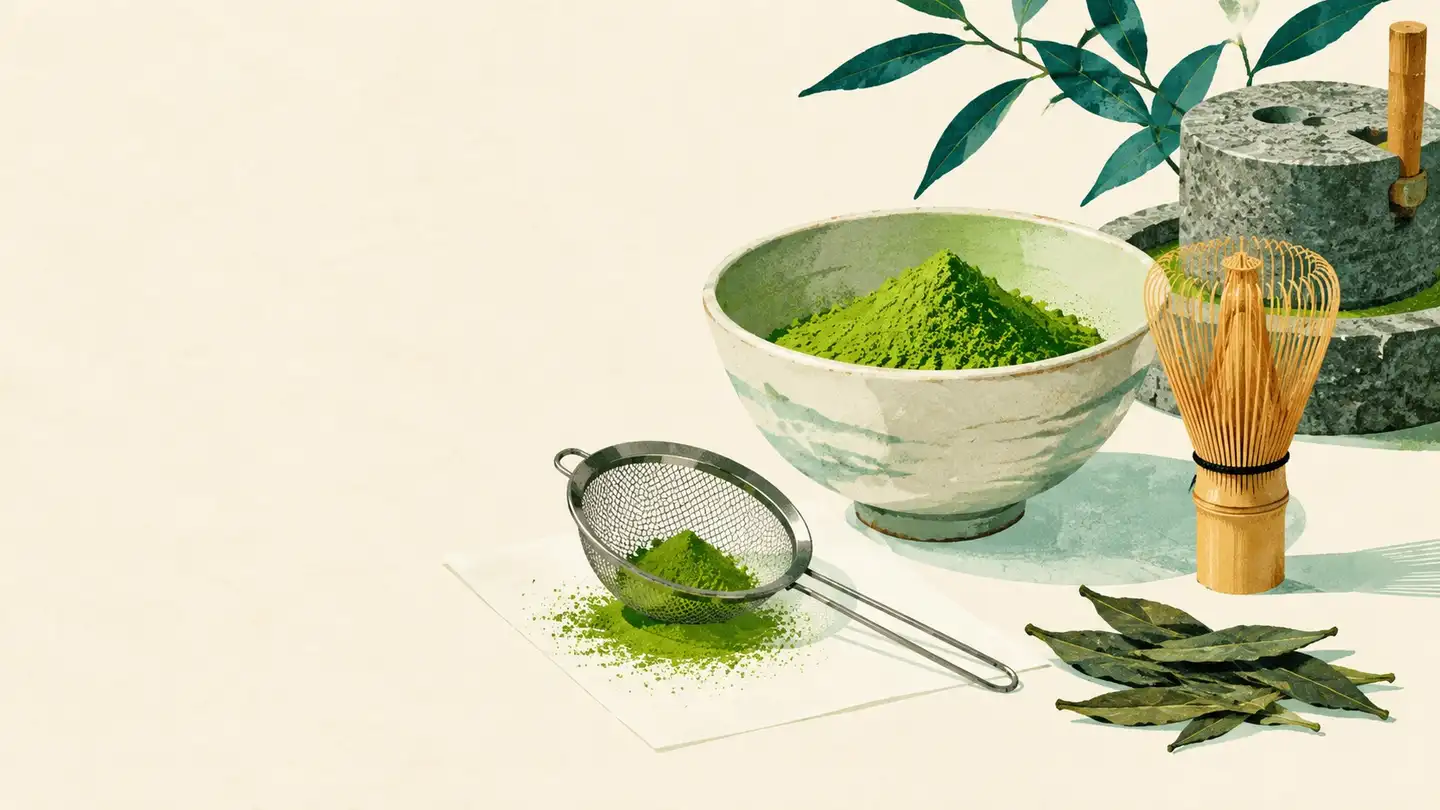
- China's matcha standard, GB/T 34778-2017 (抹茶), in force since 1 May 2018, defines matcha as a micro-powder ground from the dried leaf of shade-grown tea fixed by steam or hot air, and it bars colouring and additives.
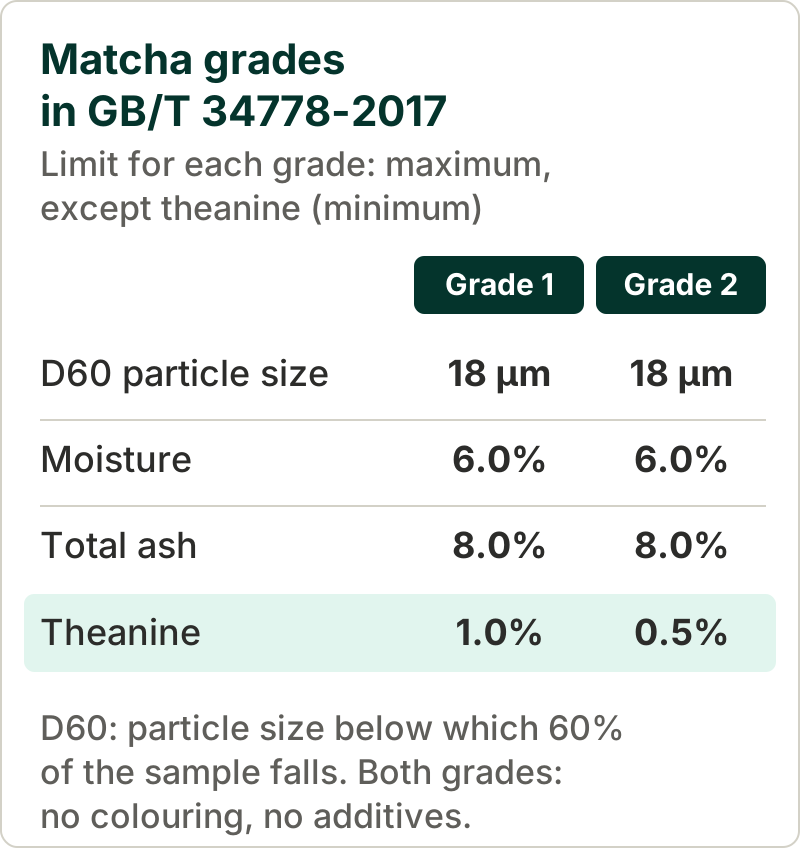
- GB/T 34778-2017 sets two matcha grades with the same limits for particle size (D60 at most 18 µm), moisture (at most 6.0%) and total ash (at most 8.0%); grade 1 needs at least 1.0% theanine and grade 2 at least 0.5%.
- A 2021 review of China's matcha standard GB/T 34778-2017 concluded that it should be revised, and a national code of practice for matcha production and processing, plan 20240352-T-442 of 25 March 2024, was still awaiting approval in October 2026 (China's standards platform).
- Neither the HS nor China's 2026 tariff has a line for matcha; by the wording of heading 09.02, plain matcha is green tea, 0902.10 or 0902.20, so China's export statistics cannot isolate it, whereas Japan's export statistics have coded powdered green tea separately since their 2019 edition.
- Guizhou and its city of Tongren (2018, 2020), Zhejiang (2020, 2021), Jiangsu (2020, 2025) and Hubei (2026) have issued local standards for matcha or tencha, according to China's national standards platform (checked October 2026).
Chinese matcha is defined by China’s national standard GB/T 34778-2017, Matcha (抹茶), in force since 1 May 2018: a micro-powder ground from the dried leaf of shade-grown tea that has been fixed by steam or hot air, with no colouring and no additives. The standard sets two grades, grade 1 (一级) and grade 2 (二级), with the same limits for particle size (D60 at most 18 µm), moisture (6.0%) and total ash (8.0%), and different minimums for theanine (1.0% and 0.5%). At the border, neither the HS nor China’s tariff names matcha: by the wording of heading 09.02, plain matcha is green tea, HS 0902.10 or 0902.20, so China’s export statistics cannot single it out (checked October 2026).
What China’s matcha standard GB/T 34778 covers
GB/T 34778-2017 is a recommended national standard (推荐性, the “T” in GB/T), published on 1 November 2017 by the General Administration of Quality Supervision, Inspection and Quarantine (AQSIQ) and the Standardization Administration of China (SAC). It was proposed by the All China Federation of Supply and Marketing Cooperatives and is managed by the national technical committee for tea standardisation (SAC/TC 339). It covers terms and definitions, requirements, test methods, inspection rules, marking, labelling, packaging, transport and storage. A review on 19 May 2021 concluded that it should be revised, but in October 2026 the 2017 edition was still in force, with no successor.
The definition (clause 3.1) has four elements: tea plants grown under cover (覆盖栽培), fresh leaf fixed (杀青) by steam or hot air, the dried leaf as raw material, and grinding (研磨) into a micro-powdered tea product. The standard also defines the “aroma of shaded tea” (覆盖香): the fresh, delicate aroma, sometimes with a note of nori seaweed (海苔), that is peculiar to matcha made from shaded tea plants (clause 3.2).
Two basic requirements apply to both grades: the product must have the quality characteristics of matcha and contain no non-tea substance, and it must be free of colouring and of any additive (clause 4.1). Contaminants and pesticide residues must meet China’s food safety standards GB 2762 and GB 2763.
Matcha grades in GB/T 34778: grade 1 and grade 2
The official text sets two grades, grade 1 (一级) and grade 2 (二级), and no special grade (特级). They differ in the five sensory factors and in theanine; the limits for particle size, moisture and ash are the same.
Matcha grades in GB/T 34778-2017 (Tables 1 and 2; English renderings: The Tea Trade)
| Requirement | Grade 1 (一级) | Grade 2 (二级) |
|---|---|---|
| Colour of the powder | bright fresh green (鲜绿明亮) | bright emerald green (翠绿明亮) |
| Particles | soft, fine and even (柔软细腻均匀) | fine and even (细腻均匀) |
| Aroma | pronounced aroma of shaded tea (覆盖香显著) | distinct aroma of shaded tea (覆盖香明显) |
| Liquor colour | deep green (浓绿) | green (绿) |
| Taste | fresh, mellow and strong (鲜醇味浓) | pure and strong (纯正味浓) |
| Particle size D60, max | 18 µm | 18 µm |
| Moisture, max | 6.0% | 6.0% |
| Total ash, max | 8.0% | 8.0% |
| Total theanine, min | 1.0% | 0.5% |
 Source: China’s national standard GB/T 34778-2017, Tables 1 and 2 (2017)
D60 is the particle size below which 60% of the sample falls (note to Table 2). The laser method of Annex B also reports D90 and D95, but the standard sets a limit for D60 only. It sets none for tea polyphenols or caffeine. Labels such as “ceremonial grade” or “culinary grade” do not appear in it, so a contract that uses them should also name the GB/T 34778 grade and the agreed sample.
How matcha is tested: particle size, theanine and the cup
Test methods in GB/T 34778-2017 (chapter 5 and Annexes A and B)
| Item | Method |
|---|---|
| Sensory quality | Annex A: dry powder, then whisked liquor |
| Particle size (D60) | Annex B: laser particle size analyser |
| Moisture | GB/T 8304 (repealed in 2017) |
| Total ash | GB/T 8306 (repealed in 2017) |
| Total theanine | GB/T 23193, by liquid chromatography (HPLC) |
| Contaminants, pesticide residues | methods of GB 2762 and GB 2763 |
| Net content | JJF 1070 |
The moisture and ash methods it names, GB/T 8304-2013 and GB/T 8306-2013, were repealed on 2 March 2017, before the matcha standard was published; China’s standards platform names no successor (checked October 2026).
Annex A judges 5 to 10 g of dry powder on a black tin-plate tray 25 to 28 cm across, for colour, fineness and smell. For the liquor, 2 g are whisked with 60 mL of water at 70–80 °C in a white porcelain bowl of 200 mL, using a tea whisk (茶筅); the taster smells the bowl, judges the colour before the powder settles, whisks again and tastes. Each of the five factors is scored against the physical reference sample (实物标准样) on a seven-step scale from +3 to −3. A sample fails if any factor scores −3, or if the five scores add up to −3 or less.
Annex B measures particle size by laser diffraction, using Mie scattering, with a particle refractive index of 1.53 and an absorption of 0.01. A sample of 0.5 g to 1.00 g is dispersed with one minute of ultrasound, measured five times, and the five results must have a coefficient of variation below 3%.
Inspection works by lot. Before release, every lot is checked for sensory quality, moisture and net content, and only lots that pass and carry a certificate of conformity may leave the factory. A type inspection, which covers every requirement including particle size and theanine, is due when a contract or a customer requires it, when production restarts after a stop of six months or more, or when a state quality supervision body asks for it. Any failed requirement makes the product non-conforming. In a dispute, the retained sample is retested, or a double sample is drawn from the same lot under GB/T 8302.
Tencha and the newer matcha standards
GB/T 34778-2017 is a product standard: it says what the powder must be, not how to grow or make it. A national code of practice for matcha production and processing (抹茶生产加工技术规程), plan 20240352-T-442 of 25 March 2024 with an 18-month schedule, was still awaiting approval in October 2026; it is to apply six months after publication.
Chinese standards for matcha and tencha (status on China’s standards platform, 14 October 2026; titles translated by The Tea Trade)
| Standard | Subject | Issued by | Status |
|---|---|---|---|
| GB/T 34778-2017 | Matcha | national | in force since 1 May 2018 |
| 20240352-T-442 (plan) | Matcha production and processing | national | awaiting approval |
| DB52/T 1358-2018 | Guizhou matcha | Guizhou | in force since 1 January 2019 |
| DB5206/T 126 to 129-2020 | Fanjing matcha: building and managing tea gardens, processing, sensory evaluation | Tongren (Guizhou) | in force since 31 January 2021 |
| DB33/T 2276-2020 | Matcha processing | Zhejiang | repealed on 21 October 2025 |
| DB33/T 2279-2020 | Matcha sensory evaluation | Zhejiang | in force since 28 November 2020 |
| DB33/T 2339-2021 | Green production in matcha tea gardens | Zhejiang | in force since 6 June 2021 |
| DB32/T 3862-2020 | Growing tea plants for matcha | Jiangsu | in force since 13 November 2020 |
| DB32/T 5298-2025 | Tencha processing | Jiangsu | in force since 30 January 2026 |
| DB42/T 2506-2026 | Matcha production and processing | Hubei | in force since 13 April 2026 |
Tencha (碾茶) is the leaf that is ground into matcha: a People’s Daily report from a Guizhou plant in February 2025 describes ball mills grinding tencha into fine matcha powder. Of the standards in the table, only Jiangsu’s 2025 code has the word in its title; GB/T 34778-2017 never uses it. The national standard allows fixing by steam or hot air: at a matcha seminar in Beijing on 11 September 2025, one speaker described Japanese tencha processing (shading, steam fixing, stem separation) and another presented “high-shed covering plus hot-air fixing” among Chinese tencha innovations (website of the Ministry of Agriculture and Rural Affairs, MARA). Matcha has a standard of its own, separate from GB/T 14456, the six-part green tea standard explained in our guide to Chinese green tea grades.
Where Chinese matcha is made
China’s official statistics do not count matcha output separately. Tea output is reported as dried crude tea (干毛茶) in the six types plus “other tea”, with steamed, pan-fired, baked and sun-dried tea all counted as green tea, and there is no line for tencha or matcha (National Bureau of Statistics reporting system, as printed by Zhejiang for 2024 and 2025). Published totals disagree: an industry forecast reported on MARA’s website in September 2025 put China’s 2025 matcha output above 5,000 tonnes, while a 2026 report of the China Tea Marketing Association (CTMA), as quoted by People’s Daily in June 2026 and China Daily in August 2026, put it above 12,000 tonnes. None of these texts says how the figures were compiled.
Official texts name these producing areas:
- Guizhou. The province’s Tea Industry Development Regulations, in force since 1 February 2021, name Guizhou matcha (贵州抹茶), with Guizhou green, black and dark tea, among the public tea brands (公用品牌) to focus on (Article 28). Guizhou’s own matcha standard dates from 2018, and Tongren city has four standards for its regional name, Fanjing matcha (梵净抹茶). A report on MARA’s website calls Jiangkou county the main producing area of Tongren matcha; the county hosted the sixth Tea Industry Conference on 8 May 2025, under a matcha theme. According to People’s Daily (February 2025), Guizhou’s tea industry plan for 2021–2025 placed Tongren in an export processing belt for quality green tea and matcha.
- Zhejiang. Its matcha standards date from 2020 and 2021. A CCTV report carried by Xinhua (August 2025) describes Jingshan, in Hangzhou, as one of China’s main matcha producing areas. The drafting group of the national processing code includes the agricultural extension services of Zhejiang province and of Hangzhou’s Yuhang district, and the agriculture bureau of Wuyi county.
- Jiangsu and Hubei. Both have issued matcha or tencha standards since 2020 (table above).
HS code for matcha: 0902.10, 0902.20 or 2101.20
Neither the HS nor China’s tariff names matcha. Heading 09.02, “Tea, whether or not flavoured”, covers “the different varieties of tea derived from the plants of the botanical genus Thea (Camellia)”, in the words of the WCO’s Explanatory Note quoted in a 2021 US ruling, and matcha is ground tea leaf, not an extract. Plain matcha is therefore declared as green tea: 0902.10 when each immediate packing holds 3 kg or less, 0902.20 otherwise. Japan’s export statistical schedule, the only official nomenclature found that names powdered green tea, places it in those subheadings, as codes 0902.10-100 and 0902.20-100, “powdered” (粉末状のもの), since its 2019 edition.
China’s tariff, unchanged for tea since 2023, has four green tea lines on each side of 3 kg: jasmine tea, other scented tea, white tea and other green tea. Plain matcha can only be other green tea, 0902.1090 in inner packings of 3 kg or less net or 0902.2090 above. The packing rules behind that split are set out in our guide to HS codes for tea.
No US customs ruling found classifies plain matcha: in 2003 US customs declined to classify one without knowing how it would be packed (ruling K81317). The rulings found on matcha products concern mixes and other foods, none in heading 09.02, for example:
- N340633 (9 July 2024): dried matcha latte mixes of 86.9% to 88% organic cane sugar and 8.2% to 9% matcha went to 2101.20, preparations with a basis of tea;
- N335577 (10 October 2023): a sugar-free mix of 89.7% erythritol, 10.0% matcha and 0.3% monk fruit extract went to 2101.20 as well.
Instant green tea powder, which is a dried extract rather than ground leaf, also goes to 2101.20 (ruling E87596, 1999).
The EU’s increased checks on tea from China list CN code 0902, the whole heading, in Annex I to Implementing Regulation (EU) 2019/1793, with identity and physical checks on 20% of consignments (consolidated version of 30 June 2026, still the latest on 14 October 2026). Matcha declared as green tea falls under that entry, and it must meet EU residue limits rather than China’s GB 2763, as our guide to EU pesticide limits for tea explains.
What China’s export statistics can and cannot show
China’s export statistics follow the tariff, so matcha disappears into other green tea. The code list printed in the monthly tea report of China’s Ministry of Commerce (MOFCOM) for December 2024 counts green tea as 09021090 and 09022090, the two lines that hold matcha along with every unscented green tea except white tea, from gunpowder to chunmee. MOFCOM’s green tea totals, analysed in our guide to China’s 2025 tea exports, therefore include matcha without showing it. Importers’ figures do not help either: the EU’s Combined Nomenclature for 2026 keeps one code for each green tea subheading, 0902 10 00 and 0902 20 00.
People’s Daily (June 2026) put Zhejiang’s matcha exports at 1,241.97 tonnes in the first quarter of 2026, without saying how they were counted. Japan can count its own trade: a report compiled from Japanese customs data and presented at the September 2025 seminar put Japan’s matcha exports at 5,091.97 tonnes in 2024, up from 2,199.72 tonnes in 2019 (MARA website).
What to put in a matcha purchase specification
- Standard and grade: GB/T 34778-2017, grade 1 or grade 2, and the number of the sealed sample agreed in the contract. Annex A scores sensory quality against a physical reference sample, so agree which one applies.
- Particle size: D60 at most 18 µm by the laser method of Annex B. The release check does not cover it, so ask in the contract for a type inspection, which the standard provides for when a contract requires it, or for a laboratory report.
- Theanine, moisture and ash: theanine at least 1.0% (grade 1) or 0.5% (grade 2) by GB/T 23193; moisture at most 6.0% and total ash at most 8.0%, by test methods named in the contract, since GB/T 8304 and GB/T 8306 have been repealed.
- Purity: no colouring and no additives. A blend with sugar or sweetener is outside the standard and, in the US rulings, outside heading 09.02.
- Residues: GB 2763 sets China’s own limits; tea for the EU must meet EU limits.
- Packing, storage and transport: packing to GH/T 1070; storage to China’s tea storage standard, GB/T 30375, in a clean, dry, non-toxic, dedicated cold store with no odours around it; transport protected from damp, rain and sun. Our guide to keeping tea fresh in transit covers the voyage. State the net weight of each immediate packing on the invoice: it decides between 0902.10 and 0902.20.
- Labels: marks to GB/T 191 and labels to China’s prepackaged food standard GB 7718, plus the rules of the destination market.
- Disputes: retesting of the retained sample, or a double sample from the same lot under GB/T 8302.
Questions and answers
Is there a Chinese national standard for matcha?
Yes. GB/T 34778-2017 抹茶 (Matcha), a recommended national standard in force since 1 May 2018, sets the definition, two grades, test methods, inspection rules, labelling, packaging, transport and storage. A 2021 review concluded that it should be revised, but no new edition had been published by October 2026.
What grades of matcha does GB/T 34778 define?
Two: grade 1 (一级) and grade 2 (二级). Both must have a D60 particle size of at most 18 µm, at most 6.0% moisture and at most 8.0% total ash; grade 1 needs at least 1.0% theanine and grade 2 at least 0.5%. Labels such as 'ceremonial' or 'culinary' grade do not appear in the standard.
What is the HS code for matcha?
Neither the HS nor China's tariff has a matcha line, and no customs ruling on plain matcha was found; by the wording of heading 09.02, plain matcha is green tea, HS 0902.10 in immediate packings of 3 kg or less and 0902.20 otherwise. US rulings of 2023 and 2024 put matcha latte mixes, mostly sugar or sweetener, under 2101.20.
What does D60 ≤ 18 µm mean for matcha?
D60 is the particle size below which 60% of the sample falls. GB/T 34778-2017 caps it at 18 µm for both grades, measured with a laser particle size analyser under its Annex B, five times per sample.
Does China's matcha standard mention tencha?
Not by name. GB/T 34778-2017 describes the raw material, the dried leaf of shade-grown tea fixed by steam or hot air, without using the word tencha (碾茶). Jiangsu's local standard DB32/T 5298-2025, in force since 30 January 2026, covers tencha processing.
How much matcha does China export?
China's trade statistics cannot say: matcha has no tariff line and is counted with other green tea, lines 0902.1090 and 0902.2090 of China's tariff. Japan, by contrast, has recorded powdered green tea under export codes of its own since 2019.
Sources
- 1. SAMR national standards full-text system: GB/T 34778-2017 Matcha, official record and online reader (in Chinese) · openstd.samr.gov.cn
- 2. National public service platform for standards information: GB/T 34778-2017 record and 2021 review (in Chinese) · std.samr.gov.cn
- 3. National public service platform for standards information: national standard plan 20240352-T-442, technical code of practice for producing and processing of matcha (in Chinese) · std.samr.gov.cn
- 4. National public service platform for standards information: national and local standards for matcha (抹茶), search results checked 14 October 2026 (in Chinese) · std.samr.gov.cn
- 5. National public service platform for standards information: standards for tencha (碾茶), Jiangsu standard DB32/T 5298-2025 (in Chinese) · std.samr.gov.cn
- 6. National public service platform for standards information: Zhejiang standard DB33/T 2276-2020, matcha processing, repealed on 21 October 2025 (in Chinese) · std.samr.gov.cn
- 7. National public service platform for standards information: Guizhou standard DB52/T 1358-2018, Guizhou matcha (in Chinese) · std.samr.gov.cn
- 8. National public service platform for standards information: GB/T 23193-2017, determination of theanine in tea by HPLC (in Chinese) · std.samr.gov.cn
- 9. National public service platform for standards information: GB/T 30375-2013, tea storage (in Chinese) · std.samr.gov.cn
- 10. National public service platform for standards information: GB/T 8304-2013, tea, determination of moisture content, repealed on 2 March 2017 (in Chinese) · std.samr.gov.cn
- 11. National public service platform for standards information: GB/T 8306-2013, tea, determination of total ash, repealed on 2 March 2017 (in Chinese) · std.samr.gov.cn
- 12. World Customs Organization: HS Nomenclature 2022 edition, Chapter 9, coffee, tea, maté and spices · wcoomd.org
- 13. World Customs Organization: HS Nomenclature 2022 edition, Chapter 21, miscellaneous edible preparations · wcoomd.org
- 14. US Customs and Border Protection: ruling H320527 on rooibos tea, quoting the Explanatory Note to heading 09.02, 12 November 2021 · rulings.cbp.gov
- 15. State Council Tariff Commission: announcement 2025 No. 12 on the 2026 Customs Tariff of the People's Republic of China, 31 December 2025 (in Chinese) · gss.mof.gov.cn
- 16. State Council Tariff Commission: 2023 tariff line adjustment table, annex 7, with the green tea lines of heading 09.02 (in Chinese) · gss.mof.gov.cn
- 17. State Council Tariff Commission: 2026 tariff line adjustment table, annex 4, with no change to heading 09.02 (in Chinese) · gss.mof.gov.cn
- 18. MOFCOM and 中国食品土畜进出口商会: China export monthly statistical report, tea, December 2024, with the list of customs codes used (in Chinese) · wms.mofcom.gov.cn
- 19. Japan Customs: export statistical schedule, January 2026 edition, Chapter 9 (in Japanese) · customs.go.jp
- 20. Japan Customs: export statistical schedule, 2019 edition, Chapter 9 (in Japanese) · customs.go.jp
- 21. Japan Customs: export statistical schedule, April 2018 edition, Chapter 9 (in Japanese) · customs.go.jp
- 22. US Customs and Border Protection: ruling N340633 on dried matcha latte mixes, 9 July 2024 · rulings.cbp.gov
- 23. US Customs and Border Protection: ruling N335577 on a sugar-free matcha latte mix, 10 October 2023 · rulings.cbp.gov
- 24. US Customs and Border Protection: ruling E87596 on instant tea, 13 October 1999 · rulings.cbp.gov
- 25. US Customs and Border Protection: ruling K81317 on a matcha and sugar mix, declining to classify plain matcha without packing details, 11 December 2003 · rulings.cbp.gov
- 26. EUR-Lex: Commission Implementing Regulation (EU) 2019/1793 on the temporary increase of official controls, consolidated version of 30 June 2026 · eur-lex.europa.eu
- 27. EUR-Lex: Regulation (EC) No 396/2005 of 23 February 2005 on maximum residue levels of pesticides in or on food and feed of plant and animal origin · eur-lex.europa.eu
- 28. EUR-Lex: Commission Implementing Regulation (EU) 2025/1926 of 22 September 2025 amending Annex I to Council Regulation (EEC) No 2658/87 (Combined Nomenclature for 2026) · eur-lex.europa.eu
- 29. National Bureau of Statistics, Zhejiang Provincial Bureau of Statistics and Zhejiang Department of Agriculture and Rural Affairs: Zhejiang agricultural production statistical reporting system for 2024 and 2025, December 2024 (in Chinese) · zjjcmspublic.oss-cn-hangzhou-zwynet-d01-a.internet.cloud.zj.gov.cn
- 30. Standing Committee of the Guizhou Provincial People's Congress: Guizhou Tea Industry Development Regulations, 4 December 2020, in MOFCOM's laws database (in Chinese) · policy.mofcom.gov.cn
- 31. Ministry of Agriculture and Rural Affairs (MARA) website, item from the organisers: sixth Tea Industry Conference opens in Tongren, Guizhou, with a focus on matcha, 8 May 2025 (in Chinese) · moa.gov.cn
- 32. Ministry of Agriculture and Rural Affairs (MARA) website, item from the organisers: matcha development seminar held in Beijing, 12 September 2025 (in Chinese) · moa.gov.cn
- 33. Tongren municipal news portal (铜仁网): Jiangkou, matcha leaves the mountains, reprinted from People's Daily of 13 February 2025, page 10 (in Chinese) · tongren.gov.cn
- 34. Xinhua, from CCTV Finance: Chinese matcha sells well at home and abroad, 2025 output expected above 5,000 tonnes, 29 August 2025 (in Chinese) · news.cn
- 35. People's Daily: why Chinese matcha is known around the world, 12 June 2026, page 18 (in Chinese) · paper.people.com.cn
- 36. China Daily website: Guizhou matcha opens new room for the industry, citing the China Tea Marketing Association's 2026 matcha industry report, 26 August 2026 (in Chinese) · cn.chinadaily.com.cn