Keeping tea fresh in transit: moisture and condensation
Keeping tea fresh in transit: China caps moisture at 7.0% for gunpowder, chunmee, black and most oolong tea. Container sweat, the CTU Code and GB/T 30375.
Key facts
- Under China's national standards, tea may hold at most 7.0% moisture for gunpowder and chunmee (GB/T 14456.4-2016 and 14456.5-2016), black tea (GB/T 13738) and most oolong (GB/T 30357), 8.5% for jasmine and white tea (GB/T 22292-2017 and GB/T 22291-2017) and 6.5% for Wuyi rock tea (GB/T 18745-2006).
- The IMO/ILO/UNECE Code of Practice for Packing of Cargo Transport Units (CTU Code, 2014 edition) calls cargo 'container-dry' when its moisture keeps it in balance with about 60% relative humidity, below the 75% at which the risk of mould rises, and warns that desiccants generally fail with hygroscopic cargo that is not container-dry.
- According to the CTU Code, containers stowed on top of a ship's deck stow can see daily temperature swings of more than 25 °C, and when the roof cools in the late afternoon the air under it reaches its dew point and water drips onto the cargo, which the Code calls container sweat.
- China's tea storage standard GB/T 30375-2013, in force since 22 June 2014, requires tea stacks at least 200 mm from walls on dunnage at least 150 mm high, and warehouse checks every month, at least twice a month in hot, rainy seasons; its revision, plan 20251082-T-442, was still awaiting approval in October 2026.
- The cargo handbook of the German Insurance Association (GDV) gives tea a favourable travel temperature range of 5–25 °C and says black tea turns hay-like below 2% water content and tends to grow mould and turn musty above 9%.
Keeping tea fresh in transit starts with dry tea: China’s national standards cap moisture at 7.0% for gunpowder, chunmee, black tea and most oolong, 8.5% for jasmine and white tea and 6.5% for Wuyi rock tea. In a closed container, the tea and its packing then set the humidity of the air. The CTU Code of the IMO, the ILO and UNECE puts the mould threshold at 75% relative humidity, asks for organic cargo to be packed “container-dry”, in balance with about 60%, and explains how daily temperature swings make water condense under the roof and drip onto the cargo. For the warehouse, China’s tea storage standard, GB/T 30375-2013, sets the rules: stacks at least 200 mm from walls, on dunnage at least 150 mm high, checked every month.
Moisture limits for Chinese tea by type
Each Chinese grade standard caps the moisture of the tea as a percentage of its mass, with one cap for all its grades. Most cite test method GB/T 8304 (withdrawn on 2 March 2017; the current method is GB 5009.3-2016), and the gunpowder, chunmee, congou, souchong, oolong, jasmine and white tea standards check moisture on every batch before release.
Maximum moisture in China’s national tea standards (% by mass; sources: the standards’ official records)
| Tea | Standard | Moisture, max |
|---|---|---|
| Gunpowder green tea | GB/T 14456.4-2016 | 7.0% |
| Chunmee and other mee teas | GB/T 14456.5-2016 | 7.0% |
| Black tea: broken, congou and souchong | GB/T 13738.1-2017, 13738.2-2017 and 13738.3-2012 | 7.0% |
| Oolong | GB/T 30357.1-2013 and most other parts | 7.0% |
| Huangjingui oolong | GB/T 30357.3-2015 | 7.5% |
| Wuyi rock tea | GB/T 18745-2006 | 6.5% |
| Jasmine tea | GB/T 22292-2017 | 8.5% |
| White tea | GB/T 22291-2017 | 8.5% |
The Wuyi rock tea standard gives way to GB/T 18745-2026 on 1 April 2027. The international standards for green, black and oolong tea, ISO 11287:2011, ISO 3720:2011 and ISO 20716:2022, set no moisture limit for tea as received, so a buyer who wants one has to write it into the contract, with the test method.
These caps are ceilings, not targets. The cargo handbook of the German Insurance Association (GDV) calls black tea strongly hygroscopic: at 4–6% water it is in balance with very low relative humidities, below 2% it turns hay-like and above 9% it tends to grow mould and turn musty. China’s 7.0% cap for black tea thus sits 2 percentage points below that mould line (The Tea Trade’s comparison).
Why moisture rises during a sea voyage
Tea does not have to get wet to take up water. In a closed container, says Annex 3 of the CTU Code, the packing code of the International Maritime Organization (IMO), the International Labour Organization (ILO) and the UN Economic Commission for Europe (UNECE), the air quickly settles at a relative humidity set by the water in the cargo, its packaging and the dunnage. Below 100% nothing condenses and below 75% no mould grows, but only as long as the temperature does not change. The Code’s 2014 edition was still the current one in October 2026; a revised edition, finalised by an ILO, IMO and UNECE group of experts in December 2025 with Annex 3 unchanged in substance, was before the three organisations for adoption.
The water sits in the cargo, not in the air. At the 7.0% cap, the 12.5–16.7 tonnes of leaf tea that fit in a 40 ft box in the worked example of the guide to tea container capacity hold about 880–1,170 kg of water (12.5–16.7 t × 7.0%), while the 65.7 m³ of air in the empty box hold at most about 2.0 kg of water vapour at 30 °C (65.7 m³ × 30.3 g/m³, the CTU Code’s saturation value; The Tea Trade’s calculations).
Wood and paper bring water too. The Code names the cargo itself, timber bracing, pallets, porous packaging and packing in rain, snow or hot, humid weather as the usual sources, and estimates dry dunnage, pallets and packing material at 12% to 15% moisture, enough on its own to set the air in a closed box at about 60% to 75% relative humidity. GDV wants the wood of tea chests at 10–12% water, equivalent to 60–70% relative humidity, and says the same of wooden container floors.
For a margin against temperature swings, the Code asks for organic cargo, foodstuffs included, to be packed “container-dry”: with a moisture content in balance with about 60% relative humidity, below the 75% at which the risk of mould rises. GDV lists 50–60% relative humidity for tea.
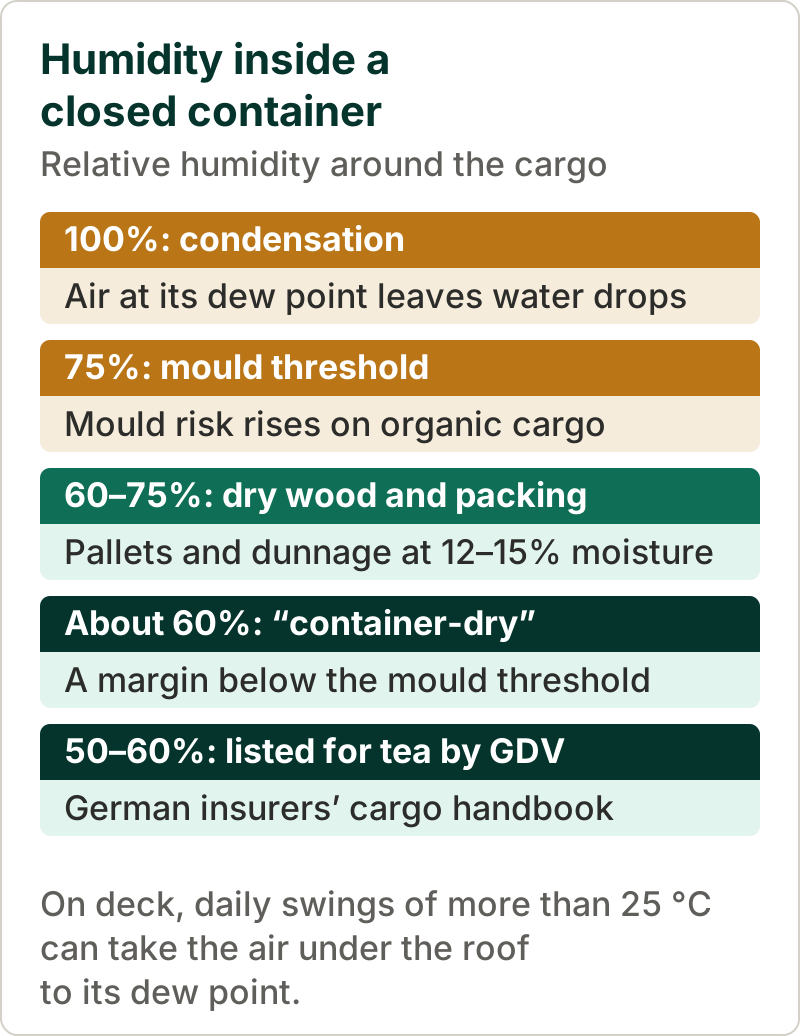 Sources: IMO/ILO/UNECE CTU Code (2014 edition), Annex 3; German Insurance Association (GDV), Transport Information Service, Tea
Container sweat and cargo sweat
Temperature swings are common on long voyages, and their size depends mainly on stowage: on top of the deck stow, daily variations can exceed 25 °C, while in the hold they may be marginal (CTU Code). The Code describes the daily cycle:
- Morning: the box warms, its relative humidity falls and the tea, cartons and wood release water vapour into the warm upper part of the box.
- Late afternoon: the roof cools first; the air touching it reaches its dew point and large drops fall onto the cargo, while condensate runs down the walls: container sweat.
- Day after day: some of the water evaporates again, but over repeated cycles the water set free can be considerable.
The Code’s figures show how little cooling it takes. Air at 30 °C and 57% relative humidity holds 17.3 g of water per cubic metre, the most air can hold at 20 °C, so its dew point is 20 °C. Cooled to 10 °C, where saturation is 9.4 g/m³, it sheds 7.9 g per cubic metre: about 0.5 kg in the air of an empty 40 ft box (65.7 m³ × 7.9 g/m³ = 519 g; The Tea Trade’s calculation), and the cargo releases more vapour the next morning. GDV therefore requires tea in containers to be stowed below deck, out of reach of rain, seawater, heating by day and cooling at night, and away from sources of heat, which also dry tea out.
Arrival brings two more risks (CTU Code):
- Warm cargo in a cold port: a box of warm, hygroscopic cargo left closed for some days in a cold climate soaks its cargo with water from the roof. Such goods should be unpacked right after unloading; drying then outruns mould, provided the packages are well ventilated.
- Cargo sweat: goods packed in a cold climate and unpacked at once in warm, humid air are cold enough for that air to condense on them. The Code advises waiting until they have warmed up, which can take a day or more, unless they are under vapour-tight plastic sheeting with enough desiccant, left on until the cargo has acclimatised.
The longer the voyage, the more cycles the tea goes through; the guide to China–Africa shipping times gives the transit times.
What the CTU Code asks before and during packing
Checking the box (chapter 8 of the 2014 edition). A closed container should be clean, dry and free of residues and persistent odours from previous cargo; if a stain comes off on a gloved hand, the box should be replaced. It should be weatherproof: rusty streaks below patches suggest leaks, and light entering the closed box reveals leaks. GDV adds that containers for tea must be watertight and uncontaminated, and that a box whose floor smells, is contaminated or is too damp should be rejected.
Packing (chapter 3 and Annexes 3 and 7).
- Avoid packing wet or damp goods, and do not use wet timber, pallets or packaging.
- Keep odorous or moisture-giving cargo away from sensitive cargo, and dusty or dirty cargo away from foodstuffs in porous packaging.
- Use dunnage against condensed water: timber planks against water on the floor, gunny cloth, paperboard or natural-fibre mats against drops from the ceiling, planks or plywood against sweat on the walls, and fleece over very sensitive cargo.
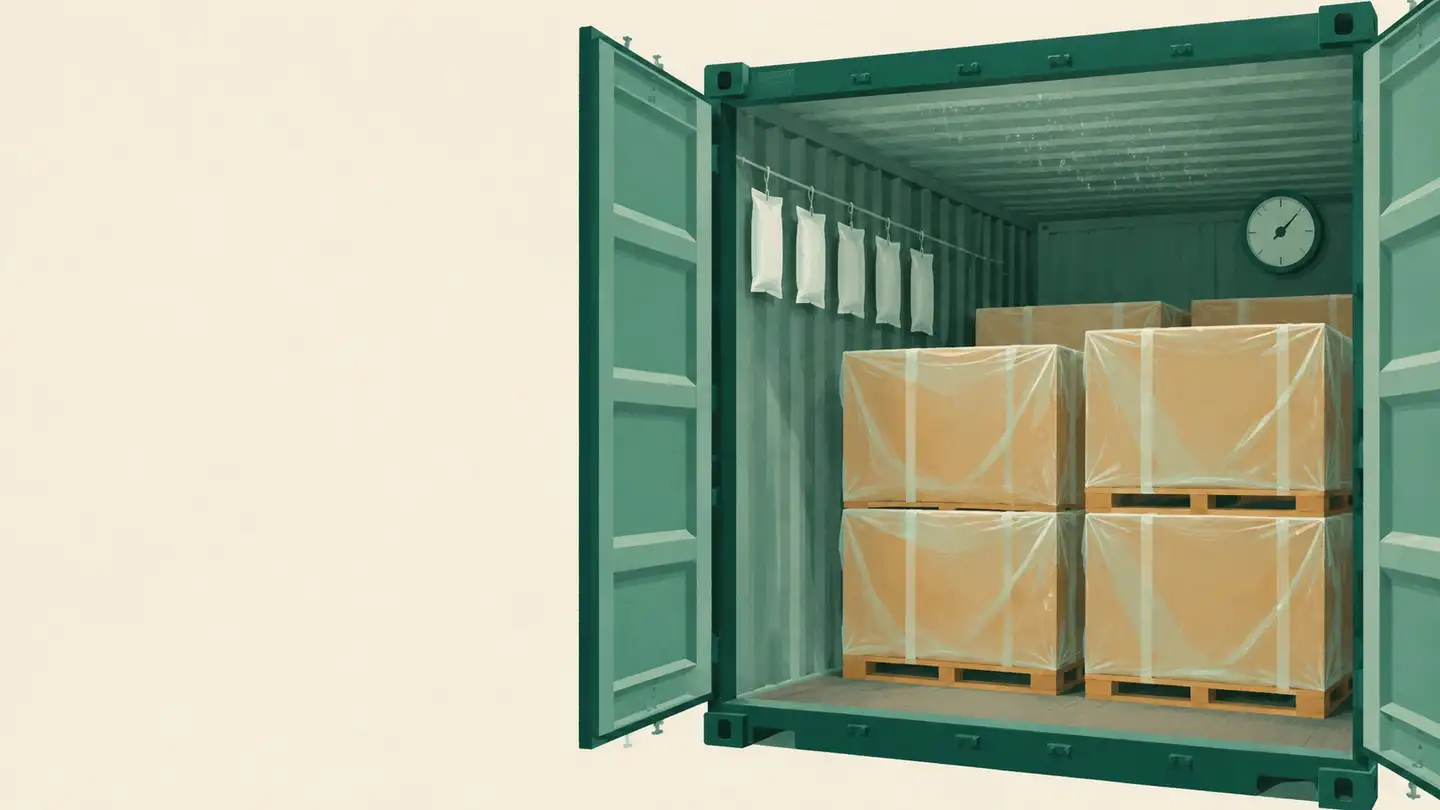
- If desiccants are used, calculate the absorption capacity needed. The Code pairs them, or active drying of dunnage and packing, with a sealed plastic wrapping, but says they generally fail with hygroscopic cargo that is not container-dry. Plastic sheeting stops drips but may promote mildew if the box is too moist overall.
Ventilation and temperature (chapters 5 to 7). The vents of a standard container only equalise pressure and do not measurably exchange air; ventilated containers have weatherproof grills in their rails, and the Code says ventilation can control condensation damage to cocoa and other agricultural produce. For tea, GDV says no ventilation is needed at “shipping dryness”, notes that tea mostly travels in standard containers and gives 5–25 °C as a favourable travel temperature; the CTU Code says a temperature-controlled unit should be considered whenever heat or cold could damage the cargo.
Odours. Tea absorbs any foreign odour at once, says GDV. Many freight contracts carry a special tea clause that keeps goods such as sugar, rubber, hides, turmeric and cassia out of its compartment, and the handbook also keeps tea away from copra, tar, camphor, tobacco, pepper, essential oils, strong-smelling chemicals and dusty or oily cargo.
Packaging and loading that keep tea dry
The pack is the first barrier; formats and liners are compared in the guide to tea export packaging formats. China’s gunpowder, chunmee and jasmine tea standards require transport that is clean, dry, odour-free and uncontaminated, with protection from rain, damp and strong sun. Tea bags are covered in our guide to tea bag materials and standards.
Morocco’s Decree 2-13-711 of 4 March 2015 requires tea to be packed in closed, clean and dry containers, as ISO 11287 does for green tea.
GB/T 30375: what China’s tea storage standard requires
Tea also waits in warehouses before and after the voyage. China’s standard for that is GB/T 30375-2013, Tea storage (茶叶贮存), a recommended national standard proposed by the All China Federation of Supply and Marketing Cooperatives and managed by the national technical committee for tea standardisation (SAC/TC 339). It was published on 31 December 2013 and took effect on 22 June 2014. An official English version followed on 14 December 2020; the project record for that translation, planned in January 2018, noted that there was then no international standard on tea storage. The gunpowder, chunmee, jasmine and white tea standards refer storage to it. Matcha storage is covered in our guide to Chinese matcha.
Its main requirements:
- Receipt: tea packed and put into store promptly, recorded (type, grade, quantity, origin, production date) and labelled; each type kept in its own zone so that odours do not transfer; packages firm, intact, damp-proof, undamaged, clean and odour-free.
- Stacking: by grade and batch, never against pillars, at least 200 mm from walls, on dunnage at least 150 mm high.
- Inspections: changes in moisture at the bottom and on the surface of each stack; mustiness, foreign odours, contamination or other faults in the packages; any heating inside the stacks; and the warehouse’s temperature, relative humidity and ventilation. Checks are monthly, at least twice a month in hot, rainy seasons, and recorded.
- Climate and housekeeping: ventilation and heat dissipation with a thermometer, dehumidification with a hygrometer, both set for the type of tea; nothing else stored in the warehouse; protection against fire and theft.
The standard is under revision. A review on 17 May 2021 concluded that it should be revised, and plan 20251082-T-442, issued on 30 April 2025 with a 12-month schedule, is to replace the 2013 edition in full and take effect six months after publication. In October 2026 the official record still listed the plan as awaiting approval and the 2013 edition as current.
A moisture checklist for each tea shipment
- Specification: maximum moisture at loading, test method (GB 5009.3-2016, which replaced the GB/T 8304 that most Chinese standards cite), a test on arrival and a retained sample.
- Packing: tea within its limit, sealed in a moisture-barrier liner, in dry, odour-free packs and cartons.
- The box: clean, dry, odour-free and weatherproof, with dry pallets and dunnage; reject a damp or smelly floor.
- Desiccants and drips: desiccant sized by calculation, as a complement to dry cargo; fleece, mats or paperboard over the top layer.
- Loading and stowage: under cover, never in rain, with no odorous, dusty, oily or moisture-giving cargo in the box; below deck and away from heat.
- Unpacking: at once in a cold climate; in a warm, humid one, only once the cargo has warmed up.
- Arrival check: the moisture and smell of the top and bottom layers, where GB/T 30375 has warehouses check each stack.
This is general information, checked in October 2026, not technical or legal advice: agree moisture limits, tests and packing with your buyer or supplier before each shipment.
Questions and answers
What is the maximum moisture content for Chinese tea?
It depends on the type: 7.0% for gunpowder, chunmee, black tea and most oolong, 8.5% for jasmine and white tea, and 6.5% for Wuyi rock tea, under China's national standards. Most of them cite moisture method GB/T 8304, withdrawn in 2017 and replaced by GB 5009.3-2016. The ISO standards for green, black and oolong tea set no moisture limit for tea as received.
What is container sweat?
Water that condenses under a container's roof and walls and falls or runs onto the cargo. The CTU Code explains that the cargo gives off water vapour as the box warms during the day; when the roof cools in the late afternoon, the air beneath it reaches its dew point and forms drops. Boxes on top of the deck stow can see daily swings of more than 25 °C.
What is cargo sweat?
Condensation on the cargo itself, when goods that are still cold are unpacked in warm, humid air. The CTU Code advises waiting, sometimes a day or more, until goods packed in a cold climate have warmed up before unpacking them in a warmer, more humid one, unless they are protected by vapour-tight sheeting and enough desiccant.
Do desiccants stop tea getting damp in a container?
Only if the tea and its packing are already dry. The CTU Code says desiccants generally fail with hygroscopic cargo that is not 'container-dry', in balance with about 60% relative humidity, and asks shippers to calculate the absorption capacity needed. Even dry pallets and dunnage hold 12–15% moisture.
Does tea need a ventilated or refrigerated container?
The GDV cargo handbook says tea is mostly carried in standard containers and needs no ventilation when it is at 'shipping dryness'; it gives 5–25 °C as a favourable travel temperature. The CTU Code says a unit able to keep cargo within acceptable temperatures should be considered whenever heat or cold could damage it.
What does GB/T 30375 say about storing tea?
China's tea storage standard, in force since 22 June 2014, requires each type of tea to be stored apart so that odours do not transfer, stacks at least 200 mm from walls on dunnage at least 150 mm high, thermometers, hygrometers and dehumidification, and checks every month, at least twice a month in hot, rainy seasons. A revision was awaiting approval in October 2026.
Sources
- 1. IMO, ILO and UNECE: Code of Practice for Packing of Cargo Transport Units (CTU Code), 2014 edition, electronic edition 2016 · ilo.org
- 2. IMO: CTU Code, page on the Code of Practice for Packing of Cargo Transport Units · imo.org
- 3. UNECE Working Party on Intermodal Transport and Logistics: IMO/ILO/UNECE CTU Code, 2025 revision, document ECE/TRANS/WP.24/2026/8, 23 June 2026 · documents.un.org
- 4. National public service platform for standards information: GB/T 30375-2013 Tea storage, record and 2021 review (in Chinese) · std.samr.gov.cn
- 5. National public service platform for standards information: revision plan 20251082-T-442 for Tea storage (in Chinese) · std.samr.gov.cn
- 6. National public service platform for standards information: English version of GB/T 30375-2013 Tea storage, published 14 December 2020 (in Chinese) · std.samr.gov.cn
- 7. GB/T 14456.4-2016 Green tea, Part 4: Gunpowder tea, official record (in Chinese) · openstd.samr.gov.cn
- 8. National public service platform for standards information: GB/T 14456.5-2016 Green tea, Part 5: Mee tea (in Chinese) · std.samr.gov.cn
- 9. GB/T 13738.1-2017 Black tea, Part 1: Broken black tea, official record (in Chinese) · openstd.samr.gov.cn
- 10. GB/T 13738.2-2017 Black tea, Part 2: Congou black tea, official record (in Chinese) · openstd.samr.gov.cn
- 11. GB/T 13738.3-2012 Black tea, Part 3: Souchong black tea, official record (in Chinese) · openstd.samr.gov.cn
- 12. National public service platform for standards information: GB/T 30357.1-2013 Oolong tea, Part 1: Basic requirements, record (in Chinese) · std.samr.gov.cn
- 13. National public service platform for standards information: GB/T 30357.3-2015 Oolong tea, Part 3: Huangjingui, record (in Chinese) · std.samr.gov.cn
- 14. National public service platform for standards information: GB/T 18745-2006 Product of geographical indication, Wuyi rock-essence tea, record (in Chinese) · std.samr.gov.cn
- 15. National public service platform for standards information: GB/T 18745-2026 Quality requirements for product of geographical indication, Wuyi rock-essence tea (in Chinese) · std.samr.gov.cn
- 16. GB/T 22292-2017 Jasmine tea, official record (in Chinese) · openstd.samr.gov.cn
- 17. GB/T 22291-2017 White tea, official record (in Chinese) · openstd.samr.gov.cn
- 18. ISO 11287:2011 Green tea, definition and basic requirements, sample pages · cdn.standards.iteh.ai
- 19. ISO 3720:2011 Black tea, definition and basic requirements, sample pages · cdn.standards.iteh.ai
- 20. ISO 20716:2022 Oolong tea, definition and basic requirements, sample pages · cdn.standards.iteh.ai
- 21. ONSSA: Decree 2-13-711 of 4 March 2015 on the quality and safety of marketed tea (English translation) · onssa.gov.ma
- 22. German Insurance Association (GDV), Transport Information Service: Tea · tis-gdv.de
- 23. National Health Commission: catalogue of national food safety standards, including GB 5009.3-2016 and GB 5009.4-2016 (in Chinese) · nhc.gov.cn