Tea bag materials and standards: paper, nylon, PET, PLA
Tea bag materials: filter paper under China's GB/T 25436-2023, nylon, PET or PLA; GB 4806 and EU food-contact rules; EU compostability required by 2028.
Key facts
- China's national standard GB/T 25436-2023 for tea filter paper (茶叶滤纸), in force since 1 April 2024, replaced the former standards for heat-seal (GB/T 25436-2010) and non-heat-seal (GB/T 28121-2011) filter paper, according to China's national standards information platform.
- China makes more than 4,000 tonnes of tea filter paper a year and exports about 3,000 tonnes a year, to countries in Europe, East Asia and South Asia among others, according to the official record of the English version of GB/T 25436-2023, published in September 2024, which gives no reference year.
- Under the EU Packaging Regulation (EU) 2025/40, which has applied since 12 August 2026, tea bags count as packaging and must be compatible with the standard for composting in industrially controlled conditions by 12 February 2028.
- Plastic tea bags of nylon, PET or PLA fall under the EU's Regulation (EU) No 10/2011, which caps overall migration at 10 mg per dm² of food-contact surface and, for example, the migration of caprolactam, used mainly to make synthetic fibres such as nylon 6, at 15 mg per kg of food.
- In a 2019 McGill University study, steeping one plastic tea bag of nylon or PET at 95 °C released about 11.6 billion microplastic and 3.1 billion nanoplastic particles into a single cup, a laboratory count rather than a regulatory limit.
Tea bag materials come in two families: filter paper and plastic. Paper bags are often heat-sealed with polypropylene, and some are blended with PLA, while fully plastic bags are made of nylon, PET or PLA (polylactic acid, a plastic made from plant biomass). In China, the paper is covered by GB/T 25436-2023 (茶叶滤纸), in force since 1 April 2024, the finished tea bag by GB/T 24690-2018 (袋泡茶), and the materials by the national food safety standards GB 4806.8-2022 for paper and GB 4806.7-2023 for plastics. In the EU, every material must meet Regulation (EC) No 1935/2004, plastics also Regulation (EU) No 10/2011, and by 12 February 2028 every tea bag must be compatible with industrial composting standards under the Packaging Regulation (EU) 2025/40 (texts checked October 2026).
What tea bags are made of: paper, nylon, PET and PLA
Tea filter paper is a food packaging paper for filter bags of tea, coffee, seasonings and Chinese medicines, made for automatic tea-packing machines and on the market for more than 80 years, according to the official record of the English version of GB/T 25436-2023. The record says China makes more than 4,000 tonnes a year and exports about 3,000 tonnes a year, a rising figure, to Europe, East Asia, South Asia and elsewhere; it gives no reference year. Chinese standards recognise two types: heat-seal (热封型) and non-heat-seal (非热封型).
Heat-sealed paper bags often hide plastic. A 2020 study for the European Commission describes paper tea bags as “often heat sealed with polypropylene”, so they contain plastic that is not obvious. In 2021, University College Dublin researchers sorted tea bags from six popular brands into three classes: a plastic bag made mainly of nylon 6/6, composites of polypropylene and cellulose, and bags free from any plastic traces. Field studies in Ireland (2022) and at the University of Plymouth (2024) also tested “plant-based” bags blending cellulose with PLA.
Fully plastic bags are made of nylon or PET, the two materials a 2019 McGill University study identified in the particles it measured, or of PLA. PLA is 100% bio-based and industrially compostable, but does not conventionally biodegrade in other environments because of the high temperatures required, according to the 2020 study, which calls it “factually incorrect” to say PLA is not a plastic. EU law agrees: Regulation 10/2011 defines a plastic as a polymer, with or without additives, that can act as the main structural component of a material.
Tea bag materials compared (sources: the standards and texts cited in this guide; checked October 2026)
| Material | What the sources describe | China | EU | Behaviour in soil (field studies) |
|---|---|---|---|---|
| Non-heat-seal filter paper (非热封型) | Filter paper, formerly under GB/T 28121-2011 | GB/T 25436-2023 (quality); GB 4806.8-2022 (food safety) | Regulation 1935/2004; no specific EU measure for paper, so national rules may apply | Cellulose-only bags no longer found in soil by 3.5 months (Ireland, 2020–2021) |
| Heat-seal filter paper (热封型) | Paper often sealed with polypropylene | GB/T 25436-2023, including heat-seal strength; GB 4806.8-2022 | Regulation 1935/2004; national rules may apply | Cellulose–polypropylene bags fragmented, leaving polypropylene pieces after 12 months (Ireland) |
| Nylon (polyamide) | Plastic bags of nylon 6 or 6/6 | GB 4806.7-2023 | Regulation 10/2011: overall migration ≤10 mg/dm²; caprolactam ≤15 mg/kg | Not tested in the field studies cited |
| PET (polyethylene terephthalate) | Plastic bags | GB 4806.7-2023 | Regulation 10/2011; terephthalic acid ≤7.5 mg/kg | Not tested in the field studies cited |
| PLA (polylactic acid) | Bio-based plastic, industrially compostable; also blended with cellulose | GB 4806.7-2023 | Regulation 10/2011, as a plastic | All-PLA bags intact after 12 months (Ireland) and unchanged after 7 (Plymouth); cellulose–PLA blends lost 66% and 78% of their mass in 7 months |
China’s tea bag standards: GB/T 25436-2023 and GB/T 24690-2018
GB/T 25436-2023, Filter paper for teabags (茶叶滤纸), was published on 7 September 2023 and took effect on 1 April 2024, replacing GB/T 25436-2010 for heat-seal paper and GB/T 28121-2011 for non-heat-seal paper, both now repealed; an official English version followed on 2 September 2024. It is a recommended (推荐性) standard of the national technical committee for food-contact materials. According to the record of the revision project, it applies to paper for bags of tea, coffee, seasonings, Chinese herbal decoctions or desiccants, and its main technical content covers food safety, grammage, tightness, tensile strength, wet strength, heat-seal strength, air permeability, filtering time, moisture on delivery and appearance.
GB/T 24690-2018, Teabag (袋泡茶), took effect on 1 June 2018, replacing the 2009 edition. The record of its English version (31 December 2021) calls it the basic standard for classifying and evaluating tea bags. A review on 17 May 2021 concluded that it should be revised, but in October 2026 the official record still listed the 2018 edition as current, with no revision plan.
The quality items of a recommended standard are not always enforced: in its sampling inspections, Guangzhou’s market regulator does not judge a product on a GB/T 25436 quality item when the product’s stated quality requirements leave that item out.
What Guangzhou’s market regulator tests on tea filter paper (sampling rules, July 2024 revision)
| Group | Items | Basis |
|---|---|---|
| Food safety | Sensory requirements; overall migration; heavy metals (as lead), lead, arsenic; fluorescent substances; formaldehyde; 1,3-dichloro-2-propanol; 3-chloro-1,2-propanediol; coliforms, salmonella, moulds | GB 4806.8-2022 |
| Quality | Tensile strength (both directions); wet tensile strength (machine direction); heat-seal strength, for heat-seal paper only | GB/T 25436 |
Food-contact standards in China: GB 4806.8 and GB 4806.7
China’s national food safety standards (GB) are mandatory for both domestic and imported products, according to the US Department of Agriculture (USDA, May 2025). Three concern tea bags directly:
- GB 4806.1-2016, the general safety requirements for all food-contact materials, still listed as current in the National Health Commission’s catalogue of national food safety standards as of September 2025.
- GB 4806.8-2022 for paper and board, in force since 30 June 2023, when it replaced the 2016 edition. According to the Ganzhou market regulator, it added two limits, 1,3-dichloro-2-propanol not detected and 3-chloro-1,2-propanediol at most 12 µg/L, and these chloropropanols come mainly from the breakdown of additives widely used in paper, such as polyamide-epichlorohydrin wet-strength resin.
- GB 4806.7-2023 for plastics, released on 6 September 2023 and in force since 6 September 2024. It replaced both GB 4806.6-2016 on plastic resins and GB 4806.7-2016, and covers nylon, PET and PLA bags alike.
For exports, China’s customs rules defer to the destination. Under GACC Order No. 249 (Article 38), export food must meet the standards of the importing country or the contract, and China’s national food safety standards apply only where neither of these, nor a treaty, sets a requirement.
EU rules: Regulation 1935/2004, Regulation 10/2011 and the Packaging Regulation
Regulation (EC) No 1935/2004 covers every material that touches food. Materials must not transfer their constituents to food in quantities that could endanger human health, bring an unacceptable change in its composition or impair its organoleptic characteristics, such as taste and smell, and their labelling must not mislead (Article 3). Filter paper or empty bags sold to a tea packer must be accompanied by the words “for food contact”, a specific indication of use or the EU symbol, which between businesses may appear on the accompanying documents, unless their characteristics show they are clearly meant for food (Article 15), and must be traceable (Article 17). The EU has specific measures for plastics but none for paper, for which member states may keep or adopt national provisions.
Regulation (EU) No 10/2011, in its version consolidated on 14 July 2026, adds rules for plastics, and so for nylon, PET and PLA bags:
- Overall migration: no more than 10 mg of constituents per dm² of food-contact surface (Article 12).
- Specific limits: for example 15 mg/kg of food for caprolactam, used mainly to make synthetic fibres such as nylon 6, and 7.5 mg/kg for terephthalic acid, a polyester raw material (Annex I).
- Declaration of compliance: at every stage before retail, a written declaration with the information in Annex IV (Article 15).
Since 12 August 2026, the Packaging Regulation (EU) 2025/40 has treated “a permeable tea, coffee or other beverage bag” as packaging. Food-contact packaging may not contain PFAS at or above 25 ppb for any single PFAS, 250 ppb for their sum, or 50 ppm including polymeric PFAS (Article 5). By 12 February 2028, tea bags placed on the market must be compatible with the standard for composting in industrially controlled conditions, and with home-composting standards where a member state requires it (Article 9). Customs codes for tea in bags are in our guide to HS codes for tea, and the EU’s other rules in our guide to importing Chinese tea into the EU.
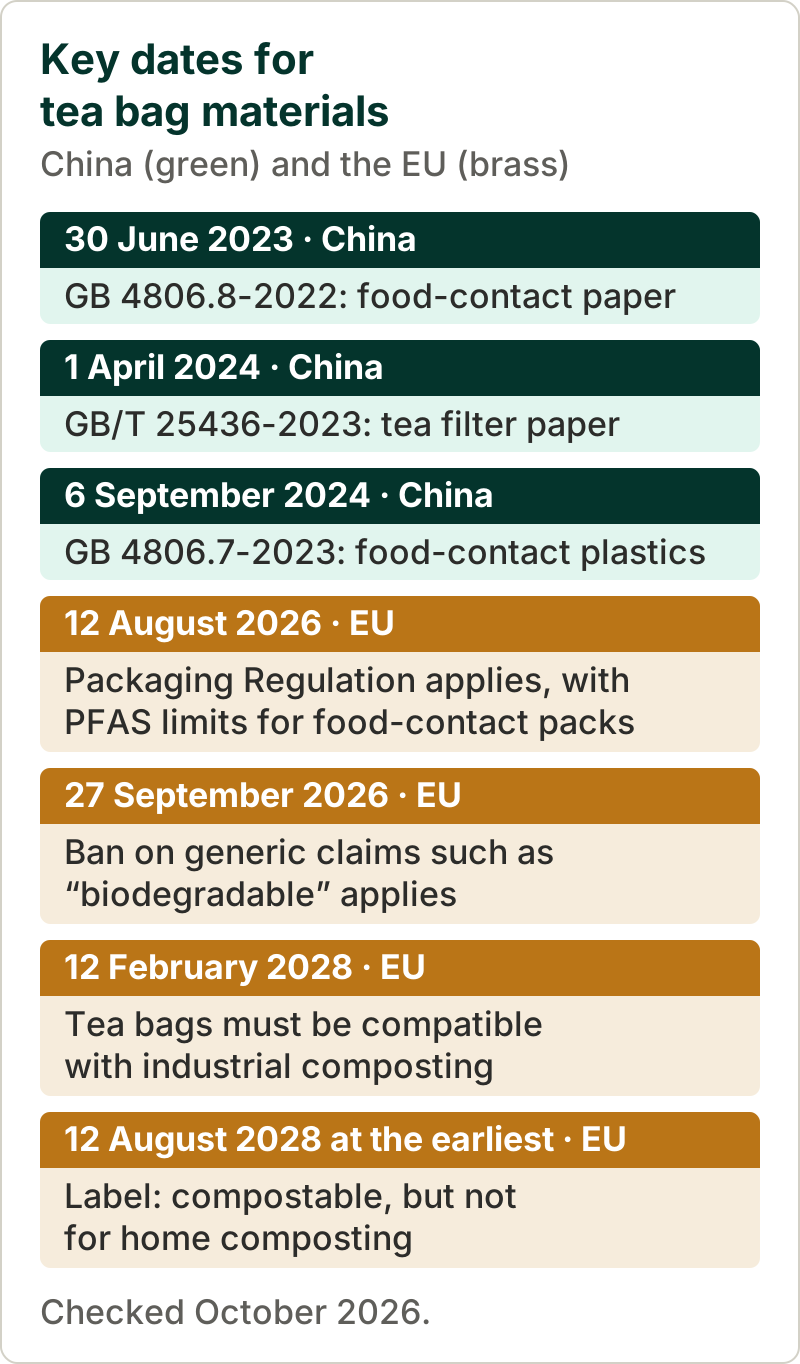 Sources: GB/T 25436-2023 record; National Health Commission catalogue of standards (September 2025); Regulation (EU) 2025/40, Articles 5, 9, 12 and 71; Directive (EU) 2024/825, Article 4
What “compostable” and “biodegradable” claims rest on
In the EU, compostable packaging has been assessed against EN 13432:2000, “the de facto method” for verifying compostable plastics according to the 2020 study for the Commission; the Commission published the standard’s reference in 2001 under the Packaging Directive 94/62/EC. As summarised in that study, the standard requires:
- Disintegration: after 12 weeks in test composting, no more than 10% of the material may remain in fragments larger than 2 mm.
- Biodegradation: at least 90% conversion to carbon dioxide, compared with a reference material, within 6 months.
- Chemistry and compost quality: heavy metals below set thresholds, no negative effect on plant growth in a germination test and no negative effect on the composting process.
The study calls the US standard ASTM D6400 the American equivalent, with almost identical requirements. China’s GB/T 28206-2011 is an identical adoption of ISO 17088:2008, and a revision was awaiting approval in October 2026; its standard on the degradability and labelling of biodegradable plastics, GB/T 41010-2021, has applied since 1 June 2022.
EN 13432 tests compostability in industrial composting, which often runs at 55 °C to 60 °C with high humidity, according to the Commission’s 2022 policy framework; the framework adds that compliance with industrial composting standards does not imply decomposition in a home compost. It names tea bags among suitable uses for industrially compostable plastics and says only certified industrially compostable plastics should be called “compostable”, always specifying industrial composting. The Packaging Regulation, which repealed Directive 94/62/EC from 12 August 2026 apart from a few transitional provisions, says EN 13432 should be revised for composting times, contamination and microplastic release, and serves only as guidance until then.
Since 27 September 2026, EU member states have applied Directive (EU) 2024/825, which bans generic environmental claims such as “biodegradable” unless recognised excellent environmental performance can be shown; a claim specified clearly on the same medium is not generic. Since 1 January 2022, France has banned placing tea and herbal-tea bags of non-biodegradable plastic on its market, under its anti-waste law (Article L541-15-10 of the Environment Code).
In a garden in Cork, Ireland, from November 2020 to November 2021, all-PLA bags stayed intact for 12 months, cellulose-only and cellulose–PLA bags had gone by the 3.5-month sampling, and cellulose–polypropylene bags fragmented, leaving polypropylene pieces after a year. In a University of Plymouth study published in 2024, two cellulose–PLA bags buried 10 cm deep in an arable field margin lost 66% and 78% of their mass in seven months, mainly cellulose, while an all-PLA bag was unchanged.
Particles released by plastic tea bags: what studies measured
Three laboratory studies have counted particles released by tea bags. Their methods and units differ, so their figures cannot be compared with one another, and none is a regulatory limit.
Particle counts from tea bags in laboratory studies (dated, as published)
| Study | Bags tested | Conditions | Result |
|---|---|---|---|
| McGill University, Environmental Science & Technology, September 2019 | Plastic bags of nylon and PET | One bag steeped at 95 °C | About 11.6 billion microplastics and 3.1 billion nanoplastics in a single cup |
| Universitat Autònoma de Barcelona, Journal of Hazardous Materials, June 2023 | Commercial PLA bags | Simulated preparation of a cup of tea | About 1 million PLA nanoparticles per tea bag |
| Universitat Autònoma de Barcelona and partners, Chemosphere, November 2024 | Commercial bags of polypropylene, cellulose and nylon-6 | Simulated tea preparation; nanoparticle tracking analysis | 1.2 billion particles per mL (polypropylene), 135 million (cellulose), 8.18 million (nylon-6) |
The 2019 paper drew a comment from researchers in Germany and a reply from its authors, both published in the same journal in October 2020.
Morocco: food-contact materials for tea
Morocco’s tea decree, Decree 2-13-711 of 4 March 2015, requires tea to be packed in closed, clean and dry containers and to meet Article 53 of Decree 2-10-473, in particular for its packaging. Among that article’s conditions for compliant food is packing in materials intended to come into contact with food, whose composition and use are set by a joint order of the ministers of agriculture, fisheries, health, and industry and trade. Label rules for Morocco, West Africa and the EU are compared in our guide to tea labelling requirements.
Checklist: tea bag material in a purchase contract
- Material and type: paper (heat-seal or non-heat-seal, under GB/T 25436-2023), nylon, PET or PLA, and the fibre used for heat-sealing.
- Chinese test report: GB 4806.8-2022 for paper or GB 4806.7-2023 for plastics, plus the GB/T 25436 items your packing line needs, such as wet strength and heat-seal strength.
- For the EU: a written declaration of compliance for plastics (Regulation 10/2011, Annex IV), PFAS below the Packaging Regulation limits, and a plan for compostable tea bags by 12 February 2028.
- Claims: “industrially compostable” with the standard named, not “biodegradable” alone.
- Outer packs and labels: cartons, liners and pack weights are compared in our guide to tea export packaging formats, and test reports and certificates in our guide to Chinese tea export documents.
This guide is general information, checked in October 2026, not legal advice: confirm the requirements with the importing country’s authorities or the buyer before ordering packaging.
Questions and answers
What are tea bags made of?
Most are made of filter paper or of plastic. Paper bags are often heat-sealed with polypropylene, according to a 2020 study for the European Commission, and some blend cellulose with PLA; fully plastic bags are made of nylon, PET or PLA, a plastic made from plant biomass.
Do paper tea bags contain plastic?
Many heat-sealed ones do. A 2020 study for the European Commission notes that paper tea bags are often heat-sealed with polypropylene, and a 2021 University College Dublin study of six popular brands found composites of polypropylene and cellulose alongside bags free of any plastic traces.
Which Chinese standards apply to tea bags?
GB/T 24690-2018 for tea bags (袋泡茶) and GB/T 25436-2023 for heat-seal and non-heat-seal filter paper (茶叶滤纸), both recommended standards, plus the national food safety standards GB 4806.8-2022 for paper and GB 4806.7-2023 for plastics, which the USDA describes as mandatory for domestic and imported products.
Are PLA tea bags compostable?
In industrial composting: a 2020 study for the European Commission calls PLA industrially compostable but not conventionally biodegradable in other environments, and all-PLA tea bags stayed intact for 12 months in garden soil in an Irish field test (2020–2021). The Commission says only certified industrially compostable plastics should be called compostable.
What EU rules apply to tea bag materials?
Regulation (EC) No 1935/2004 for every material, Regulation (EU) No 10/2011 for plastics such as nylon, PET and PLA, and the Packaging Regulation (EU) 2025/40, which limits PFAS in food-contact packaging from 12 August 2026 and requires tea bags to be compatible with industrial composting standards by 12 February 2028.
Do plastic tea bags release microplastics?
Laboratory studies have counted particles: about 11.6 billion microplastics and 3.1 billion nanoplastics in one cup from a nylon or PET bag steeped at 95 °C (McGill University, 2019), and 8.18 million particles per millilitre from nylon-6 bags (Universitat Autònoma de Barcelona, 2024). The methods differ, and the figures are measurements, not limits.
Sources
- 1. National public service platform for standards information: GB/T 25436-2023 Filter paper for teabags, record (in Chinese) · std.samr.gov.cn
- 2. National public service platform for standards information: project 20205011-T-607, revision of the tea filter paper standard, scope and main technical content (in Chinese) · std.samr.gov.cn
- 3. National public service platform for standards information: English version of GB/T 25436-2023, published 2 September 2024 (in Chinese) · std.samr.gov.cn
- 4. National public service platform for standards information: GB/T 24690-2018 Teabag, record and 2021 review (in Chinese) · std.samr.gov.cn
- 5. National public service platform for standards information: English version of GB/T 24690-2018, published 31 December 2021 (in Chinese) · std.samr.gov.cn
- 6. National public service platform for standards information: GB/T 28206-2011 Specification for compostable plastic, record (in Chinese) · std.samr.gov.cn
- 7. National public service platform for standards information: GB/T 41010-2021 Degradability and identification requirements of biodegradable plastics and products, record (in Chinese) · std.samr.gov.cn
- 8. National Health Commission and SAMR: announcement No. 6 of 2023 releasing 85 national food safety standards, including GB 4806.7-2023, 6 September 2023 (in Chinese) · gov.cn
- 9. National Health Commission: catalogue of national food safety standards, 1,725 standards as of September 2025, with replaced standards and their dates (in Chinese) · nhc.gov.cn
- 10. Minqing County People's Government: text of GB 4806.7-2023, food-contact plastic materials and articles, posted 7 February 2024 (in Chinese) · fzmq.gov.cn
- 11. Guangzhou Administration for Market Regulation: sampling inspection rules for paper food-contact products, July 2024 revision (in Chinese) · gz.gov.cn
- 12. GACC: Order No. 249, Administrative Measures on Import and Export Food Safety, 12 April 2021 (in Chinese) · gov.cn
- 13. EUR-Lex: Regulation (EC) No 1935/2004 on materials and articles intended to come into contact with food, consolidated version of 27 March 2021 · eur-lex.europa.eu
- 14. EUR-Lex: Commission Regulation (EU) No 10/2011 on plastic materials and articles intended to come into contact with food, consolidated version of 14 July 2026 · eur-lex.europa.eu
- 15. EUR-Lex: Regulation (EU) 2025/40 on packaging and packaging waste, 19 December 2024 · eur-lex.europa.eu
- 16. EUR-Lex: Directive (EU) 2024/825 on empowering consumers for the green transition, 28 February 2024 · eur-lex.europa.eu
- 17. EUR-Lex: Commission Decision 2001/524/EC relating to the publication of references for standards EN 13428:2000 to EN 13432:2000 under Directive 94/62/EC, 28 June 2001 · eur-lex.europa.eu
- 18. European Commission: EU policy framework on biobased, biodegradable and compostable plastics, COM(2022) 682, 30 November 2022 · eur-lex.europa.eu
- 19. ONSSA: Decree 2-13-711 of 4 March 2015 on the quality and safety of marketed tea (English translation) · onssa.gov.ma
- 20. ONSSA: Decree 2-10-473 of 6 September 2011 implementing Law 28-07 on food safety (in French) · onssa.gov.ma
- 21. French Ministry for Ecological Transition: the anti-waste law in everyday life, reference document, September 2021 (in French) · ecologie.gouv.fr
- 22. French Ministry for Ecological Transition (DGPR): plastics and anti-waste FAQ, July 2024 (in French) · ecologie.gouv.fr
- 23. Hernandez L.M. et al. (2019), Plastic teabags release billions of microparticles and nanoparticles into tea, Environmental Science & Technology 53(21): 12300–12310 · doi.org
- 24. Busse K. et al. (2020), Comment on 'Plastic teabags release billions of microparticles and nanoparticles into tea', Environmental Science & Technology 54(21): 14134–14135 · doi.org
- 25. Banaei G. et al. (2023), The release of polylactic acid nanoplastics (PLA-NPLs) from commercial teabags, Journal of Hazardous Materials 458: 131899 · doi.org
- 26. Banaei G. et al. (2024), Teabag-derived micro/nanoplastics (true-to-life MNPLs) as a surrogate for real-life exposure scenarios, Chemosphere 368: 143736 · doi.org
- 27. Xu J.L. et al. (2021), Spectral imaging for characterization and detection of plastic substances in branded teabags, Journal of Hazardous Materials 418: 126328 · doi.org
- 28. Mateos-Cárdenas A. (2022), Fate of petroleum-based and plant-based teabags exposed to environmental soil conditions for one year, Frontiers in Bioengineering and Biotechnology 10: 966685 · doi.org
- 29. Courtene-Jones W. et al. (2024), Deterioration of bio-based polylactic acid plastic teabags under environmental conditions, Science of the Total Environment 934: 172806 · doi.org
- 30. Ganzhou Administration for Market Regulation: interpretation of GB 4806.8-2022, food-contact paper and board, 3 March 2025 (in Chinese) · sjj.ganzhou.gov.cn
- 31. USDA Foreign Agricultural Service: FAIRS Country Report Annual, China, CH2025-0060, 7 May 2025 · apps.fas.usda.gov
- 32. European Commission: Food contact materials, legislation · food.ec.europa.eu
- 33. European Commission, DG Environment: Relevance of biodegradable and compostable consumer plastic products and packaging in a circular economy, final report, March 2020 · doi.org
- 34. PubChem (US National Library of Medicine): caprolactam, uses · pubchem.ncbi.nlm.nih.gov
- 35. PubChem (US National Library of Medicine): terephthalic acid, uses · pubchem.ncbi.nlm.nih.gov