Chinese green tea geographical indications: EU and China
Chinese green tea geographical indications differ by tea: Longjing, an EU PDO since 2011; nine green teas on the EU–China first list; Biluochun still pending.

Key facts
- The EU–China agreement on geographical indications, signed on 14 September 2020 and in force since 1 March 2021, protects 100 Chinese names in the EU; 28 of them are classed as tea, and nine of these are green teas, among them Lu'an Guapian (六安瓜片) and Anji Bai Cha (安吉白茶).
- Longjing Cha (龙井茶) has been a protected designation of origin (PDO) in the EU since 2011, under Commission Implementing Regulation (EU) No 449/2011, and appears on neither list of the 2020 EU–China agreement.
- Dongting Biluochun (No. 81), Taiping Houkui (No. 91) and Huangshan Maofeng (No. 92) are on Annex V, the second list of the EU–China agreement, which was to be processed within four years of 1 March 2021; on 13 October 2026, none of the 31 teas on that list was yet in the EU register.
- China's national geographical-indication standard for Longjing tea, GB/T 18650-2008, was reviewed on 4 August 2025 and kept in force, while the Huangshan Maofeng standard, GB/T 19460-2008, will be replaced by GB/T 19460-2026 on 1 October 2027.
- Under Article 4 of the EU–China agreement, a listed name such as Lu'an Guapian may not be used for tea from another place, even with the true origin shown, in translation, or with words such as 'type', 'style' or 'imitation'.
Protection of Chinese green tea names differs by tea. In the EU, Longjing Cha (龙井茶) has been a protected designation of origin (PDO) since 2011, and nine green teas, among them Lu’an Guapian (六安瓜片) and Anji Bai Cha (安吉白茶), have been protected since 1 March 2021 by the first list of the EU–China agreement on geographical indications (GIs, 地理标志). Dongting Biluochun, Taiping Houkui and Huangshan Maofeng, on its second list, were not yet protected in October 2026, and Xinyang Maojian is on neither list; in China, all four have national GI standards, as Longjing has GB/T 18650-2008 (checked October 2026).
Where famous Chinese green tea names stand in the EU and in China
Famous Chinese green tea names: protection in the EU and national standard in China (sources: Council document 8361/20, Regulation (EU) No 449/2011, eAmbrosia, std.samr.gov.cn; checked 13 October 2026)
| Name | Chinese | Protection in the EU | China’s national GI standard |
|---|---|---|---|
| Longjing Cha | 龙井茶 | PDO since 2011 | GB/T 18650-2008 |
| Lu’an Guapian | 六安瓜片 | since 1 March 2021 (Annex III, No. 25) | none |
| Anji Bai Cha | 安吉白茶 | since 1 March 2021 (Annex III, No. 1) | GB/T 20354-2006 |
| Dongting (shan) Biluochun | 洞庭(山)碧螺春茶 | pending: second list (Annex V, No. 81) | GB/T 18957-2008 |
| Taiping Houkui | 太平猴魁茶 | pending: second list (Annex V, No. 91) | GB/T 19698-2008 |
| Huangshan Maofeng | 黄山毛峰茶 | pending: second list (Annex V, No. 92) | GB/T 19460-2008 |
| Duyun Maojian | 都匀毛尖茶 | pending: second list (Annex V, No. 156) | none |
| Xinyang Maojian | 信阳毛尖茶 | on neither list | GB/T 22737-2008 |
“Pending”: not in the EU register on 13 October 2026. “None”: no national standard under that name on China’s standards platform.
Two routes into EU protection: a 2011 registration and the 2020 agreement
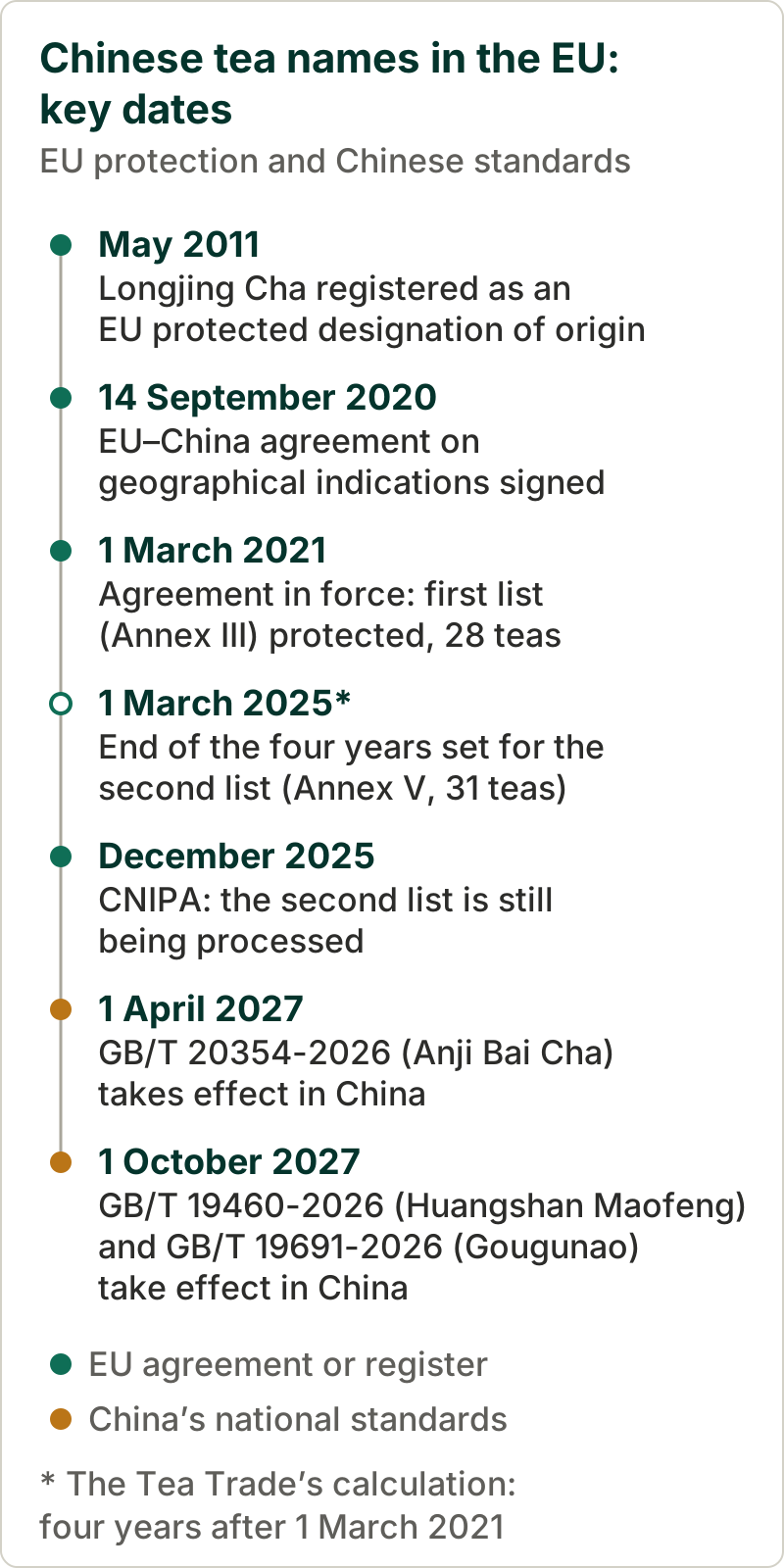
The EU registered Longjing Cha as a PDO, on China’s application, by Commission Implementing Regulation (EU) No 449/2011 of 6 May 2011, with three other Chinese names, none of them a tea; published on 11 May 2011, the regulation entered into force on 31 May 2011.
The EU–China agreement, signed on 14 September 2020 and in force since 1 March 2021, works in two phases:
- First list (Annex III): 100 Chinese names that the EU undertook to protect from entry into force (Articles 2 and 5). China in turn protects 96 EU names (Annex IV).
- Second list (Annex V): 175 more Chinese names, and 175 EU names in Annex VI, that “will be processed” during the agreement’s first four years (Article 3), by 1 March 2025 (The Tea Trade’s calculation). A second-list name is protected once the agreement’s joint committee has added it to Annex III (Articles 6(5), 10 and 14).
 Source: Council document 8361/20 and MOFCOM (agreement), Regulation (EU) No 449/2011, CNIPA (2025) and std.samr.gov.cn (checked 13 October 2026)
In December 2025, an article published by China’s intellectual property office (国家知识产权局, CNIPA) put the number of Chinese GIs protected in the EU at 110 and said that work on the second lists was progressing in an orderly way. On 13 October 2026, the EU register (eAmbrosia) held Longjing Cha and the nine first-list green teas but none of the 31 second-list teas, and the EU’s Official Journal had published no joint committee decision amending Annex III.
Nine green teas protected in the EU since 1 March 2021
Of the 100 names on the first list, 28 are classed as tea, one of them a chrysanthemum, Macheng Fu Bai Ju (麻城福白菊). Nine are green teas, as their names, their EU specifications or, for Gougunao, China’s Mission to the EU state:
Green teas on the first list (Annex III) (sources: Council document 8361/20; eAmbrosia specifications)
| No. | Name in the agreement (translation) | Chinese | Protected in China | Area in the EU specification |
|---|---|---|---|---|
| 1 | Anji Bai Cha (Anji White Tea) | 安吉白茶 | GI product, 6 April 2004 | Anji county, Zhejiang |
| 13 | Wuyuan Lü Cha (Wuyuan Green Tea) | 婺源绿茶 | certification mark, 14 January 2007 | 16 towns of Wuyuan county, Jiangxi |
| 25 | Lu’an Guapian (Lu’an Melon-seed-shaped Tea) | 六安瓜片 | GI product, 28 December 2007 | 26 townships and towns of Lu’an, Anhui |
| 30 | Songxi Lü Cha (Songxi Green Tea) | 松溪绿茶 | certification mark, 28 May 2009 | Songxi county, Fujian |
| 37 | Gou Gu Nao (Gougunao Tea) | 狗牯脑 | certification mark, 28 April 2012 | Suichuan county, Jiangxi |
| 45 | Pujiang Que She (Pujiang Que She Tea) | 蒲江雀舌 | GI product, 31 October 2008 | Pujiang county, Sichuan |
| 46 | Emeishan Cha (Mount Emei Tea) | 峨眉山茶 | GI product, 31 December 2009 | Leshan, Sichuan |
| 47 | Duobei Cha (Duobei Tea) | 朵贝茶 | GI product, 22 February 2013 | 11 towns and townships of Puding county, Guizhou |
| 75 | Qiandao Yin Zhen (Qiandao Rare Tea) | 千岛银珍 | agricultural product GI, 24 December 2010 | Jiande, Zhejiang |
The fourth column shows China’s three routes of protection, all in the agreement’s Annex I: GI products (地理标志产品) approved by the former quality inspection administration (AQSIQ), certification marks (证明商标) and agricultural product GIs of the Ministry of Agriculture. China’s Ministry of Commerce (MOFCOM) gives each first-list tea an EU file number in the PGI series, such as PGI-CN-2686 for Lu’an Guapian.
Four more first-list teas are not counted: the specifications of Fenggang Xin Xi Cha (凤冈锌硒茶, No. 19) and Taishun San Bei Xiang Cha (泰顺三杯香茶, No. 76) name no tea type, and those of Guiping Xi Shan Cha (桂平西山茶, No. 89) and Naxi Te Zao Cha (纳溪特早茶, No. 93) could not be opened in October 2026.
Lu’an Guapian’s EU specification describes a melon-seed-shaped green tea made from single leaves, without buds or stalks, in six grades (ultimate, super first, super second, first, second and third), with no more than 6.0% moisture. Anji Bai Cha is a green tea despite its translation, “Anji White Tea”, as our guide to white tea grades explains.
Longjing Cha: an EU protected designation of origin since 2011
Longjing Cha’s specification, published on the UK register of protected food names, which took over the EU entry on 31 December 2020, describes a flat green tea from three growing regions in Zhejiang:
- Xihu: the Xihu (West Lake) scenic area of Hangzhou;
- Qiantang: Xiaoshan, Binjiang, Yuhang, Fuyang, Lin’an, Tonglu, Jiande and Chun’an, in Hangzhou;
- Yuezhou: Shaoxing, Yuecheng, Xinchang, Shengzhou and Zhuji, in Shaoxing, and towns of Shangyu, Pan’an, Dongyang and Tiantai.
It sets six grades, from special grade to grade V, with no more than 6.5% moisture for the top three grades and 7.0% for the others, at least 36.0% water extract and no more than 1.0% powder and broken tea; colouring and additives are barred. The proof of origin is a certificate for GI plantations, which growers obtain by declaring their plantation and which processors and sellers are to check. The sales package must show “Longjing Cha” and the growing region, and tea picked and processed in Xihu may be labelled “Xihu Longjing Cha”.
In China, the mandatory GB 18650-2002, a “designation of origin product” (原产地域产品) standard, gave way in 2008 to the voluntary GB/T 18650-2008, Product of geographical indication – Longjing tea. In the EU, a registered name such as Longjing Cha is protected against imitation and misuse, now under Regulation (EU) 2024/1143, according to the European Commission.
Biluochun, Huangshan Maofeng and Taiping Houkui: on the second list
Selected teas on the second list (Annex V) (source: Council document 8361/20)
| No. | Name in the agreement (translation) | Chinese |
|---|---|---|
| 7 | Guizhou Lü Cha (Guizhou Green Tea) | 贵州绿茶 |
| 80 | Yu Hua Cha (Yuhua Tea) | 雨花茶 |
| 81 | Dongtingshan Bi Luo Chun Cha (Dongting Mountain Biluochun Tea) | 洞庭(山)碧螺春茶 |
| 91 | Taiping Hou Kui Cha (Taiping Hou Kui Tea) | 太平猴魁茶 |
| 92 | Huangshan Mao Feng Cha (Huangshan Maofeng Tea) | 黄山毛峰茶 |
| 109 | Rizhao Lv Cha (Rizhao Green Tea) | 日照绿茶 |
| 156 | Duyun Mao Jian Cha (Duyun Maojian Tea) | 都匀毛尖茶 |
Annex V names 31 teas. The other 24 are Wujiatai Gong Cha (伍家台贡茶, No. 6), Jingshan Cha (径山茶, 10), Qintang Mao Jian (覃塘毛尖, 25), Putuo Fo Cha (普陀佛茶, 28), Pinghe Bai Ya Qi Lan (平和白芽奇兰, 40), Baojing Huang Jin Cha (保靖黄金茶, 46), Wuzhishan Hong Cha (五指山红茶, 47), Beiyuan Gong Cha (北苑贡茶, 54), Yuexi Cui Lan (岳西翠兰, 94), Zhenghe Bai Cha (政和白茶, 97), Songxi Hong Cha (松溪红茶, 98), Fuliang Cha (浮梁茶, 106), Chibi Qing Zhuan Cha (赤壁青砖茶, 120), Yingshan Yun Wu Cha (英山云雾茶, 121), Xiangyang Gao Xiang Cha (襄阳高香茶, 122), Guzhang Mao Jian (古丈毛尖, 126), Liu Pao Cha (六堡茶, 133), Lingyun Bai Hao (凌云白毫, 134), Guliao Cha (姑辽茶, 135), Mengdingshan Cha (蒙顶山茶, 148, spelt “Mingdingshan” in the annex), Menghai Cha (勐海茶, 160), Ziyang Fu Xi Cha (紫阳富硒茶, 163), Jingyang Fu Zhuan Cha (泾阳茯砖茶, 164) and Hanzhong Xian Hao (汉中仙毫, 165). The annex states no tea type, though its translations name black tea for Wuzhishan and Songxi, white tea for Zhenghe and brick tea for Chibi and Jingyang. China’s national list of intangible cultural heritage files the making of Biluochun, Huangshan Maofeng, Taiping Houkui, Duyun Maojian and Xinyang Maojian under green tea making techniques (绿茶制作技艺).
Article 4 does not cover a second-list name until it is moved to Annex III, but one rule applies already: under Article 6(6), trade marks that consist of a second-list name, or its translation, for tea not from that area, applied for after 1 March 2021, are to be rejected.
China’s national GI standards for these teas
Most of these names are defined by national GI product standards, which fall under CNIPA. The first editions, such as GB 18957-2003 for Biluochun, were mandatory; their 2008 successors are voluntary (推荐性). Seven were kept in force at a review on 4 August 2025; the Huangshan Maofeng standard was sent for revision on 5 September 2025, and new editions are titled “quality requirements for product of geographical indication” (地理标志产品质量要求). For green tea grades in general, see our guide to Chinese green tea grades.
National GI standards for the teas in this guide (source: std.samr.gov.cn, checked 13 October 2026)
| Tea | Standard in force | In force since | Status |
|---|---|---|---|
| Longjing | GB/T 18650-2008 | 1 October 2008 | kept |
| Dongting (shan) Biluochun | GB/T 18957-2008 | 1 November 2008 | kept |
| Taiping Houkui | GB/T 19698-2008 | 1 October 2008 | kept |
| Xinyang Maojian | GB/T 22737-2008 | 1 June 2009 | kept |
| Yuhua (雨花茶) | GB/T 20605-2006 | 1 April 2007 | kept |
| Lushan Yunwu (庐山云雾茶) | GB/T 21003-2007 | 1 December 2007 | kept |
| Laoshan green tea (崂山绿茶) | GB/T 26530-2011 | 1 November 2011 | kept |
| Huangshan Maofeng | GB/T 19460-2008 | 1 December 2008 | GB/T 19460-2026 from 1 October 2027 |
| Gougunao (狗牯脑茶) | GB/T 19691-2008 | 1 December 2008 | GB/T 19691-2026 from 1 October 2027 |
| Anji Bai Cha | GB/T 20354-2006 | 1 November 2006 | GB/T 20354-2026 from 1 April 2027 |
GB/T 19460-2026 and GB/T 19691-2026 were published on 28 September 2026, GB/T 20354-2026 on 31 March 2026; their texts were not checked. Xinyang Maojian, Lushan Yunwu and Laoshan green tea are on neither EU–China list.
What GI protection means for labels and trade names
For a name on the first list, Article 4 of the agreement bars, in the EU:
- any use for tea from elsewhere, even with the true origin shown, in translation or transcription, or with words such as “kind”, “type”, “style” or “imitation”;
- any use for tea that does not meet the specification, wherever it comes from;
- any misleading indication of origin, including, a footnote adds, imitation or a suggested link with the name on packaging, in advertising or in documents.
Article 5 gives a right of use: any tea that conforms to the specification and to Chinese law may carry the name, with no administrative approval of its users in the EU and no further charges, and may bear the EU symbol for a PDO or a PGI. Under Article 6, trade marks made of a protected name, or its translation, for tea of other origin are to be refused or invalidated if applied for after the name’s date of protection; earlier marks acquired in good faith may continue. Authorities enforce the protection, also at an interested party’s request (Article 7).
The specifications add rules of their own. Besides Longjing Cha’s label rule, Qiandao Yin Zhen’s asks producers who want the GI mark on their packs to apply to the cooperative that holds the registration; the other green tea specifications read set no labelling rule. Pujiang Que She’s lists packing and storing as its last production step, all completed within Pujiang county.
For a buyer, that makes four checks:
- Check the list. For a second-list name, check eAmbrosia before printing it.
- Ask for proof of origin, such as the Longjing plantation certificate or the producer’s right to use the GI or certification mark.
- Drop “style” and “type” next to a listed name for tea from elsewhere, and build no trade mark on it.
- Write the standard into the contract, with its year (GB/T 19460-2008 until 30 September 2027, for example), the grade and a sealed sample. Other label rules are in our guide to tea labelling requirements.
The other Chinese tea names in the agreement
The first list also protects four oolong names, Anxi Tie Guan Yin, Fenghuang Dan Cong, Wuyishan Da Hong Pao and Wuyi Yan Cha (see oolong tea grades); four black teas, among them Zhengshan Xiao Zhong, translated as Lapsang Souchong (see Chinese black tea grades); Fuding Bai Cha, a white tea; the jasmine teas of Fuzhou and Hengxian (see jasmine tea grades); Pu’er Cha; Anhua Hei Cha (Anhua Dark Tea); Huoshan Huang Ya (Huoshan Yellow Bud Tea); and the Macheng chrysanthemum.
This is general information, not legal advice: have a lawyer confirm how a protected name may appear on your packs.
Questions and answers
Is Longjing tea a protected geographical indication in the EU?
Yes. Longjing Cha (龙井茶) has been a protected designation of origin (PDO) since 2011, under Commission Implementing Regulation (EU) No 449/2011. Its specification covers three growing regions in Zhejiang, Xihu, Qiantang and Yuezhou, and tea picked and processed in Xihu may be labelled Xihu Longjing Cha.
Which Chinese green teas does the EU–China agreement protect?
Nine green teas on its first list (Annex III), protected in the EU since 1 March 2021: Anji Bai Cha, Wuyuan Lü Cha, Lu'an Guapian, Songxi Lü Cha, Gou Gu Nao, Pujiang Que She, Emeishan Cha, Duobei Cha and Qiandao Yin Zhen. Longjing Cha is protected separately, as a PDO registered in 2011.
Is Biluochun protected in the EU?
Not yet. Dongting (shan) Biluochun (洞庭(山)碧螺春茶) is No. 81 on the agreement's second list (Annex V), with Taiping Houkui and Huangshan Maofeng, and the name was not in the EU register on 13 October 2026. Trade marks made of a second-list name for tea of other origin, applied for in the EU after 1 March 2021, are to be rejected.
Is Xinyang Maojian a protected geographical indication?
In China, yes: its national standard, GB/T 22737-2008, was kept in force after a review on 4 August 2025. It is on neither list of the EU–China agreement, and the name was not in the EU register in October 2026.
What is the Chinese standard for Longjing tea?
GB/T 18650-2008, Product of geographical indication – Longjing tea, in force since 1 October 2008. It replaced the mandatory GB 18650-2002 and was kept in force after a review on 4 August 2025 (checked October 2026).
Can tea from elsewhere be sold as 'Lu'an Guapian type' or 'Longjing style' in the EU?
No. Article 4 of the EU–China agreement protects first-list names such as Lu'an Guapian against use with words such as 'type' or 'style', or in translation, even when the true origin is shown. Longjing Cha, a registered PDO, is protected against imitation and misuse under the EU's own GI rules.
Sources
- 1. Council of the European Union: Agreement between the European Union and the Government of the People's Republic of China on cooperation on, and protection of, geographical indications, with annexes, document 8361/20, 9 July 2020 · data.consilium.europa.eu
- 2. EUR-Lex: Agreement between the EU and the Government of the People's Republic of China on cooperation on, and protection of, geographical indications, signed 14 September 2020 · eur-lex.europa.eu
- 3. EU Delegation to China: EU-China agreement protecting geographical indications enters into force, 1 March 2021 · eeas.europa.eu
- 4. MOFCOM intellectual property portal: the China–EU agreement on geographical indications, signature, entry into force and the two lists (in Chinese) · ipr.mofcom.gov.cn
- 5. MOFCOM intellectual property portal: Chinese tea names on Annex III of the China–EU agreement on geographical indications, with EU file numbers (in Chinese) · ipr.mofcom.gov.cn
- 6. China National Intellectual Property Administration: China–EU cooperation on geographical indications, article from China Intellectual Property News, 3 December 2025 (in Chinese) · cnipa.gov.cn
- 7. EUR-Lex: Commission Implementing Regulation (EU) No 449/2011 of 6 May 2011 entering Longjing Cha and three other Chinese names in the register of PDOs and PGIs, OJ L 122, 11 May 2011 · eur-lex.europa.eu
- 8. European Commission, agriculture: geographical indications and quality schemes explained, Regulation (EU) 2024/1143 · agriculture.ec.europa.eu
- 9. UK Department for Environment, Food and Rural Affairs: protected food name 龙井茶 / Longjing cha, PDO, original EU registration 11 May 2011 · gov.uk
- 10. UK Department for Environment, Food and Rural Affairs: product specification of Longjing cha · assets.publishing.service.gov.uk
- 11. European Commission GI register (eAmbrosia): registered names containing 'Cha', checked 13 October 2026 · ec.europa.eu
- 12. European Commission GI register (eAmbrosia): technical specification of the geographical indication Anji Bai Cha · ec.europa.eu
- 13. European Commission GI register (eAmbrosia): technical specification of the geographical indication Wuyuan Lü Cha · ec.europa.eu
- 14. European Commission GI register (eAmbrosia): technical specification of the geographical indication Lu'an Guapian · ec.europa.eu
- 15. European Commission GI register (eAmbrosia): technical specification of the geographical indication Songxi Lü Cha · ec.europa.eu
- 16. European Commission GI register (eAmbrosia): technical specification of the geographical indication Gou Gu Nao · ec.europa.eu
- 17. European Commission GI register (eAmbrosia): technical specification of the geographical indication Pujiang Que She · ec.europa.eu
- 18. European Commission GI register (eAmbrosia): technical specification of the geographical indication Emeishan Cha · ec.europa.eu
- 19. European Commission GI register (eAmbrosia): technical specification of the geographical indication Duobei Cha · ec.europa.eu
- 20. European Commission GI register (eAmbrosia): technical specification of the geographical indication Qiandao Yin Zhen · ec.europa.eu
- 21. Mission of the People's Republic of China to the EU: Gougunao tea, a product of the China–EU agreement on geographical indications, 2 June 2021 (in Chinese) · eu.china-mission.gov.cn
- 22. National public service platform for standards information: GB/T 18650-2008 Product of geographical indication, Longjing tea, record and 2025 review (in Chinese) · std.samr.gov.cn
- 23. National public service platform for standards information: GB/T 18957-2008 Product of geographical indication, Dongting (mountain) biluochun tea, record and 2025 review (in Chinese) · std.samr.gov.cn
- 24. National public service platform for standards information: GB/T 19698-2008 Product of geographical indication, Taiping houkui tea, record and 2025 review (in Chinese) · std.samr.gov.cn
- 25. National public service platform for standards information: GB/T 19460-2008 Product of geographical indication, Huangshan maofeng tea, record and 2025 review (in Chinese) · std.samr.gov.cn
- 26. National public service platform for standards information: GB/T 19460-2026 Quality requirements for product of geographical indication, Huangshan maofeng tea (in Chinese) · std.samr.gov.cn
- 27. National public service platform for standards information: GB/T 19691-2026 Quality requirements for product of geographical indication, Gougunao tea (in Chinese) · std.samr.gov.cn
- 28. National public service platform for standards information: GB/T 22737-2008 Product of geographical indication, Xinyang Maojian tea, record and 2025 review (in Chinese) · std.samr.gov.cn
- 29. National public service platform for standards information: GB/T 20605-2006 Product of geographical indication, Yuhua tea, record and 2025 review (in Chinese) · std.samr.gov.cn
- 30. National public service platform for standards information: GB/T 21003-2007 Product of geographical indication, Lushan Yunwu tea, record and 2025 review (in Chinese) · std.samr.gov.cn
- 31. National public service platform for standards information: GB/T 26530-2011 Product of geographical indication, Laoshan green tea, record and 2025 review (in Chinese) · std.samr.gov.cn
- 32. National public service platform for standards information: GB/T 20354-2026 Quality requirements for product of geographical indication, Anji Bai Cha (in Chinese) · std.samr.gov.cn
- 33. China Intangible Cultural Heritage Network: national list, item Ⅷ-148, green tea making techniques (Huangshan Maofeng), second batch, 2008 (in Chinese) · ihchina.cn
- 34. China Intangible Cultural Heritage Network: national list, item Ⅷ-148, green tea making techniques (Taiping Houkui), second batch, 2008 (in Chinese) · ihchina.cn
- 35. China Intangible Cultural Heritage Network: national list, item Ⅷ-148, green tea making techniques (Biluochun), third batch, 2011 (in Chinese) · ihchina.cn
- 36. China Intangible Cultural Heritage Network: national list, item Ⅷ-148, green tea making techniques (Xinyang Maojian), fourth batch, 2014 (in Chinese) · ihchina.cn
- 37. China Intangible Cultural Heritage Network: national list, item Ⅷ-148, green tea making techniques (Duyun Maojian), fourth batch, 2014 (in Chinese) · ihchina.cn