White tea grades: Silver Needle, White Peony, Shoumei
White tea grades come from China's GB/T 22291-2017: Silver Needle, White Peony, Gongmei and Shoumei, 12 grades in all, each capped at 8.5% moisture.
Key facts
- China's national standard GB/T 22291-2017 divides white tea (白茶) into four products by cultivar and raw material: Silver Needle (白毫银针), White Peony (白牡丹, Bai Mudan), Gongmei (贡眉) and Shoumei (寿眉).
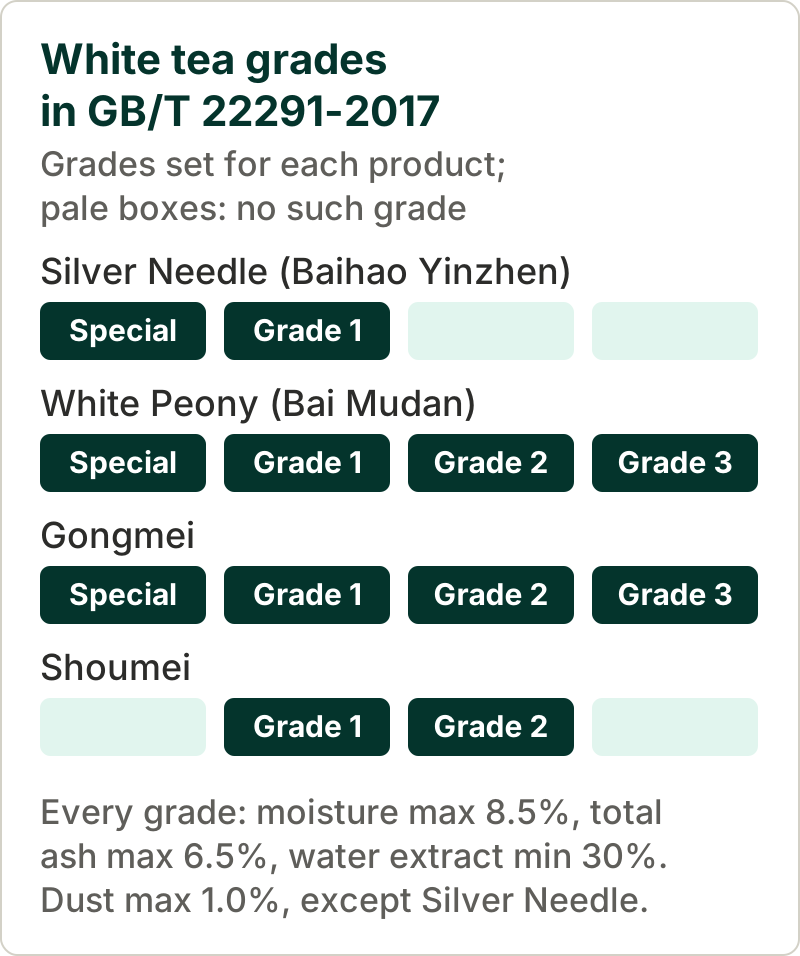
- Under GB/T 22291-2017, Silver Needle has two grades (special grade and grade 1), White Peony and Gongmei four each (special grade to grade 3) and Shoumei two (grades 1 and 2): 12 grades in all.
- GB/T 22291-2017 caps every white tea grade at 8.5% moisture and 6.5% total ash, requires at least 30% water extract, and limits dust to 1.0% for White Peony, Gongmei and Shoumei.
- Anji Bai Cha (安吉白茶) is a green tea despite its name: its geographical-indication specification, filed under the EU–China agreement of 2020, describes a green tea made from the Baiye No. 1 cultivar.
- China exported 477 tonnes of white tea in 2025, 0.11% of its tea export volume and 4.63% more than in 2024, according to the China Tea Marketing Association.
White tea grades are set by China’s national standard GB/T 22291-2017, which divides white tea (白茶) into four products by cultivar and raw material: Silver Needle (白毫银针), graded special grade and grade 1; White Peony (白牡丹, Bai Mudan) and Gongmei (贡眉), each graded from special grade to grade 3; and Shoumei (寿眉), graded 1 and 2. Every grade must stay within 8.5% moisture and 6.5% total ash and reach at least 30% water extract. Compressed white tea has its own standard, GB/T 31751-2015, and Anji Bai Cha (安吉白茶), despite its name, is a green tea.
What white tea is: GB/T 22291 and ISO 20715
GB/T 22291-2017 covers white tea made from the buds, leaves and tender stems of the tea plant by withering, drying and sorting. Unlike green tea, it is not fixed by heat; our guide to the six Chinese tea types compares the processing steps. The international standard ISO 20715:2023 defines white tea as tea made by a single withering and drying stage of the bud, or of the bud and one to three tender leaves, and divides it into bud white tea and bud-leaf white tea.
China is not the only grower. The official record of the English version of GB/T 22291, published on 12 April 2024, names Sri Lanka, Kenya, India, Nepal, Vietnam and Laos as countries growing white tea on a large scale, and presents the translation as a reference for countries that import Chinese white tea.
White tea grades in GB/T 22291-2017: four products, 12 grades
The standard was published on 1 November 2017 and took effect on 1 May 2018, replacing the 2008 edition. Among the main technical changes listed in its foreword, Shoumei was added as a product, with its own sensory and physical and chemical requirements, and water extract became a requirement. The official record shows a review on 24 March 2021 that concluded the standard should be revised, and it still lists the 2017 edition as in force (checked October 2026).
White tea products and grades (GB/T 22291-2017, clauses 3 and 4, Tables 1 to 4)
| Product | Raw material | Grades |
|---|---|---|
| Silver Needle (白毫银针, Baihao Yinzhen) | single buds of Dabai (大白茶) or Shuixian (水仙) cultivars | special grade, grade 1 |
| White Peony (白牡丹, Bai Mudan) | one bud with one or two leaves, Dabai or Shuixian cultivars | special grade, grades 1 to 3 |
| Gongmei (贡眉) | tender shoots of local seedling bushes (群体种) | special grade, grades 1 to 3 |
| Shoumei (寿眉) | tender shoots or leaves of Dabai, Shuixian or seedling bushes | grades 1 and 2 |
Each grade of each product has a physical reference sample, renewed every three years. The grades are named in words only: unlike the gunpowder standard, GB/T 22291 gives them no export codes.
Silver Needle grades and White Peony (Bai Mudan) grades
Down the scale, buds get fewer and slimmer, the down sparser and the liquor deeper, from pale apricot in special-grade Silver Needle to orange-yellow in White Peony grade 2. “Downy” renders 毫 (hao), the fine white hairs on the buds that give Baihao Yinzhen its name.
Sensory requirements, Silver Needle and White Peony (GB/T 22291-2017, Tables 1 and 2)
| Product and grade | Dry leaf and evenness | Cleanliness and colour | Aroma and taste | Liquor and infused leaf |
|---|---|---|---|---|
| Silver Needle, special | Plump needle buds, thick down; even | Clean; silvery grey-white, lustrous | Clean, pronounced downy aroma; fresh, mellow, brisk, full downy taste | Pale apricot-yellow, clear and bright; plump, soft, tender, bright |
| Silver Needle, grade 1 | Slender, long buds, slightly thinner down; fairly even | Clean; silvery grey-white | Clean, clear downy aroma; fresh, mellow, brisk, clear downy taste | Apricot-yellow, clear and bright; tender, even, bright |
| White Peony, special | Many plump buds, much down under the leaves; even | Clean; grey-green, glossy | Fresh, tender, clear downy aroma; sweet, mellow, brisk, full downy taste | Yellow, clear; many buds, plump, tender, bright leaves |
| White Peony, grade 1 | Buds fairly visible, fairly plump, tender leaves; fairly even | Fairly clean; grey-green, fairly glossy | Fairly fresh, some downy aroma; fairly sweet, mellow, brisk | Fairly yellow, clear; fairly many buds, tender, fairly bright leaves |
| White Peony, grade 2 | Buds fairly visible, leaves fairly tender; fairly even | A few yellow-green pieces; fairly grey-green | Strong, pure, slight downy aroma; fairly sweet, mellow, full | Orange-yellow; some buds, fairly tender leaves, a few reddened ones |
Gongmei and Shoumei grades, and Shoumei vs Bai Mudan
Gongmei and Shoumei are the leafier products. Shoumei entered the standard in 2017, with two grades only.
Sensory requirements, Gongmei and Shoumei (GB/T 22291-2017, Tables 3 and 4)
| Product and grade | Dry leaf and evenness | Cleanliness and colour | Aroma and taste | Liquor and infused leaf |
|---|---|---|---|---|
| Gongmei, special | Curled leaves, with buds; even | Clean; grey-green or dark green | Fresh, tender, downy aroma; sweet, mellow, brisk | Orange-yellow; some bud tips, tender, bright leaves |
| Gongmei, grade 1 | Leaves fairly curled, bud tips fairly visible; fairly even | Fairly clean; fairly grey-green | Fresh, pure, tender aroma; mellow, full, fairly brisk | Fairly orange-yellow; a few bud tips, soft, fairly bright leaves |
| Shoumei, grade 1 | Leaves fairly tightly curled; fairly even | Fairly clean; fairly grey-green | Pure; mellow, full, fairly brisk | Fairly orange-yellow; a few bud tips, soft, fairly bright leaves |
The lower grades of White Peony and Gongmei are not shown: we could not check their criteria against the 2017 text.
Shoumei and Bai Mudan differ first in raw material. White Peony must come from one bud with one or two leaves of Dabai or Shuixian bushes, and its special grade shows many plump buds and a clear yellow liquor. Shoumei may be made from shoots or leaves alone, from the same cultivars or from seedling bushes. Its grade 1 is described with only a few bud tips and a fairly orange-yellow liquor, close to Gongmei grade 1. The description of Shoumei grade 2 could not be checked against the official text of the standard, so it is not shown here.
White tea moisture, ash and dust limits
Physical and chemical requirements (GB/T 22291-2017, Table 5, % by mass)
| Parameter | Limit | Applies to |
|---|---|---|
| Moisture, max | 8.5% | every product and grade |
| Total ash, max | 6.5% | every product and grade |
| Dust, max | 1.0% | White Peony, Gongmei and Shoumei |
| Water extract, min | 30% | every product and grade |
 Source: China’s national standard GB/T 22291-2017, clauses 3 and 4 and Tables 1 to 5 (2017)
The standard also asks for normal colour, aroma and taste, with no non-tea matter, additives, off-odours or deterioration. Moisture is tested by GB/T 8304, total ash by GB/T 8306, dust by GB/T 8311, water extract by GB/T 8305 and sensory quality by GB/T 23776. GB/T 8304 and GB/T 8306 were withdrawn on 2 March 2017; the current methods are GB 5009.3-2016 for moisture and GB 5009.4-2016 for ash. Each batch is released after checks of sensory quality, moisture and net content.
The 8.5% moisture limit is a ceiling, not a target: the Fuding white tea specification filed with the EU sets 7.0% moisture, with 6.5% total ash and 1.0% dust, Silver Needle excepted.
Compressed white tea and “aged” claims
Cakes and bricks follow a separate standard, GB/T 31751-2015, published on 3 July 2015 and in force since 1 February 2016. It covers white tea that has been sorted, blended, steam-pressed into shape and dried, in four types named after the loose tea they are pressed from: compressed Silver Needle, compressed White Peony, compressed Gongmei and compressed Shoumei. Its review of 17 May 2021 concluded that it should be revised; the 2015 edition is still listed as in force (checked October 2026). Pu-erh cakes are covered in our guide to pu-erh tea grades.
GB/T 22291 refers storage to China’s tea storage standard, GB/T 30375, and states that the product can be kept long-term. Neither national standard defines “aged” white tea (老白茶); association standards cover it, such as the Cross-Strait Tea Industry Exchange Association’s T/CSTEA 00021-2025, Aged white tea (年份老白茶), issued on 7 July 2025 to replace its 2021 edition. We recommend asking for the production date and storage record behind any year printed on a cake.
Fuding and Zhenghe white tea: geographical indications and output
Fuding white tea (福鼎白茶) has been a protected geographical indication (GI) in China since 4 May 2009, under notice No. 32 of 2009 of China’s former General Administration of Quality Supervision, Inspection and Quarantine (AQSIQ). Its specification, filed with the EU, covers the administrative area of Fuding city, the Fuding Dabai and Fuding Dahao cultivars, and three types: Silver Needle, White Peony and “new craft” white tea (新工艺白茶), which is lightly rolled. Zhenghe white tea (政和白茶) has been protected since March 2007 and has its own national GI standard, GB/T 22109-2008. Its replacement, GB/T 22109-2026, published on 31 March 2026, takes effect on 1 April 2027; according to its project record, it adds Shoumei, Gongmei and compressed white tea, and adds grades.
White tea names in the EU–China agreement on geographical indications
| Name in the agreement | Chinese | Protected in China | List in the agreement |
|---|---|---|---|
| Fuding Bai Cha (Fuding White Tea) | 福鼎白茶 | since 4 May 2009 | Annex III, protected in the EU since 1 March 2021 |
| Zhenghe Bai Cha (Zhenghe White Tea) | 政和白茶 | since March 2007 | Annex V (second list), No. 97 |
| Anji Bai Cha (Anji White Tea), a green tea | 安吉白茶 | since 6 April 2004 | Annex III, protected in the EU since 1 March 2021 |
The agreement was signed on 14 September 2020 and entered into force on 1 March 2021. Annex III lists the 100 Chinese names that the EU undertook to protect from that date. Annex V lists 175 more which, under Article 3, “will be processed” during the agreement’s first four years in force; they are protected once the agreement’s joint committee adds them to Annex III. In December 2025, China’s intellectual property office (CNIPA) described mutual protection of this second list as still under way.
The sources reviewed give no official white tea total for Fujian. The province produced 601,900 tonnes of tea of all types in 2025, 4.2% more than in 2024 (Fujian Provincial Bureau of Statistics). In 2024, Fuding produced 41,000 tonnes of tea, 21,000 tonnes of it white tea, from about 319,000 mu (some 21,300 hectares) of tea gardens ready for plucking, Fujian Daily reported. In Jianyang, some 26,000 mu (about 1,700 hectares) of Xiao Bai Cha (小白茶) gardens yield more than 500 tonnes a year, the same paper reported in June 2025. Nationally, white tea made up 2.75% of China’s 3.64 million tonnes of crude tea in 2025, about 100,100 tonnes (China Tea Marketing Association; our calculation).
Anji Bai Cha is a green tea
Anji Bai Cha, from Anji county in Zhejiang, is a green tea despite its name. Its GI specification, filed with the EU by the county government, describes “a kind of green tea” made from the Baiye No. 1 (白叶一号) cultivar, and lists fixation, the heating step of green tea making, in both of its processes. The name comes from the leaf, which turns pale in cool weather, as China’s mission to the EU explained in 2021. Anji Bai Cha has been a GI in China since 6 April 2004; its national standard, GB/T 20354-2006, will be replaced by GB/T 20354-2026 on 1 April 2027. Because the agreement translates its name as “Anji White Tea”, we recommend calling it a green tea on contracts and customs documents. Other Chinese green teas with protected names are covered in our guide to Chinese green tea geographical indications.
White tea exports and the HS code
China exported 477 tonnes of white tea in 2025, 4.63% more than in 2024 and 0.11% of its tea export volume, according to the China Tea Marketing Association (CTMA), which draws on customs data. That equals roughly 0.5% of white tea output (our calculation, comparing exported tea with crude tea). China’s Ministry of Commerce (MOFCOM) counts the white tea lines in “speciality tea”, with oolong, jasmine and dark teas, and the six-digit HS subheadings do not name white tea. The sources reviewed give no destinations for Chinese white tea.
Since 1 January 2023, China’s tariff has had its own white tea lines, split from other green tea: 0902.1020 for immediate packings of 3 kg or less and 0902.2020 for larger packings. Jasmine tea, covered in our jasmine tea grades guide, got its own lines the same day. In China, white tea therefore sits under the green tea subheadings 0902.10 and 0902.20. The HS 2028 text, in force from 1 January 2028, names white tea, with yellow tea and oolong, as partly fermented tea under 0902.30 and 0902.40, and calls black and dark tea fermented tea (see our Chinese black tea grades). How China’s 2028 tariff will treat white tea is not yet known (checked October 2026); our guide to tea HS codes follows the change.
What to put in a white tea purchase specification
- Product and grade: the product and grade (for example White Peony, grade 1), GB/T 22291-2017 and the number of the sealed contract sample.
- Limits: moisture ≤8.5% (GB 5009.3-2016; the standard cites GB/T 8304, withdrawn in 2017), or a lower figure if you need it; total ash ≤6.5% (GB 5009.4-2016; the standard cites GB/T 8306, withdrawn in 2017); dust ≤1.0% (GB/T 8311) except for Silver Needle; water extract ≥30% (GB/T 8305).
- Cakes and bricks: the compressed type under GB/T 31751-2015, and the year and grade of the loose tea it was pressed from.
- Origin: for Fuding or Zhenghe white tea, the GI area and the specification the tea is made to.
- Name: the Chinese name (白茶, or 绿茶 for Anji Bai Cha) on the contract, invoice and customs entry.
- Customs line: 0902.1020 or 0902.2020 at Chinese export, by packing size, and a check of the line once HS 2028 applies.
- Age claims: the production date and storage record behind any year or “aged” label.
- Residues and storage: the destination’s residue limits, with a test report per lot, and storage to GB/T 30375. The EU’s contaminant limits are covered in our guide to EU contaminant limits for tea.
Questions and answers
What are the grades of white tea?
China's standard GB/T 22291-2017 grades Silver Needle as special grade or grade 1, White Peony and Gongmei from special grade to grade 3, and Shoumei as grade 1 or grade 2. The grades are named in words, with no export codes.
What is the difference between Shoumei and Bai Mudan?
Under GB/T 22291-2017, Bai Mudan (White Peony) is made from one bud with one or two leaves of Dabai or Shuixian cultivars and has four grades. Shoumei may be made from shoots or leaves, also of seedling bushes, has two grades and shows fewer buds and a more orange liquor.
Is Anji Bai Cha a white tea?
No. Its geographical-indication specification describes a green tea made from the Baiye No. 1 cultivar, with a fixing step in processing. The 'white' in its name refers to its leaves, which turn pale in cool weather.
Is Fuding white tea a protected geographical indication?
Yes. China has protected Fuding white tea since 4 May 2009, and it is on Annex III of the EU–China agreement on geographical indications, protected in the EU since 1 March 2021. Zhenghe white tea, protected in China since March 2007, is on the agreement's second list (Annex V), which was still being processed in December 2025.
What is the HS code for white tea?
China declares white tea under the green tea subheadings, with its own lines since 1 January 2023: 0902.1020 for immediate packings of 3 kg or less and 0902.2020 for larger ones. The HS 2028 text, in force from 1 January 2028, names white tea as a partly fermented tea under 0902.30 and 0902.40.
What moisture content should white tea have?
No more than 8.5% for every product and grade under GB/T 22291-2017, tested by method GB/T 8304, withdrawn in 2017 and replaced by GB 5009.3-2016. The Fuding white tea specification filed with the EU sets 7.0%.
Sources
- 1. GB/T 22291-2017 White tea, entry in China's official standards reading system (in Chinese) · openstd.samr.gov.cn
- 2. National public service platform for standards information: GB/T 22291-2017 record and 2021 review (in Chinese) · std.samr.gov.cn
- 3. National public service platform for standards information: English version of GB/T 22291-2017, published 12 April 2024 (in Chinese) · std.samr.gov.cn
- 4. National Library of Standards of China: GB/T 22291-2017 White tea, scope (in Chinese) · ndls.org.cn
- 5. National public service platform for standards information: GB/T 31751-2015 Compressed white tea, record and 2021 review (in Chinese) · std.samr.gov.cn
- 6. National Library of Standards of China: GB/T 31751-2015 Compressed white tea, scope (in Chinese) · ndls.org.cn
- 7. National Library of Standards of China: T/CSTEA 00021-2025 Aged white tea, group standard record (in Chinese) · ndls.org.cn
- 8. National public service platform for standards information: GB/T 22109-2008 Product of geographical indication, Zhenghe white tea, record and 2025 review (in Chinese) · std.samr.gov.cn
- 9. National public service platform for standards information: GB/T 22109-2026 Quality requirements for product of geographical indication, Zhenghe white tea (in Chinese) · std.samr.gov.cn
- 10. National public service platform for standards information: project 20240645-T-463, revision of the Zhenghe white tea standard (in Chinese) · std.samr.gov.cn
- 11. National public service platform for standards information: GB/T 20354-2006 Product of geographical indication, Anji Bai Cha, record and 2025 review (in Chinese) · std.samr.gov.cn
- 12. National public service platform for standards information: GB/T 20354-2026 Quality requirements for product of geographical indication, Anji Bai Cha (in Chinese) · std.samr.gov.cn
- 13. EUR-Lex: Agreement between the EU and the Government of the People's Republic of China on cooperation on, and protection of, geographical indications, signed 14 September 2020 · eur-lex.europa.eu
- 14. Council of the European Union: the EU–China agreement on geographical indications with its annexes, document 8361/20, 9 July 2020 · data.consilium.europa.eu
- 15. MOFCOM intellectual property portal: Chinese tea names on Annex III of the China–EU agreement on geographical indications (in Chinese) · ipr.mofcom.gov.cn
- 16. MOFCOM intellectual property portal: the China–EU agreement on geographical indications, signature, entry into force and the two lists (in Chinese) · ipr.mofcom.gov.cn
- 17. China National Intellectual Property Administration: China–EU cooperation on geographical indications, 3 December 2025 (in Chinese) · cnipa.gov.cn
- 18. European Commission GI register (eAmbrosia): technical specification of the geographical indication Fuding Bai Cha · ec.europa.eu
- 19. European Commission GI register (eAmbrosia): technical specification of the geographical indication Anji Bai Cha · ec.europa.eu
- 20. Mission of the People's Republic of China to the EU: Anji Bai Cha, a product of the China–EU agreement on geographical indications, 11 June 2021 (in Chinese) · eu.china-mission.gov.cn
- 21. Fujian provincial government portal, from Fujian Daily: Zhenghe and its tea, 27 December 2023 (in Chinese) · fujian.gov.cn
- 22. Fujian provincial government portal, from Fujian Daily: Fuding's tea output in 2024, 22 March 2025 (in Chinese) · fujian.gov.cn
- 23. Fujian provincial government portal, from Fujian Daily: Fujian's tea industry, with Jianyang white tea, 14 June 2025 (in Chinese) · fujian.gov.cn
- 24. Fujian Provincial Bureau of Statistics: statistical communiqué on Fujian's economic and social development in 2025 (in Chinese) · tjj.fujian.gov.cn
- 25. China Tea Marketing Association: 2025 tea production and sales analysis, part 1 (association's news-portal account, 9 April 2026, in Chinese) · sohu.com
- 26. China Tea Marketing Association: China's tea imports and exports in 2025, 20 January 2026 (in Chinese) · ctma.com.cn
- 27. MOFCOM: China export monthly statistical report, tea, December 2024, with the code list (in Chinese) · wms.mofcom.gov.cn
- 28. State Council Tariff Commission: 2023 tariff line adjustment table, annex 7, with the new white tea lines (in Chinese) · gss.mof.gov.cn
- 29. Office of the State Council Tariff Commission: tariff changes from 1 January 2023, 29 December 2022 (in Chinese) · gss.mof.gov.cn
- 30. World Customs Organization: amendments to the HS Nomenclature in force from 1 January 2028 (NG0304Ba) · wcoomd.org
- 31. World Customs Organization: HS Nomenclature 2022 edition, Chapter 9 (heading 09.02) · wcoomd.org
- 32. ISO 20715:2023, Tea — Classification of tea types (preview pages) · cdn.standards.iteh.ai
- 33. National Health Commission: catalogue of national food safety standards, including GB 5009.3-2016 and GB 5009.4-2016 (in Chinese) · nhc.gov.cn