Oolong tea grades: Tieguanyin, Wuyi rock tea and more
Oolong tea grades come from China's GB/T 30357 standards and GB/T 18745 for Wuyi rock tea: Tieguanyin in three aroma types, Da Hong Pao in three grades.
Key facts
- China's oolong standard GB/T 30357 (乌龙茶) has eight published parts, Parts 1 to 7 and Part 9, from basic requirements (Part 1, 2013) to Baiyaqilan (Part 9, 2020), all still in force in October 2026 according to the official records.
- In the Anxi Tieguanyin specification filed with the EU, which keeps the grades of the 2006 Anxi standard, Tieguanyin (铁观音) has four grades of delicate aroma (清香型) and five of strong aroma (浓香型); China's standards GB/T 30357.2-2013 and GB/T 19598-2025 also cover an aged-aroma type (陈香型).
- China's standard GB/T 30357.1-2013 caps oolong at 7.0% moisture, 6.5% total ash, 16% broken tea and 1.3% dust and requires at least 32% water extract, while Wuyi rock tea's GB/T 18745-2006 caps moisture at 6.5%.
- GB/T 18745-2006 divides Wuyi rock tea (武夷岩茶) into Da Hong Pao, Mingcong, Rougui, Shuixian and Qizhong, with three grades each for Da Hong Pao and Rougui; GB/T 18745-2026 replaces it on 1 April 2027.
- China exported 13,900 tonnes of oolong in 2025, 3.32% of its tea export volume and 10.14% less than in 2024, according to the China Tea Marketing Association.
Oolong tea grades in China are set by the national standard series GB/T 30357 (乌龙茶), which has eight published parts, and for Wuyi rock tea by the geographical-indication standard GB/T 18745-2006. Tieguanyin comes in delicate-aroma (清香型) and strong-aroma (浓香型) types, graded from special grade down to grade 3 or grade 4 in the Anxi specification filed with the EU, plus an aged-aroma type (陈香型); Wuyi Da Hong Pao and Rougui have three grades each. Most parts of the series cap moisture at 7.0% and require at least 32% water extract, while Wuyi rock tea is capped at 6.5% moisture.
Oolong standards in China: the GB/T 30357 series
Oolong is one of the six Chinese tea types. GB/T 30357.1-2013 describes it as tea made from the leaves, dormant buds and tender shoots of the tea plant by moderate withering, “fine manipulation” (做青), fixing, rolling and drying. Fine manipulation bruises the leaf edges so that part of their polyphenols oxidise, producing green leaves with red edges (绿叶红边). The international standard ISO 20716:2022 defines oolong in similar terms and sorts it by degree of oxidation into light, medium and high.
GB/T 30357, oolong tea: the parts (official records, checked October 2026)
| Part | Product | Edition | In force since | Number of grades |
|---|---|---|---|---|
| 1 | Basic requirements | GB/T 30357.1-2013 | 22 June 2014 | none: limits for every oolong |
| 2 | Tieguanyin (铁观音) | GB/T 30357.2-2013, with Amendment No. 1 | 22 June 2014 | 3 types: delicate, strong and aged aroma (grade tables not checked) |
| 3 | Huangjingui (黄金桂) | GB/T 30357.3-2015 | 2 November 2015 | 2 |
| 4 | Shuixian (水仙) | GB/T 30357.4-2015 | 2 November 2015 | 4 each, strip and compressed |
| 5 | Rougui (肉桂) | GB/T 30357.5-2015 | 2 November 2015 | 3 |
| 6 | Dancong (单丛) | GB/T 30357.6-2017 | 1 January 2018 | 4 each, strip and granular |
| 7 | Foshou (佛手) | GB/T 30357.7-2017 | 1 May 2018 | 3 (delicate aroma), 5 (strong aroma), 4 (aged aroma) |
| 9 | Baiyaqilan (白芽奇兰) | GB/T 30357.9-2020 | 1 April 2021 | 4 each, granular and strip, delicate and strong aroma |
Each scale starts at special grade (特级), then grade 1 (一级), grade 2 (二级) and so on; the grades are named in words only, with no export codes, and each has a physical reference sample, renewed every three years. Each product part is named after a cultivar, not a place: Part 5, for example, covers oolong made from the Rougui cultivar wherever it is grown. The official records show a review on 17 May 2021 that concluded Parts 1 to 7 should be revised; all eight published parts were still listed as in force in October 2026, and no Part 8 had been published. Taiwan-style oolong has a separate national standard, GB/T 39563-2020 (台式乌龙茶), in force since 1 June 2021.
Oolong moisture, ash and water extract limits
Physical and chemical limits for oolong (% by mass; GB/T 30357, GB/T 18745-2006 and ISO 20716:2022)
| Parameter | GB/T 30357, Parts 1, 4 to 7 and 9 | Wuyi rock tea, GB/T 18745-2006 | ISO 20716:2022 |
|---|---|---|---|
| Moisture, max | 7.0% | 6.5% | no limit |
| Total ash | max 6.5% | max 6.5% | 4.0% to 8.0% |
| Water extract, min | 32% | no limit | 32% |
| Broken tea, max | 16% | 15.0% | no limit |
| Dust, max | 1.3% | 1.3% | no limit |
Huangjingui (Part 3) is the exception in the series, at 7.5% moisture, and compressed Shuixian has no broken-tea or dust limit. ISO 20716 adds chemical minimums on a dry-matter basis: 10.0% total polyphenols, 3.0% total catechins, with a catechin-to-polyphenol ratio of at least 0.3, 1.0% caffeine and 0.1% theanine, and it caps crude fibre at 16.5%. Under GB/T 30357.1, each batch is released after checks of sensory quality, moisture, broken tea, dust and net content, and contaminant and residue limits are those of China’s GB 2762 and GB 2763. The Chinese series bans colouring and additives, and ISO 20716 bans colouring agents and flavourings.
Tieguanyin grades: delicate, strong and aged aroma
GB/T 30357.2-2013 covers raw and refined tea made from the Tieguanyin cultivar, wherever it is grown, and sets its classification and physical reference samples; its official record notes one amendment (第1号修改单). Finished Tieguanyin comes in two main types: delicate aroma (清香型), dried over a gentle fire, and strong aroma (浓香型), roasted (烘焙). The Anxi Tieguanyin specification filed with the EU, which keeps the grades of the 2006 Anxi standard, grades the first as special grade (特级) or grades 1 to 3, and the second as special grade or grades 1 to 4 (四级). It names yinyun (音韵) among the tea’s quality characteristics and describes it as the combined flavour and aroma peculiar to the Tieguanyin cultivar.
In January 2024, the drafters of the new Anxi standard wrote that aged-aroma Anxi Tieguanyin was then made mainly to GB/T 30357.2-2013, and the 2025 Anxi standard has since added it (see below). The grade and sensory tables of GB/T 30357.2 are not reproduced here, because no official copy of them could be read (checked October 2026).
Anxi Tieguanyin: the geographical-indication standard GB/T 19598-2025
Anxi Tieguanyin (安溪铁观音) is Tieguanyin from Anxi county in Fujian. China has protected the name as a geographical indication (GI) since 8 July 2004, under notice No. 91 of 2004 of its former quality inspection administration (AQSIQ), and the EU has protected it since 1 March 2021. GB/T 30357.2 applies to the cultivar wherever it is grown; the name Anxi Tieguanyin is reserved for tea from the county.
The GI standard, GB/T 19598-2025, was published on 28 February 2025 and took effect on 1 September 2025, replacing the 2006 edition; its official English version followed on 3 November 2025. Anxi county’s media centre reported that it adds aged-aroma Anxi Tieguanyin and, citing the county tea office, new limits for water extract, catechins and theanine. The published values could not be checked (October 2026). The specification filed with the EU still carries the grades and limits of the 2006 edition, including moisture of up to 7.5%.
Wuyi rock tea grades: Da Hong Pao, Rougui, Shuixian
Wuyi rock tea (武夷岩茶, Wuyi yancha) is oolong grown and made within the administrative area of Wuyishan city in Fujian, from clonally propagated bushes, and marked by the “rock character” (岩韵, yanyun) that GB/T 18745-2006 glosses as 岩骨花香, “rock bones, flower fragrance”. The standard, published on 18 July 2006 and in force since 1 December 2006, divides it into five categories.
Wuyi rock tea categories and grades (GB/T 18745-2006, clause 5.1 and Tables 2 to 6)
| Category | Grades |
|---|---|
| Da Hong Pao (大红袍) | special grade, grades 1 and 2 |
| Mingcong (名枞, “famous bushes”) | none: one set of requirements |
| Rougui (肉桂, “cinnamon”) | special grade, grades 1 and 2 |
| Shuixian (水仙) | special grade, grades 1 to 3 |
| Qizhong (奇种, from local seedling bushes) | special grade, grades 1 to 3 |
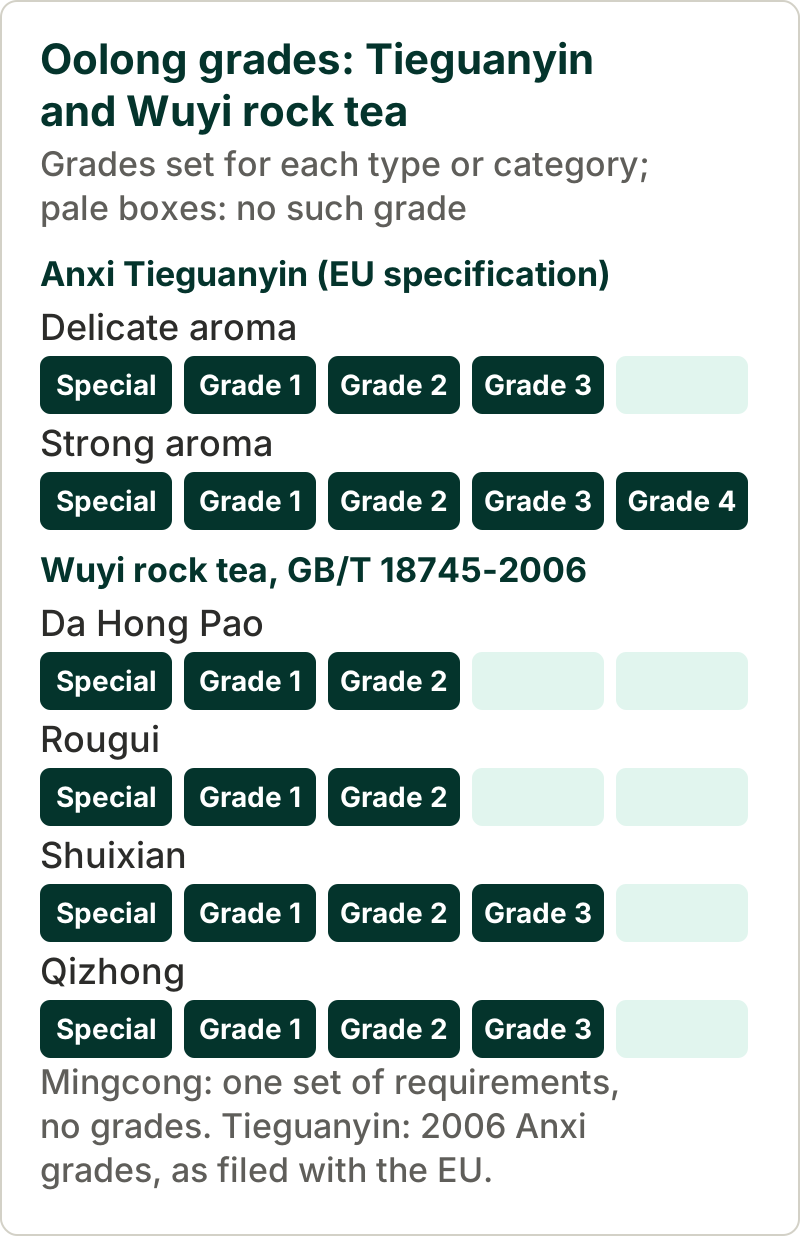 Source: Anxi Tie Guan Yin specification in the EU register of geographical indications (eAmbrosia), Tables 1 and 2; China’s national standard GB/T 18745-2006, Tables 2 to 6
Compared with the 2002 edition, the 2006 edition added the Da Hong Pao grades, dropped the split of the area into raw-material zones and the classification of cultivars, and became voluntary rather than mandatory. An amendment to the 2006 edition replaced the standard’s own table of contaminant and residue limits with China’s food safety standards GB 2762 and GB 2763. Labels must state the cultivar or category, the grade and the standard number.
Rougui grades in Wuyi rock tea (GB/T 18745-2006, Table 4)
| Grade | Dry leaf | Aroma | Taste | Liquor |
|---|---|---|---|---|
| Special (特级) | plump, tight, heavy; glossy, sand-green, distinct red spots | rich and lasting, suggesting milk, honey peach or cinnamon | mellow, full, fresh, brisk; rock character pronounced | golden, clear, bright |
| Grade 1 (一级) | fairly plump, firm, heavy; glossy, sand-green fairly clear, fairly distinct red spots | clear, high, lingering | mellow, full, fairly fresh; rock character clear | orange-yellow, clear |
| Grade 2 (二级) | fairly firm, curled, slightly heavy; dark, glossy, tinged reddish-brown or brownish-green | clean | mild; slight rock character | orange-yellow, slightly deep |
Rougui grown outside Wuyishan can still be graded under GB/T 30357.5-2015, in the same three grades and with similar words, but its taste descriptors do not mention rock character, and it may hold 7.0% moisture instead of 6.5%. Special-grade Da Hong Pao needs tight, sturdy, slightly twisted leaf with a gem-like sheen (宝色) or gloss, pronounced rock character and a deep orange-yellow liquor; grade 2 has a subtle, lasting aroma and a golden liquor.
GB/T 18745-2026, published on 31 March 2026, replaces the 2006 edition on 1 April 2027; the official record listed it as not yet in force in October 2026. Its project notice of March 2024 announced the main changes: aged Wuyi rock tea (陈茶) with its own sensory description, a new grading for Qizhong and a stated storage period. The published text was not checked.
Da Hong Pao and the oolong names protected in the EU
Da Hong Pao is covered by two protected names. As a category of Wuyi rock tea, it falls under the GI Wuyi Yan Cha, protected in China since 8 March 2002 (AQSIQ notice No. 23 of 2002) across Wuyishan city. Mount Wuyi Da Hong Pao (武夷山大红袍) is a separate name, registered in China as a certification mark on 21 December 2001 (No. 1687896), whose EU specification places its producing area in the Mount Wuyi scenic area. Both are among the 100 Chinese names that the EU–China agreement on geographical indications has protected in the EU since it took effect on 1 March 2021. The green teas among those names are covered in our guide to Chinese green tea geographical indications.
Oolong names on Annex III of the EU–China agreement on geographical indications (Council document 8361/20)
| Name in the agreement | Chinese | Protected in China | List in the agreement |
|---|---|---|---|
| Anxi Tie Guan Yin | 安溪铁观音 | since 8 July 2004 | Annex III, No. 2 |
| Fenghuang Dan Cong (Fenghuang Single Cluster) | 凤凰单丛 | since 14 April 2010 | Annex III, No. 35 |
| Wuyishan Da Hong Pao (Mount Wuyi Da Hong Pao) | 武夷山大红袍 | certification mark since 21 December 2001 | Annex III, No. 38 |
| Wuyi Yan Cha (Wuyi Rock Tea) | 武夷岩茶 | since 8 March 2002 | Annex III, No. 59 |
Annex V lists 175 more Chinese names that were to be processed within four years of the agreement’s entry into force, among them Pinghe Bai Ya Qi Lan (平和白芽奇兰, No. 40); Baiyaqilan has its own part of GB/T 30357 (Part 9). In December 2025, an article published by China’s intellectual property office (CNIPA) described the mutual protection of this second list as still under way. Fenghuang Dan Cong comes from Fenghuang in Guangdong.
Oolong exports and the HS code
China exported 13,900 tonnes of oolong in 2025, 3.32% of its tea export volume and 1,568 tonnes (10.14%) less than in 2024, according to the China Tea Marketing Association (CTMA), which draws on customs data. It also imported 1,548 tonnes, 21.08% more than in 2024. Most oolong stays in China: oolong made up 9.61% of the country’s 3.64 million tonnes of crude tea in 2025, about 349,800 tonnes, so exports equalled roughly 4% of output (our calculation from CTMA figures).
The HS Explanatory Notes place partly fermented tea such as oolong in heading 09.02, with black tea: subheading 0902.30 for immediate packings of 3 kg or less and 0902.40 for the rest. China’s tariff gives oolong its own lines, 0902.3010 and 0902.4010, and the Ministry of Commerce (MOFCOM) counts both in its “speciality tea” group, with white tea, jasmine tea and other scented tea, ripe pu-erh and other dark tea. The six-digit figures China reports to UN Comtrade mix oolong with black tea and dark tea: 41,638 tonnes left under 0902.30 and 0902.40 in 2025, of which oolong was about a third (our calculation). The HS 2028 text, in force from 1 January 2028, names oolong as a partly fermented tea under the same two subheadings; our guide to tea HS codes explains the change.
What to put in an oolong purchase specification
- Standard, type and grade: the part and its year (for example GB/T 30357.2-2013 with Amendment No. 1), the type (清香型, 浓香型 or 陈香型) and the grade, in Chinese and English.
- Reference sample: the number of the sealed contract sample, since each grade is defined against a physical reference sample.
- Limits: moisture ≤7.0% (method GB 5009.3-2016; the standards cite GB/T 8304, withdrawn in 2017), or ≤6.5% for Wuyi rock tea (GB 5009.3); water extract ≥32% (GB/T 8305); broken tea ≤16% and dust ≤1.3% (GB/T 8311).
- Origin and name: for Anxi Tieguanyin or Wuyi rock tea, the GI standard (GB/T 19598-2025; GB/T 18745-2006, then GB/T 18745-2026 from 1 April 2027) and proof that the producer may use the GI mark; for Da Hong Pao, which of the two protected names applies.
- Aged tea: the production date and storage record behind any aged-aroma or aged claim.
- Residues: the destination’s limits, with a test report per lot; at origin, China’s GB 2762 and GB 2763 apply. The EU’s maximum levels for contaminants are set out in our guide to EU contaminant limits for tea.
- Customs line: 0902.3010 or 0902.4010 at Chinese export, according to the net weight of each immediate packing.
- Disputes: a retained sample; GB/T 30357.1 settles a dispute by retesting it or a double sample drawn from the same lot.
Questions and answers
What are the grades of Tieguanyin?
In the Anxi Tieguanyin specification filed with the EU, which keeps the grades of the 2006 Anxi standard, delicate-aroma (清香型) Tieguanyin is graded special grade (特级) or grades 1 to 3, and strong-aroma (浓香型) Tieguanyin special grade or grades 1 to 4. A third type, aged aroma (陈香型), is covered by China's standard GB/T 30357.2-2013 and, since September 2025, by the Anxi standard GB/T 19598-2025.
What are the grades of Da Hong Pao?
As a category of Wuyi rock tea, Da Hong Pao is graded special grade (特级), grade 1 or grade 2 under GB/T 18745-2006, the edition that introduced these grades. That standard gives way to GB/T 18745-2026 on 1 April 2027, and no part of the national oolong series GB/T 30357 covers Da Hong Pao (checked October 2026).
Is Wuyi rock tea a protected geographical indication?
Yes. China has protected Wuyi rock tea since 8 March 2002, for tea from Wuyishan city in Fujian, and the EU has protected Wuyi Yan Cha since 1 March 2021 under the EU–China agreement on geographical indications. Mount Wuyi Da Hong Pao, Anxi Tie Guan Yin and Fenghuang Dan Cong are on the same list.
What is the HS code for oolong tea?
Oolong is partly fermented tea, so it falls under 0902.30 in immediate packings of 3 kg or less and under 0902.40 otherwise. China's tariff gives it its own lines, 0902.3010 and 0902.4010.
What moisture content should oolong tea have?
No more than 7.0% under GB/T 30357.1-2013 and most parts of the series, 7.5% for Huangjingui and 6.5% for Wuyi rock tea under GB/T 18745-2006. The international standard ISO 20716:2022 sets no moisture limit.
Is there an international standard for oolong tea?
Yes: ISO 20716:2022, Oolong tea — Definition and basic requirements. It requires at least 32% water extract, 10.0% total polyphenols, 3.0% total catechins, 1.0% caffeine and 0.1% theanine on a dry-matter basis, but it defines no grades.
Sources
- 1. National public service platform for standards information: GB/T 30357.1-2013 Oolong tea, Part 1: Basic requirements, record and 2021 review (in Chinese) · std.samr.gov.cn
- 2. GB/T 30357.2-2013 Oolong tea, Part 2: Tieguanyin, entry in China's official standards reading system, with its Amendment No. 1 (in Chinese) · openstd.samr.gov.cn
- 3. National public service platform for standards information: GB/T 30357.2-2013 record and 2021 review (in Chinese) · std.samr.gov.cn
- 4. National Library of Standards of China: GB/T 30357.2-2013 Oolong tea, Part 2: Tieguanyin, scope (in Chinese) · ndls.org.cn
- 5. National public service platform for standards information: GB/T 30357.3-2015 Oolong tea, Part 3: Huangjingui, record (in Chinese) · std.samr.gov.cn
- 6. National public service platform for standards information: GB/T 30357.4-2015 Oolong tea, Part 4: Shuixian, record (in Chinese) · std.samr.gov.cn
- 7. National public service platform for standards information: GB/T 30357.5-2015 Oolong tea, Part 5: Rougui, record (in Chinese) · std.samr.gov.cn
- 8. National public service platform for standards information: GB/T 30357.6-2017 Oolong tea, Part 6: Dancong, record (in Chinese) · std.samr.gov.cn
- 9. National public service platform for standards information: GB/T 30357.7-2017 Oolong tea, Part 7: Foshou, record (in Chinese) · std.samr.gov.cn
- 10. National public service platform for standards information: GB/T 30357.9-2020 Oolong tea, Part 9: Baiyaqilan, record (in Chinese) · std.samr.gov.cn
- 11. National public service platform for standards information: GB/T 39563-2020 Taiwan style oolong tea, record (in Chinese) · std.samr.gov.cn
- 12. National public service platform for standards information: GB/T 18745-2006 Product of geographical indication, Wuyi rock-essence tea, record and 2025 review (in Chinese) · std.samr.gov.cn
- 13. National public service platform for standards information: GB/T 18745-2026 Quality requirements for product of geographical indication, Wuyi rock-essence tea (in Chinese) · std.samr.gov.cn
- 14. National public service platform for standards information: project 20240647-T-463, revision of the Wuyi rock tea standard, notice of March 2024 (in Chinese) · std.samr.gov.cn
- 15. National public service platform for standards information: GB/T 19598-2025 Quality requirements for product of geographical indication, Anxi tieguanyin (in Chinese) · std.samr.gov.cn
- 16. National public service platform for standards information: GB/T 19598-2006 Product of geographical indication, Anxi tieguanyin tea, record (in Chinese) · std.samr.gov.cn
- 17. National public service platform for standards information: English version of GB/T 19598-2025, published 3 November 2025 (in Chinese) · std.samr.gov.cn
- 18. Anxi county tea industry management committee and drafting group: notes on the consultation draft of the Anxi Tieguanyin standard, January 2024, on the China National Institute of Standardization site (in Chinese) · cnis.ac.cn
- 19. Anxi county media centre: the new national standard for Anxi Tieguanyin takes effect on 1 September, 17 March 2025 (in Chinese) · news.qq.com
- 20. ISO 20716:2022 Oolong tea, definition and basic requirements, sample pages · cdn.standards.iteh.ai
- 21. Council of the European Union: Agreement between the European Union and the Government of the People's Republic of China on cooperation on, and protection of, geographical indications, document 8361/20, 9 July 2020 · data.consilium.europa.eu
- 22. MOFCOM intellectual property portal: Chinese tea names on Annex III of the China–EU agreement on geographical indications (in Chinese) · ipr.mofcom.gov.cn
- 23. MOFCOM intellectual property portal: the China–EU agreement on geographical indications, signature, entry into force and the two lists (in Chinese) · ipr.mofcom.gov.cn
- 24. China National Intellectual Property Administration: China–EU cooperation on geographical indications, article from China Intellectual Property News, 3 December 2025 (in Chinese) · cnipa.gov.cn
- 25. European Commission GI register (eAmbrosia): technical specification of the geographical indication Anxi Tie Guan Yin · ec.europa.eu
- 26. European Commission GI register (eAmbrosia): technical specification of the geographical indication Wuyi Yan Cha · ec.europa.eu
- 27. European Commission GI register (eAmbrosia): technical specification of the geographical indication Wuyishan Da Hong Pao · ec.europa.eu
- 28. European Commission GI register (eAmbrosia): technical specification of the geographical indication Fenghuang Dan Cong · ec.europa.eu
- 29. China Tea Marketing Association: China's tea imports and exports in 2025, 20 January 2026 (in Chinese) · ctma.com.cn
- 30. China Tea Marketing Association: 2025 tea production and sales analysis, part 1 (association's news-portal account, 9 April 2026, in Chinese) · sohu.com
- 31. MOFCOM: China export monthly statistical report, tea, December 2024, with the code list of each tea group (in Chinese) · wms.mofcom.gov.cn
- 32. State Council Tariff Commission: 2021 agreement tariff rate table (annex 7, with the 8-digit lines of heading 0902, in Chinese) · gss.mof.gov.cn
- 33. World Customs Organization: HS Nomenclature 2022 edition, Chapter 9, coffee, tea, maté and spices · wcoomd.org
- 34. World Customs Organization: amendments to the HS Nomenclature in force from 1 January 2028 (NG0304Ba) · wcoomd.org
- 35. US Customs and Border Protection: ruling H236614 on oolong tea fermented with ginseng, quoting the HS Explanatory Notes, 5 August 2013 · rulings.cbp.gov
- 36. UN Comtrade via WITS: China exports of black and partly fermented tea in immediate packings of 3 kg or less, HS 0902.30, 2025 · wits.worldbank.org
- 37. UN Comtrade via WITS: China exports of other black and partly fermented tea, HS 0902.40, 2025 · wits.worldbank.org
- 38. National Health Commission: catalogue of national food safety standards, including GB 5009.3-2016 and GB 5009.4-2016 (in Chinese) · nhc.gov.cn