EU contaminant limits for tea: alkaloids and perchlorate
EU contaminant limits for tea: 150 µg/kg of pyrrolizidine alkaloids and 0.75 mg/kg of perchlorate (Regulation 2023/915), plus RASFF data on China.
Key facts
- Regulation (EU) 2023/915, which replaced Regulation (EC) No 1881/2006 on 25 May 2023, caps pyrrolizidine alkaloids in dried tea at 150 µg/kg, counted as the lower-bound sum of 21 alkaloids and 14 that co-elute with them, a limit that has applied since 1 July 2022.
- The EU maximum level for perchlorate in dried tea is 0.75 mg/kg, the same as for dried herbal and fruit infusions; it has applied since 1 July 2020 and is point 6.3.2 of Annex I to Regulation (EU) 2023/915 (consolidated version of 19 August 2026).
- Regulation (EU) 2023/915 sets no limit for lead, cadmium, aluminium or PAHs in leaf tea; its PAH limits for finely ground powders stirred into drinks, 10 µg/kg of benzo(a)pyrene and 50 µg/kg for four PAHs, were applied to matcha from China in a Dutch alert of February 2025.
- Anthraquinone in tea is held to 0.02 mg/kg as a pesticide residue under Regulation (EC) No 396/2005, while peer-reviewed studies name other possible sources without ranking them: deposition on tea gardens, fuel smoke during processing and formation in tea under heat.
- The Tea Trade counted 97 RASFF Window notifications on tea with China as a country of origin in 2021–2025: 71 for pesticide residues, 11 naming anthraquinone and 5 for contaminants, all five on matcha; 81 of the 97 were border rejections (count of October 2026).
The EU caps two contaminants in tea by name, both in Regulation (EU) 2023/915, which replaced Regulation (EC) No 1881/2006 in May 2023: pyrrolizidine alkaloids, at 150 µg/kg counted as the sum of 35 alkaloids, and perchlorate, at 0.75 mg/kg in dried tea. The regulation sets no limit for lead, cadmium, aluminium or polycyclic aromatic hydrocarbons (PAHs) in leaf tea, although its PAH limit for finely ground powders stirred into drinks has been applied to matcha. Anthraquinone, which peer-reviewed studies link to deposition on tea gardens, to fuel smoke during processing and to formation in tea under heat, is held to 0.02 mg/kg as a pesticide residue. In the EU’s Rapid Alert System for Food and Feed (RASFF), tea with China as a country of origin drew 97 notifications in 2021–2025, most for pesticide residues and 5 for contaminants, all five on matcha (The Tea Trade’s count, checked October 2026).
Which EU contaminant limits apply to tea
Commission Regulation (EU) 2023/915 of 25 April 2023 entered into force on 25 May 2023 and repealed Regulation (EC) No 1881/2006, keeping the maximum levels it had set. In the consolidated version of 19 August 2026, the latest when checked in October 2026, its Annex I names tea (Camellia sinensis) only in the entries for pyrrolizidine alkaloids and perchlorate. Two other entries can reach dried tea products without naming tea.
EU maximum levels that apply to tea products (source: Regulation (EU) 2023/915, Annex I, consolidated version of 19 August 2026)
| Contaminant | Product (point of Annex I) | Maximum level |
|---|---|---|
| Pyrrolizidine alkaloids, sum of 35 | Tea and flavoured tea, dried (2.4.4) | 150 µg/kg |
| Pyrrolizidine alkaloids | Tea, flavoured tea and herbal infusions for infants and young children, dried (2.4.5) | 75 µg/kg |
| Pyrrolizidine alkaloids | The same, liquid (2.4.6) | 1.0 µg/kg |
| Perchlorate | Tea, dried; herbal and fruit infusions, dried (6.3.2) | 0.75 mg/kg |
| PAHs: benzo(a)pyrene / sum of four PAHs | Powders of food of plant origin for the preparation of beverages (5.1.2) | 10 / 50 µg/kg |
| Lead | Drinks for infants and young children, to be prepared by infusion or decoction (3.1.25.2) | 0.50 mg/kg |
Under Articles 2 to 4, food above a maximum level may not be placed on the market or used as an ingredient, food that complies may not be mixed with food that does not, and food containing a listed contaminant may not be deliberately detoxified by chemical treatment; unless Annex I says otherwise, the levels apply to food as placed on the market. For dried, diluted, processed or compound food without a level of its own, Article 3 takes account of concentration, processing, the proportions of the ingredients and the limit of quantification. In an official control, the business must provide and justify those factors, or the authority sets them itself.
Where no level is set, Council Regulation (EEC) No 315/93 still bars food containing a contaminant in an amount unacceptable from the public health viewpoint, and requires contaminant levels to be kept as low as can reasonably be achieved by good practice (Article 2).
Pyrrolizidine alkaloids: 150 µg/kg in dried tea
The 150 µg/kg level is the lower-bound sum of 21 pyrrolizidine alkaloids named in Annex I, such as senecionine, retrorsine and heliotrine and their N-oxides, plus 14 more known to co-elute with them in some analytical methods. Lower bound means that a value below the limit of quantification counts as zero; any alkaloid the method can identify separately must be quantified and added in.
For this entry, dried tea means dried leaves, stalks and flowers, in sachets or in bulk, and instant teas; powdered tea extracts are assessed with a concentration factor of 4. Flavoured tea, meaning tea with a flavouring or a food ingredient with flavouring properties, is held to the same 150 µg/kg. For teas with dried fruits and dried herbs, Article 3 applies, so the proportions count. That matters for blends, because herbal infusions are held to 200 µg/kg, and seven of them, such as rooibos, chamomile and peppermint, to 400 µg/kg.
The level was first set by Regulation (EU) 2020/2040, which applied from 1 July 2022; tea already on the market could be sold until 31 December 2023. According to its recitals, the European Food Safety Authority (EFSA) had reported in 2016 that tea and herbal infusions were the main contributors to dietary exposure to these alkaloids, whose presence can be minimised or prevented by good agricultural and harvest practices. The Commission deferred the date of application, judging that two growing seasons were needed to put those practices in place.
A 2022 study in the Journal of Visualized Experiments looked for their source in the Jinzhai tea garden, in Anhui, sampling a weed, Ageratum conyzoides, the soil around it and 60 fresh tea leaf samples. Of 15 alkaloids measured, only two were found in the fresh leaves, intermedine-N-oxide at 34.7 µg/kg and senecionine at 9.69 µg/kg, both concentrated in young leaves. The authors concluded that the alkaloids passed from the weeds through the soil into the fresh leaves.
Laboratories doing official controls must quantify each alkaloid down to 10 µg/kg or less in dried products, under Implementing Regulation (EU) 2023/2783, which has applied since 1 April 2024; methods validated earlier may stay in use until 1 July 2028. In April 2026, Croatia rejected at its border green tea of Chinese origin that came from Serbia, at 399.4 µg/kg. The notification gives 200 µg/kg as the maximum and does not say which entry of Annex I it applied; the entry for dried tea sets 150 µg/kg.
Perchlorate: 0.75 mg/kg in dried tea
Perchlorate is capped at 0.75 mg/kg in dried tea, the same level as for dried herbal and fruit infusions and their ingredients, against 0.50 mg/kg for leaf vegetables and herbs. Regulation (EU) 2020/685 of 20 May 2020 set the level from 1 July 2020, after EFSA’s 2014 opinion and its 2017 report on dietary exposure; tea already on the market could be sold until its date of minimum durability.
The European Commission’s page on perchlorate explains where it comes from: it occurs naturally in deposits of nitrate and potash, arises from the use of nitrate fertilisers and forms when sodium hypochlorite used to disinfect water degrades. It names certain fertilisers with high perchlorate levels as an important contributor.
The only case on tea from China in the notifications counted below came in July 2026: Poland found green tea on its market at 1.213 ± 0.182 mg/kg, against the 0.75 mg/kg maximum, and notified it for attention.
PAHs, lead and aluminium in matcha and other powders
Annex I sets no PAH limit for leaf tea. Its point 5.1.2 covers powders of food of plant origin for the preparation of beverages, defined as powders that are finely ground and stirred into drinks, instant coffee excepted: 10 µg/kg of benzo(a)pyrene and 50 µg/kg for the sum of benzo(a)pyrene, benz(a)anthracene, benzo(b)fluoranthene and chrysene. Regulation (EU) 2020/1255 added that entry, in force since 28 September 2020, because some such powders had high PAH levels from inappropriate drying.
The entry names neither tea nor matcha, but RASFF notifications have applied its levels to matcha. In February 2025, the Netherlands issued an alert on matcha from China that had reached it via Germany, with 22 µg/kg of benzo(a)pyrene and 120 µg/kg for the four PAHs, against maximums of 10 and 50 µg/kg; Germany had notified PAHs in matcha from China twice in 2022, once against the same maximums. Our guide to Chinese matcha covers the product itself.
Lead has no general EU limit in tea: the only lead entry that reaches dried tea is the 0.50 mg/kg for infant drinks prepared by infusion or decoction, as placed on the market. Aluminium has no maximum level at all. Both have still triggered notifications on matcha: Germany issued an alert in March 2024 on matcha powder from China at 1,902 mg/kg of aluminium, with “n/a” as the maximum, and Poland rejected matcha at its border in October 2025 for “high lead content”, with no analytical result listed.
The consolidated text has no tea entry for cadmium, mercury or mycotoxins either, and the nickel limits that Regulation (EU) 2024/1987 brought in from 1 July 2025 do not cover tea.
Anthraquinone: a pesticide limit for a residue with other sources
EU law does not regulate anthraquinone as a contaminant. Anthraquinone was used in plant protection products until Decision 2008/986/EC withdrew their authorisations, and Regulation (EC) No 396/2005 defines pesticide residues as residues of substances currently or formerly used in such products that are present in food (Article 3(2)(c)). The 0.02 mg/kg limit for tea, set at the limit of determination by Regulation (EU) No 1146/2014, therefore applies whatever the source; the limit and a 2022 study on coal-fired processing are covered in our guide to EU pesticide limits for tea.
Peer-reviewed studies point to sources other than spraying:
- Deposition in the garden. A 2018 study in Food Chemistry, which simulated deposits on tea shoots, concluded that anthraquinone deposited on the crop during cultivation might cause the contamination found in tea. It also found that 58.8% to 84.6% of it degraded during processing, with drying playing a key role.
- Formation in tea. A 2021 study in the same journal found that anthraquinone forms through reactions between carbonyl compounds and hydroquinone or benzoquinone, reactions that also take place in tea: when four of the eight commercial teas studied were heated at 60 °C for 72 hours, their anthraquinone content rose significantly. The authors call it a process-induced contaminant.
- Air pollution. A modelling study published in Ambio in 2023 found atmospheric deposition to be a potentially significant source, especially near industrialised and populated areas of southern and eastern Asia, with Hubei province in China and West Bengal in India the tea regions expected to be most exposed. Citing earlier studies, it also names combustion during processing as an important source; its authors say uncertainties rule out definitive quantitative conclusions.
Anthraquinone was named in 11 of the 97 RASFF notifications on tea from China in 2021–2025, at 0.051 to 0.15 mg/kg where the subject gives a level, and in 3 more by 12 October 2026, among them a French alert of June 2026 after a company’s own check found 0.022 ± 0.011 mg/kg.
Official controls and RASFF notifications on tea from China
At the border, tea from China (CN code 0902) is on the list of foods under increased checks for pesticide residues, including tolfenpyrad, with identity and physical checks on 20% of consignments (Regulation (EU) 2019/1793, consolidated version of 30 June 2026). Contaminants are not the listed hazard; they fall under the control plans that every member state runs. Since 1 January 2023, Delegated Regulation (EU) 2022/931 and Implementing Regulation (EU) 2022/932 require each plan to cover food of non-animal origin entering the EU and to consider every contaminant with an EU maximum level. States choose what to sample partly by how often non-compliance has been found, especially as reported in RASFF, and take at least 100 to 2,000 samples of food of non-animal origin a year, depending on population. Customs clearance is covered in our guide to importing Chinese tea into the EU.
RASFF links the member states, the Commission and EFSA (Article 50 of Regulation (EC) No 178/2002). Member states must notify any rejection of a consignment at a border post related to a risk to human health, and the Commission then informs all EU border posts and the country of origin. Implementing Regulation (EU) 2019/1715 defines the notification types: an alert notification reports a serious risk that may need rapid action by another member; an information notification reports a risk that does not, for follow-up if the product is or may be on another member’s market, for attention if it is not; a border rejection notification reports a batch, container or cargo rejected at the border because of a risk.
RASFF notifications on tea with China as a country of origin, by hazard, 2021–2026 (source: RASFF Window, The Tea Trade’s count of 14 October 2026)
| Year | Pesticide residues | Anthraquinone | Contaminants | Import controls and documents | Other | Total |
|---|---|---|---|---|---|---|
| 2021 | 11 | 3 | 0 | 0 | 1 | 15 |
| 2022 | 14 | 3 | 2 | 0 | 0 | 19 |
| 2023 | 12 | 2 | 0 | 0 | 0 | 14 |
| 2024 | 22 | 0 | 1 | 2 | 2 | 27 |
| 2025 | 12 | 3 | 2 | 3 | 2 | 22 |
| 2021–2025 | 71 | 11 | 5 | 5 | 5 | 97 |
| 2026, to 12 October | 26 | 3 | 3 | 4 | 0 | 36 |
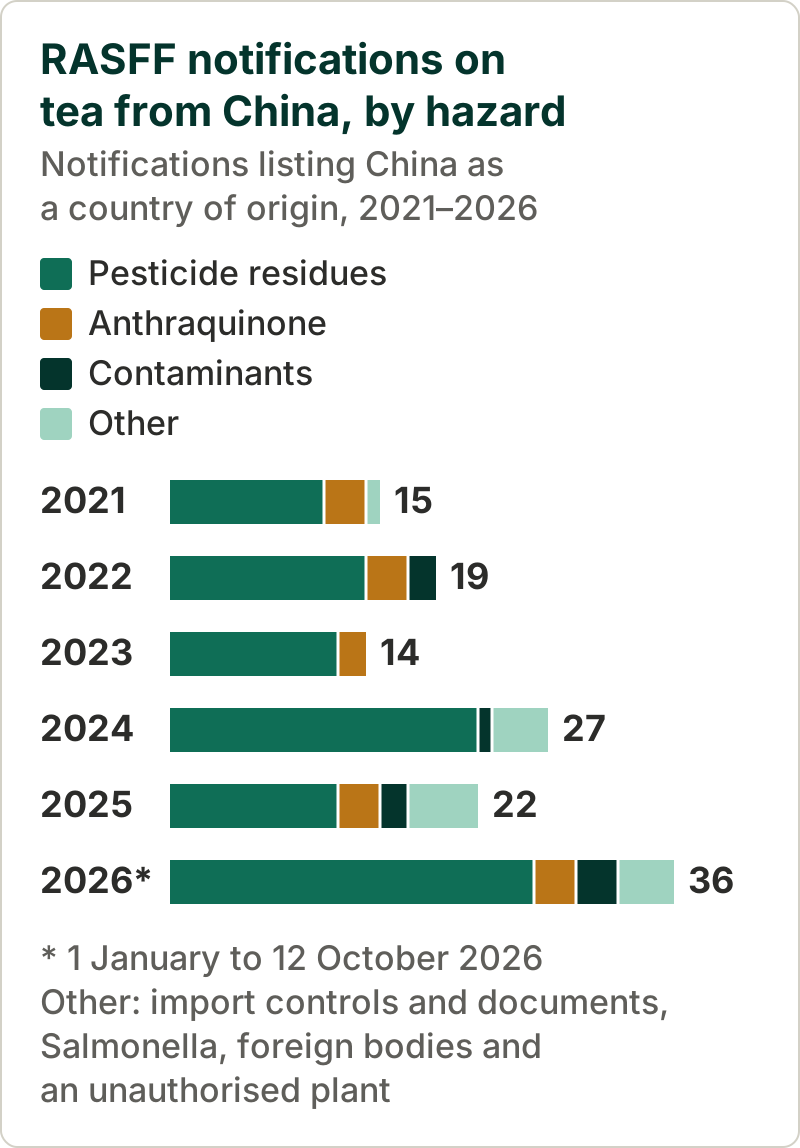 Source: RASFF Window, notifications listing China as a country of origin, counted and grouped by The Tea Trade on 14 October 2026
The count covers RASFF’s product category for cocoa, coffee and tea, plus tea from China filed in other categories, found by searching subjects for “tea” and “matcha”: a notification filed elsewhere without either word would be missed. It leaves out herbal infusions, milk-tea drinks, coffee, cocoa and the years before 2021; each notification is grouped by its subject. Of the 97 in 2021–2025, 81 were border rejections. The five on contaminants all concerned matcha: three for PAHs, one for aluminium, one for lead. The five on import controls involved missing certificates, entry documents or checks; the other five were two findings of Salmonella in black tea, two foreign bodies and an unauthorised plant. With 36 notifications by 12 October, 2026 has already passed every full year since 2021, and it brought the period’s only perchlorate and pyrrolizidine alkaloid cases on tea from China.
What importers and exporters should check
- Pyrrolizidine alkaloids: a test report per lot giving the lower-bound sum of the 35 alkaloids against 150 µg/kg, from a method that quantifies each alkaloid at 10 µg/kg or less, and an account of weed control in the gardens.
- Perchlorate: a result against 0.75 mg/kg, and questions on fertilisers and on the water used.
- Matcha and other powders: benzo(a)pyrene and the four PAHs against 10 and 50 µg/kg; aluminium and lead have no EU limit for these powders but have triggered notifications.
- Anthraquinone: a result against 0.02 mg/kg, and the heat source used for fixing and drying.
- Blends: the recipe and the proportions of tea, herbs and fruit on file, since Article 3 makes the business justify them in an official control.
- Documents: a common health entry document (CHED) filed before each consignment arrives, since customs release tea from China only against a finalised CHED (Article 56(4) of Regulation (EU) 2017/625; Article 4 of Regulation (EU) 2019/1793). Certificates issued in China are covered in our guide to Chinese tea export documents.
EU limits apply whatever the rules at origin: China’s grade standards, such as GB/T 14456.4-2016 for gunpowder, refer contaminants (污染物) to China’s own standard, GB 2762. Check the latest consolidated text of Regulation (EU) 2023/915 before relying on a level: amendments were adopted as recently as July 2026. This is general information, not legal advice.
Questions and answers
What is the EU limit for pyrrolizidine alkaloids in tea?
150 µg/kg in dried tea and flavoured tea (point 2.4.4 of Annex I to Regulation (EU) 2023/915), for the lower-bound sum of 35 alkaloids. It includes instant teas, and powdered tea extracts are assessed with a concentration factor of 4. Tea for infants and young children is held to 75 µg/kg dried and 1.0 µg/kg liquid.
Is there an EU limit for perchlorate in tea?
Yes: 0.75 mg/kg in dried tea, the same as for dried herbal and fruit infusions. Regulation (EU) 2020/685 set it with effect from 1 July 2020, and it is now point 6.3.2 of Annex I to Regulation (EU) 2023/915.
Does the EU limit lead or PAHs in tea?
Not in leaf tea. Among dried tea products, lead is capped only in drinks for infants and young children prepared by infusion or decoction (0.50 mg/kg), and PAHs only in finely ground plant powders stirred into drinks (10 µg/kg of benzo(a)pyrene, 50 µg/kg for four PAHs). Without a set level, food with a contaminant at a level unacceptable for public health still may not be sold (Regulation (EEC) No 315/93).
Why is anthraquinone in tea treated as a pesticide residue?
Anthraquinone was used in plant protection products until the EU withdrew their authorisations (Decision 2008/986/EC), and Regulation (EC) No 396/2005 covers residues of substances currently or formerly used in such products. Its limit in tea is 0.02 mg/kg, whatever the source of the residue.
How many RASFF notifications concern tea from China?
The Tea Trade counted 97 notifications on tea listing China as a country of origin in 2021–2025, and 36 more from 1 January to 12 October 2026, in the RASFF Window. Most were border rejections for pesticide residues; contaminants (PAHs, lead, aluminium, perchlorate and pyrrolizidine alkaloids) account for 8 of the 133.
How do EU contaminant limits apply to tea blended with herbs or fruit?
For teas with dried fruits and dried herbs, Article 3 of Regulation (EU) 2023/915 applies: the limit takes account of the proportions of the ingredients. In an official control, the business must provide and justify those proportions and any concentration factors; otherwise the authority sets them.
Sources
- 1. EUR-Lex: Commission Regulation (EU) 2023/915 of 25 April 2023 on maximum levels for certain contaminants in food, consolidated version of 19 August 2026 · eur-lex.europa.eu
- 2. EUR-Lex: Commission Regulation (EU) 2023/915 of 25 April 2023, as published (Official Journal L 119, 5 May 2023) · eur-lex.europa.eu
- 3. EUR-Lex: Commission Regulation (EU) 2020/2040 of 11 December 2020 on maximum levels of pyrrolizidine alkaloids in certain foodstuffs · eur-lex.europa.eu
- 4. EUR-Lex: Commission Regulation (EU) 2020/685 of 20 May 2020 on maximum levels of perchlorate in certain foods · eur-lex.europa.eu
- 5. EUR-Lex: Commission Regulation (EU) 2020/1255 of 7 September 2020 on maximum levels of PAHs, including in powders of food of plant origin used for the preparation of beverages · eur-lex.europa.eu
- 6. EUR-Lex: Commission Regulation (EU) 2024/1987 of 30 July 2024 on maximum levels of nickel in certain foodstuffs · eur-lex.europa.eu
- 7. EUR-Lex: Council Regulation (EEC) No 315/93 of 8 February 1993 laying down Community procedures for contaminants in food · eur-lex.europa.eu
- 8. EUR-Lex: Regulation (EC) No 178/2002 laying down the general principles and requirements of food law, consolidated version of 1 January 2026 · eur-lex.europa.eu
- 9. EUR-Lex: Regulation (EC) No 396/2005 of 23 February 2005 on maximum residue levels of pesticides in or on food and feed · eur-lex.europa.eu
- 10. EUR-Lex: Commission Regulation (EU) No 1146/2014 of 23 October 2014 on maximum residue levels for anthraquinone and other substances · eur-lex.europa.eu
- 11. EUR-Lex: Commission Implementing Regulation (EU) 2023/2783 of 14 December 2023 on methods of sampling and analysis for plant toxins in food · eur-lex.europa.eu
- 12. EUR-Lex: Commission Delegated Regulation (EU) 2022/931 of 23 March 2022 on official controls as regards contaminants in food · eur-lex.europa.eu
- 13. EUR-Lex: Commission Implementing Regulation (EU) 2022/932 of 9 June 2022 on official controls as regards contaminants in food, consolidated version of 1 January 2026 · eur-lex.europa.eu
- 14. EUR-Lex: Commission Implementing Regulation (EU) 2019/1793 on the temporary increase of official controls, consolidated version of 30 June 2026 · eur-lex.europa.eu
- 15. EUR-Lex: Commission Implementing Regulation (EU) 2019/1715 on the information management system for official controls (IMSOC), consolidated version of 1 December 2021 · eur-lex.europa.eu
- 16. EUR-Lex: Regulation (EU) 2017/625 of 15 March 2017 on official controls · eur-lex.europa.eu
- 17. European Commission: RASFF Window, search of notifications · webgate.ec.europa.eu
- 18. European Commission: RASFF Window, notification 2025.1353, PAHs and benzo(a)pyrene in matcha tea from China via Germany · webgate.ec.europa.eu
- 19. European Commission: RASFF Window, notification 2022.4578, benzo(a)pyrene and PAHs in matcha tea powder from China, via the Netherlands · webgate.ec.europa.eu
- 20. European Commission: RASFF Window, notification 2026.6241, perchlorate in green tea from China · webgate.ec.europa.eu
- 21. European Commission: RASFF Window, notification 2026.3393, pyrrolizidine alkaloids in green tea from Serbia (origin China) · webgate.ec.europa.eu
- 22. European Commission: RASFF Window, notification 2026.4887, anthraquinone in tea · webgate.ec.europa.eu
- 23. European Commission: RASFF Window, notification 2024.2264, high aluminium content in matcha tea from China · webgate.ec.europa.eu
- 24. European Commission: perchlorate, in the catalogue of contaminants · food.ec.europa.eu
- 25. Jiao W. et al., Source and route of pyrrolizidine alkaloid contamination in tea samples, Journal of Visualized Experiments, 2022 · doi.org
- 26. Wang X. et al., 9,10-Anthraquinone deposit in tea plantation might be one of the reasons for contamination in tea, Food Chemistry, 2018 · doi.org
- 27. Zamora R. and Hidalgo F.J., A potential route for the origin of 9,10-anthraquinone in tea, Food Chemistry, 2021 · doi.org
- 28. Li C.W.Y. et al., Contamination of tea leaves by anthraquinone: the atmosphere as a possible source, Ambio, 2023 · doi.org
- 29. GB/T 14456.4-2016 Green tea, Part 4: Gunpowder tea, entry in China's official standards reading system (in Chinese) · openstd.samr.gov.cn