Verify a Chinese tea exporter: filings and public checks
How to verify a Chinese tea exporter: business registration, customs filing and credit level, factory and plantation filings, and what you can check online.

Key facts
- Every Chinese company has an 18-character unified social credit code, printed on its business licence; under the State Council's plan of June 2015 (Guofa [2015] No. 33), characters 3 to 8 give the administrative division of the authority that registered it.
- A Chinese exporter must file with customs as a consignor before it can declare goods (Customs Law, Article 11), and since 1 April 2026 GACC Order No. 282 has rated every company filed with customs at one of five credit levels, published on credit.customs.gov.cn.
- Under GACC Order No. 249, in force since 1 January 2022, every Chinese factory that makes food for export, tea factories included, files with the customs office of its domicile and marks its filing number on the transport packaging (Articles 42 and 46).
- Tea is one of nine raw materials, with vegetables, rice and bee products among them, whose plantations or farms must file with China's customs when they supply export food, under AQSIQ Announcement 2012 No. 149 and GACC Order No. 249 (Article 40).
- GACC Order No. 280, in force since 1 June 2026, replaced Decree 248 on registering foreign factories that export food to China through the CIFER system; it does not cover Chinese tea exporters, whose factories file under GACC Order No. 249.
To verify a Chinese tea exporter, check what it has filed with two Chinese authorities: its business registration, with an 18-character unified social credit code (统一社会信用代码), on the National Enterprise Credit Information Publicity System (国家企业信用信息公示系统), and its customs filing as a consignor, published with one of five customs credit levels on the China Customs credit platform. Behind the exporter, China’s Food Safety Law and GACC Order No. 249 require the factory that makes export tea, and the tea gardens that supply it, to file with customs (海关). None of these filings certifies quality, and none is the “CIFER” registration of GACC Decree 248, which concerns foreign factories exporting food into China and was replaced by Order No. 280 on 1 June 2026 (rules checked October 2026).
“GACC registration” and CIFER: rules for food entering China
The “GACC registration” of food companies concerns foreign factories that ship food to China. GACC Decree 248 (Order No. 248 of 12 April 2021, in force from 1 January 2022) had them register through a system at cifer.singlewindow.cn, hence the name CIFER. Since 1 June 2026, GACC Order No. 280 of 14 October 2025 has replaced Decree 248. It applies to overseas producers, processors and storage companies of food exported to China (Article 2), which receive a registration number in China (Article 13) and mark it, or their own authority’s registration number, on the packaging (Article 14); GACC publishes their list (Article 16), and registration still runs through cifer.singlewindow.cn (GACC Announcement 2026 No. 27). More than 96,000 food companies in 178 countries and regions were registered in China, Xinhua reported in March 2026.
A Chinese tea exporter is not on that list and does not need to be: its tea leaves China instead of entering it, and its filings sit in Chinese registers.
The filings of a Chinese tea exporter at a glance
Filings and certificates of a Chinese tea exporter, and how to check them (sources: Chinese laws and GACC rules cited below; checked October 2026)
| Record | Chinese name | Granted or issued by | What it shows | Public check |
|---|---|---|---|---|
| Business registration | 营业执照, 统一社会信用代码 | Market regulator (company registration authority) | The company exists; its legal representative, registered capital and business scope | gsxt.gov.cn |
| Customs filing as consignor | 进出口货物收发货人备案 | Local customs office | The company may declare goods to customs; its customs credit level | credit.customs.gov.cn |
| Export food production enterprise filing | 出口食品生产企业备案 | Customs office of the factory’s domicile | The factory has filed with customs, which supervises it | No public list found; filing certificate and carton marks |
| Plantation filing | 出口食品原料种植场备案 | Customs office where the garden is | The tea garden has filed with customs, which supervises it | Required by Order No. 249; no published list found |
| Health certificate | 卫生证书 | Customs, for each shipment | The lot passed customs checks | E-certificate search, with a query code |
| Certificate of origin | 原产地证书 | Customs or CCPIT, for each shipment | Chinese origin of the goods described | origin.customs.gov.cn; check.ecoccpit.net |
Business licence and unified social credit code
A Chinese company receives its business licence (营业执照) from the company registration authority. Under the Company Law, as revised in 2023 and in force since 1 July 2024, the licence states the company’s name, domicile, registered capital, business scope and legal representative (Article 33), and the registration authority publishes the registered details on the National Enterprise Credit Information Publicity System (Article 32).
The licence also carries the company’s unified social credit code. Under the State Council’s plan of June 2015 (Guofa [2015] No. 33), the code has 18 characters in five parts: the registration department (1st character), the type of organisation (2nd), the administrative division of the registration authority (3rd to 8th), the organisation code (9th to 17th) and a check character (18th). One entity has one code, and the code stays the same for as long as the entity exists, whatever else changes. Characters 3 to 8 therefore show where the company was registered when it received its code, not necessarily where it is today.
What a buyer can check. The publicity system (gsxt.gov.cn) is, in the words of the market regulator (SAMR), the national platform that collects and publishes enterprise credit information. Under the Interim Regulations on Enterprise Information Disclosure (2014, revised in 2024), market regulators publish on it each company’s registration details, chattel mortgages, equity pledges and penalties (Article 6) and the results of their spot checks (Article 14). Under SAMR’s rules, revised in 2025 and 2026, any entry on the list of abnormal operations (经营异常名录) or of serious violators (严重违法失信名单) is published there too. Under the Interim Regulations:
- every company files an annual report on the previous year between 1 January and 30 June (Article 8);
- the report’s figures on staff, assets, liabilities, revenue, profit and tax are published only if the company chooses (Article 9);
- a company that misses the deadline is put on the list of abnormal operations, and one that publishes false information can be fined and, in serious cases, put on the list of serious violators (Article 18).
Check the company’s status, that its name and code match your contract and invoice character for character, and whether it appears on either list.
What it does not show. Registered capital is subscribed capital: for a limited liability company it is the amount all shareholders have subscribed, to be paid in within five years of incorporation (Company Law, Article 47), and the company publishes both the subscribed and the paid-in amounts on the system (Article 40). The business scope shows what the company registered to do, not what it does, and nothing in the registration speaks to tea quality.
Customs filing as consignor (进出口货物收发货人备案)
To declare goods to China’s customs, an exporter must file with customs as a consignor (Customs Law, Article 11, last amended in 2021). Under GACC Order No. 253, it must first be registered as a market entity, which may be anything from a company to an individual business (个体工商户). The local customs office handles the filing in 3 working days, free of charge; the filing does not expire, customs supply a paper filing certificate (报关单位备案证明) on request, and the filing is published on the China Customs Enterprise Import and Export Credit Information Publicity Platform (中国海关企业进出口信用信息公示平台), according to GACC’s service guide.
A separate registration with the commerce authorities no longer exists: Article 4 of Order No. 253 still mentions it, but GACC’s service guide does not ask for it. Local commerce departments stopped registering foreign trade operators (对外贸易经营者备案登记) on 30 December 2022, when the Standing Committee of the National People’s Congress deleted Article 9 of the Foreign Trade Law (MOFCOM), and the law as revised on 27 December 2025, in force since 1 March 2026, has no such registration for trade in goods.
Customs credit levels since April 2026. GACC Order No. 282, published on 13 January 2026, replaced Order No. 251 on 1 April 2026 and rates every company registered or filed with customs at one of five levels (Article 4):
- Advanced certified (高级认证企业) and certified (认证企业) enterprises are China’s authorised economic operators (AEO), certified against standards for internal control, finances, compliance and trade security (Articles 8 and 14). Advanced certified enterprises are reviewed every five years (Article 22).
- Regular enterprises (常规企业) are those not rated at any other level (Article 17).
- Discredited enterprises (失信企业) include companies penalised by customs for smuggling, or that leave taxes unpaid more than three months after the due date (Article 15).
- Seriously discredited enterprises (严重失信企业) are serious cases, also put on the list of seriously dishonest entities in customs supervision (Article 16).
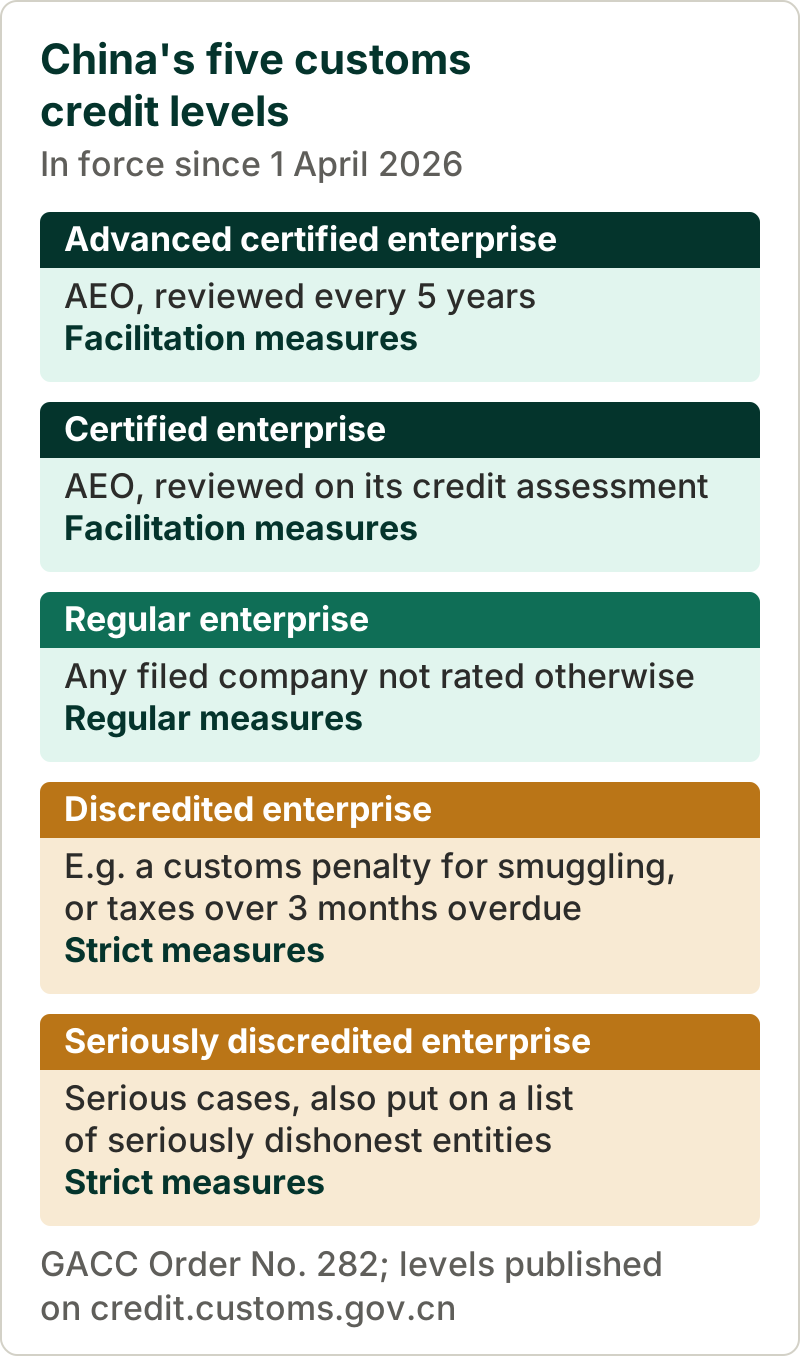 Source: GACC Order No. 282 (2026), Articles 4, 8, 15 to 17, 22 and 32; GACC Announcement 2026 No. 32
Customs publish each company’s registration or filing, credit level, administrative licences and penalties, and joint rewards and punishments (Article 12) on the platform at credit.customs.gov.cn (GACC Announcement 2026 No. 32). Under the same announcement, customs also publish there a list of companies with abnormal credit information, for example those that fail to file their annual credit report or cannot be reached at their registered address. Records of dishonesty also appear on the Credit China (信用中国) website, general ones for one year and serious ones for three; minor ones are not published (Order No. 282, Articles 33 to 35).
What it shows, and what it does not. The filing shows that the company can declare goods to Chinese customs, and the credit level shows its customs record. Neither says whether it makes tea or how good its tea is: AEO certification covers customs compliance and trade security, not food quality.
Export food production enterprise filing (出口食品生产企业备案)
China’s Food Safety Law, as amended on 12 September 2025, requires export food producers to file with the national entry-exit inspection and quarantine authority (Article 99), and GACC Order No. 249, in force since 1 January 2022, has them file with the customs office of their domicile (Article 42). No product catalogue limits this filing: GACC’s service guide applies it to any food producer in China that intends to export, so tea factories file.
- Condition: a food safety and hygiene control system built on hazard analysis and preventive controls, including a food defence plan (service guide). Order No. 249 adds traceability records, from supplier evaluation to the handling of non-conforming food, kept for at least six months after the shelf life ends, or two years where there is none (Article 44).
- Procedure: customs review the application and, if it is complete and meets the conditions, issue a filing certificate (出口食品生产企业备案证明), within a committed 3 working days and free of charge. Filings have had no expiry date since December 2019, and a change of name, legal representative or address must be filed within 15 days (service guide).
- Supervision: customs carry out routine and annual checks of the factory’s control system (Article 47).
- Carton marks: the factory marks the transport packaging with its filing number, the product name, the batch number and the production date (Article 46), as our guide to tea export packaging formats explains.
Order No. 249 distinguishes the production enterprise from the exporter (出口商): either may apply for pre-declaration supervision at the customs office of the place of production or consolidation (Article 49). The company that sells you tea may therefore be a trading company with a customs filing only, while the food filing belongs to the factory that made the tea.
What a buyer can check. Order No. 249 requires GACC to publish the list of filed plantations (Article 40) but contains no such rule for factories, and no public list of filed factories could be found for this guide (checked October 2026). Ask for the filing certificate, check that its name and address match the factory’s business registration, and that its number matches the one on the cartons. The filing shows that customs know and supervise the factory. It does not test your lot against your country’s limits, which belong in the contract and in a laboratory report: for the EU, see our guide to EU pesticide limits for tea.
Tea plantation filing (出口食品原料种植场备案)
Tea is one of nine raw materials on a catalogue published by the former AQSIQ on 8 October 2012 (Announcement 2012 No. 149), with vegetables (including cultivated mushrooms), rice, poultry meat, eggs, pork, rabbit meat, bee products and aquatic products: when export food is made mainly from one of them, the plantations or farms that produce it must file with the inspection authorities. GACC’s service guide still lists tea (checked October 2026), and Order No. 249 requires plantations to file with their local customs office, which supervises them through document reviews, on-site inspections and company checks (Articles 40 and 41).
Organisations with legal-person status, such as export food producers, plantations, farmers’ cooperatives and trade associations, can apply, free of charge. The garden’s air, soil and irrigation water must meet national standards, with no source of pollution nearby, and it needs a plant protection officer (service guide).
What a buyer can check. Order No. 249 requires GACC to publish the list of filed plantations (Article 40), but no such list could be found on an official page for this guide (checked October 2026). Ask the exporter which filed gardens supplied your lot. A filed garden is known to customs; linking a given lot to it depends on the factory’s traceability records (Article 44).
Health certificate and certificate of origin, shipment by shipment
The filings come before trade starts; two documents follow each shipment. Customs issue a certificate for export food that passes their on-site checks and sampling (Order No. 249, Article 51): depending on the destination and the product, a phytosanitary certificate, a health certificate (卫生证书) or an inspection certificate (GACC service guide). A certificate of origin comes from customs or from the China Council for the Promotion of International Trade (CCPIT) under GACC Order No. 270. When each one is needed is covered in our guide to Chinese tea export documents.
Each certificate covers the consignment it describes, not the exporter’s other lots. Three public checks exist (checked October 2026):
- Certificate of origin issued by customs: GACC’s E-government Platform for the Origin of China’s Exports (origin.customs.gov.cn) searches a certificate by its number and an invoice number.
- Certificate of origin issued by the CCPIT: its query site, check.ecoccpit.net, verifies printed or downloaded certificates. Your country’s authorities can also request a verification, which the Chinese issuing body carries out and GACC’s liaison point answers (Order No. 270, Article 18).
- Health and other inspection certificates: the China International Trade Single Window has a search for outbound inspection and quarantine e-certificates that asks for the certificate number and a query code (查询码). The page does not say how a buyer abroad obtains the code, so ask the exporter.
A verification checklist for tea buyers
- Company: get the exporter’s exact Chinese name and 18-character code, and look it up on gsxt.gov.cn for its status, address, legal representative, latest annual report and any listing.
- Customs: look up its filing and credit level on credit.customs.gov.cn.
- Factory: ask who makes the tea; if the seller is a trading company, look the factory up on gsxt.gov.cn too and ask for its export food production enterprise filing certificate.
- Gardens: ask which filed plantations supply the tea.
- Contract: require the factory’s filing number on the cartons (Order No. 249, Article 46) and the certificates your country needs for each shipment.
- Shipment: check the certificate of origin on the official site, and compare names, weights and lot numbers across the invoice, the packing list and the certificates.
- Payment: pay only the company named in the contract; our guide to tea export payment terms explains China’s rule that whoever exports collects the payment (谁出口谁收汇).
These checks show what a company has filed and what the authorities have recorded about it. They do not show how it will perform a contract, and none of them is a recommendation of any exporter. This is general information, checked in October 2026, and not legal advice.
Questions and answers
How can I check that a Chinese tea company is real?
Ask for its exact Chinese name and its 18-character unified social credit code, and look it up on the National Enterprise Credit Information Publicity System (gsxt.gov.cn). It shows the company's registration, legal representative and registered capital, its annual reports, and whether it is on the list of abnormal operations or of serious violators.
Does a Chinese tea exporter need an export licence?
No. Tea is not among the goods under export licence management in China's 2026 catalogue (MOFCOM and GACC Announcement 2025 No. 89), and the registration of foreign trade operators ended on 30 December 2022. The exporter needs a customs filing as consignor, and the factory and tea gardens behind it need food safety filings with customs.
Does my Chinese tea supplier need GACC or CIFER registration?
No. CIFER is GACC's system for registering foreign factories that export food into China, first under Decree 248 and, since 1 June 2026, under Order No. 280, which replaced it. A Chinese tea factory files instead as an export food production enterprise under GACC Order No. 249.
How do I check a Chinese company's customs registration?
On the China Customs Enterprise Import and Export Credit Information Publicity Platform (credit.customs.gov.cn), where customs publish each filed company's filing, credit level, administrative licences and penalties. Since 1 April 2026 there have been five credit levels, from advanced certified enterprise to seriously discredited enterprise (GACC Order No. 282).
Is there a public list of Chinese tea factories registered for export?
None was found (checked October 2026). GACC Order No. 249 requires GACC to publish a list of filed plantations, though no such list could be found either, and sets no such rule for factories. Ask for the factory's export food production enterprise filing certificate and check that its number matches the one marked on the cartons.
How can I verify a Chinese certificate of origin?
A certificate issued by customs can be searched by its number and an invoice number on GACC's E-government Platform for the Origin of China's Exports (origin.customs.gov.cn), and one issued by the CCPIT on check.ecoccpit.net. The importing country's authorities can also ask the Chinese issuing body to verify a certificate (GACC Order No. 270, Article 18).
Sources
- 1. GACC: Order No. 249, Administrative Measures on Import and Export Food Safety, 2021 (in Chinese) · gov.cn
- 2. Food Safety Law of the People's Republic of China, as amended on 12 September 2025 (in Chinese) · policy.mofcom.gov.cn
- 3. GACC service guide: record-filing of export food production enterprises (in Chinese) · online.customs.gov.cn
- 4. GACC service guide: record-filing of export food raw material plantations (in Chinese) · online.customs.gov.cn
- 5. AQSIQ: Announcement 2012 No. 149, catalogue of export food raw materials under record-filing, 8 October 2012 (in Chinese) · tid.gov.hk
- 6. GACC service guide: record-filing of consignors and consignees (in Chinese) · online.customs.gov.cn
- 7. GACC: Order No. 253, Provisions on the record-filing of customs declaration entities, 19 November 2021 (in Chinese) · gov.cn
- 8. GACC: Order No. 282, Measures on the credit management of enterprises registered or filed with customs, 13 January 2026 (in Chinese; text of the GACC website annexed to a Hong Kong Trade and Industry Department circular) · tid.gov.hk
- 9. GACC: Announcement 2026 No. 32 on implementing the credit management measures, 27 March 2026 (in Chinese; annexed to a Hong Kong Trade and Industry Department circular) · tid.gov.hk
- 10. State Council: Interim Regulations on Enterprise Information Disclosure, 2014, as revised on 10 March 2024 (in Chinese) · policy.mofcom.gov.cn
- 11. SAMR: Notice on further improving the National Enterprise Credit Information Publicity System, July 2019 (in Chinese) · gov.cn
- 12. SAMR: Measures on the list of enterprises with abnormal operations, 2014, as revised on 18 March 2025 (in Chinese) · policy.mofcom.gov.cn
- 13. SAMR: Order No. 128, Measures on the list of serious violators in market regulation, 25 May 2026 (in Chinese) · samr.gov.cn
- 14. Company Law of the People's Republic of China, as revised on 29 December 2023 (in Chinese) · gov.cn
- 15. State Council: Notice on the overall plan for a unified social credit code for legal persons and other organisations, Guofa [2015] No. 33, June 2015 (in Chinese) · gov.cn
- 16. NPC Standing Committee: Decision amending the Foreign Trade Law, 30 December 2022 (in Chinese) · gov.cn
- 17. MOFCOM: Foreign Trade Department on ending the registration of foreign trade operators, 3 January 2023 (in Chinese) · gov.cn
- 18. Foreign Trade Law of the People's Republic of China, as revised on 27 December 2025 (in Chinese) · policy.mofcom.gov.cn
- 19. SAMR: List of laws in force at 28 August 2026 (in Chinese) · samr.gov.cn
- 20. MOFCOM and GACC: Announcement 2025 No. 89, 2026 export licence catalogue, 30 December 2025 (in Chinese) · mofcom.gov.cn
- 21. GACC: Order No. 280, Regulations on the registration of overseas producers of imported food, 14 October 2025 (in Chinese) · gov.cn
- 22. GACC: Announcement 2026 No. 27 on implementing Order No. 280, 18 March 2026 (in Chinese; annexed to a Hong Kong Trade and Industry Department circular) · tid.gov.hk
- 23. GACC: Announcement 2021 No. 103 on implementing Orders No. 248 and No. 249, 13 December 2021 (in Chinese) · policy.mofcom.gov.cn
- 24. GACC: Registration information of overseas producers of imported food, public search (in Chinese) · ciferquery.singlewindow.cn
- 25. GACC service guide: inspection and quarantine of animals, plants and their products (in Chinese) · online.customs.gov.cn
- 26. GACC: Order No. 270 on issuing certificates of origin for export goods, 30 July 2024 (in Chinese) · policy.mofcom.gov.cn
- 27. GACC: E-government Platform for the Origin of China's Exports, certificate search · origin.customs.gov.cn
- 28. CCPIT: Certificate of origin declaration system, about the system (in Chinese) · co.ccpit.org
- 29. China International Trade Single Window: search for inspection and quarantine e-certificates (in Chinese) · swapp.singlewindow.cn
- 30. Xinhua: GACC revises the rules on registering overseas producers of imported food, 19 March 2026 (in Chinese) · news.cn