EU pesticide limits for tea: MRLs and checks on China
EU MRLs for tea: 0.01 mg/kg by default, 0.02 for anthraquinone, 0.5 for nicotine. Tea from China faces 20% border checks under Regulation 2019/1793.
Key facts
- Under Regulation (EC) No 396/2005, a pesticide with no specific EU limit for tea is held to a default of 0.01 mg/kg (Article 18(1)(b)), and tea's limits apply to the dried leaves, stalks and flowers of Camellia sinensis (Annex I, code 0610000).
- Tea from China is listed in Annex I to Implementing Regulation (EU) 2019/1793 for pesticide residues, tolfenpyrad included, with identity and physical checks on 20% of consignments at EU border control posts (consolidated version of 30 June 2026).
- The EU limit for anthraquinone in tea is 0.02 mg/kg, set in Annex V to Regulation (EC) No 396/2005 by Regulation (EU) No 1146/2014 and applicable since 18 May 2015 (checked 2 October 2026).
- Nicotine in tea has a temporary EU limit of 0.5 mg/kg, which Regulation (EU) 2026/742 kept and extended until 22 February 2030, while chlorate has a temporary limit of 0.05 mg/kg under Regulation (EU) 2020/749.
- Tolfenpyrad, the one pesticide the EU names in its border checks on tea from China, was never authorised in the EU and has no specific limit, so the 0.01 mg/kg default applies (EU Pesticides Database, checked 2 October 2026).
The European Union sets a maximum residue level (MRL) for each pesticide in tea under Regulation (EC) No 396/2005, and any pesticide without a specific limit is held to a default of 0.01 mg/kg. As of October 2026, the EU limit for tea is 0.02 mg/kg for anthraquinone, 0.05 mg/kg for chlorate and 0.5 mg/kg for nicotine, while tolfenpyrad has no specific limit, so the 0.01 mg/kg default applies. Tea from China is also on the EU’s list of foods under increased border checks: under Implementing Regulation (EU) 2019/1793, 20% of consignments get identity and physical checks for pesticide residues.
How EU pesticide limits for tea work
Regulation (EC) No 396/2005 of 23 February 2005 harmonises the maximum levels of pesticide residues in food and feed across the EU. Its annexes carry the detail: Annex I lists the products and their codes, Annex II holds the definitive MRLs, Annex III the temporary ones, Annex IV the substances that need no MRL, and Annex V default values other than 0.01 mg/kg. From the time a product is placed on the market as food, it must not contain any residue above those limits (Article 18(1)).
For imported tea, the key rule is the default. Under Article 18(1)(b), the limit is 0.01 mg/kg for any product with no specific MRL in Annex II or III, for every active substance not listed in Annex IV, unless a different default is set in Annex V. A pesticide that was never approved in the EU and never given a limit for tea is therefore held to 0.01 mg/kg.
In the annexes, an asterisk next to a value marks the limit of analytical determination: the limit sits at the lowest level that routine laboratory methods can quantify. Temporary MRLs, in Annex III, can be set in exceptional cases, in particular where residues may arise from environmental or other contamination (Article 16(1)(a)). The EU limits for chlorate and nicotine in tea are temporary.
Dried tea, blends and processing factors
Annex I, last replaced by Regulation (EU) 2018/62 with effect from 1 January 2018, files tea under code 0610000, “Teas” (Camellia sinensis), and applies the limits to the “dried leaves, stalks and flowers, whether fermented or otherwise treated”. The limits therefore apply to tea as traded, not to the infusion, and one set of limits covers green, black, oolong, white and dark tea alike. Herbal infusions such as rooibos or chamomile have their own codes, under 0630000.
Article 20 covers processed and composite foods for which no MRL is set: the limit of the raw product applies, taking into account the changes in residue levels caused by processing or mixing. That is the route for blends, such as green tea mixed with dried mint, and for products made from tea, such as instant tea. Article 19 adds a prohibition that matters to blenders: tea that breaches a limit may not be mixed with other tea to dilute it and then sold as food or feed.
EU MRLs for tea: anthraquinone, chlorate, nicotine and others
EU limits for selected substances in tea (code 0610000), in mg/kg (sources: EU Pesticides Database and the regulations cited)
| Substance | EU limit for tea (mg/kg) | Regulation | Date checked |
|---|---|---|---|
| Tolfenpyrad | 0.01 (default) | No specific MRL: Regulation (EC) No 396/2005, Art. 18(1)(b) | 2 October 2026 |
| Dinotefuran | 0.01 (default) | No value for tea in Annex III: Art. 18(1)(b) | 2 October 2026 |
| Chlorpyrifos | 0.01* | Regulation (EU) 2020/1085 (Annex V), applicable from 13 November 2020 | 2 October 2026 |
| Anthraquinone | 0.02* | Regulation (EU) No 1146/2014 (Annex V), applicable from 18 May 2015 | 2 October 2026 |
| Imidacloprid | 0.05* | Regulation (EU) 2021/1881 (Annex II), applicable from 16 May 2022 | 2 October 2026 |
| Chlorate | 0.05 (temporary) | Regulation (EU) 2020/749 (Annex III), in force from 28 June 2020 | 2 October 2026 |
| Nicotine | 0.5 (temporary) | Regulation (EU) 2026/742 (Annex III), in force from 20 April 2026 | 2 October 2026 |
| Perchlorate (contaminant) | 0.75 | Regulation (EU) 2023/915 on contaminants (a maximum level, not an MRL), Annex I, point 6.3.2 | 2 October 2026 |
* Limit of analytical determination.
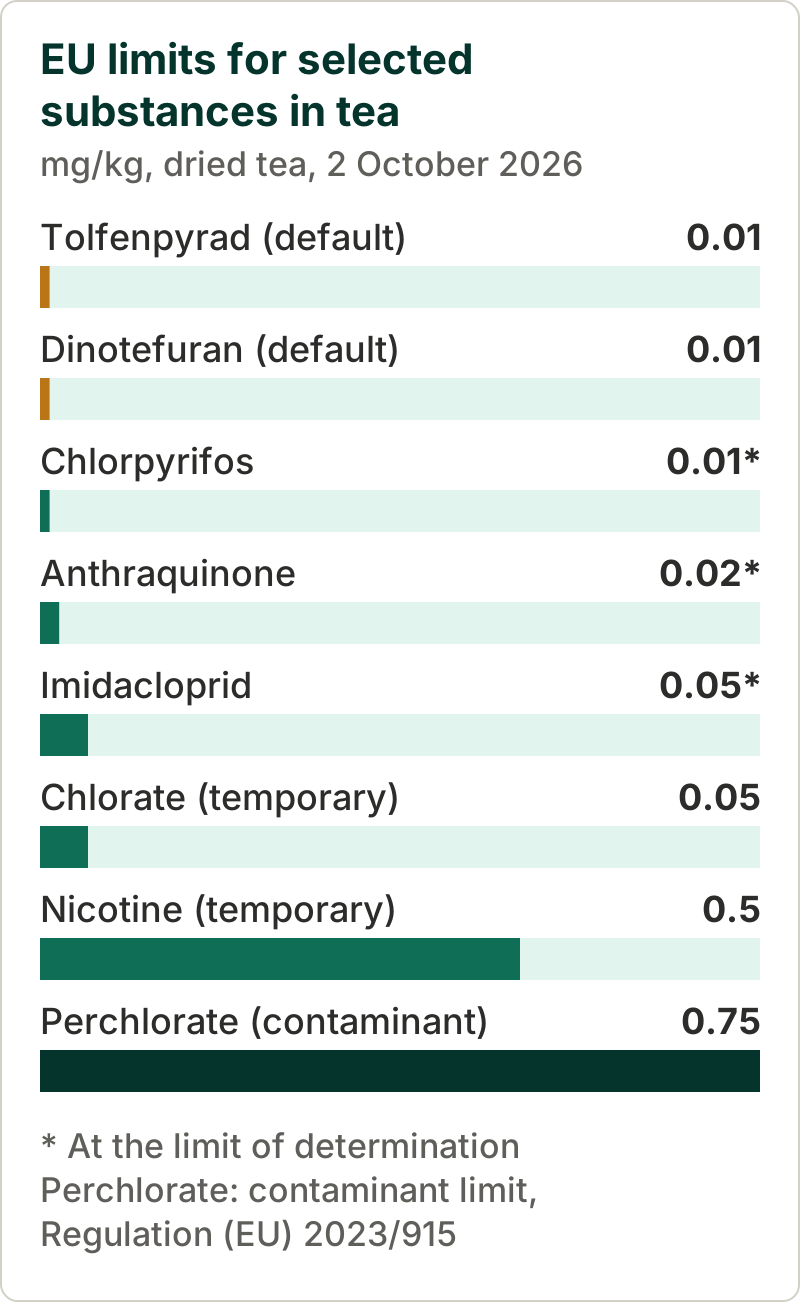 Sources: Regulation (EC) No 396/2005 and the amending regulations cited; Regulation (EU) 2023/915; EU Pesticides Database (checked 2 October 2026)
Anthraquinone. The EU did not approve anthraquinone as a pesticide, and no authorised uses in third countries had been notified when Regulation (EU) No 1146/2014 set its limits, so they sit at the limit of determination: 0.02 mg/kg for tea, applicable since 18 May 2015 and unchanged when checked on 2 October 2026. Residues do not only come from spraying. A 2022 study in the journal Beverage Plant Research found that anthraquinone rose 4.3 to 23.9 times when green tea was processed with coal rather than electricity as the heat source, reaching 0.064 mg/kg, 3.2 times the EU limit (our calculation). It identified fixation and drying, the steps where the leaves meet the fumes, as the main sources.
Chlorate. Chlorate is no longer authorised in plant protection products, but it forms as a by-product of the chlorine disinfectants used in food processing and drinking water. Regulation (EU) 2020/749 replaced the 0.01 mg/kg default with temporary limits, among them 0.05 mg/kg for teas, coffee, herbal infusions, cocoa and carobs, in force since 28 June 2020. The regulation sets no expiry date and called for a review by 8 June 2025; on 2 October 2026, the EU Pesticides Database still listed 0.05 mg/kg under Regulation (EU) 2020/749 as the applicable value.
Nicotine. The EU limit for nicotine in tea is a temporary 0.5 mg/kg. Regulation (EU) 2025/115 had set that level with a review due in February 2026, after which it would have fallen to 0.4 mg/kg. Monitoring data from food businesses showed that 0.4 mg/kg was not widely achievable, and the Commission noted that nicotine in food often comes from environmental or manufacturing contamination, or from the plant itself, rather than from its use as a pesticide. Regulation (EU) 2026/742, in force since 20 April 2026, therefore kept 0.5 mg/kg and extended its validity until 22 February 2030.
Tolfenpyrad and dinotefuran. The EU Pesticides Database records both insecticides as not approved, never notified or authorised in the EU. Tolfenpyrad has no EU limit at all, and the database’s own record holds it to the 0.01 mg/kg default of Article 18(1)(b). Dinotefuran has limits for some products, set in Annex III by Regulation (EU) No 491/2014, but that regulation and the database give no value for tea, so Article 18(1)(b) applies the same 0.01 mg/kg default. Both are named in the EU’s 2025 alert figures for cocoa, coffee and tea (see below), and tolfenpyrad is the one substance the EU names in its border checks on tea from China.
Chlorpyrifos and imidacloprid. The EU did not renew the approval of chlorpyrifos in January 2020, and Regulation (EU) 2020/1085 cut its limits in all products to 0.01 mg/kg, applicable from 13 November 2020 after a corrigendum. The limit for imidacloprid in tea is 0.05 mg/kg, the limit of determination, under Regulation (EU) 2021/1881, applicable since 16 May 2022. EFSA’s report on 2024 data names chlorpyrifos in green tea from China and Sri Lanka, and imidacloprid in green tea from Vietnam, among the residues of pesticides not approved in the EU and without an import tolerance.
Perchlorate and other contaminant limits for tea
Perchlorate is regulated as a contaminant, not as a pesticide. Regulation (EU) 2023/915 on contaminants in food sets a maximum level of 0.75 mg/kg for dried tea (Camellia sinensis), the same as for dried herbal and fruit infusions. The same regulation caps pyrrolizidine alkaloids at 150 µg/kg (0.15 mg/kg) in dried tea; for that limit, dried tea includes instant tea, and powdered tea extracts are assessed with a concentration factor of 4. These maximum levels sit in a different regulation from the MRLs, but they apply to the same tea. Our guide to EU contaminant limits for tea covers them in detail.
Increased checks on tea from China under Regulation (EU) 2019/1793
Implementing Regulation (EU) 2019/1793 lists the foods of non-animal origin from given countries that face a temporary increase of official controls when they enter the EU (Annex I), and those that must also travel with an official certificate and test results from the country of origin (Annex II). The Commission reviews both lists at intervals of no more than six months. In 2026 alone, it replaced both annexes twice, by Implementing Regulations (EU) 2026/194 of 28 January and 2026/1206 of 9 June. The latest consolidated version on EUR-Lex is dated 30 June 2026, and no later amendment was listed on 2 October 2026.
Tea from China in Annex I to Regulation (EU) 2019/1793 (consolidated version of 30 June 2026)
| Field | Entry |
|---|---|
| Country of origin | China (CN), row 6 |
| Food | Tea, whether or not flavoured (food) |
| CN code | 0902 |
| Hazard | Pesticide residues: those of the EU control programme that multi-residue GC-MS and LC-MS methods can analyse, plus tolfenpyrad |
| Frequency of identity and physical checks | 20% |
Tea from China has been on the list since the regulation began to apply on 14 December 2019, at 20% in the original annex and in every consolidated version published since. Because the entry covers the whole of CN heading 0902, it applies to green and black tea alike, whether in immediate packings of up to 3 kg or larger.
In practice, each consignment must be notified in advance on a Common Health Entry Document (CHED) and presented at a border control post, and customs release it for free circulation only on presentation of a finalised CHED. Identity and physical checks, including sampling and laboratory analysis, are carried out on 20% of consignments. Because tea from China is in Annex I and not in Annex II, Regulation (EU) 2019/1793 requires no official certificate or pre-export test report for it; the documents China issues for tea exports are covered in our guide to Chinese tea export documents.
If a consignment fails, the authorities detain it and refuse its entry, then order the operator to destroy it, re-dispatch it outside the EU or subject it to special treatment, at the operator’s expense (Article 66 of Regulation (EU) 2017/625). The decision is notified to the Commission, the other member states, customs and the authorities of the country of origin.
For scale, China’s figures in UN Comtrade show 29,660 tonnes of tea worth US$124.9 million shipped to 26 of the 27 EU member states in 2025, 7.1% of China’s tea exports by volume. Germany (9,503 tonnes), Poland (7,972 tonnes) and France (4,803 tonnes) took 75.1% of that tonnage (totals and shares are our calculation). Duty, VAT and the other import formalities for that tea are set out in our guide to importing Chinese tea into the EU.
What EU alerts and monitoring show for tea
The Rapid Alert System for Food and Feed (RASFF) carries notifications between food safety authorities, and its public database, RASFF Window, gives summary information on recent notifications. Two EU reports published in 2026 name several of the substances in the table:
- Alert & Cooperation Network, 2025 Annual Report. The European Commission’s report counts 225 notifications on cocoa, coffee and tea products in 2025, 2.6% of all its notifications; tea and infusions made up about 57% of the products concerned. Pesticides were the largest issue in that group, at 28%, “including substances such as tolfenpyrad and dinotefuran”, and China was the origin of about 11% of the products, second to the Netherlands (15%).
- EFSA, 2024 data. EFSA’s 2024 European Union report on pesticide residues in food, published in May 2026, counts 39,433 samples reported under the increased import controls of Regulation (EU) 2019/1793, all products included, of which 3.6% were non-compliant. In a separate section on samples from non-EU countries, it lists among the reasons for exceedances pesticides not approved in the EU and without an import tolerance, citing chlorpyrifos in green tea from China and Sri Lanka.
How to look up an EU MRL for tea
- Open the EU Pesticides Database and its search of pesticide residues and MRLs.
- Select the product Teas (code 0610000) and the substance you need.
- Read the limit, the regulation that set it and its date of application. An asterisk marks the limit of determination.
- If the substance has no value for tea, the 0.01 mg/kg default applies; the database’s record for tolfenpyrad says so in so many words.
- Check the date of application, since new limits often apply months after publication: Regulation (EU) 2021/1881 on imidacloprid was published on 27 October 2021 and applied from 16 May 2022.
- Confirm in the Official Journal, on EUR-Lex. The Commission states that the database “has no legal value”. Read the latest consolidated version of Regulation (EU) 2019/1793 in the same way before relying on a check rate.
What importers and exporters should check
Under EU food law, responsibility sits with the businesses that place food on the market. Regulation (EC) No 178/2002 requires imported food to comply with EU food law (Article 11). Food businesses must ensure and verify that their food meets it (Article 17(1)) and be able to identify their suppliers and their business customers (Article 18). An importer that has reason to believe a food it imported does not comply with food safety requirements must start withdrawing it and inform the authorities (Article 19). EU limits apply whatever the rules at origin: China’s grade standards for gunpowder and chunmee refer pesticide residues (农药残留) to China’s own standard, GB 2763. For matcha, see our guide to Chinese matcha.
- Test reports. Agree on a pesticide residue report for each lot from a laboratory accredited to ISO/IEC 17025, the standard the EU itself requires for the analyses that accompany Annex II goods (Article 10(5) of Regulation (EU) 2019/1793). Ask that the analysis cover tolfenpyrad, which the EU names separately from the multi-residue screen in its checks on Chinese tea, as well as the other substances in the table above.
- Limits in the contract. Refer to the EU limits in force when the tea is placed on the EU market, and keep a retained sample of each lot.
- Processing. Ask how the tea was fixed and dried: the 2022 study links coal heating to anthraquinone above the EU limit.
- No dilution. A lot that exceeds a limit may not be blended with other tea to bring it under (Article 19 of Regulation (EC) No 396/2005).
- Prior notice. Each consignment of tea from China must be notified on a CHED before it physically arrives in the EU (Article 56(4) of Regulation (EU) 2017/625).
- Specifications. Add the residue limits to the purchase specification, next to grade, moisture and dust. For tea in bags, see our guide to tea bag materials and standards.
Questions and answers
What is the EU MRL for tea?
There is no single figure: the EU sets a maximum residue level for each pesticide in tea (code 0610000) under Regulation (EC) No 396/2005. Where no specific level is set, the default is 0.01 mg/kg (Article 18(1)(b)).
What is the EU limit for anthraquinone in tea?
0.02 mg/kg. Regulation (EU) No 1146/2014 set it in Annex V to Regulation (EC) No 396/2005, applicable since 18 May 2015, and it was unchanged when checked on 2 October 2026.
Is tea from China under increased checks in the EU?
Yes. Tea from China (CN code 0902) is in Annex I to Implementing Regulation (EU) 2019/1793 for pesticide residues, tolfenpyrad included, and 20% of consignments get identity and physical checks. It has been listed since the regulation began to apply on 14 December 2019.
Do EU MRLs apply to dry tea or to the brewed drink?
To the dry tea. Annex I to Regulation (EC) No 396/2005 defines tea as the dried leaves, stalks and flowers of Camellia sinensis, whether fermented or otherwise treated, so one set of limits covers green, black and other teas.
What happens if tea exceeds an EU MRL at the border?
The consignment is detained and refused entry, and the authorities order it destroyed, re-dispatched outside the EU or given special treatment, at the operator's expense (Article 66 of Regulation (EU) 2017/625).
How can I check the current EU MRL for a pesticide in tea?
Search the EU Pesticides Database for the product Teas (code 0610000) and the pesticide. It shows the limit, the regulation that set it and its date of application, but it has no legal value: the Official Journal of the EU is the reference.
Sources
- 1. EUR-Lex: Regulation (EC) No 396/2005 of 23 February 2005 on maximum residue levels of pesticides in or on food and feed of plant and animal origin · eur-lex.europa.eu
- 2. EUR-Lex: Commission Regulation (EU) 2018/62 of 17 January 2018 replacing Annex I to Regulation (EC) No 396/2005 · eur-lex.europa.eu
- 3. EUR-Lex: Commission Implementing Regulation (EU) 2019/1793 on the temporary increase of official controls, consolidated version of 30 June 2026 · eur-lex.europa.eu
- 4. EUR-Lex: Commission Implementing Regulation (EU) 2019/1793 of 22 October 2019, as published (Official Journal L 277, 29 October 2019) · eur-lex.europa.eu
- 5. EUR-Lex: Commission Implementing Regulation (EU) 2026/1206 of 9 June 2026 amending Implementing Regulation (EU) 2019/1793 (new Annexes I and II) · eur-lex.europa.eu
- 6. EUR-Lex: Commission Regulation (EU) No 1146/2014 of 23 October 2014 on maximum residue levels for anthraquinone and other substances · eur-lex.europa.eu
- 7. EUR-Lex: Commission Regulation (EU) 2020/749 of 4 June 2020 on maximum residue levels for chlorate · eur-lex.europa.eu
- 8. EUR-Lex: Commission Regulation (EU) 2026/742 of 30 March 2026 on maximum residue levels for cyflufenamid, fenazaquin and nicotine · eur-lex.europa.eu
- 9. EUR-Lex: Corrigendum of 30 July 2020 to Commission Regulation (EU) 2020/1085 on maximum residue levels for chlorpyrifos and chlorpyrifos-methyl · eur-lex.europa.eu
- 10. EUR-Lex: Commission Regulation (EU) 2021/1881 of 26 October 2021 on maximum residue levels for imidacloprid · eur-lex.europa.eu
- 11. EUR-Lex: Commission Regulation (EU) No 491/2014 of 5 May 2014 on maximum residue levels for dinotefuran and other substances · eur-lex.europa.eu
- 12. EUR-Lex: Commission Regulation (EU) 2023/915 of 25 April 2023 on maximum levels for certain contaminants in food · eur-lex.europa.eu
- 13. EUR-Lex: Regulation (EU) 2017/625 of 15 March 2017 on official controls · eur-lex.europa.eu
- 14. EUR-Lex: Regulation (EC) No 178/2002 of 28 January 2002 laying down the general principles and requirements of food law · eur-lex.europa.eu
- 15. European Commission: EU Pesticides Database · food.ec.europa.eu
- 16. European Commission: Alert & Cooperation Network, 2025 Annual Report (2026) · food.ec.europa.eu
- 17. European Commission: RASFF, the Rapid Alert System for Food and Feed · food.ec.europa.eu
- 18. EFSA: The 2024 European Union report on pesticide residues in food, EFSA Journal, May 2026 · doi.org
- 19. Yu J. et al., 9,10-Anthraquinone contamination in tea processing using coal as heat source, Beverage Plant Research, 2022 · maxapress.com
- 20. UN Comtrade via WITS: China exports of tea, HS 0902, by partner, 2025 · wits.worldbank.org