Jasmine tea grades: how China's standard classifies them
Jasmine tea grades follow China's GB/T 22292-2017: special types, then special grade to grade 5, with 30 to 270+ kg of jasmine suggested per 100 kg of tea.
Key facts
- China's national standard GB/T 22292-2017, in force since 1 February 2018, divides jasmine tea (茉莉花茶) into baked, pan-fired, broken and flake jasmine tea, and grades baked and pan-fired jasmine tea from special types and a special grade down to grade 5.
- GB/T 22292-2017 limits every grade of jasmine tea to 8.5% moisture, caps total ash at 6.5% (7.0% for broken and flake tea) and allows 1.0% to 1.5% of spent jasmine flowers, depending on the grade.
- Annex A of China's jasmine tea standard, GB/T 22292-2017, an informative annex, suggests 30 kg of fresh jasmine per 100 kg of base tea for grade 5, 120 kg for the special grade and 130 kg to 270 kg or more for the special types.
- Hengzhou in Guangxi accounted for 65.17% of China's jasmine tea processing volume in 2024 and Fuzhou in Fujian for 15.95%, according to a 2025 survey by the China Tea Marketing Association.
- China exported 7,510 tonnes of jasmine tea in 2025, 1.79% of its tea export volume, according to the China Tea Marketing Association; in 2024 it exported 7,486 tonnes worth US$56.04 million.
Jasmine tea grades are set by China’s national standard GB/T 22292-2017, Jasmine tea (茉莉花茶), in force since 1 February 2018. It sorts jasmine tea by its base tea and grades baked and pan-fired jasmine tea from special types (特种) and a special grade (特级) down to grade 5. The higher the grade, the more tender the leaf and the more often it is scented with fresh jasmine: the standard’s informative Annex A suggests 30 kg of flowers per 100 kg of tea for grade 5, 120 kg for the special grade and 130 kg to 270 kg or more for the special types. Every grade is limited to 8.5% moisture.
What China’s jasmine tea standard covers
GB/T 22292-2017 applies to jasmine tea made from green tea that is refined into graded base tea (茶坯) and then scented (窨制) with fresh jasmine flowers, a process that may include a base scenting with fresh white orchid flowers (白兰鲜花打底). The tea must show no spoilage or off-odours and may contain no additives of any kind. In this standard, jasmine tea is a scented green tea; our guide to the six types of Chinese tea shows where scented teas sit among them.
Published on 1 November 2017, the same day as China’s white tea standard, GB/T 22291-2017 (see our guide to white tea grades), it replaced the 2008 edition and added the special types, requirements for broken and flake tea, flower quantities for the special types (Annex A) and a test for spent flowers (Annex B). The national standards platform still lists it as in force (checked October 2026); a review on 24 March 2021 concluded that it should be revised, and no newer edition is listed. A separate code of practice, GB/T 34779-2017, in force since 1 May 2018, covers jasmine tea processing.
Each grade of each product must have a physical reference sample (实物标准样), and sensory quality is judged with China’s tea evaluation method, GB/T 23776. Unlike China’s gunpowder standard, GB/T 22292 gives its grades names, not export codes.
Jasmine tea grades in GB/T 22292-2017
The standard divides jasmine tea by base tea into four products: baked jasmine tea (烘青茉莉花茶), made on baked green tea; pan-fired jasmine tea (炒青茉莉花茶), which includes semi-baked, semi-pan-fired tea; broken jasmine tea (碎茶); and flake jasmine tea (片茶). Baked and pan-fired jasmine tea are graded from a special type through the special grade and grades 1 to 5. The two Chinese terms differ by one character: 特种 (special type) is a kind of tea made from buds and young leaves, 特级 (special grade) the top rung of the ordinary ladder.
Special types of baked jasmine tea
The standard defines special baked jasmine tea as tea made from single buds or a bud with one or two leaves, shaped as needles, orchid forms or other special shapes, made into plump or fine strips, or sold under a special product name. Its Table 1 describes seven categories, all even and clean, and all but Xiang Hao yellowish-brown and glossy.
Special types of baked jasmine tea (GB/T 22292-2017, Table 1)
| Type | Shape | Aroma | Taste | Liquor |
|---|---|---|---|---|
| Shaped tea (造型茶) | Needles, orchid forms or other special shapes | Fresh, rich, lasting | Fresh, strong, mellow, full | Pale yellow, clear, bright |
| Da Bai Hao (大白毫) | Plump, tight, straight, heavy, covered in white down | Fresh, rich, lasting, long, delicate | Fresh, brisk, full, sweet, smooth | Pale or apricot yellow, vivid |
| Mao Jian (毛尖) | Fine, slender, tight, flat buds, white down showing | Fresh, rich, lasting, delicate | Fresh, brisk, sweet, mellow | Pale or apricot yellow, clear |
| Mao Feng (毛峰) | Tight, plump, downy tips showing | Fresh, rich, high, long | Fresh, brisk, strong, mellow | Pale or apricot yellow, clear |
| Yin Hao (银毫) | Tight, plump, flat, downy buds showing | Fresh, rich | Fresh, brisk, full | Pale yellow or yellow, clear |
| Chun Hao (春毫) | Tight, fine, tender, flat, buds fairly visible | Fresh, strong, pure | Fresh, brisk, strong, pure | Bright yellow |
| Xiang Hao (香毫) | Tight, downy | Fresh, pure | Fresh, strong, mellow | Bright yellow |
Baked jasmine tea: special grade to grade 5
Down the grades, the strips loosen and coarsen, stalks appear, the colour dulls and the aroma fades.
Sensory requirements of baked jasmine tea by grade (GB/T 22292-2017, Table 2)
| Grade | Strips, evenness, cleanliness | Colour | Aroma; taste | Liquor; infused leaf |
|---|---|---|---|---|
| Special grade (特级) | Fine and tight or plump, with tips and down; even; clean | Greenish yellow, glossy | Fresh, strong, lasting; strong, mellow, brisk | Bright yellow; tender, soft, even, bright yellow-green |
| Grade 1 (一级) | Tight, with tips; even; fairly clean | Greenish yellow, fairly glossy | Fresh, strong; strong, mellow | Clear yellow; tender, even, bright yellow-green |
| Grade 2 (二级) | Fairly tight; fairly even; a few young stems | Greenish yellow | Fairly fresh and strong; fairly strong and mellow | Fairly bright yellow; tender, fairly even, bright yellow-green |
| Grade 3 (三级) | Fairly firm; fairly even; young stems | Fairly greenish yellow | Fairly strong; mild | Fairly clear yellow; fairly tender and even, yellow-green |
| Grade 4 (四级) | Slightly loose; fairly uniform; stems and stalks | Yellow, slightly dull | Thin; fairly mild | Yellow, not bright; some open leaves, greenish yellow |
| Grade 5 (五级) | Slightly coarse and loose; fairly uniform; stalks and coarse leaves | Yellow, slightly lifeless | Weak; slightly coarse | Rather dark yellow; slightly coarse and large, yellow, slightly dull |
Pan-fired, broken and flake jasmine tea
Pan-fired jasmine tea follows the same ladder in Table 3. Its special type is flat, curled, rolled into round pearls (圆珠) or otherwise shaped, with a fresh, rich and lasting aroma. Below it, the strips go from tight with visible tips at the special grade to slightly coarse and loose, with many stalks, at grade 5, and the aroma from fresh, strong and pure to weak and fleeting.
Broken and flake jasmine tea are not graded. Table 4 requires both to pass through the sizing sieve (紧门筛), with a mesh of 0.8 to 1.6 mm: broken tea as clean, heavy granules with a fairly mellow taste, flake tea as light flakes with a fairly pure taste, both with a floral aroma.
How jasmine tea is scented, grade by grade
Scenting brings dry base tea and fresh flowers together so that the tea absorbs the flowers’ fragrance, as China’s Mission to the EU puts it; the spent flowers are then removed. Fujian’s standard for Fuzhou jasmine tea, DB35/T 991-2010, sets out the traditional Fuzhou process:
- The base tea is dried at 100 to 110 °C to 4 to 5% moisture, then cooled.
- The flowers are cleared of green buds and used once at least 80% have opened.
- Tea and flowers are heaped 25 to 35 cm deep. After 5 to 6 hours, when the heap has warmed to 40 to 48 °C, it is spread out for 30 to 60 minutes to cool (通花), then heaped again.
- After 10 to 12 hours in all, the wilted flowers are separated from the tea (起花), which, at 17 to 18% moisture after the first round, is dried again at 90 to 110 °C.
- The cycle is repeated (转窨): Fuzhou jasmine tea needs at least four scenting rounds in all.
- A last round of 6 to 8 hours with 5 to 10% of top-quality flowers, the finishing scenting (提花), leaves the tea at no more than 8% moisture for blending and packing.
Annex A of GB/T 22292-2017 is an informative annex (资料性附录), given for reference only: it suggests the rounds and the flower quantity for each grade. Its unit is 0.5 kg of flowers per 50 kg of base tea, so its figures read as kilograms of fresh jasmine per 100 kg of base tea. A row for special teas in general (特种茶类) gives 270 kg or more, with six scentings or more plus the finishing round; the named special types range from 270 kg for Da Bai Hao (six plus one) to 130 kg for Xiang Hao (four plus one), and the grades from 120 kg for the special grade (four plus one) to 30 kg for grade 5. Grades 3 to 5 get a “pressing” (压), one scenting and the finishing round. Broken tea takes 65 kg in two rounds plus one, flake tea 30 kg.
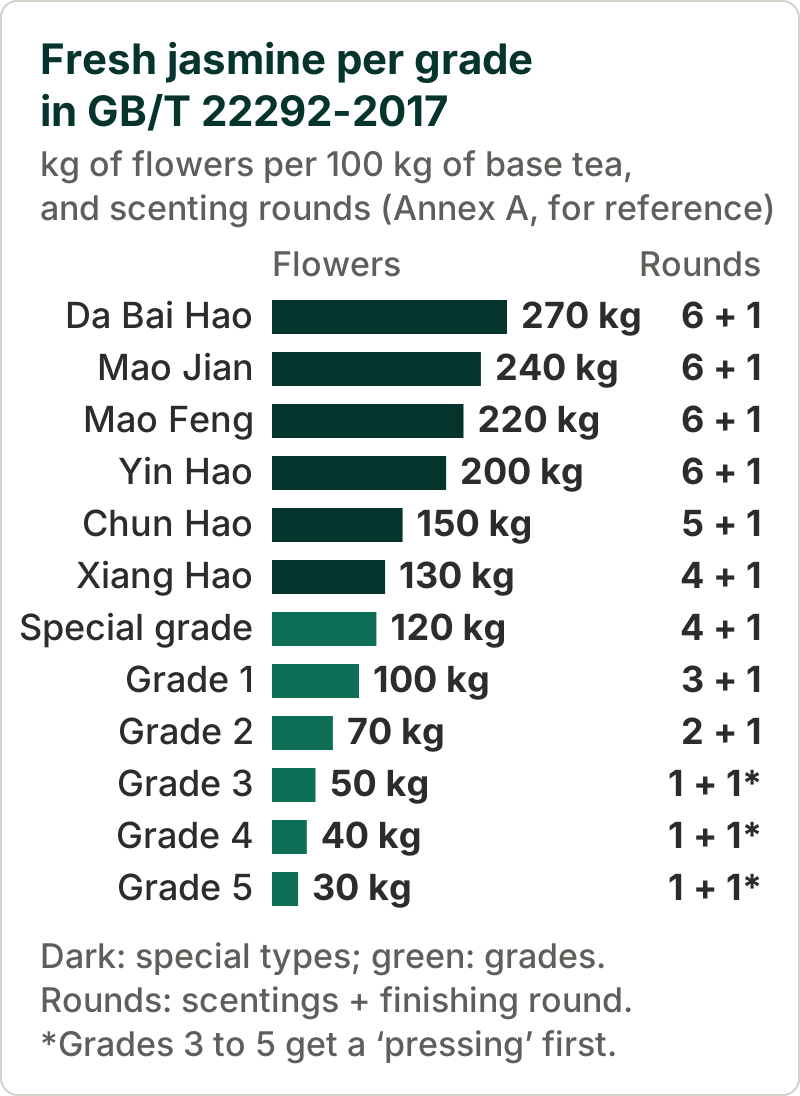 Source: China’s national standard GB/T 22292-2017, Annex A (informative), 2017
Moisture, ash, dust and spent flowers: the limits
Physical and chemical requirements (GB/T 22292-2017, Table 5, % by mass)
| Parameter | Special types, special grade, grades 1–2 | Grades 3–5 | Broken tea | Flake tea |
|---|---|---|---|---|
| Moisture, max | 8.5% | 8.5% | 8.5% | 8.5% |
| Total ash, max | 6.5% | 6.5% | 7.0% | 7.0% |
| Water extract, min | 34% | 32% | 32% | 32% |
| Dust, max | 1.0% | 1.2% | 3.0% | 7.0% |
| Spent jasmine flowers, max | 1.0% | 1.5% | 1.5% | 1.5% |
Spent jasmine (茉莉花干) means flowers that have yellowed and lost their scent in scenting, often with their green base (花托) attached. Annex B counts them by picking flowers and bases out of a 100 g sample and weighing them. Moisture is tested with GB/T 8304, water extract with GB/T 8305, total ash with GB/T 8306 and dust with GB/T 8311. Unlike the gunpowder standard, Table 5 sets no minimum for polyphenols or catechins.
Every batch needs a factory release check on sensory quality, moisture, dust and net content, and every requirement is type-tested once a year. A lot that fails any requirement is non-conforming; in a dispute, the retained sample or a double sample from the same lot is retested. Contaminants and pesticide residues must meet China’s GB 2762 and GB 2763. Tea sold in the EU must also meet the EU’s own limits, set out in our guide to EU pesticide limits for tea.
Jasmine pearls and other names that are not grades
Shapes and product names are not grades in China’s standard. GB/T 22292-2017 places tea rolled into round pearls (圆珠) in the special type of pan-fired jasmine tea, alongside flat and curled teas and teas sold under a specific product name (特定品名). Fuzhou’s geographical-indication standard also lists pearl shapes (珠形) among those of its special teas. Neither standard has a grade called “jasmine pearls” or “dragon pearls”: a pearl-shaped jasmine tea is judged as a special type. Annex A’s row for special teas in general suggests six scentings or more and at least 270 kg of flowers per 100 kg of tea, and the Fuzhou standard requires six scentings or more for its special teas.
Where jasmine tea is made: Hengzhou and Fuzhou
The China Tea Marketing Association (CTMA, 中国茶叶流通协会) names four main producing areas: Hengzhou in Guangxi, Fuzhou in Fujian, Qianwei county in Sichuan and Yuanjiang county in Yunnan. According to its 2025 national survey of the jasmine tea trade, in 2024 they grew 234,400 mu of jasmine (about 15,600 hectares, at 15 mu to the hectare), harvested 153,600 tonnes of flowers and processed 138,100 tonnes of jasmine tea, 11.73% more than in 2023. Hengzhou accounted for 65.17% of China’s jasmine tea processing volume and Fuzhou for 15.95%.
Hengzhou (横州). People’s Daily reported in April 2026 that Hengzhou grows 180,000 mu of jasmine (12,000 hectares) and harvests 150,000 tonnes of flowers a year, and that six of every ten jasmine flowers grown in the world come from there. Its protected names use Hengxian (横县), the county’s name when they were registered. Hengxian jasmine tea (横县茉莉花茶) has been a protected geographical-indication (GI) product in China since 9 December 2013, under announcement No. 118 of 2013 of the former quality inspection administration (AQSIQ), according to its specification in the EU’s register of geographical indications; it must be made with Hengxian jasmine, itself a protected GI.
Fuzhou (福州). Fuzhou jasmine tea (福州茉莉花茶) has been a protected GI product in China since AQSIQ announcement No. 87 of 2009, which limits it to ten districts, county-level cities and counties of Fuzhou. Fujian’s standard DB35/T 991-2010, in force since 20 March 2010 and still current (checked October 2026), requires baked green tea from local cultivars, single- or double-petal jasmine grown in the area and at least four scentings plus a finishing round. In 2014, FAO listed the Fuzhou jasmine and tea culture system as a Globally Important Agricultural Heritage System, according to China’s Mission to the EU. In January 2025, the city’s agriculture bureau put Fuzhou’s jasmine tea exports at about 1,500 tonnes and US$13 million a year over the previous five years; its customs district shipped 1,297.3 tonnes in the first eleven months of 2024 (+8.4%).
Fuzhou jasmine tea and the national standard compared (GB/T 22292-2017; DB35/T 991-2010)
| Requirement | GB/T 22292-2017 (national) | DB35/T 991-2010 (Fuzhou GI) |
|---|---|---|
| Grades | Special types; special grade to grade 5 | Special teas, Yinhao, Chunhao, Xianghao, special grade |
| Scenting rounds | From a pressing + 1 + 1 to 6 + 1 or more (Annex A, for reference) | At least 4 + 1; 6 or more for special teas |
| Moisture, max | 8.5% | 8.0% |
| Total ash, max | 6.5% (7.0% for broken and flake tea) | 5.0% |
| Dust, max | 1.0% to 7.0%, by grade or type | 0.5% |
| Broken tea, max | No limit | 5.0% |
| Shelf life | Not set | 18 months at room temperature |
In the EU. Both names are on the first list of Chinese GIs that the EU protects under the EU–China agreement on geographical indications, in force since 1 March 2021: Fuzhou Mo Li Hua Cha (Fuzhou Jasmine Tea) is No. 14 of its Annex III and Hengxian Mo Li Hua Cha (Hengxian Jasmine Tea) No. 44. The specification registered in the EU for Fuzhou jasmine tea rests on a certification mark registered in China in January 2008 and covers 13 districts, county-level cities and counties, three more than the 2009 decision.
Jasmine tea in China’s customs and export statistics
Scenting does not take tea out of heading 09.02 of the Harmonized System (HS), which reads “Tea, whether or not flavoured”. The HS Explanatory Notes, as quoted in a 2013 US customs ruling, keep in that heading tea flavoured with parts of aromatic plants “such as jasmine flowers, dried orange peel or cloves”. Our guide to tea HS codes explains the split at 3 kg. Since 1 January 2023, China’s tariff has had its own jasmine tea lines under green tea: 0902.1011 for immediate packings of up to 3 kg and 0902.2011 for larger ones.
In 2025 China exported 7,510 tonnes of jasmine tea, 1.79% of its tea export volume and 23 tonnes more than in 2024, according to CTMA, which cites customs statistics; it publishes no value. For 2024, CTMA’s jasmine tea survey reports exports of 7,486.49 tonnes (+20.54%) worth US$56.04 million (+10.97%), from 20 provinces, regions and municipalities to 72 countries and regions. That is about US$7.49 per kg, against US$3.31 per kg for green tea that year (our calculation from CTMA and MOFCOM figures).
The monthly tea report of China’s Ministry of Commerce (MOFCOM) does not show jasmine tea on its own: the list of customs codes in its December 2024 edition counts both jasmine lines among speciality teas (特种茶), a group that totalled 23,904 tonnes worth US$166.9 million in 2025. Jasmine tea made up about 31% of that volume (our calculation). Our analysis of China’s tea exports in 2025 covers the other categories.
What to put in a jasmine tea purchase specification
- Standard and product: GB/T 22292-2017, the base tea (baked, pan-fired, broken or flake), the grade or special type, and the number of the sealed contract sample.
- Scenting: the number of rounds and the flower quantity, if they matter; Annex A is only a reference.
- Additives: none; the standard forbids additives of any kind.
- Limits: moisture ≤8.5% (GB/T 8304), dust for the grade (GB/T 8311) and spent flowers ≤1.0% or 1.5% (Annex B).
- Origin: for a protected name such as Fuzhou jasmine tea or Hengxian jasmine tea, proof that the tea comes from the protected area and meets its specification.
- Customs line: 0902.1011 for packings of up to 3 kg, or 0902.2011 for larger ones, on the Chinese export declaration.
- Packing and storage: packaging to GH/T 1070 and storage to GB/T 30375; transport clean, dry, odour-free and protected from rain, damp and sun.
- Disputes: a retained sample, which the standard uses for retesting.
Questions and answers
What are the grades of jasmine tea?
China's standard GB/T 22292-2017 grades baked and pan-fired jasmine tea from a special type (特种) through the special grade (特级) and grades 1 to 5. Baked jasmine tea has seven special types, such as Da Bai Hao, Mao Feng and Yin Hao; broken and flake jasmine tea are not graded.
Is jasmine tea a green tea?
Under China's standard, yes: GB/T 22292-2017 covers jasmine tea made from green tea scented with fresh jasmine flowers. China's customs tariff also lists jasmine tea under green tea, as lines 0902.1011 and 0902.2011.
Are jasmine pearls or dragon pearls an official grade?
No. GB/T 22292-2017 places tea rolled into round pearls in the special type of pan-fired jasmine tea, which may also carry a specific product name, but none of its grades is called pearls. Fuzhou's geographical-indication standard also treats pearl shapes as special teas, not as a grade.
How many times is jasmine tea scented?
Annex A of GB/T 22292-2017, which is for reference only, suggests six scentings or more plus a finishing round for the top special types, four plus one for Xiang Hao and the special grade, and fewer for lower grades. Fuzhou jasmine tea must be scented at least four times plus a finishing round.
What is the moisture limit for jasmine tea?
No more than 8.5% for every grade under GB/T 22292-2017, tested with method GB/T 8304. Fujian's standard for Fuzhou jasmine tea, DB35/T 991-2010, sets 8.0%.
Where is jasmine tea made in China?
Mainly in four areas: Hengzhou in Guangxi, Fuzhou in Fujian, Qianwei county in Sichuan and Yuanjiang county in Yunnan, according to the China Tea Marketing Association. Hengzhou accounted for 65.17% of China's jasmine tea processing volume in 2024 and Fuzhou for 15.95%.
Sources
- 1. GB/T 22292-2017 Jasmine tea, entry in China's official standards reading system (in Chinese) · openstd.samr.gov.cn
- 2. National public service platform for standards information: GB/T 22292-2017 record, replacement of the 2008 edition and 2021 review (in Chinese) · std.samr.gov.cn
- 3. GB/T 34779-2017 Technique specification for processing of jasmine tea, official entry (in Chinese) · openstd.samr.gov.cn
- 4. GB/T 22291-2017 White tea, official entry (in Chinese) · openstd.samr.gov.cn
- 5. GB/T 23776-2018 Methodology for sensory evaluation of tea, official entry (in Chinese) · openstd.samr.gov.cn
- 6. Fujian Bureau of Quality and Technical Supervision: DB35/T 991-2010 Product of geographical indication, Fuzhou jasmine tea, record in the local standards filing system (in Chinese) · dbba.sacinfo.org.cn
- 7. Fujian Bureau of Quality and Technical Supervision: DB35/T 991-2010, official full text, 2010 (in Chinese) · dbba.sacinfo.org.cn
- 8. EUR-Lex: Agreement between the European Union and the Government of the People's Republic of China on cooperation on, and protection of, geographical indications, OJ L 408I, 4 December 2020 · eur-lex.europa.eu
- 9. Council of the European Union: EU–China agreement on geographical indications, with annexes, document 8361/20, July 2020 · data.consilium.europa.eu
- 10. MOFCOM: EU–China geographical indications agreement, Chinese tea names in Annex III (in Chinese) · ipr.mofcom.gov.cn
- 11. Mission of China to the EU: Fujian teas in the EU–China geographical indications agreement, 20 June 2022 (in Chinese) · eu.china-mission.gov.cn
- 12. European Commission GI register (eAmbrosia): technical specification of the geographical indication Hengxian Mo Li Hua Cha, protected in China since 9 December 2013 · ec.europa.eu
- 13. European Commission GI register (eAmbrosia): technical specification of the geographical indication Fuzhou Mo Li Hua Cha · ec.europa.eu
- 14. World Customs Organization: HS Nomenclature 2022 edition, Chapter 9, coffee, tea, maté and spices · wcoomd.org
- 15. US Customs and Border Protection: ruling H236614, quoting the HS Explanatory Note to heading 09.02, 5 August 2013 · rulings.cbp.gov
- 16. State Council Tariff Commission: 2023 tariff line adjustment table, annex 7, with the new jasmine tea lines (in Chinese) · gss.mof.gov.cn
- 17. Office of the State Council Tariff Commission: tariff changes from 1 January 2023, 29 December 2022 (in Chinese) · gss.mof.gov.cn
- 18. MOFCOM and 中国食品土畜进出口商会: China export monthly statistical report, tea, December 2025 (in Chinese) · wms.mofcom.gov.cn
- 19. MOFCOM and 中国食品土畜进出口商会: China export monthly statistical report, tea, December 2024, with the list of customs codes used (in Chinese) · wms.mofcom.gov.cn
- 20. China Tea Marketing Association (CTMA): brief on China's tea imports and exports in 2025, 20 January 2026 (in Chinese) · ctma.com.cn
- 21. CTMA, reprinting China Food News: 2025 national survey of jasmine tea production and sales, 24 November 2025 (in Chinese) · ctma.com.cn
- 22. National Forestry and Grassland Administration, reprinting People's Daily: six of every ten jasmine flowers come from Hengzhou, Guangxi, 30 April 2026 (in Chinese) · forestry.gov.cn
- 23. Fuzhou Municipal Government, Bureau of Agriculture and Rural Affairs: how Fuzhou jasmine tea reaches the world, 2 January 2025 (in Chinese) · fuzhou.gov.cn