Importing green tea into Algeria: rules, duties and data
Importing green tea into Algeria: 30% duty in the latest tariff data (2023), 19% VAT, 3% solidarity levy, no DAPS; PPI, bank domiciliation and China data.
Key facts
- The latest tariff data available for Algeria (UNCTAD TRAINS, 2023) show a 30% customs duty on green tea in packs of 3 kg or less and in larger packings alike, and no change for tea was found in the 2024, 2025 and 2026 finance laws (checked October 2026); imports also pay 19% VAT (turnover tax code, Article 21, 2026 edition) and a 3% solidarity contribution (2025 finance law).
- Tea is not on Algeria's list of goods subject to the additional provisional safeguard duty (DAPS) in any of the three orders listed by Algerian Customs and published in the Journal officiel, in January 2019, April 2019 and December 2023 (checked October 2026).
- China exported 15,298 tonnes of tea worth US$53.9 million to Algeria in 2025, up 10.9% in volume, after 20,266 tonnes in 2023, according to MOFCOM; in 2023 Algeria was China's fourth tea market by volume (UN Comtrade).
- Packs of 3 kg or less made up 23.7% of the green tea China declared for Algeria in 2025, against 53.2% in 2022 and 77.8% in 2017, according to The Tea Trade's calculation from China's data in UN Comtrade.
- Under Banque d'Algérie Regulation 07-01 of 3 February 2007 (Article 50), an Algerian importer's bank may pay a foreign supplier advances of up to 15% of the contract value, against a refund guarantee of equal value from a first-class bank; larger advances need the Banque d'Algérie's authorisation.
The latest tariff data available for Algeria (UNCTAD TRAINS, 2023) show a 30% customs duty on green tea, in small packs or in bulk, and we found no change for tea in the 2024, 2025 and 2026 finance laws (checked October 2026); 19% VAT (turnover tax code, 2026 edition) and a 3% solidarity contribution (2025 finance law) come on top, and tea is not on the DAPS safeguard-duty list. Imports go through a controlled regime: a specialised commercial register entry, bank domiciliation before any payment or customs clearance and, according to the business press, a forecast import programme (PPI) since July 2025. China shipped 15,298 tonnes of tea worth US$53.9 million to Algeria in 2025, according to China’s Ministry of Commerce (MOFCOM), after a peak of 20,266 tonnes in 2023.
China’s tea exports to Algeria, 2023 to 2026
China’s export statistics, where Algeria appears as 阿尔及利亚, show a jump and a fall. In 2023 Algeria took 20,266 tonnes of Chinese tea, 76.8% more than in 2022, which made it China’s fourth tea market by volume and fifth by value. Its volume fell 31.9% in 2024, then rose 10.9% in 2025.
China’s tea exports to Algeria, 2023 to April 2026 (HS 0902, all tea; sources: MOFCOM, UN Comtrade via WITS)
| Period | Volume (t) | Volume change | Value (US$ million) | Value change | US$/kg | Rank by volume | Rank by value |
|---|---|---|---|---|---|---|---|
| 2023 | 20,266 | +76.8% | 70.9 | +49.5% | 3.50 | 4th | 5th |
| 2024 | 13,795 | −31.9% | 52.3 | −26.1% | 3.79 | 7th | 9th |
| 2025 | 15,298 | +10.9% | 53.9 | +2.9% | 3.52 | 8th | 10th |
| January–April 2026 | 4,812 | −7.5% | 17.5 | −9.2% | 3.64 | – | 10th |
Unit values (value ÷ volume) and ranks by volume are The Tea Trade’s calculation from UN Comtrade; ranks by value come from MOFCOM’s top-ten tables, and the January–April 2026 report was MOFCOM’s latest at the end of September 2026. Algeria took 5.5% of China’s tea export volume in 2023 and 3.7% in 2025 (our calculation).
The unit value moved less than the volume: between US$3.50 and US$3.79 per kg from 2023 to 2025, against US$4.14 in 2022 (US$47.4 million for 11,462 tonnes). How Algeria compares with China’s other destinations over ten years is shown in our guide to China’s tea export markets, 2015–2025, and its place in the 2025 ranking in China’s 2025 tea exports.
From small packs to larger packings
Algeria’s green tea from China has moved from small packs to larger packings. In 2017, 77.8% of the green tea China declared for Algeria came in packs of 3 kg or less (HS 0902.10); in 2025 the share was 23.7% (The Tea Trade’s calculation from China’s declarations to UN Comtrade).
China’s green tea exports to Algeria by pack size (tonnes; source: UN Comtrade, China’s declarations)
| Year | Packs of 3 kg or less (0902.10) | Packings over 3 kg (0902.20) | Share in packs of 3 kg or less |
|---|---|---|---|
| 2017 | 10,525 | 3,011 | 77.8% |
| 2022 | 6,087 | 5,363 | 53.2% |
| 2023 | 7,034 | 13,199 | 34.8% |
| 2024 | 2,887 | 10,895 | 20.9% |
| 2025 | 3,604 | 11,622 | 23.7% |
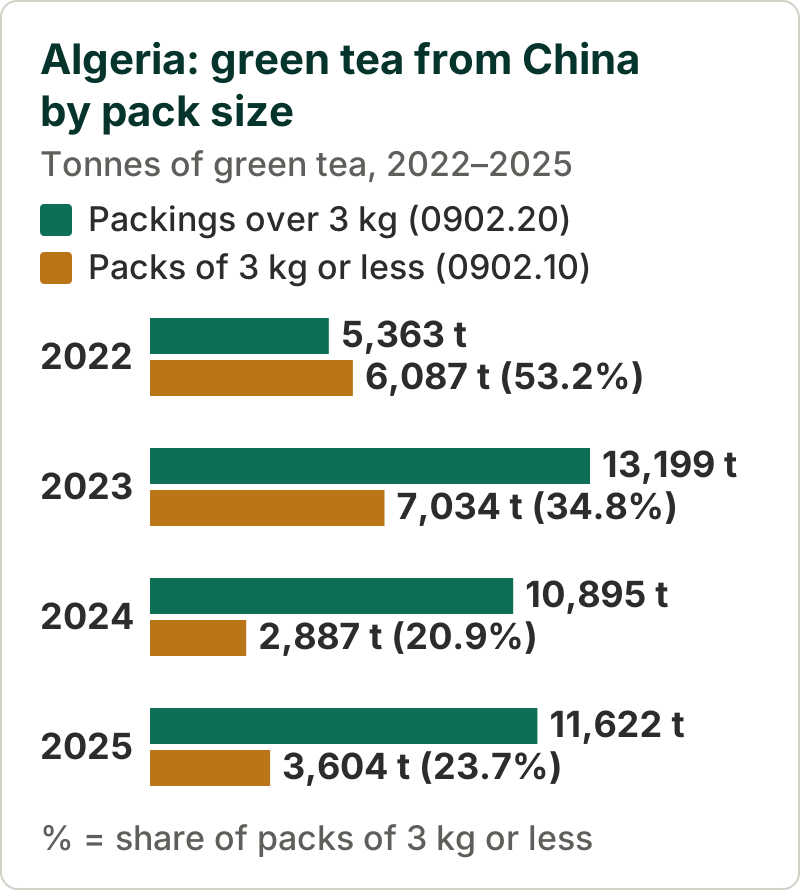 Source: UN Comtrade, China’s export declarations (2022–2025)
The 2023 surge came from larger packings, up 146% on 2022 to 13,199 tonnes, while packs of 3 kg or less rose 16%; both fell back in 2024. The data do not say why. In 2025 the two formats had almost the same unit value, US$3.57 per kg in small packs and US$3.51 in larger packings (our calculation); customs values mix grades and include the packing, so they are not prices. How the two formats compare in China’s other main green tea markets is shown in our guide to green tea export unit values.
Nor does the tariff explain the shift: UNCTAD’s tariff data show the same 30% duty on both subheadings in every year reported from 2002 to 2023. Morocco, by contrast, has charged 2.5% on green tea in packings of 20 kg or more and 30% below since 2024, as explained in our guide to importing green tea into Morocco.
What Algeria’s own statistics show
Algeria’s last report to UN Comtrade with weights is for 2017: 14,060 tonnes of tea imports worth US$33.9 million, 13,637 tonnes of them from China (97.0%). The volume matches China’s declaration within 0.7% (13,544 tonnes), but the value does not: Algeria recorded US$32.1 million for tea from China, 71.5% of the US$44.9 million China declared (our calculation), although import values include freight and insurance. The statistics do not explain the gap.
Algeria made no report for 2018 to 2023, and none yet for 2025 (checked October 2026). For 2024 it reported values only: US$30.0 million of tea imports, US$28.8 million of them from China (96.0%), which is 55.1% of the US$52.3 million China declared (our calculation); UN Comtrade marks the weights shown with them as its own estimates, so they are not used here. Tunisia’s own tea import figures are examined in our guide to Tunisia’s tea imports.
Import duty, VAT and other taxes on tea in Algeria
Duties and taxes on green tea imported into Algeria (checked October 2026; sources as listed)
| Charge | Rate | Applies to | Legal basis |
|---|---|---|---|
| Customs duty | 30% | Green tea in packs of 3 kg or less (0902.10) and in larger packings (0902.20) | The latest tariff data available (UNCTAD TRAINS, 2023) show 30%; we found no change for tea in the 2024, 2025 and 2026 finance laws (checked October 2026) |
| Solidarity contribution | 3% | All goods imported for consumption | 2018 finance law, Article 109; 3% since the 2025 finance law (Article 178) |
| VAT | 19% | Tea, at the normal rate | Turnover tax code, Article 21 (2026 edition) |
| Advance tax (précompte) | 2% | Goods imported for resale in the same state | 2022 finance law, Article 113 |
| DAPS safeguard duty | None | Tea is not on the list | 2018 supplementary finance law, Article 2; orders of 2019 and 2023 |
Duty and VAT stack up. In the Customs’ worked example, VAT is charged on the customs value plus the duty, so on DA 10,000 a 30% duty (DA 3,000) and 19% VAT (DA 2,470) come to DA 5,470, or 54.7% of the customs value. The solidarity contribution, created at 1% in 2018, is collected like customs duty. The advance tax is calculated on the value including import duties and taxes other than the DAPS, and the importer deducts it from its corporate income tax (IBS). The table leaves out the bank domiciliation tax due when an import is domiciled (2005 supplementary finance law, Article 2, as rewritten in 2025).
Tea gets none of the relief granted to green coffee (tariff lines 0901.11.10.00 and 0901.11.20.00), which has paid 5% duty with no VAT and no domestic consumption tax (TIC) since the 2025 finance law, until 31 December 2026 under the 2026 finance law. Tea is neither on the TIC list, which taxes coffee at 10%, nor on the reduced 9% VAT list (turnover tax code, 2026 edition). How the 3 kg line splits tea into subheadings is explained in our guide to tea HS codes.
The DAPS: a safeguard duty that leaves tea out
Algeria created the additional provisional safeguard duty (droit additionnel provisoire de sauvegarde, DAPS) in its supplementary finance law of July 2018 (Law 18-13, Article 2). It applies to goods imported for consumption at a rate between 30% and 200%, and the list of goods and rates is set periodically by regulation. The Customs’ list of orders gives three DAPS orders, all published in the Journal officiel:
- an order of 26 January 2019 (No. 6 of 27 January 2019), the first list;
- an order of 8 April 2019 (No. 26 of 21 April 2019), which replaced it;
- an order of 19 December 2023 (No. 84 of 27 December 2023), which changed the entries for 78 tariff lines of sheep, goat and poultry meat.
None of them includes chapter 09 of the tariff, which covers coffee, tea and spices: the 2019 lists go from chapter 08 (fruit and nuts) straight to chapter 11 (milling products), and the 2023 order covers meat only. The Customs’ list, read to its last page, shows no later DAPS order (checked October 2026), but the law provides for revisions.
Who may import tea for resale
Buying tea abroad to sell it on as imported counts in Algeria as importing goods for resale in the same state (revente en l’état), a regulated activity:
- Commercial register. Every trader must be registered (Law 04-08 of 14 August 2004, Journal officiel No. 52 of 18 August 2004, Article 4), and the national commercial register centre (CNRC) keeps the register (Article 2). Since Executive Decree 21-94 of 9 March 2021 (Journal officiel No. 20 of 17 March 2021), import for resale has required an electronic register extract whose import activity codes all belong to one sub-group of the activity nomenclature; extracts not brought into line by 31 December 2021 ceased to have effect until regularised.
- Company and premises. Since Executive Decree 18-51 of 30 January 2018 (amending Decree 05-458 of 30 November 2005, as Decree 21-94 also does), only commercial companies under Algerian law with a statutory auditor may import for resale. They need storage and distribution facilities suited to the goods and used only for that activity, suitable transport, and checks on the conformity of the goods before they enter the country.
- Certificate. The company signs a set of specifications (cahier des charges) and obtains from the commerce directorate of its wilaya a certificate of compliance, valid for two years and renewable, which the directorate must issue or refuse within 15 days of the file being lodged. The certificate is withdrawn if the conditions are not met.
Forecast import programmes and the new Import Body
Algeria has tightened its control of import flows since 2025:
- The PPI. On 2 July 2025 the Ministry of Foreign Trade and Export Promotion asked companies importing for resale, or for their own operations or equipment, to file a forecast import programme (programme prévisionnel d’importation, PPI) for the second half of 2025, according to the Algerian business press. A note from the banks’ association (ABEF), reported in July 2025, told banks to require the ministry-stamped programme before any pre-domiciliation, domiciliation or letter of credit. No decree or order setting up the PPI was found in the Journal officiel (checked October 2026).
- The 2026 rounds. The ministry’s digital platform opened registration for importers reselling goods in the same state from 22 March to 30 April 2026, according to Algérie Presse Service; a window for companies’ operating imports in the second half of 2026 ran from 23 June to 31 July 2026, according to the business press.
- The Import Body. Executive Decree 25-233 of 3 September 2025 created the Algerian Import Body (organisme algérien de l’importation), under the minister for foreign trade, to apply a high council’s decisions on imports for resale and for companies’ own production, build a national file of importers and run a digital platform linked to the Banque d’Algérie, the banks and Customs; it may also issue an importer’s card.
- The end of ALGEX. Decree 25-235 of the same day dissolved the national agency for the promotion of foreign trade (ALGEX) and transferred its assets and staff to the Algerian export body.
Bank domiciliation and paying a Chinese supplier
Apart from goods in transit and a few exempted operations, no import into Algeria can be paid or cleared without a bank domiciliation:
- First step. Under Banque d’Algérie Regulation 07-01 of 3 February 2007 (Journal officiel No. 31 of 13 May 2007), every import of goods or services must be domiciled with an authorised bank before any transfer of funds, commitment or customs clearance (Article 29).
- The file. The bank gives the importer a copy of the contract bearing its domiciliation stamp (Article 41), and pays only once it holds the final invoices and the shipping documents or the customs documents releasing the goods for consumption (Article 44).
- Advances. The bank may pay advances of up to 15% of the total contract value if the contract provides for them in line with international rules and practice, against a refund guarantee of equal value issued by a first-class bank; beyond 15%, the Banque d’Algérie’s authorisation is required (Article 50). No amending regulation up to July 2026 changes that article (checked October 2026).
- Payment instruments. The rule that goods imported for resale be paid only by documentary credit or documentary collection (2009 supplementary finance law, Article 69, as amended in 2014) was repealed by the 2017 finance law (Law 16-14, Article 111); no annual finance law from 2018 to 2026 restores it (checked October 2026).
A sales contract for Algeria therefore needs a domiciled contract, any advance kept within 15% and backed by a refund guarantee unless the central bank authorises more, and the balance paid against the shipping or customs documents. Our guide to Chinese tea export documents lists the papers the seller supplies. How importers pay for tea in Libya is explained in our guide to Libya’s tea import and payment rules.
Border checks, Arabic labels and standards
- Border check. Before customs clearance, the Ministry of Commerce checks imported products at the border under Executive Decree 05-467 of 10 December 2005, still cited as the legal basis (checked October 2026). The importer files the import declaration and certified copies of its register extract and invoice; inspectors may also inspect the goods and their labels and take samples, then admit or refuse them, and a refusal can be appealed within 8 days.
- Arabic labels. Executive Decree 13-378 of 9 November 2013 on consumer information (Journal officiel No. 58 of 18 November 2013), in force one year after its publication, requires the mandatory information to be written mainly in Arabic, with other languages allowed in addition (Article 7). Prepacked food must show, among other items, its sales name, net quantity, durability date, lot, the importer’s name and address and the country of origin (Article 12). Overprinting or adding to label mentions is banned, although some mentions omitted at origin may be added by an accepted method under fraud-control supervision (Article 6). Plain tea, a single ingredient, needs no ingredient list if its name identifies it (Article 25). Morocco’s and West Africa’s rules are compared in our guide to tea labelling requirements.
- Nutrition labelling. Teas with no added ingredient other than flavourings that leave their nutritional value unchanged are exempt from the nutrition labelling order of 19 October 2017 (Annex III, item 7).
- Barcode. Under an order of 16 February 2021, prepacked food must carry a barcode with a GTIN. Imported products need a barcode from a recognised organisation in their country of origin, with its data filed beforehand with the Algerian chamber of commerce and industry (Articles 5, 7 and 8); raw materials for processing or packing are outside the rule (Article 3).
- Standards. The catalogue of Algerian standards (IANOR, 31 December 2025) lists standards for tea sampling and testing, among them NA 716 (loss in mass at 103 °C, 1992) and NA 717 (total ash, 1992), and a definition of black tea, NA ISO 3720 (2015), but no definition of green tea.
Checklist for exporters and importers in 2026
- Before the order: the buyer’s register extract, certificate of compliance and approved PPI.
- Payment: a contract domiciled before any payment; any advance within 15% of the contract value and backed by a refund guarantee from a first-class bank; the balance against the final invoices and the shipping or customs documents.
- Landed cost: the 30% duty shown by the latest tariff data (2023), to be confirmed for the exact tariff line, 19% VAT, the 3% solidarity contribution, the bank domiciliation tax and, for resale, the 2% advance tax.
- Packed tea: the Arabic label printed at origin and the barcode data filed in Algeria; the barcode order excludes raw materials imported for processing or packing.
- Every contract: a fresh check of the DAPS list and of the PPI calendar.
This is general information, checked in October 2026, not legal or tax advice. Algeria’s import rules change often, so have a customs broker (commissionnaire en douane) and the importer’s bank confirm each point before shipping.
Questions and answers
What is the import duty on tea in Algeria?
The latest tariff data available (UNCTAD TRAINS, 2023) show 30% on green tea, whether in packs of 3 kg or less (HS 0902.10) or in larger packings (0902.20); we found no change for tea in the 2024, 2025 and 2026 finance laws (checked October 2026). Imports also pay 19% VAT and a 3% solidarity contribution, goods imported for resale a 2% advance tax, and a customs broker should confirm the duty for the exact 10-digit tariff line.
Is tea subject to the DAPS in Algeria?
No. The DAPS, created in 2018 at rates of 30% to 200%, applies only to the goods listed by ministerial order, and none of the lists published in January 2019, April 2019 and December 2023 includes chapter 09 of the tariff, where tea sits (checked October 2026).
How much tea does Algeria import from China?
China declared 15,298 tonnes of tea worth US$53.9 million for Algeria in 2025, according to MOFCOM. Algeria's own latest figures with weights, for 2017, show 14,060 tonnes of tea imports, 97.0% of them from China; its 2024 report to UN Comtrade gives values only.
What is the PPI for importers in Algeria?
According to the business press and Algérie Presse Service, the programme prévisionnel d'importation is a half-yearly forecast of a company's imports that Algeria's Ministry of Foreign Trade and Export Promotion has asked importers to file since July 2025; no decree or order setting it up was found in the Journal officiel (checked October 2026). The business press reported in July 2025 that the banks' association had told banks to ask for the approved programme before domiciling an import or opening a letter of credit.
How can an Algerian importer pay a Chinese tea supplier?
Through the bank that has domiciled the contract: domiciliation must come before any payment, commitment or customs clearance, and the bank pays against the final invoices and the shipping or customs documents (Regulation 07-01, Articles 29 and 44). Advances are limited to 15% of the contract value, against a refund guarantee from a first-class bank, unless the Banque d'Algérie authorises more (Article 50). The former rule that imports for resale be paid only by documentary credit or documentary collection was repealed by the 2017 finance law.
Must tea labels be in Arabic in Algeria?
Yes. Executive Decree 13-378 of 9 November 2013 (Journal officiel No. 58 of 18 November 2013) requires the mandatory label information to be written mainly in Arabic, with other languages allowed in addition. Overprinting or correcting a label is banned, although some mentions omitted at origin may be added by an accepted method under fraud-control supervision.
Sources
- 1. Algeria, Journal officiel No. 88 of 31 December 2025: Law 25-17 of 14 December 2025, finance law for 2026 (in French) · joradp.dz
- 2. Algeria, Journal officiel No. 84 of 26 December 2024: Law 24-08 of 24 November 2024, finance law for 2025 (in French) · joradp.dz
- 3. Algeria, Journal officiel No. 86 of 31 December 2023: Law 23-22 of 24 December 2023, finance law for 2024 (in French) · joradp.dz
- 4. Algeria, Journal officiel No. 100 of 30 December 2021: Law 21-16, finance law for 2022, Article 113 (in French) · joradp.dz
- 5. Algeria, Journal officiel No. 76 of 28 December 2017: Law 17-11, finance law for 2018, Article 109 (in French) · joradp.dz
- 6. Algeria, Journal officiel No. 77 of 29 December 2016: Law 16-14, finance law for 2017, Article 111 (in French) · joradp.dz
- 7. Algeria, Journal officiel No. 68 of 31 December 2013: Law 13-08, finance law for 2014, Article 81 (in French) · joradp.dz
- 8. Algeria, Journal officiel No. 42 of 15 July 2018: Law 18-13, supplementary finance law for 2018, Article 2 on the DAPS (in French) · joradp.dz
- 9. Algeria, Journal officiel No. 6 of 27 January 2019: order of 26 January 2019 listing the goods subject to the DAPS (in French) · joradp.dz
- 10. Algeria, Journal officiel No. 26 of 21 April 2019: order of 8 April 2019 replacing the DAPS list (in French) · joradp.dz
- 11. Algeria, Journal officiel No. 84 of 27 December 2023: order of 19 December 2023 amending the DAPS list (in French) · joradp.dz
- 12. Algerian Customs: orders and decisions, including the DAPS orders (in French, checked October 2026) · douane.gov.dz
- 13. Algerian Customs: estimating the duties and taxes due on imports (in French) · douane.gov.dz
- 14. Directorate General of Taxes: turnover tax code (Code des taxes sur le chiffre d'affaires), 2026 edition (in French) · mfdgi.gov.dz
- 15. UNCTAD TRAINS via WITS: applied duty reported by Algeria on green tea in packings over 3 kg (HS 0902.20), 1993–2023 · wits.worldbank.org
- 16. UNCTAD TRAINS via WITS: applied duty reported by Algeria on green tea in packs of 3 kg or less (HS 0902.10), 1993–2023 · wits.worldbank.org
- 17. Algeria, Journal officiel No. 52 of 18 August 2004: Law 04-08 on the conditions for carrying on commercial activities (in French) · joradp.dz
- 18. Algeria, Journal officiel No. 6 of 1 February 2018: Executive Decree 18-51 on importing goods for resale in the same state (in French) · joradp.dz
- 19. Algeria, Journal officiel No. 20 of 17 March 2021: Executive Decree 21-94 on importing goods for resale in the same state (in French) · joradp.dz
- 20. Algeria, Journal officiel No. 60 of 7 September 2025: Executive Decrees 25-233 and 25-235 on the Algerian Import Body and the dissolution of ALGEX (in French) · joradp.dz
- 21. Ministry of Foreign Trade and Export Promotion: home page with the forecast import programme platform (in Arabic) · mcepe.gov.dz
- 22. Algérie Presse Service: opening of the digital platform for importers' forecast programmes, 23 March 2026 (in French) · aps.dz
- 23. Algeria, Journal officiel No. 31 of 13 May 2007: Banque d'Algérie Regulation 07-01 of 3 February 2007 on current transactions with other countries and foreign currency accounts (in French) · joradp.dz
- 24. Algeria, Journal officiel No. 80 of 11 December 2005: Executive Decree 05-467 on border checks of the conformity of imported products (in French) · joradp.dz
- 25. Ministry of Commerce: legal basis of border checks on imported products (in French) · commerce.gov.dz
- 26. Algeria, Journal officiel No. 58 of 18 November 2013: Executive Decree 13-378 on consumer information (in French) · joradp.dz
- 27. Ministry of Commerce: interministerial order of 19 October 2017 on nutrition labelling, Journal officiel No. 25 of 2 May 2018 (in French) · commerce.gov.dz
- 28. Algeria, Journal officiel No. 23 of 28 March 2021: interministerial order of 16 February 2021 on barcodes (in French) · joradp.dz
- 29. Algerian Standards Institute (IANOR): catalogue of Algerian standards at 31 December 2025 (in French) · ianor.dz
- 30. MOFCOM and 中国食品土畜进出口商会: China export monthly statistical report, tea, December 2023 (in Chinese) · wms.mofcom.gov.cn
- 31. MOFCOM and 中国食品土畜进出口商会: China export monthly statistical report, tea, December 2024 (in Chinese) · wms.mofcom.gov.cn
- 32. MOFCOM and 中国食品土畜进出口商会: China export monthly statistical report, tea, December 2025 (in Chinese) · wms.mofcom.gov.cn
- 33. MOFCOM and 中国食品土畜进出口商会: China export monthly statistical report, tea, April 2026 (in Chinese) · wms.mofcom.gov.cn
- 34. UN Comtrade via WITS: China's tea exports (HS 0902) by partner, 2023 · wits.worldbank.org
- 35. UN Comtrade via WITS: China's tea exports (HS 0902) by partner, 2024 · wits.worldbank.org
- 36. UN Comtrade: China's tea exports to Algeria by subheading (HS 0902, 0902.10, 0902.20), 2025 · comtradeapi.un.org
- 37. UN Comtrade: China's tea exports to Algeria by subheading, 2024 · comtradeapi.un.org
- 38. UN Comtrade: China's tea exports to Algeria by subheading, 2023 · comtradeapi.un.org
- 39. UN Comtrade: China's tea exports to Algeria by subheading, 2022 · comtradeapi.un.org
- 40. UN Comtrade: China's tea exports to Algeria by subheading, 2017 · comtradeapi.un.org
- 41. UN Comtrade: Algeria's tea imports, world and China, 2017 · comtradeapi.un.org
- 42. UN Comtrade: Algeria's tea imports, world and China, 2024 (values reported, weights estimated) · comtradeapi.un.org