Chinese dark tea and brick tea: standards and grades
Chinese dark tea and brick tea: 14 standards, seven ungraded teas, Fu brick's 20×10⁴ CFU/g golden-flower minimum, HS 0902.3039, 472 t exported in 2025.
Key facts
- China's dark tea standard GB/T 32719 has five parts in force in October 2026: basic requirements, Huajuan, Xiangjian and Liubao tea (2016) and Fu tea (2018); a review on 19 May 2021 concluded that all five should be revised.
- China's compressed tea standard GB/T 9833-2013 has nine parts, from Hua brick to Qing brick; Fu brick tea, Part 3, has no grades, a 14.0% moisture cap with net weight calculated at 12.0%, and requires at least 20×10⁴ CFU/g of the fungus 冠突散囊菌.
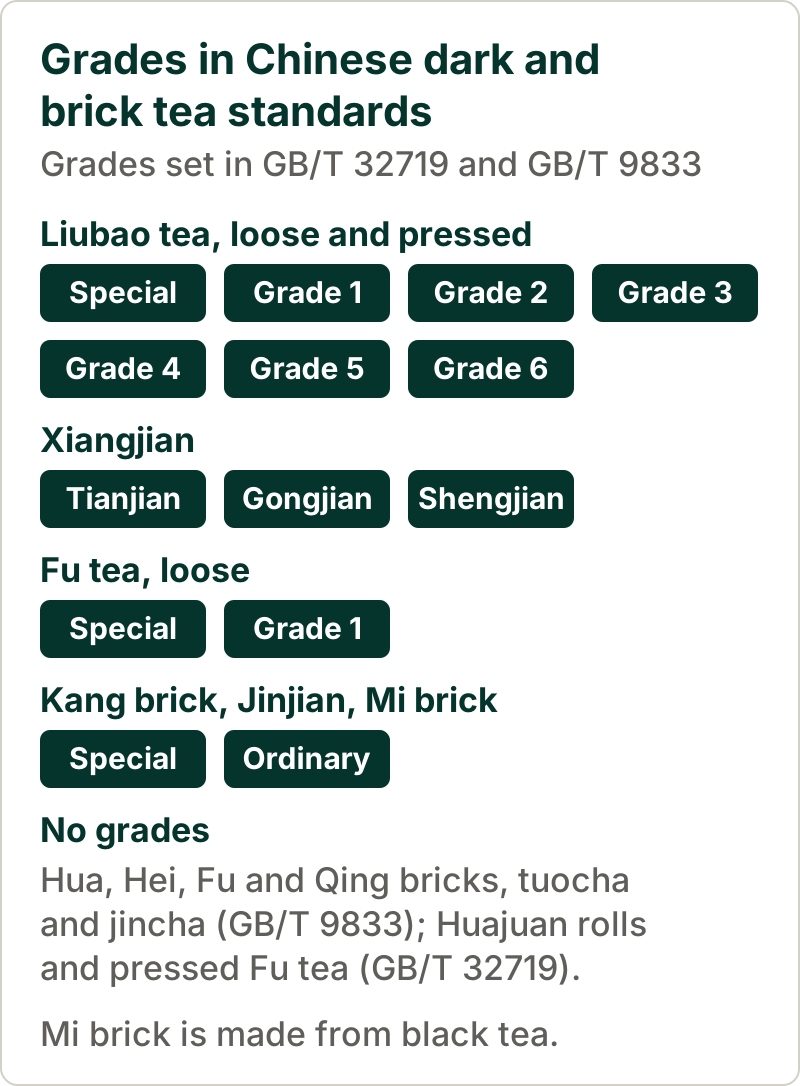
- Under GB/T 32719 and GB/T 9833, only Liubao tea (seven grades), Xiangjian (three), loose Fu tea, Kang brick, Jinjian and Mi brick (two each) are graded; Hua, Hei, Fu and Qing bricks, tuocha, jincha and Huajuan rolls are not.
- China caps the fluoride content of brick tea at 300 mg per kg under its mandatory standard GB 19965-2005, in force since 1 May 2006 and still listed as current in October 2026.
- China exported 472 tonnes of dark tea in 2025, 0.11% of its tea exports and 40 tonnes less than in 2024, according to the China Tea Marketing Association, which puts dark tea at 12.26% of China's 3.64 million tonnes of crude tea output.
Chinese dark tea (黑茶, heicha) is pile-fermented (渥堆) and sold loose or pressed into bricks, rolls and cakes. Its specifications sit in two series of Chinese national standards: GB/T 32719, the dark tea series (five parts, 2016 and 2018), and GB/T 9833-2013, the compressed tea series (nine parts). Seven of the thirteen teas they cover have no grades, and Fu brick tea, Part 3 of GB/T 9833, may hold up to 14.0% moisture but must contain at least 20×10⁴ CFU/g of its “golden flower” fungus. China exported 472 tonnes of dark tea in 2025, according to the China Tea Marketing Association; ripe pu-erh, a dark tea with its own standard, is covered in our guide to pu-erh tea grades.
What China’s standards call dark tea
GB/T 32719.1-2016, the basic requirements for dark tea, defines it as tea made from the fresh leaves and tender shoots of Camellia sinensis by fixing (杀青), rolling (揉捻), pile-fermentation (渥堆) and drying, and covers the raw dark tea (黑毛茶) made this way and every refined or reprocessed product made from it. Pile-fermentation is the slow change of the leaf’s contents in heaped tea under set temperature and humidity. The international standard ISO 20715:2023 uses the same steps, describes piling fermentation as damping heaped leaves to allow microbial activity, and calls it unique to dark tea. The name causes mistakes: heicha means “black tea” in Chinese, while the black tea of the trade is hongcha (红茶), as our guide to the six Chinese tea types explains.
The basic standard sorts dark tea into loose tea (散茶) and compressed tea (紧压茶), named by process and quality, and recommends a physical reference sample for each product, renewed every five years. Every product must have the normal colour, aroma and taste of its kind, contain no non-tea matter, and carry no colouring or additives.
Physical and chemical limits for dark tea (GB/T 32719.1-2016, Table 1, % by mass)
| Parameter | Loose dark tea | Compressed dark tea |
|---|---|---|
| Moisture, max | 12.0% | 15.0% (net weight at 12.0%) |
| Total ash, max | 8.0% | 8.5% |
| Water extract, min | 24.0% | 22.0% |
| Dust, max | 1.5% | not set |
| Stalks, max | set by each product | set by each product |
China’s dark tea and brick tea standards compared
GB/T 32719 covers dark tea by type: basic requirements, Huajuan, Xiangjian and Liubao (published 14 June 2016, in force from 1 January 2017) and Fu tea (published 6 February 2018, in force from 1 June 2018). GB/T 9833 covers compressed tea in nine parts, all published 19 July 2013 and in force from 6 December 2013, each replacing a 2002 edition. All fourteen were listed as in force in October 2026; each was reviewed on 19 May 2021 with the conclusion that it should be revised, but the national standards platform showed no newer edition (checked October 2026).
Not every compressed tea is a dark tea: Mi brick is pressed from black tea (红茶), and tuocha is made without piling; its standard describes it as dark green with visible white down.
The two series and their teas (GB/T 32719 and GB/T 9833; raw material as each standard’s scope states it)
| Standard | Tea | Made from |
|---|---|---|
| GB/T 32719.2-2016 | Huajuan (花卷茶) rolls | raw dark tea, steamed, packed in baskets, pressed |
| GB/T 32719.3-2016 | Xiangjian (湘尖茶) | Anhua raw dark tea, packed in baskets, pressed |
| GB/T 32719.4-2016 | Liubao (六堡茶), loose or pressed | Cangwu county and other medium- or large-leaf bushes; piled, aged |
| GB/T 32719.5-2018 | Fu tea (茯茶), loose or pressed | raw dark tea; piled, steamed, “flowered” |
| GB/T 9833.1-2013 | Hua brick (花砖茶) | raw dark tea; piled, steam-pressed |
| GB/T 9833.2-2013 | Hei brick (黑砖茶) | raw dark tea; piled, steam-pressed |
| GB/T 9833.3-2013 | Fu brick (茯砖茶) | raw dark tea; piled, steam-pressed, “flowered” |
| GB/T 9833.4-2013 | Kang brick (康砖茶) | zuozhuang and jinyu teas of Ya’an, Sichuan, and nearby |
| GB/T 9833.5-2013 | Tuocha (沱茶) | sun-dried crude tea |
| GB/T 9833.6-2013 | Jincha (紧茶) | sun-dried crude tea, piled |
| GB/T 9833.7-2013 | Jinjian (金尖茶) | zuozhuang and jinyu teas of Ya’an, Sichuan, and nearby |
| GB/T 9833.8-2013 | Mi brick (米砖茶) | black tea |
| GB/T 9833.9-2013 | Qing brick (青砖茶) | laoqing tea (老青茶), steam-pressed |
Limits by tea (each standard’s physical and chemical table; % by mass; in brackets, the moisture at which net weight is calculated; ranges run from the top grade or type to the lowest)
| Tea (standard) | Moisture, max | Total ash, max | Stalks, max | Water extract, min |
|---|---|---|---|---|
| Huajuan (32719.2) | 15.0 (12.0) | 8.0 | 5.0 | 24.0 |
| Xiangjian (32719.3) | 14.0 (12) | 7.5–8.0 | 5.0–10.0 | 26.0–22.0 |
| Liubao, loose (32719.4) | 12.0 | 8 | 3.0–10.0 | 30.0–26.0 |
| Liubao, pressed (32719.4) | 14.0 (12) | 8.5 | 3.0–10.0 | 30.0–26.0 |
| Fu tea, loose (32719.5) | 12.0 | 7.5 | 6.0–8.0 | 26.0–24.0 |
| Fu tea, pressed (32719.5) | 13.0 (12.0) | 8.0 | 10.0 machine, 8.0 hand | 24.0 |
| Hua brick (9833.1) | 14.0 (12.0) | 8.0 | 15.0 | 22.0 |
| Hei brick (9833.2) | 14.0 (12.0) | 8.5 | 18.0 | 21.0 |
| Fu brick (9833.3) | 14.0 (12.0) | 9.0 | 20.0 | 20.0 |
| Kang brick (9833.4) | 16.0 (14.0) | 7.5 | 7.0–8.0 | 28.0–26.0 |
| Tuocha (9833.5) | 9.0 | 7.0 | 3.0 | 36.0 |
| Jincha (9833.6) | 13.0 (10.0) | 7.5 | 8.0 | 36.0 |
| Jinjian (9833.7) | 16.0 (14.0) | 8.0–8.5 | 10.0–15.0 | 25.0–18.0 |
| Mi brick (9833.8) | 9.5 (9.5) | 7.5–8.0 | not set | 30.0–28.0 |
| Qing brick (9833.9) | 12.0 (12.0) | 8.5 | 20.0 | 21.0 |
Every GB/T 9833 part also caps non-tea matter at 0.2%, and seven of the nine cap stalks longer than 30 mm at 1.0%; Huajuan allows 0.5% and the Xiangjian grades 0.1% to 1.0%. Stalks are lignified stems, not tender internodes, measured on two opposite quarters of a brick, about 100 g, loosened by steam (GB/T 9833.1, Annex A).
Grades: Liubao, Xiangjian and the ungraded bricks
The seven ungraded teas, Hua, Hei, Fu and Qing bricks, tuocha, jincha and Huajuan rolls, each have a single specification and a physical reference sample that marks the minimum quality and is renewed every five years. Six standards set grades:
- Liubao: special grade and grades 1 to 6, seven grades in both loose and pressed form, more than any other tea in the two series. Loose Liubao has a reference sample renewed every five years; pressed Liubao has none, and the producer keeps its own retained samples.
- Xiangjian: Tianjian (天尖, Xiangjian No. 1), Gongjian (贡尖, No. 2) and Shengjian (生尖, No. 3), made mainly from special- and first-grade, second-grade and third-grade Anhua raw dark tea respectively.
- Fu tea: loose Fu tea has a special grade and grade 1; pressed Fu tea is divided into hand-pressed (手筑) and machine-pressed (机制) types, not grades. Its reference samples are renewed every three years.
- Kang brick and Jinjian, made from teas of Ya’an, Sichuan: special (特制) and ordinary (普通).
- Mi brick, the pressed black tea: special (特级) and ordinary.
 Source: China’s national standards GB/T 32719.2 to 32719.5 (2016, 2018) and GB/T 9833.1 to 9833.9 (2013)
Liubao’s standard was drafted with bodies of Wuzhou and of the Guangxi Zhuang Autonomous Region.
Liubao tea grades (GB/T 32719.4-2016, Tables 1 to 3)
| Grade | Loose leaf | Liquor | Stalks, max | Water extract, min |
|---|---|---|---|---|
| Special | tight, fine | deep red, bright | 3.0% | 30.0% |
| Grade 1 | tight | deep red, bright | 3.0% | 30.0% |
| Grade 2 | fairly tight | fairly deep red, bright | 6.5% | 28.0% |
| Grade 3 | coarse and firm, tightly rolled | red, bright | 6.5% | 28.0% |
| Grade 4 | coarse and firm | red, bright | 10.0% | 26.0% |
| Grade 5 | coarse, loose | fairly red, fairly bright | 10.0% | 26.0% |
| Grade 6 | coarse, old | fairly red, fairly bright | 10.0% | 26.0% |
Every grade must have a pure aged aroma (陈香), only fairly pure for grade 6. Pressed Liubao, in bamboo baskets, bricks, cakes, tuocha or columns, must match its grade’s colour, aroma, taste, liquor and infused leaf.
Fu brick tea and the “golden flower” in the standards
Fu brick tea (茯砖茶) is the only brick in GB/T 9833 with a fungus requirement. GB/T 9833.3-2013 lists “flowering” (发花) among its processing steps and asks for a flat brick with sharp edges, yellowish-brown and “flowered throughout” (发花普遍), with no black, white, green or red moulds or other foreign fungi inside, giving an orange-yellow liquor and a pure, mild taste without astringency. Its physical and chemical table adds a fungus count: at least 20×10⁴ colony-forming units per gram (CFU/g) of 冠突散囊菌, counted with China’s food microbiology method for moulds and yeasts, GB 4789.15. In the English specification of Anhua Hei Cha filed with the EU, the fungus in Fu brick appears as Eurotium cristatum.
The 2013 edition made the fungus count and the water extract decisive indicators (判定指标): a lot that fails any requirement fails as a whole. The count is not part of the factory release check, which covers sensory quality, moisture, ash, stalks, non-tea matter and net content, but it is part of the type inspection of all requirements, due once a year.
GB/T 32719.5-2018 applies the same minimum to Fu tea (茯茶) in loose and pressed form. Its sensory tables ask for abundant “golden flowers” (金花茂盛) or abundant flowering, no foreign fungi, and a pure aroma with a fungal-flower note (菌花香). Huajuan rolls may show “golden flowers” too, but GB/T 32719.2 sets no count for them. None of the three standards defines the term.
Moisture, net weight and fluoride in brick tea
Most compressed teas have a second moisture figure, the “weighing moisture” (计重水分), which Annex C of GB/T 9833.1-2013 defines as the moisture allowed when the weight of each brick is calculated. Net content is converted with W = W₀ × (1 − M₀) ÷ (1 − M), where W₀ is the weighed net content, M₀ the measured moisture and M the weighing moisture. A Fu brick weighing 1,000 g at 14.0% measured moisture therefore counts as 977.3 g at the standard’s 12.0%, and the same brick dried to 10.0% as 1,022.7 g (The Tea Trade’s calculation).
China also caps fluoride in brick tea at 300 mg per kg under its mandatory standard GB 19965-2005, in force since 1 May 2006 and still listed as current in October 2026. It counts Hei, Fu, Hua, Qing and Kang bricks, jincha, Jinjian, Mi brick and tuocha among brick teas, “also called compressed tea or border-sales tea” (边销茶).
GB/T 32719.1 and the Liubao, Fu tea and Fu brick standards end with the same line on shelf life: stored as they prescribe, the products can be kept long-term (可长期保存). In its questions and answers of 28 August 2026 on the food labelling Measures that apply from 16 March 2027, the market regulator, SAMR, cites the GB/T 32719 series and lets pu-erh and dark tea that keep under suitable storage give their expiry date as “long-term storage” (长期保存), provided they stay safe and within their standards under the storage conditions on the label.
Anhua, Liubao and other protected names
Anhua Hei Cha (安化黑茶, “Anhua dark tea”) is a geographical indication (地理标志) protected in China since 6 April 2010 and in the EU since 1 March 2021, when the EU–China agreement on geographical indications entered into force; it is No. 41 on the agreement’s Annex III. China’s Ministry of Commerce (MOFCOM) gives its origin as Anhua and Taojiang counties and Heshan and Ziyang districts of Yiyang, Hunan. Its EU specification covers Fu brick in three grades, Hua and Hei bricks in two each, Qianliang (千两, “thousand-tael”) rolls and the three Xiangjian types. Three more dark and brick tea names are on the agreement’s second list, Annex V: Chibi Qing Zhuan Cha (No. 120), Liu Pao Cha (No. 133) and Jingyang Fu Zhuan Cha (No. 164). None was in the EU register on 14 October 2026. Our guide to Chinese tea geographical indications explains the two lists.
Dark tea in China’s customs tariff and export statistics
China’s tariff gives dark tea two lines of its own, “other dark tea” (其他黑茶): 0902.3039 for immediate packings of 3 kg net or less and 0902.4039 for larger ones, so a thousand-tael Huajuan roll of 36.25 kg, the size listed in GB/T 32719.2, would fall under 0902.4039. Ripe pu-erh has 0902.3031 and 0902.4031. All four sit under HS 0902.30 and 0902.40, with black tea and oolong; they appear in the 2021 tariff and in MOFCOM’s code list of December 2024, and the tariff-line adjustments for 2025 and 2026 did not change them (checked October 2026). From 1 January 2028 the HS text names dark tea among fermented teas under the same subheadings; our guide to tea HS codes sets out the structure.
China exported 472 tonnes of dark tea in 2025, 0.11% of its 418,800 tonnes of tea exports and 40 tonnes (7.88%) less than in 2024, according to the China Tea Marketing Association (CTMA), which draws on customs data. Ripe pu-erh added 1,401 tonnes, and dark tea imports came to 0.8 tonnes. Output is far larger: dark tea made up 12.26% of China’s 3.64 million tonnes of crude tea in 2025, or 446,500 tonnes (CTMA), so exports of dark tea and ripe pu-erh together came to less than 0.5% of it (The Tea Trade’s calculation). The CTMA gives no destinations; the whole picture is in China’s tea exports in 2025.
Mongolia shows how differently the same trade can be classified on each side of a border; its six-digit figures do not show the tea type. In 2023 China declared 663.7 tonnes of tea for Mongolia, 80.3% of it under 0902.30, at US$1.23 per kg for that part, while Mongolia recorded 635.5 tonnes from China, 90.2% of it under 0902.10, green tea in packings of 3 kg or less (The Tea Trade’s calculation from UN Comtrade). Mongolia’s total is 4.3% lower, and the subheadings do not match.
Tea from China to Mongolia by HS subheading, 2023: China’s declarations and Mongolia’s records (kg; source: UN Comtrade)
| Subheading | Exports declared by China | Imports from China recorded by Mongolia |
|---|---|---|
| 0902.10 green tea, packings of 3 kg or less | 35,172 | 573,364 |
| 0902.20 other green tea | 25,770 | 24,367 |
| 0902.30 black and partly fermented tea, 3 kg or less | 532,854 | 5,424 |
| 0902.40 other black and partly fermented tea | 69,913 | 32,295 |
| Total | 663,709 | 635,450 |
In 2025 China declared 626.7 tonnes under 0902.30 for Mongolia at US$1.37 per kg, against US$9.48 per kg for all its 0902.30 exports (The Tea Trade’s calculation); UN Comtrade held no Mongolian figures for 2024 or 2025 in October 2026.
What to put in a dark tea purchase specification
- Product and standard: the Chinese name and standard, for example 茯砖茶 under GB/T 9833.3-2013 or 六堡茶 grade 2 under GB/T 32719.4-2016, loose or pressed, and the number of the sealed contract sample.
- Limits: moisture, with the weighing moisture used for net weight; total ash; stalks, including the 30 mm cap; water extract; non-tea matter.
- Fungus count for Fu tea: at least 20×10⁴ CFU/g (GB 4789.15), with a test report per lot.
- Fluoride: no more than 300 mg/kg under GB 19965-2005, and any limit of the destination.
- Shape and weight: size and net weight of each brick or roll; GB/T 32719.2 lists Huajuan rolls from 0.363 kg to 362.5 kg, for information.
- Customs line: 0902.3039 or 0902.4039 at Chinese export, by the net weight of each immediate packing; agree the import line with the buyer and the customs broker.
- Residues and contaminants: the destination’s limits, with a test report per lot; the Chinese standards refer to GB 2762 and GB 2763.
- Transport and storage: clean, dry, odour-free vehicles protected from rain, damp and sun, as the standards require, and storage away from odorous goods.
Questions and answers
What is Chinese dark tea?
Dark tea (黑茶, heicha) is tea made by fixing, rolling, pile-fermentation (渥堆) and drying, as defined in China's standard GB/T 32719.1-2016. It is sold loose or pressed into bricks, rolls and cakes. Ripe pu-erh is a dark tea too, with its own standard, GB/T 22111-2008.
What is the golden flower in Fu brick tea?
China's Fu brick and Fu tea standards require a 'flowering' stage (发花), widespread or abundant 'golden flowers' (金花) on the tea, and at least 20×10⁴ CFU/g of the fungus 冠突散囊菌. In the English specification of Anhua Hei Cha filed with the EU, the fungus in Fu brick appears as Eurotium cristatum. The standards make no other claim about it.
Are Chinese brick teas graded?
Mostly not. Hua, Hei, Fu and Qing bricks, tuocha and jincha have no grades under GB/T 9833-2013, while Kang brick, Jinjian and Mi brick have two each. In the dark tea series, Liubao tea has seven grades and Xiangjian three.
How much moisture can Chinese brick tea contain?
Between 9.0% for tuocha and 16.0% for Kang brick and Jinjian under China's compressed tea standards; Fu, Hua and Hei bricks may hold 14.0% and Qing brick 12.0%. Net weight is calculated at a set 'weighing moisture', 12.0% for most bricks.
What is the HS code for Chinese dark tea?
China's tariff lines are 0902.3039 for other dark tea in immediate packings of 3 kg net or less and 0902.4039 for larger packings, under HS 0902.30 and 0902.40 with black tea and oolong. Ripe pu-erh has its own lines, 0902.3031 and 0902.4031.
How much dark tea does China export?
472 tonnes in 2025, 0.11% of China's tea exports, according to the China Tea Marketing Association. Dark tea made up 12.26% of China's 3.64 million tonnes of crude tea that year, or 446,500 tonnes (CTMA).
Sources
- 1. GB/T 32719.1-2016 Dark tea, Part 1: Basic requirements, full text in China's official standards reading system (in Chinese) · openstd.samr.gov.cn
- 2. National public service platform for standards information: GB/T 32719.1-2016 record and 2021 review (in Chinese) · std.samr.gov.cn
- 3. GB/T 32719.2-2016 Dark tea, Part 2: Huajuan tea, official full text (in Chinese) · openstd.samr.gov.cn
- 4. GB/T 32719.3-2016 Dark tea, Part 3: Xiangjian tea, official full text (in Chinese) · openstd.samr.gov.cn
- 5. GB/T 32719.4-2016 Dark tea, Part 4: Liupao tea, official full text (in Chinese) · openstd.samr.gov.cn
- 6. National public service platform for standards information: GB/T 32719.4-2016 record, drafting bodies and 2021 review (in Chinese) · std.samr.gov.cn
- 7. GB/T 32719.5-2018 Dark tea, Part 5: Fu tea, official full text (in Chinese) · openstd.samr.gov.cn
- 8. National public service platform for standards information: GB/T 32719.5-2018 record and 2021 review (in Chinese) · std.samr.gov.cn
- 9. GB/T 9833.1-2013 Compressed tea, Part 1: Hua zhuan tea, official full text with the annexes on stalks and net weight (in Chinese) · openstd.samr.gov.cn
- 10. GB/T 9833.2-2013 Compressed tea, Part 2: Hei zhuan tea, official full text (in Chinese) · openstd.samr.gov.cn
- 11. GB/T 9833.3-2013 Compressed tea, Part 3: Fu zhuan tea, official full text (in Chinese) · openstd.samr.gov.cn
- 12. National public service platform for standards information: GB/T 9833.3-2013 record and 2021 review (in Chinese) · std.samr.gov.cn
- 13. GB/T 9833.4-2013 Compressed tea, Part 4: Kang zhuan tea, official full text (in Chinese) · openstd.samr.gov.cn
- 14. GB/T 9833.5-2013 Compressed tea, Part 5: Tuo tea, official full text (in Chinese) · openstd.samr.gov.cn
- 15. GB/T 9833.6-2013 Compressed tea, Part 6: Jin tea, official full text (in Chinese) · openstd.samr.gov.cn
- 16. GB/T 9833.7-2013 Compressed tea, Part 7: Jin jian tea, official full text (in Chinese) · openstd.samr.gov.cn
- 17. GB/T 9833.8-2013 Compressed tea, Part 8: Mi zhuan tea, official full text (in Chinese) · openstd.samr.gov.cn
- 18. GB/T 9833.9-2013 Compressed tea, Part 9: Qing zhuan tea, official full text (in Chinese) · openstd.samr.gov.cn
- 19. GB 19965-2005 The fluoride content of brick tea, mandatory national standard, official full text (in Chinese) · openstd.samr.gov.cn
- 20. State Administration for Market Regulation: questions and answers on implementing the Measures for the supervision and administration of food labelling, 28 August 2026 (in Chinese) · samr.gov.cn
- 21. State Administration for Market Regulation: Measures for the supervision and administration of food labelling, Order No. 100 of 14 March 2025, in force from 16 March 2027, on the central government portal (in Chinese) · gov.cn
- 22. ISO 20715:2023, Tea — Classification of tea types (preview pages) · cdn.standards.iteh.ai
- 23. State Council Tariff Commission: 2021 agreement tariff rate table (annex 7, with the 8-digit lines of heading 0902, in Chinese) · gss.mof.gov.cn
- 24. MOFCOM: China export monthly statistical report, tea, December 2024, with the code list of each tea group (in Chinese) · wms.mofcom.gov.cn
- 25. World Customs Organization: amendments to the HS Nomenclature in force from 1 January 2028 (NG0304Ba) · wcoomd.org
- 26. China Tea Marketing Association: China's tea imports and exports in 2025, 20 January 2026 (in Chinese) · ctma.com.cn
- 27. China Tea Marketing Association: 2025 tea production and sales analysis, part 1 (association's news-portal account, 9 April 2026, in Chinese) · sohu.com
- 28. Council of the European Union: Agreement between the EU and China on cooperation on, and protection of, geographical indications, with Annexes I to VII (document 8361/20, 9 July 2020) · data.consilium.europa.eu
- 29. MOFCOM intellectual property portal: Chinese tea names on Annex III of the China–EU agreement on geographical indications (in Chinese) · ipr.mofcom.gov.cn
- 30. MOFCOM intellectual property portal: the China–EU agreement on geographical indications, signature, entry into force and the two lists (in Chinese) · ipr.mofcom.gov.cn
- 31. European Commission GI register (eAmbrosia): technical specification of the geographical indication Anhua Hei Cha · ec.europa.eu
- 32. European Commission GI register (eAmbrosia): name index, entries matching 'Anhua' · ec.europa.eu
- 33. UN Comtrade: China's tea exports to Mongolia by HS subheading (0902.10 to 0902.40), 2023 · comtradeapi.un.org
- 34. UN Comtrade: Mongolia's tea imports by HS subheading (0902.10 to 0902.40), world and China, 2023 · comtradeapi.un.org
- 35. UN Comtrade: China's tea exports by HS subheading to Mongolia and four other partners, 2025 · comtradeapi.un.org
- 36. UN Comtrade: China's exports of black and partly fermented tea (HS 0902.30 and 0902.40), world and Hong Kong, 2025 · comtradeapi.un.org