Pre-shipment inspection for tea in West and Central Africa
Pre-shipment inspection for tea in 12 African countries, October 2026: certificates of conformity for Cameroon and Côte d'Ivoire; ended in Senegal and Mali.

Key facts
- Of 12 West and Central African countries checked in October 2026, two require a certificate of conformity before shipment: Côte d'Ivoire for tea since 1 July 2026, under its VoC programme, and Cameroon, whose PECAE programme, in force since 31 August 2016, covers all imports except products on an exemption list that the standards agency ANOR has not published.
- According to ANOR, Cameroon's PECAE was instituted by Decree 2015/1875/PM of 1 July 2015 and covers all imported goods except products exempted under article 8 of the decree; its fee table charges 0.27% to 0.45% of the FOB value per shipment, with a minimum of 196,787 CFA francs (checked October 2026).
- Senegal's import verification programme ended when the last inspection contract expired on 31 December 2020; since 1 May 2024 its customs have required a prior import declaration (DPI), with no added fee, for imports worth 500,000 CFA francs FOB or more.
- Niger's government scheduled conformity checks of imported staples to start on 1 August 2026 at pilot customs offices in Niamey, under Decree 2020-840 of 13 November 2020, through its standards agency ANMC, according to the Council of Ministers of 18 May 2026.
- Pre-shipment inspection ended in Mauritania in 2014 and in Guinea in March 2017 (WTO), Mali replaced it with a documentary check on 1 January 2018 (Mali customs), and Chad abolished it by decree in 2018, Chad told the WTO in 2023.
Of the 12 West and Central African countries checked for this guide in October 2026, two require a certificate of conformity before shipment: Côte d’Ivoire, whose VoC programme has covered tea since 1 July 2026, and Cameroon, where the pre-shipment conformity programme (PECAE) of the standards agency ANOR, in force since 31 August 2016, covers all imports except products on an exemption list that ANOR has not published, so whether tea is exempt could not be confirmed. Niger scheduled conformity checks of imported staples at customs offices in Niamey from 1 August 2026. Elsewhere, the pre-shipment inspections that private companies ran for customs have ended, in Mauritania (2014), Guinea and Niger (2017), Mali (replaced on 1 January 2018), Chad (2018) and Senegal (2020), according to national customs and WTO reviews, and tea is checked on documents or on arrival.
Which countries check tea before it is shipped
Pre-shipment checks for tea in 12 West and Central African countries, as of October 2026 (sources: national customs, trade ministries and standards agencies; WTO)
| Country | Certificate or inspection before shipment? | What applies instead, or as well | Main source |
|---|---|---|---|
| Cameroon | Yes for all imports except exempted products (list not published): PECAE certificate of conformity, since 31 August 2016 | Import declaration (DI) before loading under the customs verification programme (PVI), which checks value and classification on documents | ANOR, 2025–2026; WTO, 2023 |
| Côte d’Ivoire | Yes for tea since 1 July 2026: VoC certificate of conformity above 1 million CFA francs FOB | — | Ministry of Commerce, 2026 |
| Niger | Not stated: conformity checks at Niamey customs offices scheduled from 1 August 2026, start not confirmed | Standards agency ANMC, Decree 2020-840 | Council of Ministers, May 2026 |
| Senegal | No: inspection contract expired on 31 December 2020 | Prior import declaration (DPI) from 500,000 CFA francs FOB; food import declaration (DIPA) | Customs, 2021 and 2024 |
| Mali | No: documentary check since 1 January 2018 | Value and classification checked on documents; scanning on arrival | Customs; Council of Ministers, 2025 |
| Burkina Faso | None in the trade ministry’s 2024 import procedures, but no text ending the 2004 programme found | DPI; 1% FOB verification levy; health quality certificate for tea | Trade portal, 2024; WTO, 2017 |
| Guinea | No: ended at the end of March 2017 | Positive inspection report on arrival, under a 2024 order | WTO, 2018; order of 10 July 2024 |
| Benin | No | Documentary verification certificate (AVD) stating the value | Customs website |
| Togo | No: inspection was at destination in 2017; no text ending it found | Bill of lading, commercial invoice, cargo tracking note (BESC) | Revenue office (OTR); WTO, 2017 |
| Ghana | No | Customs inspection on arrival; Food and Drugs Authority for food | Ministry of Finance, 2015; WTO, 2022 |
| Mauritania | No: ended in 2014 | Customs inspection at clearance | WTO, 2018; customs guide, 2026 |
| Chad | No: abolished by decree in 2018 | Cargo tracking note validated before loading | WTO, 2023 |
In 2017 the WTO found that inspection of imports by private companies, before shipment or on arrival, was compulsory in every member of the West African Economic and Monetary Union (WAEMU) except Niger, whose contract had not been renewed, and Guinea-Bissau, which had suspended it in November 2016. The union had no common rules on these programmes, so companies, procedures and fees differed from one country to the next. In 2023 the authorities of the Economic and Monetary Community of Central Africa (CEMAC) told the WTO they intended to end compulsory inspection by private companies because of its cost to traders. Most of these programmes valued and classified goods for customs; the two certificate programmes that now apply before loading check goods against standards.
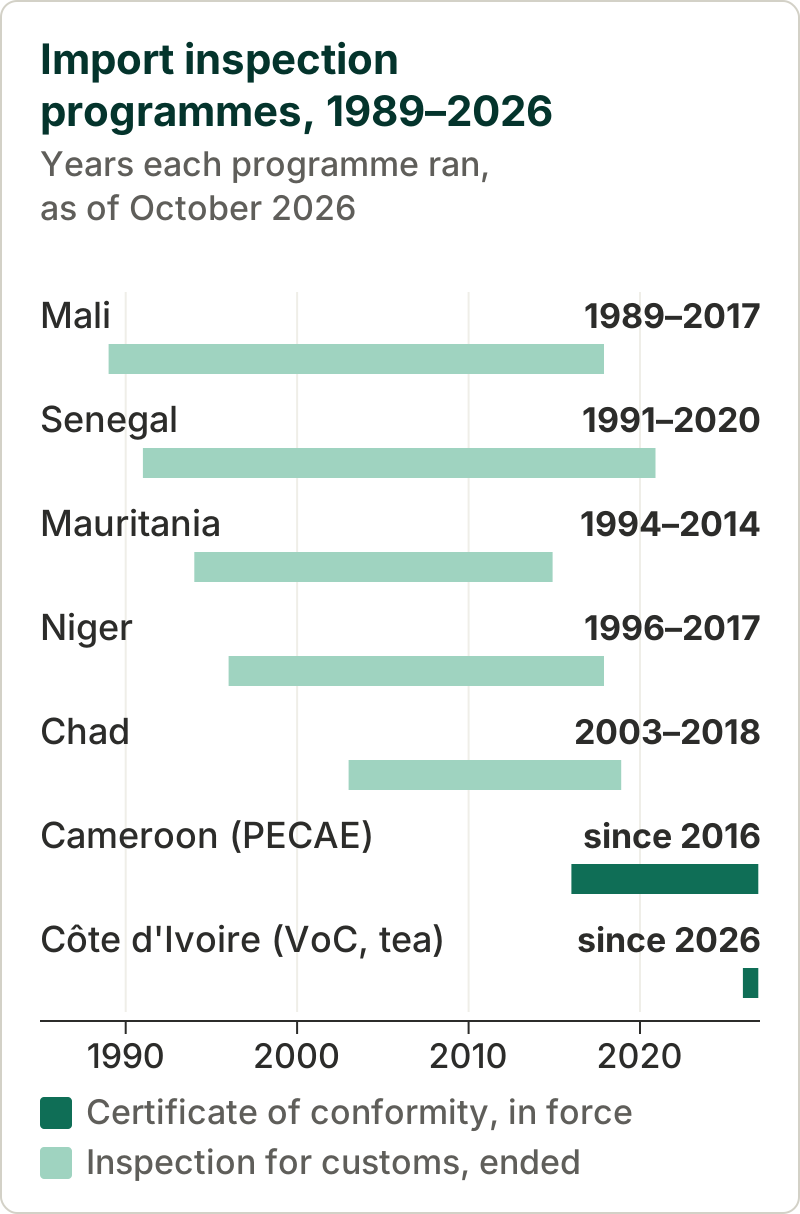 Source: WTO Trade Policy Reviews (2017, 2018, 2023); customs of Senegal and Mali; ANOR; Côte d’Ivoire Ministry of Commerce
Cameroon: ANOR’s pre-shipment conformity programme (PECAE)
Cameroon’s programme d’évaluation de la conformité avant embarquement (PECAE) was instituted by Decree 2015/1875/PM of 1 July 2015, specified and amended by Decree 2021/3306/PM of 31 May 2021, and has applied since 31 August 2016, according to the Agence des Normes et de la Qualité (ANOR), the standards agency that runs it. The WTO’s 2023 review cites the same 2015 decree for the customs programme described below, and the decrees linked from ANOR’s website could not be opened (checked October 2026). Cameroon’s tea market itself is covered in our guide to Cameroon and Chad tea imports.
- Scope. In a notice of 2 May 2025, ANOR reminded importers that all goods imported into Cameroon must be assessed before shipment, except products exempted under article 8 of the 2015 decree, whose full list is held by its technical services and has not been published. ANOR’s published pages name pharmaceuticals as outside the programme and no exemption for tea or other food (checked October 2026), while the WTO’s 2023 review describes the PECAE as aimed mainly at products subject to technical regulations. Whether tea is exempt could therefore not be confirmed: have the importer ask ANOR.
- Before loading. The importer or exporter opens a file with one of the three inspection bodies accredited by ANOR. The exporter sends the pro forma invoice and the product specifications; the body checks them against Cameroonian or equivalent international standards, inspects the goods and/or has them tested, then issues an attestation of conformity (AC) for the shipment. Since a notice of 6 October 2026, the file can be opened with the IM number issued by the foreign trade single window (GUCE) instead of the import declaration (DI) number.
- The certificate. ANOR checks the AC against the inspection body’s records and issues the certificate of conformity (CoC) within two working days for sea freight and one for air freight. The CoC goes with the shipping documents and is required for customs clearance on arrival; the AC alone is not accepted by customs or other control services.
- Validity. An inspection report is valid for 60 days and an AC for three months; the CoC is valid until the product’s expiry or minimum durability date, for one year at most.
- Routes and fees. The body sets the route by risk: A (each shipment inspected and tested), B (regular exporters, random inspections) or C (approved products, mainly document checks). ANOR’s fee table charges 0.45%, 0.40% and 0.27% of the FOB value respectively, with a minimum of 196,787 CFA francs and a maximum of 4,591,699 CFA francs per shipment, plus an annual registration fee of 246,000 CFA francs for the first 15 products and 13,119 CFA francs for each further one. Sugar, cereals, dairy products, edible oils and fresh farm produce are among the categories always on route A; tea is not on that list.
- Penalties. ANOR lists penalties of 5% of turnover and 100% of net profit for goods imported without an attestation of conformity, and its May 2025 notice told control teams to seize products imported outside the programme.
The PECAE is not the only check. The WTO’s 2023 review describes a customs import verification programme (PVI), introduced under Decree 2015/1875/PM, in which a mandated company checks the origin, value and tariff classification of goods worth 2 million CFA francs FOB or more on arrival. Cameroon, however, told WTO members in 2023 that since a 2016 reform the PVI has been documentary only: the importer must obtain the import declaration (DI) before the goods are loaded, and the declaration receives a value and classification report within 15 days. The review also reported an inspection and control tax of 0.95% of the FOB value, with a minimum of 110,000 CFA francs per shipment, under the PVI and the PECAE. ANOR stresses that the PVI checks identity and value, not quality, and that a phytosanitary certificate is not taken into account for the CoC.
Côte d’Ivoire: tea joined the VoC programme on 1 July 2026
Côte d’Ivoire’s conformity verification programme (VoC) has covered all four tea lines, HS 0902.10 to 0902.40, since 1 July 2026 (date of the bill of lading), under notice n° 249/MCIA/DGCE of the Ministry of Commerce, Industry and Crafts. Under the ministry’s procedure guide, the check applies when the covered goods in a shipment exceed 1 million CFA francs FOB; a State-mandated inspection company issues the certificate of conformity, and customs require it before the goods can enter. The procedure, the fees and the open question of transit to Mali and Burkina Faso are set out in our Côte d’Ivoire tea imports guide.
Niger: conformity checks at Niamey customs from August 2026
A communication of the trade minister to Niger’s Council of Ministers of 18 May 2026 announced that the programme of inspection and conformity verification of imported and local products would start on 1 August 2026, under Decree 2020-840 of 13 November 2020, run by the Agence Nigérienne de Normalisation, de Métrologie et de Certification (ANMC). It covers basic necessities and mass-consumption goods first, at pilot sites in Niamey’s customs offices, before extending to the whole country; a government report of 30 July 2026 on the minister’s announcement named food products and infant foods first. The texts published do not say whether a certificate must be obtained before shipment, what the checks cost or who pays; the decree itself could not be found, nor any official report that the checks began (checked October 2026).
Niger’s earlier programme, a pre-shipment check of tariff classification and value, ended when its contract expired in January 2017, according to the WTO.
Where pre-shipment inspection has ended
Senegal. The import verification programme (PVI), instituted by Decree 91-1221 of 14 November 1991 and run by inspection companies under contracts signed in 1994 and 2000, ended when the last contract expired on 31 December 2020, according to the Directorate General of Customs (DGD). Customs took the work over. What remains is the prior import declaration (déclaration préalable d’importation, DPI), filed electronically: since 1 May 2024 it has been compulsory for imports worth 500,000 CFA francs FOB or more, and for any “conteneur personnalisé” whatever its value, and the DGD says it adds no tax or fee. Its 2021 form asked for it at least 15 days before loading. Food imports also need a food import declaration (DIPA) from the Ministry of Industry and Commerce, which asks for quality documents and four samples for analysis; see our guide to Senegal’s green tea imports.
Mali. Mali’s customs say the country ended its pre-shipment import verification programme and replaced it with a modern import control programme (PMCI), based on risk analysis and the scanning of goods on arrival. Since 1 January 2018 a mandated company has checked documents only: the import intention, the final invoice, the packing list and the transport document. The Technical Expertise Centre (CET) reports the classification and value it finds to customs, which keep the final say. On 28 May 2025 the Council of Ministers adopted a draft decree instituting this prior documentary verification of imports and their scanning on arrival.
Guinea. The import verification programme run by an inspection company was abolished at the end of March 2017, together with its fee, according to the WTO’s 2018 review. An order of the Ministry of Commerce of 10 July 2024 (A/2024/920) now provides for the inspection on arrival of goods entering in containers or trucks, by an inspection and quarantine centre: customs may not clear a lot without a positive inspection report, and a lot that fails is quarantined for 7 to 14 days. Whether the centre was operating in October 2026 could not be confirmed.
Chad. The pre-shipment inspection programme instituted in 2003 was abolished by decree in 2018, Chad told WTO members in 2023; the decree’s number was not found. A cargo tracking note (BESC) from the Chadian Shippers’ Council must still be validated before loading (WTO, 2023).
Mauritania. The pre-shipment inspection programme run by a private company since 1994 ended in 2014; customs have since valued and classified imports themselves, according to the WTO’s 2018 review. The customs clearance guide published in 2026 describes no inspection or certificate before shipment (checked October 2026).
Checks on documents or on arrival
Benin. According to the WTO’s 2017 review, Benin’s pre-shipment inspection was suspended from 2012 to 2014; a value certification programme followed in 2014, and since 1 April 2017 a company has been in charge of certifying import values. Today the importer or its licensed broker files an advance declaration through the single window before or on arrival of the goods, and the company issues a documentary verification certificate (attestation de vérification documentaire, AVD) stating the transaction value, according to the customs website.
Togo. Togo ran an inspection at destination, not before shipment: in 2017 a mandated company inspected goods for home use worth at least 1 million CFA francs by land or 1.5 million CFA francs by sea or air, funded by a levy of 0.75% of the CIF value (WTO, 2017). In January 2020 the revenue office (OTR) still listed its attestation de vérification among four documents for an import declaration, but a later OTR clearance manual for the port of Lomé, posted on the trade ministry’s website, lists only the bill of lading, the commercial invoice and the BESC. No text ending the programme was found (checked October 2026).
Ghana. Customs took over valuation, inspection and classification from the destination inspection companies in 2015, the finance ministry told Parliament that November. In 2022 customs inspected imports worth US$3,000 or more on arrival, with an inspection fee of 1% of the CIF value, and firms contracted in Europe and Asia checked the values on invoices, where possible with the company that issued them (WTO, 2022). Since 2020 the Ghana Standards Authority has no longer inspected products regulated by the Food and Drugs Authority, such as food (WTO, 2022); the FDA’s import permit is covered in our guide to Ghana’s green tea imports.
Burkina Faso. The import verification programme run by an inspection company since 2004 required pre-shipment inspection of goods worth 3 million CFA francs or more in 2017 (WTO). The import procedures on the trade ministry’s portal, updated in late 2024, have no inspection-company step, and Burkina Faso’s schedule under the WTO Trade Facilitation Agreement shows the agreement’s ban on pre-shipment inspection for tariff classification and customs valuation as applied since 22 February 2018. No text ending the programme was found, and the customs prepayment still includes a “contribution au programme de vérification” of 1% of the FOB value. Tea (“Thés et cafés”, 09.02) is on the list of products that need a health quality certificate from the national public health laboratory before release for consumption, under a joint order in force since 15 January 2008: a check in Burkina Faso, not before shipment.
Certificate of conformity, verification certificate, tracking note
Three documents with similar names do different jobs:
- Certificate of conformity. It states that the goods meet the importing country’s standards. Cameroon’s ANOR issues it on the strength of an inspection body’s attestation; in Côte d’Ivoire the mandated inspection company issues it.
- Verification certificate. An attestation de vérification, or Benin’s AVD, supports the value and tariff classification used by customs.
- Cargo tracking note. The bordereau électronique de suivi des cargaisons (BESC) is issued by the importing country’s shippers’ council on documents: in Benin, for sea imports, against a copy of the bill of lading and the commercial invoice (WTO, 2017).
The certificates issued in China, such as the phytosanitary certificate and the certificate of origin, are covered in our guide to Chinese tea export documents.
What this means for tea exporters and importers
- Cameroon. Unless ANOR confirms that tea is exempt, open the PECAE file with an accredited body before loading, using the import declaration or, since October 2026, the importer’s IM number, and allow two working days after the attestation for ANOR’s certificate on sea shipments. On route A the minimum fee applies to shipments worth less than about 43.7 million CFA francs FOB (The Tea Trade’s calculation: 196,787 CFA francs ÷ 0.45%). ANOR’s pages do not mention goods in transit to Chad, so ask before shipping through Douala.
- Côte d’Ivoire. Since 1 July 2026, obtain the certificate of conformity before the tea is loaded.
- Niger. Ask the importer whether the ANMC checks scheduled from August 2026 apply to tea and what they require.
- Elsewhere. Expect no certificate before loading, but send complete and consistent documents: invoices are checked on documents in Benin, Mali and Ghana, and Senegal’s DPI comes before loading.
- The contract. Say who opens any inspection file and who pays its fees, and keep names, weights and values identical on every document.
This is general information, not legal advice: have the importer’s customs broker confirm the programme, documents and fees before each shipment.
Questions and answers
Which West African countries require pre-shipment inspection for tea?
Of the 12 countries checked in October 2026, Côte d'Ivoire (VoC, for tea since 1 July 2026) and Cameroon (PECAE, since 2016, for all imports except products on an unpublished exemption list) require a certificate of conformity before shipment. Niger scheduled conformity checks at Niamey customs offices from 1 August 2026; the others check documents or goods on arrival.
Does tea need a certificate of conformity for Cameroon?
Yes, according to ANOR, unless tea is on the list of products exempted under article 8 of Decree 2015/1875/PM; ANOR's technical services hold that list, which has not been published, so have the importer confirm. An accredited inspection body issues an attestation before loading, and ANOR turns it into the certificate of conformity that customs require on arrival.
Is pre-shipment inspection still required for Senegal?
No. The import verification programme ended when the last inspection contract expired on 31 December 2020, according to Senegal's customs. Since 1 May 2024, imports worth 500,000 CFA francs FOB or more need a prior import declaration (DPI), which customs say adds no tax or fee.
Does Mali still inspect imports before shipment?
No. Mali's customs say the country ended its pre-shipment import verification programme: since 1 January 2018 a mandated company has checked only the import documents, and goods are scanned on arrival. The Council of Ministers adopted a draft decree on this documentary check on 28 May 2025.
Is a Chinese phytosanitary certificate enough for Cameroon's PECAE?
No. ANOR says the phytosanitary certificate is not taken into account when it issues the certificate of conformity, which concerns quality against standards, and the programme applies without prejudice to other ministries' import controls.
How much does a certificate of conformity for Cameroon cost?
ANOR's fee table charges 0.45%, 0.40% or 0.27% of the FOB value per shipment, depending on the verification route, with a minimum of 196,787 CFA francs and a maximum of 4,591,699 CFA francs, plus an annual product registration fee (checked October 2026).
Sources
- 1. Cameroon, Agence des Normes et de la Qualité (ANOR): information on the pre-shipment conformity assessment programme (PECAE), legal framework, procedure, fees and FAQ (in French) · anor.cm
- 2. Cameroon, ANOR: notice to all importers on the PECAE, 2 May 2025 (in French) · anor.cm
- 3. Cameroon, ANOR: notice amending the procedure for opening a PECAE file, 6 October 2026 (in French) · anor.cm
- 4. Côte d'Ivoire, Ministry of Commerce, Industry and Crafts: notice to importers n° 249/MCIA/DGCE on the conformity verification programme (VoC), 1 July 2026 (in French) · commerce.gouv.ci
- 5. Côte d'Ivoire, Ministry of Commerce: remaining products of Decree 2016-1152 subject to the VoC programme from 1 July 2026 (in French) · commerce.gouv.ci
- 6. Côte d'Ivoire, Ministry of Commerce: procedure guide for verifying the conformity of imported goods with standards, version 1.2 (in French) · commerce.gouv.ci
- 7. Niger, Government: conclusions of the Council of Ministers of 18 May 2026 (in French) · gouv.ne
- 8. Niger, Government: the trade minister announces conformity inspection of imported products from 1 August 2026, report of 30 July 2026 (in French) · gouv.ne
- 9. Senegal, Directorate General of Customs: notice to users on the end of the import verification contract and the electronic prior import declaration (DPI), 4 January 2021 (in French) · douanes.sn
- 10. Senegal, Directorate General of Customs: extension of the prior import declaration (DPI), 29 April 2024, archived copy of 25 January 2026 (in French) · web.archive.org
- 11. Senegal, Ministry of Industry and Commerce: food import declaration (DIPA), March 2026 (in French) · industriecommerce.gouv.sn
- 12. Mali, Directorate General of Customs: Technical Expertise Centre (CET) and the modern import control programme (in French) · douanes.gouv.ml
- 13. Mali, Presidency: communiqué of the Council of Ministers of 28 May 2025 (in French) · koulouba.ml
- 14. Burkina Faso, Ministry of Commerce, Burkina Trade Portal: customs prepayment step of a full import procedure, updated 12 November 2024 (in French) · burkinatradeportal.bf
- 15. Burkina Faso, Ministry of Commerce, Burkina Trade Portal: full import procedure for edible oils via OuagaRinter, updated 4 December 2024 (in French) · burkinatradeportal.bf
- 16. Burkina Faso: joint order 08-008/MS/MCPEA/MEF listing products subject to the national certificate of conformity and the health quality certificate, January 2008 (in French) · burkinatradeportal.bf
- 17. Guinea, Ministry of Commerce, Industry and SMEs: order A/2024/920/MCIPME/CAB/SGG of 10 July 2024 on the inspection and quarantine of incoming and outgoing products, Official Journal, July 2024, via FAOLEX (in French) · faolex.fao.org
- 18. Benin, Directorate General of Customs: clearance and removal of goods at the port of Cotonou (in French) · douanes.gouv.bj
- 19. Togo, Office Togolais des Recettes: service note n° 001/2020/OTR/CG/CDDI on the documents required to check customs declarations, 9 January 2020 (in French) · otr.tg
- 20. Togo, Office Togolais des Recettes: clearance procedures manual of the Lomé port customs operations directorate, posted by the Ministry of Commerce (in French) · commerce.gouv.tg
- 21. Ghana, Ministry of Finance: Budget Statement and Economic Policy for the 2016 financial year, 13 November 2015 · mofep.gov.gh
- 22. Mauritania, Directorate General of Customs: import and export clearance procedures guide (2026, in French) · douanes.mr
- 23. WTO: Trade Policy Review of the CEMAC countries, Secretariat report, joint part (WT/TPR/S/445, 16 August 2023, in French) · wto.org
- 24. WTO: Trade Policy Review of the CEMAC countries, annex 1, Cameroon (WT/TPR/S/445, 2023, in French) · wto.org
- 25. WTO: Trade Policy Review of the CEMAC countries, annex 5, Chad (WT/TPR/S/445, 2023, in French) · wto.org
- 26. WTO: Trade Policy Review of the CEMAC countries, minutes of the meeting, addendum with written questions and answers (WT/TPR/M/445/Add.1, 19 December 2023) · docs.wto.org
- 27. WTO: Trade Policy Review of the WAEMU countries, Secretariat report, joint part (WT/TPR/S/362, 14 September 2017, in French) · wto.org
- 28. WTO: Trade Policy Review of the WAEMU countries, annex 1, Benin (WT/TPR/S/362, 2017, in French) · wto.org
- 29. WTO: Trade Policy Review of the WAEMU countries, annex 2, Burkina Faso (WT/TPR/S/362, 2017, in French) · wto.org
- 30. WTO: Trade Policy Review of the WAEMU countries, annex 5, Mali (WT/TPR/S/362, 2017, in French) · wto.org
- 31. WTO: Trade Policy Review of the WAEMU countries, annex 6, Niger (WT/TPR/S/362, 2017, in French) · wto.org
- 32. WTO: Trade Policy Review of the WAEMU countries, annex 8, Togo (WT/TPR/S/362, 2017, in French) · wto.org
- 33. WTO: Trade Policy Review, Guinea, Secretariat report (WT/TPR/S/370, 24 April 2018, in French) · wto.org
- 34. WTO: Trade Policy Review, Mauritania, Secretariat report (WT/TPR/S/371, 24 April 2018, in French) · wto.org
- 35. WTO: Trade Policy Review, Ghana, Secretariat report (WT/TPR/S/427, 17 May 2022) · wto.org
- 36. WTO: Agreement on Trade Facilitation, article 10.5, pre-shipment inspection · wto.org
- 37. WTO Trade Facilitation Agreement Database: Burkina Faso, implementation schedule · tfadatabase.org