Importing Chinese tea into the EU: duty, VAT and checks
Importing Chinese tea into the EU: 3.2% duty on green tea in packs of up to 3 kg, 0% on other tea, national VAT rates, 20% border checks, e-COI for organic.
Key facts
- In 2025 the EU-27 imported 29,154 tonnes of tea from China, 23.2% of its tea imports from outside the EU by volume and more than from any other country, ahead of Kenya, India and Sri Lanka, according to Eurostat (share: The Tea Trade's calculation).
- The EU charges a 3.2% customs duty on green tea in immediate packings of 3 kg or less (CN 0902 10 00) and none on the other three tea codes, and TARIC lists no tariff preference for tea from China (checked October 2026).
- Import VAT on tea follows each member state's rate for the same tea sold at home: 5.5% in France, 7% in Germany and 23% in Poland, according to their tax and customs administrations (checked October 2026).
- Tea from China is listed in Implementing Regulation (EU) 2019/1793 for pesticide residues, so each consignment needs a Common Health Entry Document (CHED-D) and 20% undergo identity and physical checks at the EU border (consolidated version of 30 June 2026).
- Council Regulation (EU) 2026/382 ended the EU's customs duty relief for consignments worth EUR 150 or less on 1 July 2026 and set a duty of EUR 3 per item until 1 July 2028 for such consignments sold at a distance to consumers.
Tea from China enters the European Union under a single customs tariff: 3.2% duty on green tea in immediate packings of 3 kg or less, none on other tea, and no preference for China, according to the EU’s TARIC database (checked October 2026). Import VAT then follows each member state’s own rate (5.5% in France, 7% in Germany and 23% in Poland), and 20% of consignments are checked at the border for pesticide residues under Implementing Regulation (EU) 2019/1793. Taken as one market, the EU-27 imported 29,154 tonnes of tea from China in 2025, more than from any other country, according to Eurostat.
The EU market for Chinese tea in 2025
Seen from China, the EU is a set of mid-sized markets. Germany (9,503 tonnes) and Poland (7,972 tonnes) were the 15th and 19th destinations of Chinese tea by volume in 2025, as our guide to Chinese tea export markets shows from UN Comtrade data. Added up, China declared 29,660 tonnes of tea worth US$124.9 million for 26 of the 27 member states, all but Luxembourg: 7.1% of its tea exports by volume, and more than the 29,217 tonnes it sent to Uzbekistan, its second destination by country (The Tea Trade’s calculation from UN Comtrade).
Seen from the EU, China is the first supplier. Eurostat records the EU’s imports by country of origin, valued at the EU border (CIF). In 2025 they show 29,154 tonnes of tea from China, 23.2% of the 125,431 tonnes the EU-27 imported from outside the EU, ahead of Kenya, India and Sri Lanka. By value China came second, with EUR 119.3 million against EUR 137.4 million for Sri Lanka: Chinese tea averaged EUR 4.09 per kg at the border, Sri Lankan tea EUR 7.20 (The Tea Trade’s calculation from Eurostat).
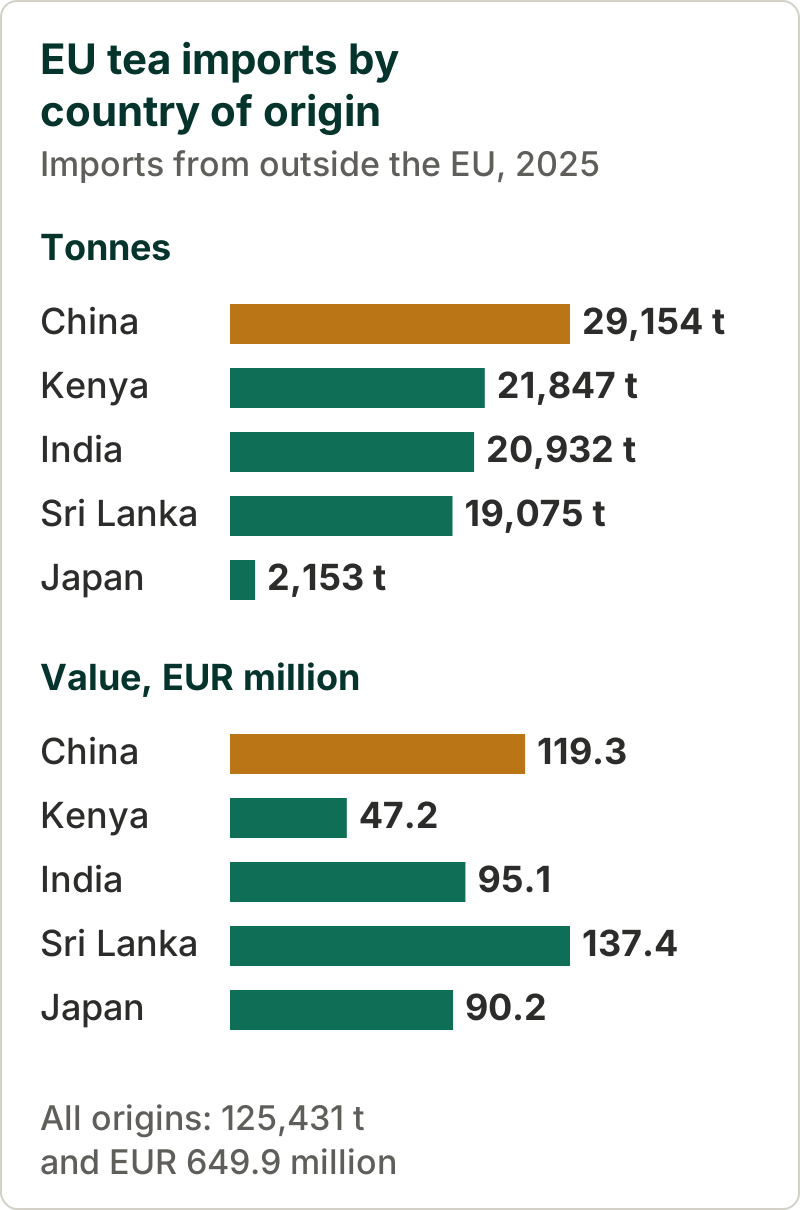 Source: Eurostat, Comext, EU-27 imports of CN 0902 by country of origin (2025)
The two sides of the trade agree on the total: the EU’s 29,154 tonnes are 1.7% below China’s 29,660. Member state by member state they differ more, because the EU records an import in the member state where the tea is cleared through customs (Eurostat metadata), which need not be the destination China declared.
Tea from China to the main EU markets: China’s declarations and the EU’s records, 2025 (HS/CN 0902; sources: UN Comtrade, Eurostat Comext)
| Member state | Exports declared by China (t) | Value declared by China (US$ million, FOB) | Imports from China recorded in the EU (t) | Value recorded in the EU (EUR million, CIF) |
|---|---|---|---|---|
| Germany | 9,503 | 44.31 | 9,556 | 41.06 |
| Poland | 7,972 | 20.49 | 7,728 | 18.36 |
| France | 4,803 | 22.89 | 4,335 | 21.86 |
| Netherlands | 2,477 | 11.68 | 2,790 | 12.77 |
| Belgium | 2,494 | 11.43 | 2,138 | 10.54 |
| Italy | 1,076 | 4.69 | 1,225 | 5.33 |
| Spain | 867 | 4.71 | 731 | 3.66 |
| EU total | 29,660 | 124.90 | 29,154 | 119.26 |
China’s EU total covers 26 member states; the EU total is Eurostat’s EU-27 aggregate. Germany, Poland and France took 75.1% of the tonnage China declared for the EU (The Tea Trade’s calculation).
EU import duty on tea: TARIC rates for heading 0902
The EU applies one customs tariff at all its borders. For tea it has four codes, and only one carries duty.
EU customs duty on tea from China (source: TARIC, reference date 13–14 October 2026)
| TARIC code | Goods | Third-country duty |
|---|---|---|
| 0902 10 00 00 | Green tea (not fermented) in immediate packings of a content not exceeding 3 kg | 3.2% |
| 0902 20 00 00 | Other green tea (not fermented) | 0% |
| 0902 30 00 00 | Black tea (fermented) and partly fermented tea, in immediate packings of a content not exceeding 3 kg | 0% |
| 0902 40 00 00 | Other black tea (fermented) and other partly fermented tea | 0% |
No preference lowers these rates for China: TARIC lists none for Chinese tea, while green tea in small packs from Japan and Vietnam enters at 0% under their agreements with the EU. Duty is charged on the customs value, the price paid plus the cost of transport and insurance up to the EU border (Union Customs Code, Articles 70 and 71), so a buyer on FOB terms adds sea freight and insurance before applying the 3.2%.
What the EU actually imports shows how little tea pays it. Of the 29,154 tonnes from China in 2025, about a quarter came in under the one dutiable code.
EU-27 imports of tea from China by CN code, 2025 (source: Eurostat Comext; shares and unit values: The Tea Trade’s calculation)
| CN code | Duty | Tonnes | Share of volume | EUR million | EUR per kg |
|---|---|---|---|---|---|
| 0902 10 00 | 3.2% | 7,824 | 26.8% | 40.82 | 5.22 |
| 0902 20 00 | 0% | 14,784 | 50.7% | 53.35 | 3.61 |
| 0902 30 00 | 0% | 386 | 1.3% | 4.11 | 10.66 |
| 0902 40 00 | 0% | 6,161 | 21.1% | 20.96 | 3.40 |
Shares do not add to 100% because of rounding. The 3 kg line comes from the Harmonized System and is explained, with China’s own export codes, in our guide to tea HS codes. Where the classification of a pack is in doubt, an importer can ask customs for a binding tariff information (BTI) decision, valid for three years (Union Customs Code, Article 33).
Import VAT on tea in France, Germany and Poland
VAT is charged at import at the rate the member state applies to the same goods sold at home (VAT Directive 2006/112/EC, Article 94(2)). The base is the customs value plus the duties due on import and the incidental costs, such as transport and insurance, up to the first place of destination in that state (Articles 85 and 86). For tea, the rates range widely.
Import VAT on tea in three member states (sources: national VAT laws and administrations, checked October 2026)
| Member state | VAT on tea | Basis |
|---|---|---|
| France | 5.5% | Reduced rate for products intended for human consumption (General Tax Code, Article 278-0 bis, A, 1°); tea is not among the exceptions listed by the tax administration (BOFiP, 19 November 2025) |
| Germany | 7% | Reduced rate for the goods in Annex 2 to the VAT Act, item 12 of which covers coffee, tea, maté and spices (Kaffee, Tee, Mate und Gewürze; UStG, § 12(2), No 1; German customs) |
| Poland | 23% | Standard rate, set at 23% by Article 146ef(1) of the VAT Act, whose reduced-rate annexes exclude tea (Annex 3, item 1); ISZTAR4, the Ministry of Finance’s tariff, shows 23% for all four tea codes |
Take a hypothetical consignment of green tea in 100 g tins with a customs value of EUR 10,000 and EUR 200 of transport from the EU border to the importer’s warehouse (round figures for the arithmetic, not prices). The duty is EUR 320 and the VAT base EUR 10,520 (10,000 + 320 + 200), so import VAT comes to EUR 578.60 in France, EUR 736.40 in Germany and EUR 2,419.60 in Poland (The Tea Trade’s calculation).
A business that uses the tea for its taxed sales deducts import VAT like other input VAT (VAT Directive, Article 168(e)), so it weighs mainly on cash flow. France has gone further: since 1 January 2022, every business identified for VAT in France declares import VAT on its VAT return instead of paying it at clearance, according to the tax administration (DGFiP).
EORI, entry summary declaration and customs declaration
- EORI number. Every economic operator established in the EU registers with the customs of its member state (Union Customs Code, Article 9) and receives an EORI number, unique across the EU’s customs territory (Delegated Regulation (EU) 2015/2446, Article 1(18)). A business established outside the EU needs one when it carries out customs activities such as lodging declarations, according to the European Commission.
- Entry summary declaration. Goods entering the EU are covered by an entry summary declaration for security risk analysis, lodged by the carrier or, in its place, by the importer (Union Customs Code, Article 127). For containerised cargo by sea, it is due, as a rule, at the latest 24 hours before loading onto the EU-bound vessel (Delegated Regulation 2015/2446, Article 105). It goes through the EU’s Import Control System 2 (ICS2), which operators join with their EORI number.
- Customs declaration. Release for free circulation entails the collection of duty and other charges and gives the tea the customs status of Union goods, so it can move on to any member state (Union Customs Code, Article 201). The declarant must be established in the EU (Article 170); a seller outside it can appoint a customs representative, who must be established there (Article 18).
- Food business registration. Every food business operator must notify the competent authority of each establishment under its control that produces, processes or distributes food, for registration (Regulation (EC) No 852/2004, Article 6(2)).
- National steps. Member states add their own. Poland’s integrated tariff, ISZTAR4, also lists a national border sanitary control for tea, and allows import on a certificate confirming it (checked October 2026).
The Union Customs Code cited here, Regulation (EU) No 952/2013, is repealed with effect from 21 September 2027 by Regulation (EU) 2026/2108 (Articles 284 and 287).
Border checks on tea from China under Regulation (EU) 2019/1793
Tea from China (CN 0902), flavoured or not, is listed in Annex I to Implementing Regulation (EU) 2019/1793 for pesticide residues, with identity and physical checks on 20% of consignments. That was the case in the consolidated version of 30 June 2026, and no later amendment was listed on 14 October 2026. The operator notifies each consignment in advance on a Common Health Entry Document (CHED-D) before it arrives (Regulation (EU) 2017/625, Article 56), and TARIC makes release for free circulation conditional on a finalised CHED. The limits the laboratories apply, and what happens to a consignment that fails, are set out in our guide to EU pesticide limits for tea.
Samples are partly exempt. The regulation does not apply to trade samples, laboratory samples or display items that are not intended to be placed on the market unless their net weight exceeds 10 kg, nor to tea in passengers’ luggage or in non-commercial parcels to private persons up to 2 kg (Article 1(3)).
Organic tea: Regulation (EU) 2018/848 and the certificate of inspection
Tea sold as organic in the EU must meet Regulation (EU) 2018/848, which has applied since 1 January 2022. China has neither an organic trade agreement with the EU nor recognition of equivalence: the European Commission lists Chile, Switzerland and the United Kingdom under agreements, and 11 countries, from Argentina to the United States, under equivalence. Chinese organic tea therefore follows the compliance route. It must meet all the EU rules, and every operator, the exporter included, must be controlled and certified by a control authority or control body recognised by the Commission (Article 45(1)). The older recognitions of control bodies that applied equivalent standards expired on 31 December 2024 at the latest (Article 57).
Each consignment needs a certificate of inspection, which that control body issues in TRACES, the EU’s Trade Control and Expert System, before the tea leaves China, in a language of the member state of entry (Delegated Regulation (EU) 2021/2306, Articles 4 and 5). At the border, the authorities check the documents of every consignment, make identity checks at random and physical checks according to risk, then endorse the certificate: the tea is released as organic, as in-conversion or as non-organic, or not released (Article 6). TARIC asks for this certificate, as document C644, whenever the labelling or documents of the tea refer to organic production.
Labels, contaminants and deforestation rules
Labels follow Regulation (EU) No 1169/2011 in every member state, each of which may require one or more of the EU’s official languages; the mandatory particulars, the importer’s details and the rules on lots and dates are compared in our guide to tea labelling requirements. Contaminants such as perchlorate and pyrrolizidine alkaloids have maximum levels of their own under Regulation (EU) 2023/915, covered in our guide to EU contaminant limits for tea. One recent rule does not reach tea: Annex I to the EU Deforestation Regulation, (EU) 2023/1115, lists coffee (0901) but not tea, in its consolidated version of 18 September 2026.
Small parcels and samples: the end of the EUR 150 duty relief
Until 30 June 2026, tea and most other goods sent directly from a country outside the EU to a consignee in the EU in a consignment worth EUR 150 or less paid no customs duty. Council Regulation (EU) 2026/382 of 11 February 2026 deleted that relief from 1 July 2026; import VAT had already applied to such consignments since 1 July 2021.
In its place, from 1 July 2026 until 1 July 2028, a duty of EUR 3 per item applies to consignments worth up to EUR 150 that are imported under the Import One-Stop Shop (IOSS) for VAT or are goods in postal consignment, which Delegated Regulation (EU) 2026/1022 redefined as goods in such consignments sold at a distance to consumers. An item means one or more goods sharing the same tariff classification and description, so identical tins of green tea declared on one line count once. Customs will also charge a Union handling fee per item on distance sales from 10 days after the Commission’s act fixing its amount enters into force; that act was still unpublished on 15 October 2026 (Regulation (EU) 2026/2108, Articles 20(2) and 287(4)). Other small commercial consignments, such as a parcel for a business customer, pay the normal tariff: 3.2% on green tea in packs of 3 kg or less, nothing on other tea. Samples of negligible value that can be used only to solicit orders keep a separate relief (Regulation (EC) No 1186/2009, Article 86).
Checklist for importing Chinese tea into the EU
- Code and duty: 3.2% only on green tea in immediate packings of 3 kg or less (CN 0902 10 00), 0% on other tea, applied to the value at the EU border.
- VAT: the national rate, 5.5% in France, 7% in Germany and 23% in Poland, on the value plus duty and inland transport to the first destination.
- Registrations: an EORI number and food business registration before the first shipment, and a declarant or customs representative established in the EU.
- Advance data: the carrier’s entry summary declaration, as a rule 24 hours before loading onto the EU-bound vessel, and the CHED-D before the tea arrives.
- Residues: a pesticide residue report per lot against EU limits, since 20% of consignments from China are checked.
- Organic: producer and exporter certified by a control body recognised by the Commission, and a certificate of inspection in TRACES before departure.
- Parcels: no duty relief up to EUR 150 since 1 July 2026; EUR 3 per item on distance sales to consumers.
This is general information, checked in October 2026, not legal or tax advice: have a customs representative in the member state of entry confirm codes, rates and procedures before the first shipment.
Questions and answers
What is the EU import duty on tea from China?
3.2% on green tea in immediate packings of 3 kg or less (CN 0902 10 00) and 0% on other green tea and on black and partly fermented tea, according to TARIC (October 2026). No preference applies to China, and the duty is charged on the customs value, freight and insurance to the EU border included.
What VAT is charged on tea imported into the EU?
The rate each member state applies to tea sold at home: 5.5% in France, 7% in Germany and 23% in Poland (October 2026). It is charged on the customs value plus the duty and the transport costs to the first destination, and a business that uses the tea for its taxed sales can deduct it (VAT Directive, Articles 86 and 168).
Do I need an EORI number to import tea into the EU?
Yes. Every economic operator established in the EU registers with the customs of its member state (Union Customs Code, Article 9) and receives one EORI number, valid across the EU's customs territory. The declarant must also be established in the EU; a seller outside it can appoint a customs representative established there.
Is tea from China checked at the EU border?
Yes. Tea from China is listed in Implementing Regulation (EU) 2019/1793 for pesticide residues: each consignment is notified in advance on a CHED-D, and 20% get identity and physical checks, sampling included. Trade samples not intended for the market are outside these checks up to 10 kg net (Article 1(3)).
How can organic tea from China be imported into the EU?
The tea must meet all the rules of Regulation (EU) 2018/848, and its producer and exporter must be certified by a control body recognised by the European Commission. That body issues a certificate of inspection in TRACES before the consignment leaves China, and the border authorities endorse it on arrival.
Are small parcels of tea still duty-free in the EU?
No. Council Regulation (EU) 2026/382 removed the relief for consignments worth EUR 150 or less on 1 July 2026. Until 1 July 2028, distance sales to consumers pay EUR 3 per item; other small commercial consignments pay the normal tariff, 3.2% on green tea in packs of 3 kg or less.
Sources
- 1. European Commission, TARIC: measures for tea (0902 10 00 00) originating in China, reference date 13 October 2026 · ec.europa.eu
- 2. Eurostat (Comext): EU-27 imports of tea (CN 0902) from China by member state of import, 2025 · ec.europa.eu
- 3. Eurostat (Comext): EU-27 imports of tea from China by CN code (0902 10 00 to 0902 40 00), 2025 · ec.europa.eu
- 4. Eurostat (Comext): EU-27 imports of tea (CN 0902) from outside the EU and by main country of origin, 2025 · ec.europa.eu
- 5. Eurostat: International trade in goods, aggregated and detailed data, reference metadata (updated 6 October 2025) · ec.europa.eu
- 6. UN Comtrade: China's tea exports (HS 0902) to the EU member states, 2025 · comtradeapi.un.org
- 7. UN Comtrade via WITS: China's tea exports (HS 0902) by partner, 2025 · wits.worldbank.org
- 8. EUR-Lex: Regulation (EU) No 952/2013 of 9 October 2013 laying down the Union Customs Code · eur-lex.europa.eu
- 9. EUR-Lex: Regulation (EU) 2026/2108 of 16 September 2026 establishing the Union Customs Code and the European Union Customs Authority, and repealing Regulation (EU) No 952/2013 · eur-lex.europa.eu
- 10. EUR-Lex: Commission Delegated Regulation (EU) 2015/2446 of 28 July 2015 supplementing the Union Customs Code · eur-lex.europa.eu
- 11. European Commission: Economic operators registration and identification (EORI) number · taxation-customs.ec.europa.eu
- 12. European Commission: Import Control System 2 (ICS2) · taxation-customs.ec.europa.eu
- 13. EUR-Lex: Council Directive 2006/112/EC of 28 November 2006 on the common system of value added tax · eur-lex.europa.eu
- 14. France, DGFiP: BOFiP, VAT reduced rates on food, BOI-TVA-LIQ-30-10-10, 19 November 2025 (in French) · bofip.impots.gouv.fr
- 15. France, DGFiP: notice on import VAT (in French) · impots.gouv.fr
- 16. Germany, Federal Ministry of Justice: VAT Act (UStG), Annex 2, list of goods at the reduced rate (in German) · gesetze-im-internet.de
- 17. Germany, Customs (Zoll): import VAT, customs tariff information for VAT purposes (in German) · zoll.de
- 18. Poland, Dziennik Ustaw: VAT Act (ustawa o podatku od towarów i usług), consolidated text, Dz.U. 2026 poz. 1263, 28 September 2026 (in Polish) · dziennikustaw.gov.pl
- 19. Poland, Ministry of Finance: ISZTAR4 integrated tariff, measures for 0902 10 00 00, 14 October 2026 · ext-isztar4.mf.gov.pl
- 20. EUR-Lex: Commission Implementing Regulation (EU) 2019/1793 on the temporary increase of official controls, consolidated version of 30 June 2026 · eur-lex.europa.eu
- 21. EUR-Lex: Regulation (EU) 2017/625 of 15 March 2017 on official controls · eur-lex.europa.eu
- 22. EUR-Lex: Regulation (EC) No 852/2004 of 29 April 2004 on the hygiene of foodstuffs · eur-lex.europa.eu
- 23. EUR-Lex: Regulation (EU) 2018/848 of 30 May 2018 on organic production and labelling of organic products, consolidated version of 25 March 2025 · eur-lex.europa.eu
- 24. EUR-Lex: Commission Delegated Regulation (EU) 2021/2306 on official controls of organic products intended for import and on the certificate of inspection, consolidated version of 2 December 2024 · eur-lex.europa.eu
- 25. European Commission, Agriculture and rural development: trade in organics · agriculture.ec.europa.eu
- 26. EUR-Lex: Regulation (EU) No 1169/2011 on the provision of food information to consumers, consolidated version of 1 April 2025 · eur-lex.europa.eu
- 27. EUR-Lex: Commission Regulation (EU) 2023/915 on maximum levels for certain contaminants in food, consolidated version of 19 August 2026 · eur-lex.europa.eu
- 28. EUR-Lex: Regulation (EU) 2023/1115 on deforestation-free products, consolidated version of 18 September 2026 · eur-lex.europa.eu
- 29. EUR-Lex: Council Regulation (EU) 2026/382 of 11 February 2026 amending Regulation (EC) No 1186/2009 as regards the elimination of the threshold-based customs duty relief · eur-lex.europa.eu
- 30. EUR-Lex: Commission Delegated Regulation (EU) 2026/1022 of 30 June 2026 amending Delegated Regulation (EU) 2015/2446 as regards the temporary EUR 3 customs duty on distance sales of imported goods · eur-lex.europa.eu
- 31. EUR-Lex: Council Regulation (EC) No 1186/2009 setting up a Community system of reliefs from customs duty, consolidated version of 1 July 2026 · eur-lex.europa.eu