Tea export cartons and pallets: standards, marks, ISPM 15
Tea export cartons and pallets: China's box standard GB/T 6543-2025 (up to 55 kg), stacking strength, shipping marks, ISPM 15 heat treatment and customs rules.
Key facts
- China's national standard for corrugated transport boxes, GB/T 6543-2025, in force since 1 December 2025 in place of the 2008 edition, sorts single-wall and double-wall boxes for contents of up to 55 kg into 2 classes and 20 types, class 1 being meant for harsher distribution conditions.
- Under GB/T 6543-2025, a single-wall box may hold at most 40 kg with a combined inside dimension (length + width + height) of 2,000 mm, and a double-wall box at most 55 kg with 2,500 mm.
- Annex D of GB/T 6543-2025 sets an empty box's minimum compression strength at K × G × (number of tiers − 1) × 9.8 newtons, G being the packed box's mass in kilograms, with a safety factor K of at least 1.65 when the contents help carry the load and at least 2 when they do not.
- ISPM 15, the International Plant Protection Convention's standard on wood packaging (2018 version), requires solid-wood pallets and cases to be debarked, treated, for example heated to at least 56 °C for 30 continuous minutes throughout the wood, and marked with the IPPC symbol, the country code, a producer code and the treatment code.
- In China, only enterprises holding a customs qualification, valid for three years, may apply the treatment mark to wood packaging for export, under the Measures for quarantine treatment of wood packaging of exit goods (AQSIQ Order No. 69 of 2005, amended by GACC Orders No. 238 and No. 240 in 2018).
China’s national standard for corrugated transport cartons is GB/T 6543-2025, a recommended standard in force since 1 December 2025: it sorts single-wall and double-wall boxes for up to 55 kg of contents into 2 classes and 20 types and shows how to work out the strength an empty box needs for its stack. Export cartons carry a shipping mark, the producer’s marks required by China’s customs (GACC) and ISO 780 handling symbols, while solid-wood pallets and cases must meet ISPM 15: debarked, treated, for example at 56 °C for 30 minutes throughout the wood, and stamped with the IPPC mark. In China only enterprises qualified by customs may apply that mark to export wood packaging (rules checked October 2026).
Corrugated carton standards in China: GB/T 6543-2025
GB/T 6543-2025, Single and double corrugated boxes for transport packages (运输包装用单瓦楞纸箱和双瓦楞纸箱), is a recommended national standard published on 30 May 2025. It replaced GB/T 6543-2008, which had absorbed GB/T 5033-1985, China’s former standard for corrugated boxes for export products, and it covers boxes whose contents weigh no more than 55 kg. Inner packs and liners are covered in our guide to tea export packaging formats.
The standard sorts boxes into 2 classes and 20 types by the maximum mass of the contents, the combined inside dimension (length + width + height), the distribution conditions and the board. Class 1 is meant for relatively harsh distribution conditions and class 2 for better ones.
Corrugated box types in GB/T 6543-2025 (Table 1 of the standard)
| Board | Contents, max | Combined inside dimension, max | Class 1 box (board) | Class 2 box (board) |
|---|---|---|---|---|
| Single wall | 5 kg | 700 mm | BS-1.1 (S-1.1) | BS-2.1 (S-2.1) |
| Single wall | 10 kg | 1,000 mm | BS-1.2 (S-1.2) | BS-2.2 (S-2.2) |
| Single wall | 20 kg | 1,400 mm | BS-1.3 (S-1.3) | BS-2.3 (S-2.3) |
| Single wall | 30 kg | 1,750 mm | BS-1.4 (S-1.4) | BS-2.4 (S-2.4) |
| Single wall | 40 kg | 2,000 mm | BS-1.5 (S-1.5) | BS-2.5 (S-2.5) |
| Double wall | 15 kg | 1,000 mm | BD-1.1 (D-1.1) | BD-2.1 (D-2.1) |
| Double wall | 20 kg | 1,400 mm | BD-1.2 (D-1.2) | BD-2.2 (D-2.2) |
| Double wall | 30 kg | 1,750 mm | BD-1.3 (D-1.3) | BD-2.3 (D-2.3) |
| Double wall | 40 kg | 2,000 mm | BD-1.4 (D-1.4) | BD-2.4 (D-2.4) |
| Double wall | 55 kg | 2,500 mm | BD-1.5 (D-1.5) | BD-2.5 (D-2.5) |
When the mass and the dimension fall in different tiers, the higher tier applies. Take the 600 × 500 × 400 mm carton of the worked example in our guide to tea container capacity, filled with 33–44 kg of tea. Its combined inside dimension is under 1,500 mm, so the 1,750 mm tier would do for size, but the contents decide: up to 40 kg the box falls in the 40 kg tier, for example BS-1.5 in single wall or BD-1.4 in double wall, and heavier contents, such as that example’s 44 kg, need the 55 kg tier, which only double wall offers (BD-1.5 or BD-2.5).
Board grades and box compression strength: what the codes mean
The board code beside each box type points to China’s corrugated fibreboard standard: each box must use board at least as good as the matching grade in Table 1 of GB/T 6544-2008, an edition that GB/T 6543-2025 cites by date. GB/T 6544-2026 replaces the 2008 edition from 1 November 2026, but because the reference is dated, only the 2008 edition applies to the box types of GB/T 6543-2025.
The whole box is tested too. The empty box’s compression strength, measured with GB/T 4857.4-2008, an identical adoption of ISO 12048:1994, must reach at least a calculated value. Annex D of GB/T 6543-2025, given for information, sets out the calculation:
P = K × G × (H ÷ h − 1) × 9.8
Here P is the compression strength in newtons, G the mass of the packed box in kilograms, H the stacking height and h the box height in millimetres, so that H ÷ h is the number of tiers. The safety factor K reflects the climate, the handling and the storage time: 1.65 or more where the contents help carry the load, 2 or more where they do not, with special requirements agreed between buyer and seller. Stacks are generally no higher than 3,000 mm.
How strong a tea carton must be in a container stack
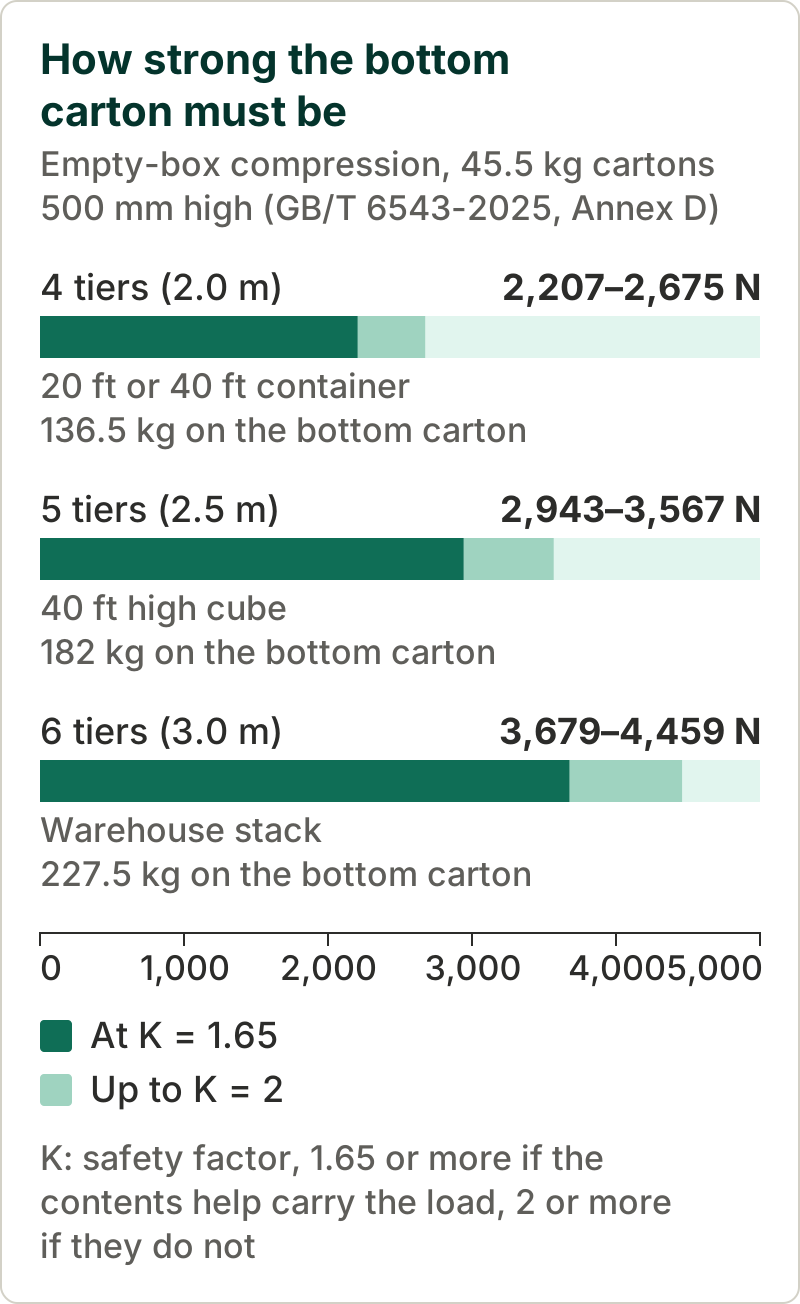
In the container capacity guide’s worked example, 600 × 500 × 400 mm cartons stand with their 500 mm side upright, four high in a 20 ft or 40 ft container and five high in a 40 ft high cube, and weigh up to 45.5 kg each. Annex D then gives the minimum compression strength of the bottom carton, empty:
Minimum empty-box compression strength for a 45.5 kg carton 500 mm high (GB/T 6543-2025, Annex D; calculated)
| Stack | Tiers (H ÷ h) | Load on the bottom carton | At K = 1.65 | At K = 2 |
|---|---|---|---|---|
| 20 ft or 40 ft container, 2.0 m | 4 | 136.5 kg | 2,207 N | 2,675 N |
| 40 ft high cube, 2.5 m | 5 | 182 kg | 2,943 N | 3,567 N |
| Warehouse, 3.0 m | 6 | 227.5 kg | 3,679 N | 4,459 N |
 Source: China’s national standard GB/T 6543-2025, Annex D (2025); carton from this site’s container capacity example; calculation in this guide
The warehouse stack, not the container, demands the most here. Whether loose tea in a liner counts as contents that help carry the load is for buyer and seller to agree. Damp weakens board: the CTU Code, the packing code of the IMO, the ILO and UNECE, notes that cardboard loses up to 75% of its strength as humidity rises from 40% to 95%, so that stacked cartons can collapse, and points to wet-strength board; our guide to keeping tea fresh in transit explains how a container gets damp. The code also asks for cartons of one size to be stacked so that the weight bears on the walls of the cartons below, with sheets of fibreboard, plywood or pallets between layers if the stack can shift.
A China Agriculture Press reference on tea packaging inspection, which gives no date for its figures, sets higher ones: a full corrugated tea box should withstand at least 1,350 kg in compression and an empty kraft-board case 2,000 kg, and a full case should survive drops from 1.3 m, three on a face, two on an edge and one on a corner, without splitting or losing tea. Its case boards may hold no more than 15% moisture for wood and 11% for paperboard.
Carton size also decides how boxes fill pallets and containers. ISO 3394:2012, adopted in China with modifications as GB/T 4892-2021, derives package sizes from plan modules of 600 × 400, 600 × 500 and 550 × 366 mm, tied to unit loads of 1,219 × 1,016, 1,200 × 1,000, 1,200 × 800 and 1,100 × 1,100 mm. The “international standard cases” of 400 × 400 × 600 and 400 × 500 × 600 mm that the China Agriculture Press reference describes for the main tea-exporting countries take 600 × 400 and 600 × 500 mm laid on their largest face: five of the first or four of the second fill a 1,200 × 1,000 mm pallet layer (calculated).
Shipping marks and handling symbols on tea cartons
China has two national standards for shipping marks. GB/T 18131-2010, Standardized shipping marks for international trade (国际贸易用标准化运输标志), confirmed as valid at its review of 30 May 2025, is a modified adoption of UN/CEFACT Recommendation No. 15, whose standard shipping mark (唛头 on Chinese papers) has four elements, in this order: the consignee’s initials or abbreviated name, a reference number, the destination and the package number. The older GB/T 6388-1986, Transport package shipping mark (运输包装收发货标志), was confirmed as valid on 28 December 2023.
Marks on a tea export carton and where each comes from
| Mark | What it shows | Rule or source |
|---|---|---|
| Shipping mark (唛头) | Consignee’s initials or abbreviated name, reference number, destination, package number | UN/CEFACT Recommendation No. 15 (GB/T 18131-2010); the contract |
| Producer’s marks | Record-filing number, product name, production batch number, production date | GACC Order No. 249, Article 46 |
| Contents | Tea name and grade or tea number, net weight (or gross and net), country or place of origin | China Agriculture Press reference |
| Handling symbols | For example this way up, keep away from rain, or a stacking limit by number | ISO 780:2015; in China, GB/T 191-2025 |
| Treatment mark, solid wood only | IPPC symbol, country and producer codes, treatment code | ISPM 15, Annex 2 |
ISO 780:2015, which China adopted with changes as GB/T 191-2025 (in force since 1 March 2026), has 17 handling symbols. They are printed in black, on a white panel if the package is dark, normally 100, 150 or 200 mm high, and red, orange and yellow are avoided so that they are not mistaken for dangerous-goods labels. The CTU Code asks packers to follow them: cargo marked “this way up” stays upright throughout handling, and a marked stacking limit is not exceeded. The China Agriculture Press reference adds that marks on tea cases should be clear, in proportion and in the right place, in ink that does not fade and has no strong smell. Keep marks, weights and lot numbers identical on the cartons and on the papers listed in our guide to Chinese tea export documents.
Pallets and wooden cases: ISPM 15 treatment and the IPPC mark
ISPM 15, the wood packaging standard of the International Plant Protection Convention (IPPC), covers crates, boxes, packing cases, dunnage, pallets, cable drums and reels made from raw wood. Its current version dates from April 2018, when the annexes on treatments and the mark were revised (checked October 2026). Its exemptions include packaging made wholly of wood 6 mm thick or less or of processed wood such as plywood, particle board, oriented strand board and veneer, as well as sawdust, shavings, wood wool and wooden parts fixed permanently to vehicles and containers: a plywood tea chest is outside it, a solid-wood pallet is not.
Whatever the treatment, the wood must be debarked. Small pieces of bark may remain if each is less than 3 cm wide or, if wider, smaller than 50 cm².
Treatments approved in ISPM 15, Annex 1 (2018 version)
| Code | Treatment | What the wood must reach |
|---|---|---|
| HT | Heat treatment in a conventional steam or dry kiln | At least 56 °C for at least 30 continuous minutes throughout, core included |
| DH | Dielectric heating (microwave or radio frequency) | At least 60 °C for 1 continuous minute throughout, surface included |
| MB | Methyl bromide fumigation | At least 10 °C for at least 24 hours, at a set concentration × time (650 to 900 g·h/m³ by temperature); not for timber over 20 cm in its smallest cross-section |
| SF | Sulphuryl fluoride fumigation | 24 hours at 30 °C or more (1,400 g·h/m³) or 48 hours at 20 °C or more (3,000 g·h/m³); not for timber over 20 cm in its smallest cross-section or above 75% moisture |
The mark set out in Annex 2 puts the IPPC symbol on the left, then the ISO two-letter country code (CN for China), a hyphen and the code that the national plant protection organization gives the producer or treatment provider, then the treatment code. It sits in a rectangular or square border with nothing else inside, must be legible without visual aids, durable and not transferable, preferably on at least two opposite sides, and never hand-drawn; red and orange, the colours of dangerous-goods labels, should be avoided. Because the mark shows an internationally accepted measure, the standard says no phytosanitary certificate is needed for the wood packaging itself.
Repairs count: a pallet with up to about a third of its parts replaced is repaired only with treated or processed wood, each added piece of treated wood marked; beyond that it is remanufactured, stripped of its old marks, treated and marked again. Treatment comes before packing: the CTU Code says treating wood in the container is not permitted, and a fumigant thrown in just before the doors close does not meet ISPM 15.
How China’s customs supervise treated wood packaging for export
China’s rule is the Measures for quarantine treatment of wood packaging of exit goods (出境货物木质包装检疫处理管理办法), issued as AQSIQ Order No. 69 on 10 January 2005, in force since 1 March 2005 and amended by GACC Orders No. 238 and No. 240 in 2018. Drawn up with reference to ISPM 15, it covers wood that carries, packs, pads, supports or reinforces goods, such as wooden cases, crates, pallets, frames, barrels, reels and dunnage, but not plywood, fibreboard or other deeply processed wood, nor wood 6 mm thick or less. Its main rules:
- Treatment and mark. Export wood packaging is treated by the methods customs list and carries the dedicated mark (Article 4).
- Qualified enterprises. The directly affiliated customs office (直属海关) assesses an enterprise’s heat-treatment or fumigation facilities, staff and quality system, issues a qualification valid for three years and publishes the list of qualified enterprises; without the certificate, no enterprise may apply the mark (Article 6).
- Supervision. The enterprise declares each treatment plan to the local customs beforehand, customs supervise the treatment and the marking, and the mark goes on once customs confirm the treatment passed (Articles 8 and 9). Reused or repaired packaging is checked and marked again.
- Buying pallets. An exporter without the qualification can buy from a listed enterprise and ask for its certificate that the treatment passed (除害处理合格凭证) (Article 11).
- Checks. Customs spot-check the wood packaging of export goods (Article 11), and an importing country’s special requirements prevail (Article 16).
Carton and pallet checklist for a tea contract
- Box type: the GB/T 6543-2025 code, for example BS-1.5 or BD-1.5, and the outside dimensions.
- Compression: a minimum empty-box compression strength in newtons, worked out with Annex D for an agreed K and stack height, and a test report under GB/T 4857.4.
- Moisture: boxes kept dry until packing.
- Marks: the shipping mark, the Order No. 249 marks, net and gross weights and the handling symbols, in odourless ink that does not fade.
- Wood: the ISPM 15 mark on every solid-wood pallet, case or piece of dunnage, from an enterprise on the customs list, with its certificate; or plywood or other processed wood.
- Stacking: the number of tiers allowed and any sheets between layers.
This guide is general information, not legal advice: confirm the requirements with the buyer, the importing country’s authorities or a customs broker before shipping.
Questions and answers
What is the Chinese standard for export cartons?
GB/T 6543-2025, Single and double corrugated boxes for transport packages, in force since 1 December 2025. It replaced GB/T 6543-2008, which had absorbed China's former standard for export cartons, GB/T 5033-1985, and it covers boxes for contents of up to 55 kg.
What do BS-1.5 and BD-1.5 mean in a carton specification?
They are box type codes from Table 1 of GB/T 6543-2025. BS codes are single-wall boxes and BD codes double-wall boxes; the first digit is the class, 1 for harsher distribution conditions, and the second the tier. BS-1.5 holds up to 40 kg with a combined inside dimension of 2,000 mm, BD-1.5 up to 55 kg and 2,500 mm.
How strong must a tea carton be for stacking in a container?
Annex D of GB/T 6543-2025 gives the minimum empty-box compression strength as K × G × (tiers − 1) × 9.8 N. For a 45.5 kg carton 500 mm high, stacked five high in a 40 ft high cube, that is about 2,943 N at K = 1.65 and 3,567 N at K = 2 (calculation in this guide).
What marks go on a tea export carton?
A shipping mark (the consignee's initials or abbreviated name, a reference number, the destination and the package number, as in UN/CEFACT Recommendation No. 15, adopted in China as GB/T 18131-2010), the producer's marks required by GACC Order No. 249, the net and gross weights, and handling symbols under ISO 780, adopted in China with changes as GB/T 191-2025.
What does the HT stamp on a wooden pallet mean?
HT is the ISPM 15 code for heat treatment: the wood was heated to at least 56 °C for at least 30 continuous minutes throughout, core included. The stamp also carries the IPPC symbol, the country code, such as CN for China, and the code of the producer or treatment provider.
Who may treat and mark export pallets in China?
Only enterprises holding a qualification certificate from the directly affiliated customs office, valid for three years, may apply the treatment mark, after customs have supervised the treatment. An exporter without one can buy marked pallets or cases from an enterprise on the customs list and ask it for the certificate that the treatment passed.
Sources
- 1. SAMR national standards full-text system: GB/T 6543-2025 Single and double corrugated boxes for transport packages (in Chinese) · openstd.samr.gov.cn
- 2. National public service platform for standards information: GB/T 6543-2008, abolished on 1 December 2025 (in Chinese) · std.samr.gov.cn
- 3. National public service platform for standards information: GB/T 5033-1985 Corrugated box for export products, abolished in 2008 (in Chinese) · std.samr.gov.cn
- 4. National public service platform for standards information: GB/T 6544-2026 Corrugated fiberboard, in force from 1 November 2026 (in Chinese) · std.samr.gov.cn
- 5. National public service platform for standards information: GB/T 4857.4-2008 Compression and stacking tests using a compression tester (in Chinese) · std.samr.gov.cn
- 6. National public service platform for standards information: GB/T 4892-2021 Dimensions of rigid rectangular transport packages (in Chinese) · std.samr.gov.cn
- 7. National public service platform for standards information: GB/T 18131-2010 Standardized shipping marks for international trade (in Chinese) · std.samr.gov.cn
- 8. National public service platform for standards information: GB/T 6388-1986 Transport package shipping mark (in Chinese) · std.samr.gov.cn
- 9. National public service platform for standards information: GB/T 191-2025 Graphical symbols marking for handling and storage of packages (in Chinese) · std.samr.gov.cn
- 10. Chinese government portal, national rules database: GACC, Measures for quarantine treatment of wood packaging of exit goods, AQSIQ Order No. 69 of 2005 as amended by GACC Orders No. 238 and No. 240 of 2018 (in Chinese) · gov.cn
- 11. GACC: Order No. 249, Administrative Measures on Import and Export Food Safety, 12 April 2021 (in Chinese) · gov.cn
- 12. IPPC: ISPM 15, Regulation of wood packaging material in international trade, 2018 version (published July 2021) · ippc.int
- 13. UNECE (UN/CEFACT): Recommendation No. 15, Simpler shipping marks, ECE/TRADE/243 · unece.org
- 14. ISO 780:2015 Packaging, distribution packaging, graphical symbols for handling and storage of packages, sample pages · cdn.standards.iteh.ai
- 15. ISO 3394:2012 Packaging, complete, filled transport packages and unit loads, dimensions of rigid rectangular packages, sample pages · cdn.standards.iteh.ai
- 16. IMO, ILO and UNECE: Code of Practice for Packing of Cargo Transport Units (CTU Code), 2014 edition · ilo.org
- 17. China Agriculture Press, 智汇三农 knowledge platform: tea packaging inspection (in Chinese) · pwsannong.com